Standing on the summit of Glacier National Park’s Logan Pass last August, I watched the sun illuminate peaks stretching endlessly toward the Canadian border — and it struck me that most visitors I met that day had only a vague sense of where Montana actually sits on the map, and how its location shapes everything from its weather to its wild character.
- Montana sits in the Mountain West subregion of the northwestern United States — not the Midwest
- It’s the 4th largest state by area but 8th least populous — vast wilderness, very few people
- Montana shares borders with three Canadian provinces — the only US state to do so
- It operates entirely on Mountain Time (no time zone split)
- Major airports in Bozeman, Missoula, Kalispell, and Billings provide access
- Distance matters: Glacier to Yellowstone is 460 miles — plan multiple days, not a weekend
Quick Answer — Where Is Montana?
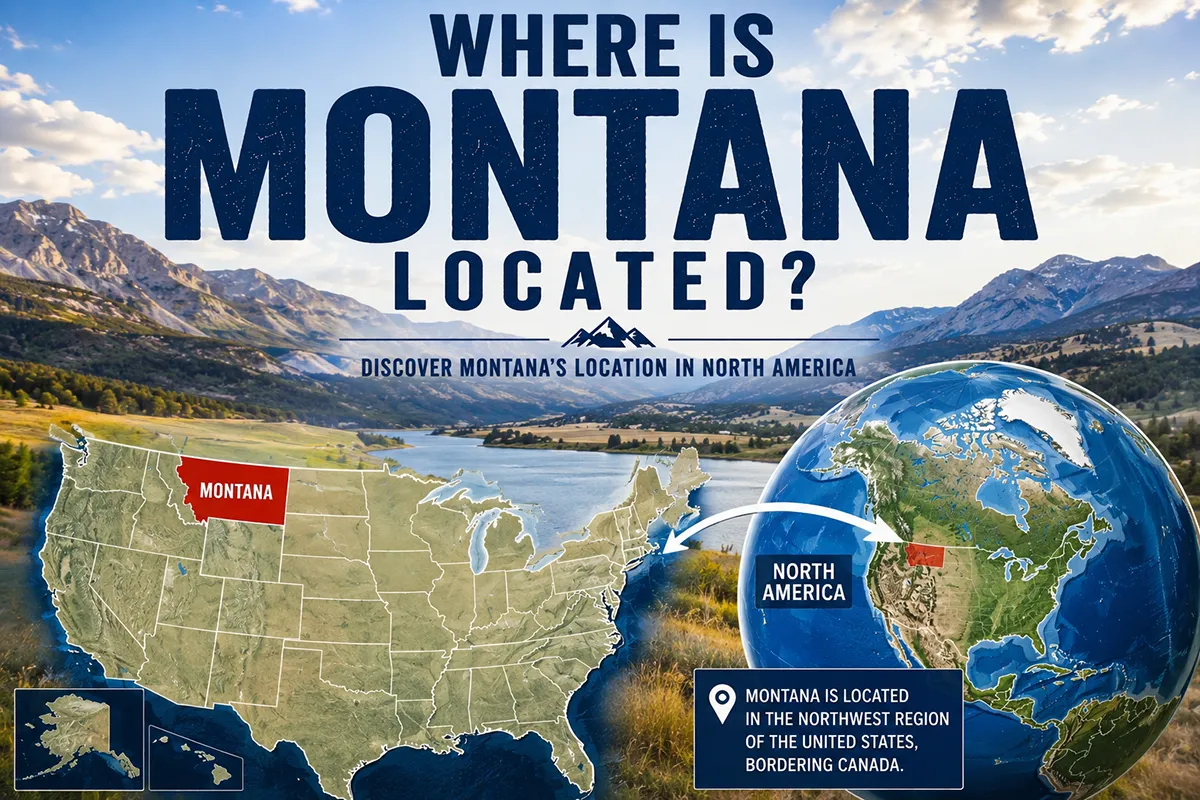
Montana is a landlocked state in the Mountain West subregion of the northwestern United States, bordered by Canada (British Columbia, Alberta, and Saskatchewan) to the north, Idaho to the west, Wyoming to the south, and North Dakota and South Dakota to the east. It sits between approximately 44°N and 49°N latitude and 104°W to 116°W longitude, covering 147,040 square miles — the fourth-largest state in the US and the largest landlocked state in the country. The capital is Helena and the largest city is Billings.
Liked this article?
Add Roaming Montana as a preferred source so you see more of our articles and guides on Google.
Montana’s Exact Geographic Position
Montana sits in the Mountain West subregion of the Western United States — specifically in the northern portion. That designation matters because it places Montana firmly in the West, not the Midwest, despite sitting inland. (More on that distinction in the “Midwest or West?” section below.)
The state spans roughly between 44°N and 49°N latitude and 104°W to 116°W longitude, with the 49th parallel forming its entire northern boundary — that famous invisible line separating the US from Canada.
Montana covers 147,040 square miles, making it the fourth-largest state after Alaska, Texas, and California. In raw dimensions, it stretches approximately 570 miles east to west and 315 miles north to south.
During my road trip across the state, I drove the equivalent distance of New York City to Charlotte — and never left Montana.
The geographic center of Montana falls in Fergus County, close to Lewistown — a fact that surprises most people who assume Bozeman or Helena is central. See my Montana regions guide for how the state divides geographically.
Montana’s total boundary length — the sum of all its borders — is approximately 1,947 miles.
For population context: with roughly 1.13 million residents across that vast area, Montana has one of the lowest population densities in the country — about 7.4 people per square mile. See my Montana population guide for the full breakdown.
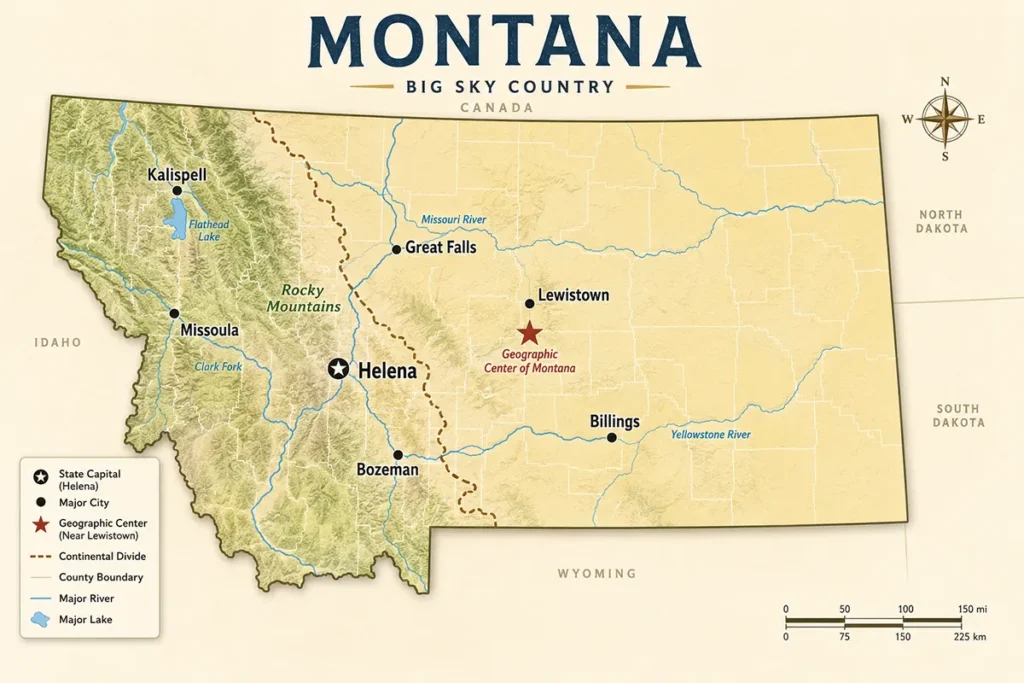
Montana’s Neighboring States and International Border
Understanding Montana’s neighbors helps with route planning and appreciating the state’s extraordinary position.
The Canadian Border: 545 Miles, Three Provinces
Montana shares its entire northern edge with Canada — specifically the provinces of British Columbia, Alberta, and Saskatchewan. This makes Montana the only US state to border three Canadian provinces, a distinction that matters both culturally and ecologically. I’ve crossed at several points, including the remote Roosville crossing near Eureka and the busier Sweet Grass/Coutts port on I-15.
This international boundary isn’t just a line on a map. Grizzly bears, wolves, and woodland caribou move freely through protected wildlife corridors across it. Waterton-Glacier International Peace Park — one of the world’s first transboundary protected areas — straddles the Alberta-Montana border.
For a full look at Montana’s Canadian border and what it means for visitors, see my Montana Canadian border guide.
Idaho: The Western Neighbor
Montana’s western boundary with Idaho follows the rugged Bitterroot Mountains for much of its length — roughly 475 miles through some of the most remote wilderness in the Lower 48.
Driving Interstate 90 west from Missoula toward Spokane, you cross this border near Lookout Pass where the forests noticeably thicken and the valleys narrow.
Wyoming: The Southern Connection to Yellowstone
Wyoming sits directly south, and this border is crucial for travelers because Yellowstone National Park straddles both states. Three of Yellowstone’s five entrances — West Yellowstone, Gardiner, and Cooke City — are accessed via Montana.
The Wyoming border runs about 364 miles, crossing from the dramatic Beartooth Highway in the east to ranch lands near the Idaho corner.
North Dakota and South Dakota: The Eastern Plains
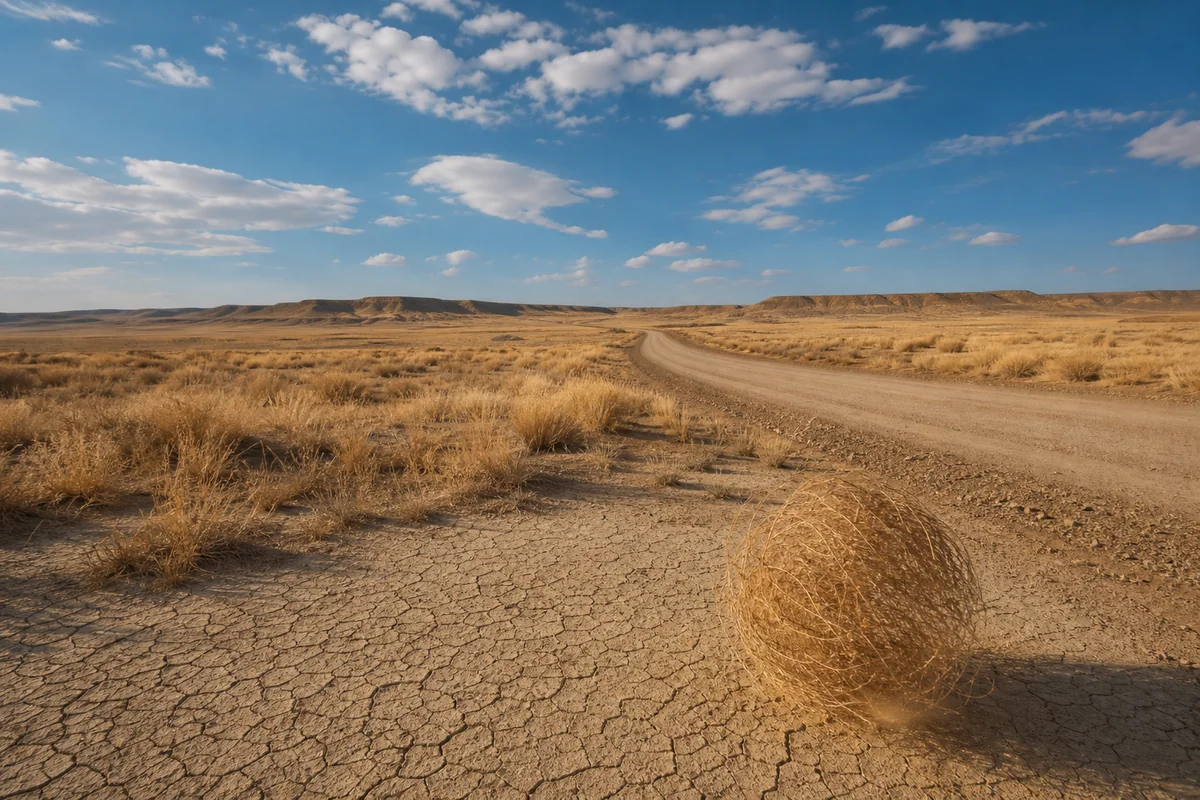
Montana’s eastern borders run through dramatically different terrain than the mountainous west. Driving east from Billings, the landscape transforms from rugged rimrocks to rolling prairie — wide-open grasslands that feel oceanic in scale. The North Dakota border stretches about 211 miles; South Dakota adds another 98 miles.
The Crown of the Continent: Triple Divide Peak
Here’s the single most remarkable geographic fact about Montana’s location — one that almost no travel guide gives proper space to.
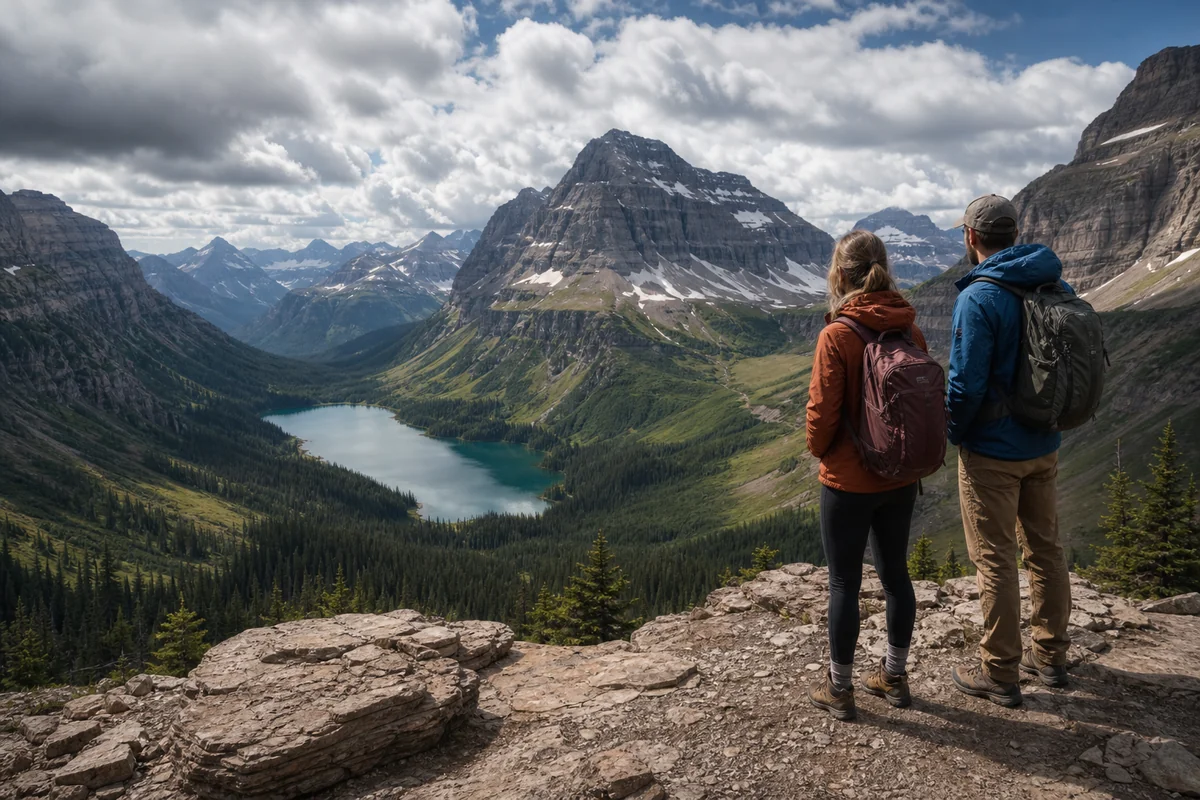
In Glacier National Park, at an elevation of 8,020 feet, sits Triple Divide Peak — the only place in North America where a single mountain sends water to three separate oceans. A raindrop landing on the east slope flows eventually into the Missouri and Mississippi rivers, reaching the Gulf of Mexico.
Water from the west slope crosses into Idaho and reaches the Pacific Ocean. And water from the north slope flows into Alberta’s rivers, ultimately reaching Hudson Bay and the Arctic Ocean.
This happens because two of North America’s great divides intersect here: the Continental Divide (separating Pacific from Atlantic drainage) and the Northern Divide (separating Arctic from Gulf drainage). The result is that Glacier National Park carries the nickname “Crown of the Continent” — and Triple Divide Peak is the literal apex of that crown.
No other point in the contiguous United States occupies this kind of geographic position. For visitors to Going-to-the-Sun Road, Triple Divide Peak is visible from certain viewpoints — a dramatic reminder of just where Montana sits on the North American map.
Montana’s Two Distinct Regions
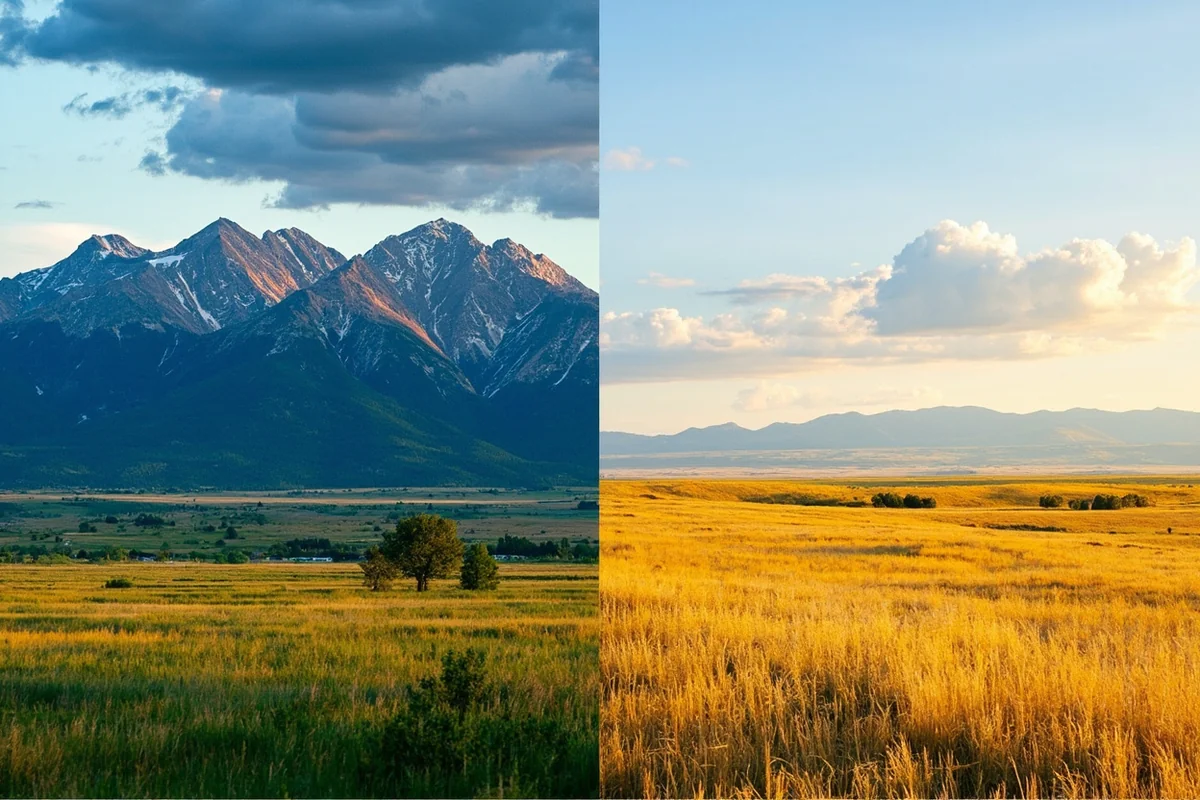
Montana’s topography is defined by the Continental Divide, which crosses the state diagonally from northwest to southeast and creates two fundamentally different landscapes.
Western Montana: Mountain Country
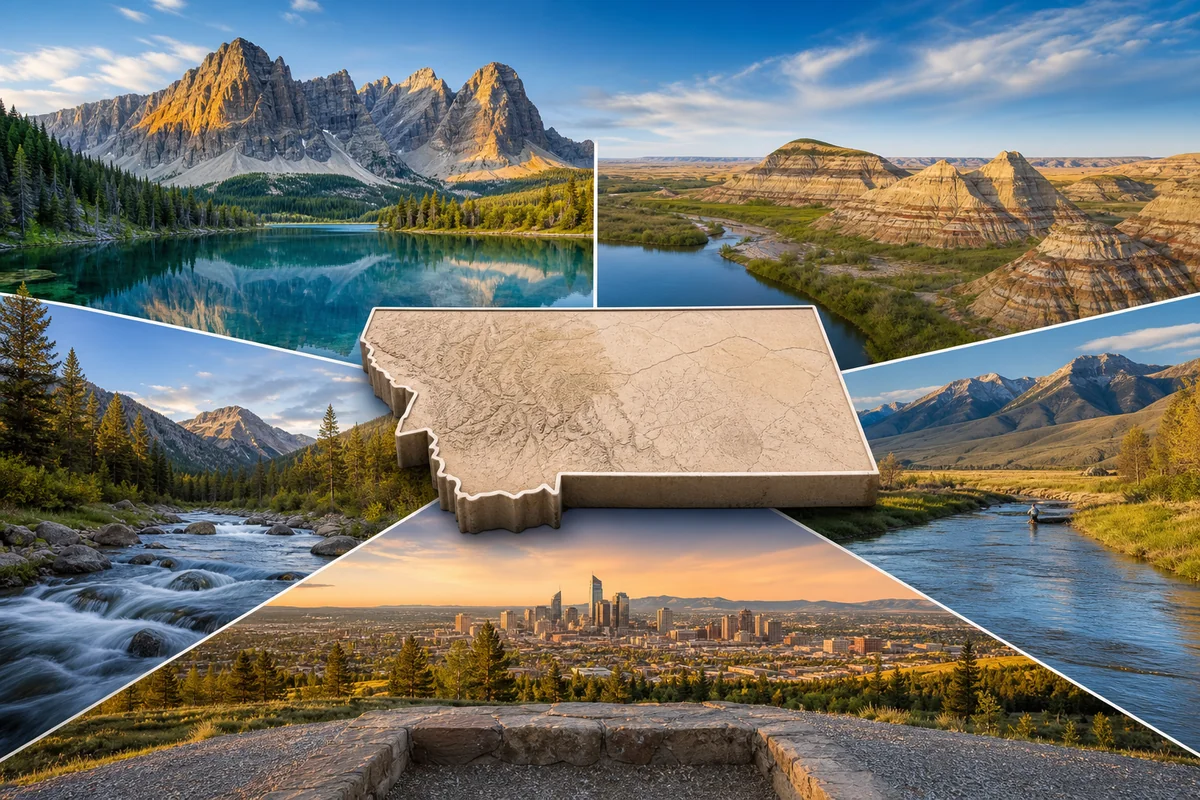
The western two-fifths of Montana lie within the Rocky Mountains — soaring peaks, crystal-clear rivers, dense forests, and a modified maritime climate driven by Pacific weather systems pushing through the mountain passes.
This is the Montana most people picture: Glacier National Park, Flathead Lake (the largest natural freshwater lake west of the Mississippi), Missoula, Kalispell, Helena, and ski towns like Whitefish and Big Sky.
Elevations in western Montana range from valley floors around 2,500–3,500 feet to peaks exceeding 10,000 feet. The highest point in Montana is Granite Peak in the Beartooth Mountains at 12,799 feet — the highest summit in the state.
The lowest point in Montana is the Kootenai River in Lincoln County at approximately 1,820 feet above sea level — still higher than most of the eastern US. For complete elevation data, see my Montana elevation guide.
Eastern Montana: High Plains Prairie
East of the Rockies, Montana transforms into high plains — cattle country, badlands, and the authentic American West. I initially overlooked this region, but exploring the Missouri River Breaks completely changed my perspective.
Eastern Montana covers the eastern three-fifths of the state and includes Billings (Montana’s largest city), Miles City, Glendive, and Makoshika State Park — Montana’s own version of badlands. Elevations here range from about 2,000 feet along river valleys to around 4,000 feet on higher plateaus.
For a deeper look at how these geographic regions define Montana’s character, see my guide to whether Montana belongs to the Great Plains and my Montana biomes guide.
Montana’s Rivers: Headwaters of a Continent
Montana’s geographic position makes it the source of some of the most important river systems in North America — a fact directly tied to where it sits on the map.
The Missouri River — the longest river in North America — originates at the confluence of the Madison, Gallatin, and Jefferson Rivers near Three Forks, Montana. From there it flows 2,341 miles to the Mississippi. When Lewis and Clark followed the Missouri upstream through Montana in 1805, they were tracing the continent’s circulatory system to its source.
The Yellowstone River — the longest undammed river in the contiguous United States — originates in Wyoming’s Yellowstone National Park and flows north into Montana near Gardiner, then east across the entire state before joining the Missouri near the North Dakota border.
The Flathead River drains the mountains of northwestern Montana through Flathead Lake — the largest natural freshwater lake west of the Mississippi at 197 square miles — and joins the Clark Fork near Paradise.
The Clark Fork River crosses western Montana into Idaho, ultimately reaching the Columbia River and the Pacific Ocean — water that started on the west side of the Continental Divide following its natural path to the sea.
Montana has approximately 169,829 miles of river — almost entirely in a natural, undammed state except for a handful of specific reaches. This river network is one of the primary reasons Montana’s geography is so central to the ecology of the entire American West.
Montana’s Latitude: Where in the World Is Big Sky Country?
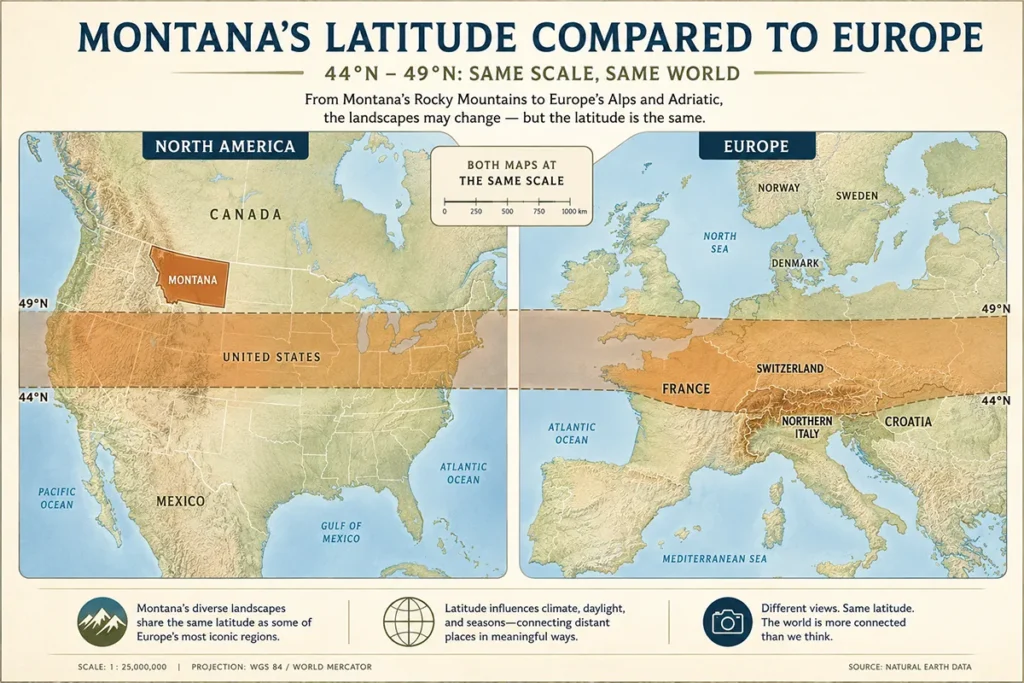
Montana sits between 44°N and 49°N latitude. That positioning has specific global parallels worth knowing — especially useful for international visitors trying to understand Montana’s climate and daylight.
| Montana Latitude | Same-latitude international locations |
|---|---|
| 49°N (northern border) | Paris, France; Vancouver, BC; Bordeaux, France |
| 47°N (Helena, state capital) | Geneva, Switzerland; Lyon, France; Irkutsk, Russia |
| 46°N (Missoula) | Milan, Italy; Ljubljana, Slovenia; Bern, Switzerland |
| 45°N (Bozeman / Billings area) | Venice, Italy; Bordeaux, France; Zagreb, Croatia |
| 44°N (southern border) | Florence, Italy; Grenoble, France |
The practical upshot: Montana sits at approximately the same latitude as northern and central France and northern Italy. This means:
- Long summer days (sunset after 9:30 PM in July at the northern border)
- Short winter days (less than 9 hours of daylight in December)
- Climate similar to central Europe — continental, with real seasons, cold winters, warm summers
- Much colder winters than France or Italy at the same latitude, because Montana has no ocean moderation
Is Montana in the Midwest or the West?
This is one of the most frequently searched questions about Montana’s location, and the answer is clear: Montana is firmly in the West, not the Midwest.
Officially, Montana is classified as one of the eight Mountain States — a subgroup of the Western United States that also includes Idaho, Wyoming, Colorado, New Mexico, Arizona, Utah, and Nevada. The U.S. Census Bureau places Montana in the Western region, specifically the Mountain division.
The confusion arises because Montana is landlocked and has an agricultural, frontier character that some associate with “the Midwest.” But geography tells a different story. Montana’s defining feature is the Rocky Mountains — a decidedly Western characteristic — and the state’s culture, economy, and landscape align far more closely with Wyoming, Idaho, and Colorado than with any Midwestern state.
I explore this question in much more detail in my dedicated post: Is Montana in the Midwest?
Similarly, if you’re wondering whether Montana qualifies as high desert, landlocked, or part of the Great Plains — I’ve written dedicated posts for each of these questions:
- Is Montana a landlocked state?
- Is Montana high desert?
- Does Montana belong to the Great Plains?
- Is Montana rural?
Practical Location Considerations for Trip Planning
Now for what matters most to travelers — the realities of navigating a state this large.
Distances Are Genuinely Vast
| Route | Distance | Drive Time |
|---|---|---|
| Glacier NP to Yellowstone NP | 460 miles | 7–8 hours |
| Missoula to Billings | 340 miles | 5 hours |
| Bozeman to Glacier NP | 300 miles | 4.5 hours |
| Helena to Miles City | 330 miles | 5 hours |
| Kalispell to Great Falls | 220 miles | 3.5 hours |
| Canadian border to Wyoming | 315 miles | 4.5–5 hours |
Do not attempt Glacier and Yellowstone in the same weekend. I’ve met disappointed travelers who learned this at a gas station in Livingston with five hours of driving still ahead of them.
Montana’s Time Zone
Montana operates entirely on Mountain Time (MT) — UTC-7 in summer (Mountain Daylight Time), UTC-6 in winter (Mountain Standard Time). There is no time zone split within the state. All Montana businesses, services, and parks operate on Mountain Time. Simply set your phone to update automatically and you’ll never have an issue.
Montana Is Completely Landlocked
Montana has no ocean coastline — it is a fully landlocked state on all sides. This directly influences its climate: without oceanic temperature moderation, Montana experiences more extreme temperature swings than coastal states at similar latitudes.
See my Montana weather guide for the full climate breakdown by region and season.
Getting to Montana: Access by Air
Montana has eight commercial airports, but four handle the overwhelming majority of visitors. See my complete Montana airports guide for routes, airlines, and logistics.
Bozeman Yellowstone International (BZN) — Now Montana’s busiest airport by passenger volume, with direct flights from most major US hubs. Ideal for Yellowstone access, Big Sky skiing, and the Gallatin Valley. If you’re flying to any part of south-central Montana, this is your best bet.
Glacier Park International (FCA), Kalispell — The correct gateway for Glacier National Park. Located 30 miles south of the park’s west entrance. Direct seasonal flights from Seattle, Denver, Salt Lake City, Minneapolis, and others. This is the airport to use for northwestern Montana — not Missoula.
Missoula International (MSO) — Serves western Montana: the Bitterroot Valley, Clark Fork River corridor, Missoula itself, and as an alternate approach to the Bob Marshall Wilderness. Ideal for trips focused on west-central Montana and the Rattlesnake Wilderness. Not the closest airport to Glacier (that’s FCA).
Billings Logan International (BIL) — Montana’s most connected airport for eastern Montana and Wyoming. Direct flights from Seattle, Denver, Minneapolis, Salt Lake City, Las Vegas, Phoenix, and Dallas. Ideal entry point for the Beartooth Highway, Little Bighorn Battlefield, and eastern Montana road trips.
For driving to Montana, see my Montana transportation guide.
Driving Distances from Major US Cities
| From | To Bozeman | To Missoula |
|---|---|---|
| Seattle, WA | 680 miles | 480 miles |
| Denver, CO | 640 miles | 835 miles |
| Salt Lake City, UT | 470 miles | 495 miles |
| Minneapolis, MN | 920 miles | 1,050 miles |
| Portland, OR | 700 miles | 480 miles |
| Calgary, AB (Canada) | 390 miles | 540 miles |
From the Pacific Northwest, I-90 through Lookout Pass is the classic route — the descent into the Clark Fork Valley sets the tone for western Montana immediately. From the south, I-15 through Butte is fast; the Beartooth Highway from Red Lodge (seasonal, late May–mid October) is unforgettable.
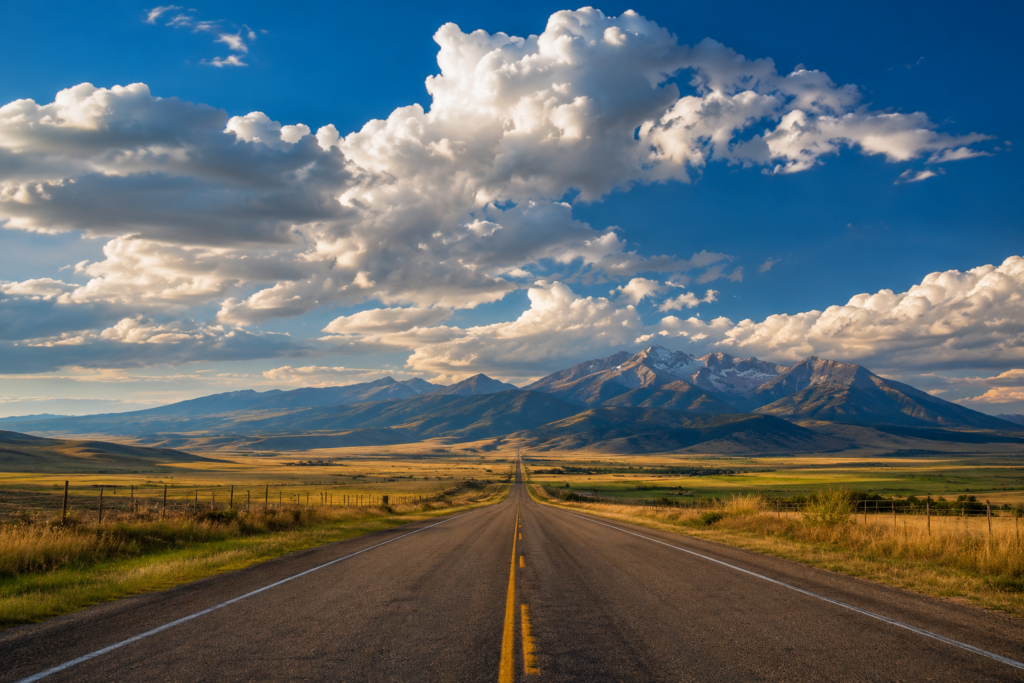
Montana’s Location Within the Greater Yellowstone Ecosystem
Montana contains significant portions of the Greater Yellowstone Ecosystem — one of the largest intact temperate ecosystems remaining on Earth at roughly 20 million acres.
The ecosystem centers on Yellowstone National Park but extends deep into Montana through the Absaroka-Beartooth Wilderness, Gallatin National Forest, and the Paradise Valley — that stunning corridor between Livingston and Gardiner where elk, bears, and wolves use a migration corridor unchanged for thousands of years.
Montana’s northern position in this ecosystem means cooler temperatures, longer winters, and later trail openings — all factors that affect when wildlife is most active and accessible to visitors.
How Montana’s Remote Location Shapes the Culture
Montana’s relative isolation from major population centers has created a distinctive, self-sufficient character that visitors notice immediately.
Space changes perspective. At 7.4 people per square mile, Montana is the third-least densely populated state. During a week in the Missouri River Breaks, I went three consecutive days without seeing another vehicle. That kind of solitude isn’t an accident — it’s a direct product of location and geography. For more on this, see my Is Montana rural? post.
Self-reliance is necessary. The nearest hospital can be an hour away. Winter storms close roads for days. Montanans carry emergency gear in their vehicles year-round — a habit visitors should adopt.
Seven reservations, twelve tribal nations. Montana’s geography was home to the Blackfeet, Crow, Salish, Kootenai, Assiniboine, Sioux, and others long before any state boundary existed. The Blackfeet Reservation borders Glacier National Park to the east. The Crow Reservation stretches southeast of Billings. Engaging with tribal museums and cultural centers gives Montana travel its fullest context.
Regional Breakdown: Where to Base Yourself
Montana’s geographic position creates five distinct travel zones. Understanding them prevents the most common mistake first-time visitors make — treating Montana like a small state.
Northwest (Glacier Region) — Based in Whitefish, Kalispell, or Columbia Falls for Glacier National Park access. The region closest to Canada, with the heaviest snowfall and most maritime climate influence. Summer temperatures stay mild. Going-to-the-Sun Road is the signature experience.
Western (Missoula Region) — Missoula anchors this region: the Bitterroot Valley, Clark Fork River, extensive trail networks, and university-town energy. I spent two full weeks based here and never ran out of day trips.
Southwest (Yellowstone Region) — Bozeman, Big Sky, Livingston, and West Yellowstone serve different budgets and styles. Bozeman offers the best balance of amenities and access. Livingston, where I based for a week one October, delivers authentic Montana character without Bozeman’s tourism density.
Central (Helena / Great Falls Region) — Helena, the state capital, and Great Falls provide access to the Rocky Mountain Front — the dramatic transition where mountains meet plains. This is also the gateway to the Bob Marshall Wilderness.
Eastern (Billings / High Plains) — Billings is the practical hub for eastern exploration. Miles City, Glendive, and Lewistown offer increasingly authentic high-plains experiences as you move away from the I-90 corridor.
For a full geographic breakdown, see my Montana regions guide.
Seasonal Considerations Based on Montana’s Northern Location
Montana’s position between 44°N and 49°N creates dramatic seasonal variations. For complete timing guidance, see my best time to visit Montana guide.
Summer (June–August) — Long days (sunset past 9:30 PM in July near the northern border), temperatures reaching the 80s and 90s in valleys, cooler in mountains. Peak crowds at Glacier. Hit popular trailheads by 7 AM.
Fall (September–October) — My personal favorite season. Western larch turn gold, elk begin bugling, crowds disappear. Shoulder season pricing across most hotels. Nights grow cold quickly after mid-September.
Winter (November–April) — Serious cold, particularly in the Yellowstone corridor and the high plains. Going-to-the-Sun Road closes to vehicles by mid-October, typically reopening late June. Ski resorts thrive. Wildlife watching improves dramatically as animals descend to valley floors. See my Montana winter weather guide for what to expect.
Spring (May–Early June) — High river levels from snowmelt, muddy backcountry trails, fewer crowds, and wildflowers beginning in lower elevations. The transition season rewards patient, flexible travelers.
Montana’s Position in American History
Montana’s location made it a crossroads of American expansion and Indigenous history. The Lewis and Clark Expedition crossed Montana in 1805–1806, following the Missouri River through the eastern plains and crossing the Bitterroot Range into Idaho.
Retracing portions of that journey — particularly at the Great Falls of the Missouri, where the expedition spent nearly a month portaging — connects you viscerally to that history.
The gold rushes that defined Montana’s early statehood, the open-range cattle era, the copper mining that made Butte globally significant, and the homestead boom of the early 20th century are all directly shaped by where Montana sits: at the edge of the frontier, far enough from established cities to attract risk-takers, rich enough in resources to reward them.
See my Montana history guide for the full story.
Practical Tips Based on Montana’s Location
Fuel up frequently. Gas stations can be 80+ miles apart in eastern Montana. I once watched my fuel gauge with genuine anxiety between Jordan and the next town.
Cell service is unreliable. Download offline maps before leaving pavement. Google Maps and Apple Maps require a connection; apps like Gaia GPS work on pre-downloaded data.
Wildlife encounters are real. Montana’s position in major wildlife corridors means bear spray is essential equipment, not optional insurance. Carry it accessible on your hip on every trail.
Border crossing requires documentation. Visiting Waterton Lakes National Park in Alberta (connected to Glacier) requires a valid passport. Canada uses NEXUS lanes for frequent border crossers at major crossings.
Elevation affects you. Much of Montana sits above 4,000 feet, with mountain passes exceeding 7,000 feet. Arriving from sea level, you’ll notice altitude during strenuous hikes. Drink extra water, go slower on day one.
Why Montana’s Location Makes It Special
After years of exploring Big Sky Country, I’ve come to understand what’s genuinely rare about Montana’s geographic position. It’s far enough north to sustain grizzly bears, wolves, and wolverines in viable numbers.
It sits where Pacific maritime forests, Rocky Mountain peaks, and Northern Great Plains converge — three distinct ecosystems colliding in a single state. It borders three Canadian provinces, sharing wildlife corridors with the Canadian Rockies. And Triple Divide Peak sends water to three oceans from a single ridge.
The same geography that makes Montana challenging to reach — the vast distances, remote communities, extreme seasons — also protects it from the overdevelopment that has reshaped more accessible destinations. When I stand on a ridge and see nothing but wilderness to every horizon, I’m grateful for exactly where on the map Montana sits.
That location isn’t coordinates on a screen. It’s the reason Big Sky Country lives up to its name.
Planning a Montana trip? See my Montana trip planning guide for the full roadmap.
Frequently Asked Questions
Where is Montana located in the United States?
Montana is located in the Mountain West subregion of the northwestern United States. It borders Canada (British Columbia, Alberta, and Saskatchewan) to the north, Idaho to the west, Wyoming to the south, and North Dakota and South Dakota to the east. The state capital is Helena and the largest city is Billings.
What region is Montana in — Midwest or West?
Montana is in the West, not the Midwest. It is officially classified as one of the eight Mountain States in the Western United States, alongside Idaho, Wyoming, Colorado, Nevada, Utah, Arizona, and New Mexico. The U.S. Census Bureau places Montana in the Mountain division of the Western region. Despite its inland, landlocked position, Montana’s defining geography — the Rocky Mountains — is distinctly Western. See my dedicated post on whether Montana is in the Midwest for the full answer.
What states and countries border Montana?
Montana borders four US states — Idaho to the west, Wyoming to the south, and North Dakota and South Dakota to the east. To the north, Montana borders three Canadian provinces: British Columbia, Alberta, and Saskatchewan. Montana is the only US state that borders three Canadian provinces, making it unique among all 50 states.
How large is Montana and how does it compare to other countries?
Montana covers 147,040 square miles — roughly the same size as Germany or Japan. It stretches approximately 570 miles east to west and 315 miles north to south. It is the fourth-largest US state after Alaska, Texas, and California, and notably the largest landlocked state in the country.
What time zone is Montana in?
Montana is entirely in the Mountain Time Zone — Mountain Daylight Time (UTC-7) in summer and Mountain Standard Time (UTC-6) in winter. There is no time zone split within the state. All Montana businesses, national parks, and services operate on Mountain Time.
What airports serve Montana and which is best for Glacier National Park?
Montana’s four main airports are Bozeman Yellowstone International (BZN), Glacier Park International in Kalispell (FCA), Missoula International (MSO), and Billings Logan International (BIL). For Glacier National Park, Glacier Park International (FCA) in Kalispell is the correct gateway — located about 30 miles south of the park’s west entrance. Missoula (MSO) is better suited for the Bitterroot Valley, Clark Fork corridor, and west-central Montana. See my full Montana airports guide for current routes and airlines.
What are Montana’s highest and lowest elevations?
Montana’s highest point is Granite Peak in the Beartooth Mountains at 12,799 feet — the 11th highest state high point in the US. The lowest point is the Kootenai River in Lincoln County at approximately 1,820 feet above sea level. For complete elevation data across the state, see my Montana elevation guide.
What is Triple Divide Peak and why is it significant?
Triple Divide Peak (8,020 ft) in Glacier National Park is the only place in North America where a single mountain sends water to three different oceans: the Pacific Ocean, the Gulf of Mexico (via the Atlantic watershed), and Hudson Bay (via the Arctic watershed). The Continental Divide and the Northern Divide intersect here, making this a uniquely significant geographic point. It’s the reason Glacier National Park carries the nickname “Crown of the Continent.”
How long does it take to drive across Montana?
Driving I-90 from the Idaho border to the North Dakota border covers approximately 550 miles and takes 9–10 hours without stops. Driving north to south from the Canadian border to Wyoming is about 315 miles — roughly 4.5–5 hours. Always add time for scenery stops, wildlife, and fuel breaks in areas with sparse services.
Is Montana close to Yellowstone National Park?
Yes — Montana shares Yellowstone’s northern boundary, and three of the park’s five entrances are in Montana: West Yellowstone, Gardiner, and Cooke City/Silver Gate. Bozeman is approximately 90 miles north of Gardiner — the most common Montana base for Yellowstone visits. Note that Glacier National Park is 460 miles north of Yellowstone’s main entrances, so visiting both parks requires careful multi-day planning.
What is Montana’s geographic center?
The geographic center of Montana is in Fergus County, near the town of Lewistown in the central part of the state. Lewistown itself often advertises itself as the geographic heart of Montana, making it a modest point of local pride in a region that doesn’t get many first-time visitors.
How far is Montana from Seattle, Denver, and other major cities?
From Seattle, Montana is approximately 480 miles to Missoula or 680 miles to Bozeman. From Denver, it’s about 640 miles to Bozeman or 835 miles to Missoula. From Salt Lake City, Bozeman is about 470 miles. From Minneapolis, Billings is roughly 900 miles. See the driving distances table above for a full reference.
Sources
- https://mco.cfc.umt.edu/ghcn/station/US1MTFH0017.html
- https://www.census.gov/geographies/reference-files/2010/geo/state-local-geo-guides-2010/montana.html
- https://www.msudenver.edu/wp-content/uploads/2022/06/Statesnativelanguagesdiverse.pdf
- https://www.umt.edu/this-is-montana/columns/stories/montana-winters.php
- https://scholarworks.umt.edu/cgi/viewcontent.cgi?article=1084&context=ruralinst_independent_living_community_participation
- https://www.usgs.gov/educational-resources/highest-and-lowest-elevations