I’ll never forget standing at the trailhead of Avalanche Lake in Glacier National Park last June, slathering on my third layer of DEET, while a family from Florida stood nearby in shorts and tank tops.
Within ten minutes they’d retreated to their car, swatting frantically at the mosquito clouds that had risen out of the cedar shadows.
Understanding Montana’s bug season isn’t a comfort issue — it’s the difference between the trip of a lifetime and an itchy retreat to the parking lot.
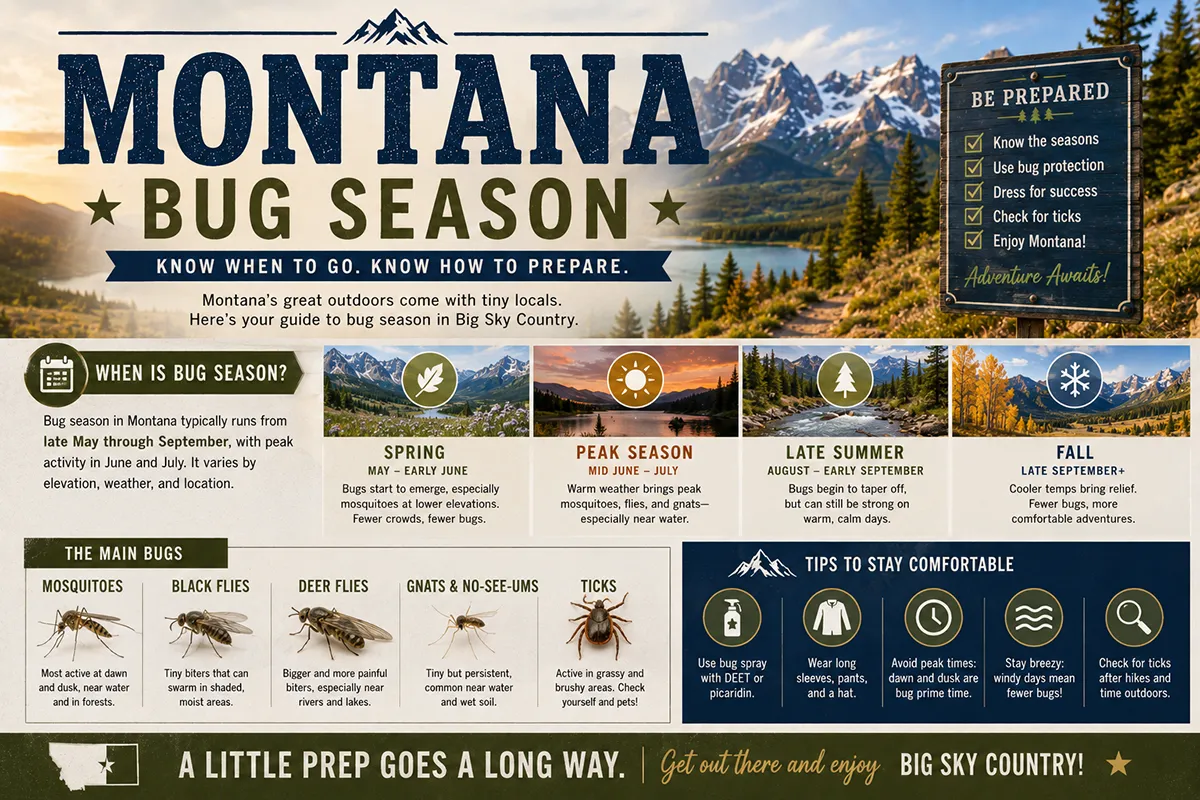
- Peak Montana bug season runs mid-May through early August, with June being the worst month statewide for mosquitoes and black flies.
- Western Montana (Glacier, Flathead, Bitterroot) is the most insect-intense region. Eastern Montana is drier but produces aggressive deer and horse flies in mid-summer.
- DEET 25–30%, picaridin, or permethrin-treated clothing are the only repellents that reliably work in Montana’s worst conditions. Natural alternatives fail at scale.
- Montana has 10–25 confirmed human West Nile virus cases per year, concentrated along the Yellowstone River corridor and irrigated eastern valleys.
- Lyme disease is extremely rare in Montana — black-legged ticks aren’t established here. The main concern is the Rocky Mountain wood tick (RMSF, tularemia, Colorado tick fever).
- Late August through October is bug-free travel bliss. If you have flexibility, shift the trip later.
Liked this article?
Add Roaming Montana as a preferred source so you see more of our articles and guides on Google.
Why Montana’s Bug Season Is Worse Than You Expect
Montana’s combination of abundant snowmelt, hundreds of mountain lakes, slow-moving rivers, marshy meadows, and warm summer temperatures creates near-perfect breeding conditions for biting insects.
Add vast wilderness areas with minimal human suppression of mosquito populations, and you get peak-season bug pressure that rivals anywhere in the Lower 48.
Most visitors arrive expecting “some bugs.” What they get in mid-June near a beaver pond is something else entirely. I’ve watched experienced hikers turn around on trails they’d been planning for years because they weren’t prepared for the density.
For a fuller view of what you’ll encounter beyond the biters, see our companion Montana insects field guide and Montana bug bites treatment guide.
Month-by-Month Montana Bug Season Timeline
Understanding the seasonal rhythm has saved me more trips than I can count. Here’s what to expect across a typical year.
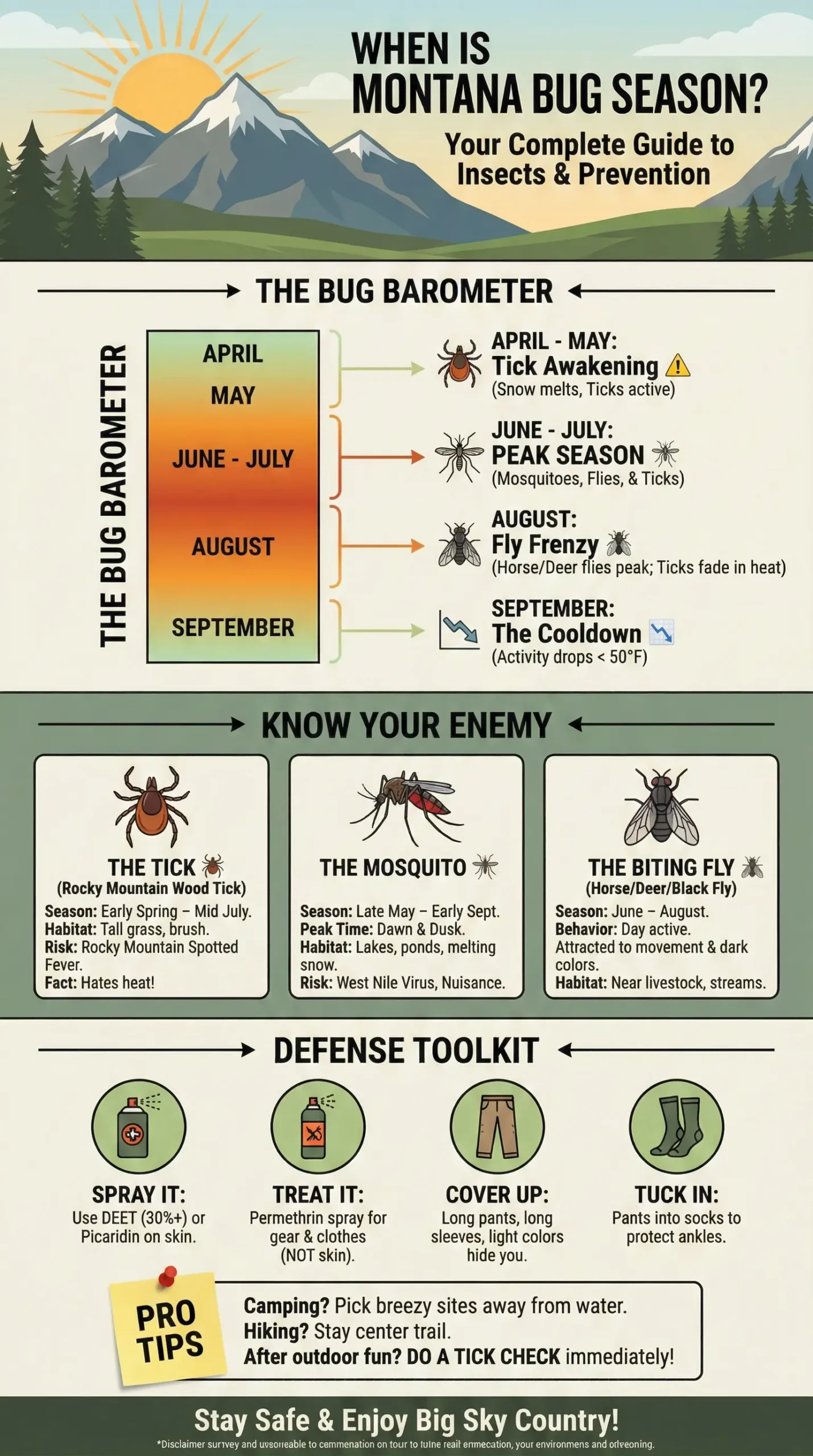
April to Early May: The Calm Before the Storm
Bug activity is minimal across most of the state. Snow is still melting at higher elevations, and nighttime temperatures keep populations suppressed.
Lower-elevation hikes around Missoula, Bozeman, and Helena can be done in standard hiking clothes without repellent on most days. The Kim Williams Nature Trail in Missoula is reliably bug-free in early May.
The first ticks emerge in this window — the Rocky Mountain wood tick is active anytime temperatures climb above ~40°F. See Montana in May for a broader seasonal picture.
Mid-May to Early June: The Emergence
As temperatures rise and snowmelt accelerates, mosquitoes begin hatching in earnest. This window is highly variable by snowpack.
Heavy snow years produce unbearable mosquitoes by late May in low-elevation western valleys; light snow years stay manageable into mid-June.
Black flies also start appearing along rivers and streams. The Blackfoot River corridor reliably produces black fly swarms around May 20.
June: Peak Misery Month
I’m going to be honest: June is the hardest month in Montana for biting insects, and if you have flexibility, plan around it. Recent June trips to Glacier National Park have left me with 30+ mosquito bites through supposedly bug-resistant hiking pants on a single day hike.
June is when you get the full ensemble: mosquitoes, black flies, no-see-ums, and the first deer flies of the season.
Plan trips to higher elevations (above 7,000 feet), exposed ridgelines, or eastern Montana grasslands if you must travel this month. For broader June trip planning, see Montana in June.
July: Still Bad, But Improving
By mid-July, mosquito intensity drops noticeably in areas that have dried out. Horse flies and deer flies then peak — they’re heat-activated and most aggressive between 10 AM and 4 PM on warm sunny days.
Higher elevations (Beartooth Highway, alpine basins) still have substantial mosquito populations through July due to lingering snowmelt. See Montana in July for full context.
August: The Turning Point
Early August still requires precautions, but by mid-month conditions improve dramatically. Bug pressure typically drops to about 20% of what it was in June.
Grasshoppers become the dominant insect presence — they don’t bite, but they startle you when they explode out of the grass. See Montana in August for the full picture.
September to October: Bug-Free Bliss
If I could only visit Montana during one window of the year, I’d choose September. Bugs are essentially gone, crowds have thinned, fall colors are emerging across the Seeley-Swan, and the weather is often perfect.
See Montana in September and Montana in October for trip-planning specifics, plus our broader best time to visit Montana guide.
Know Your Enemy: Montana’s Biting Insects
Different bugs require different strategies. Here’s what you’re actually dealing with.
| Insect | Peak Season | Where Found | Bite Severity |
|---|---|---|---|
| Mosquitoes | June–early August | Standing water, wetlands, shaded forests | Moderate (itchy welts) |
| Black flies | Late May–July | Moving water, rivers, streams | Severe (bleeding, swelling) |
| Horse flies | July–August | Open meadows, near livestock | Severe (painful, large welts) |
| Deer flies | Late June–August | Forested trails, meadow edges | Severe (painful) |
| No-see-ums | June–July | Lakeshores, wetlands | Moderate (intense itch) |
| Ticks (RM wood tick) | April–July | Grasslands, sagebrush, forest edges | Disease risk |
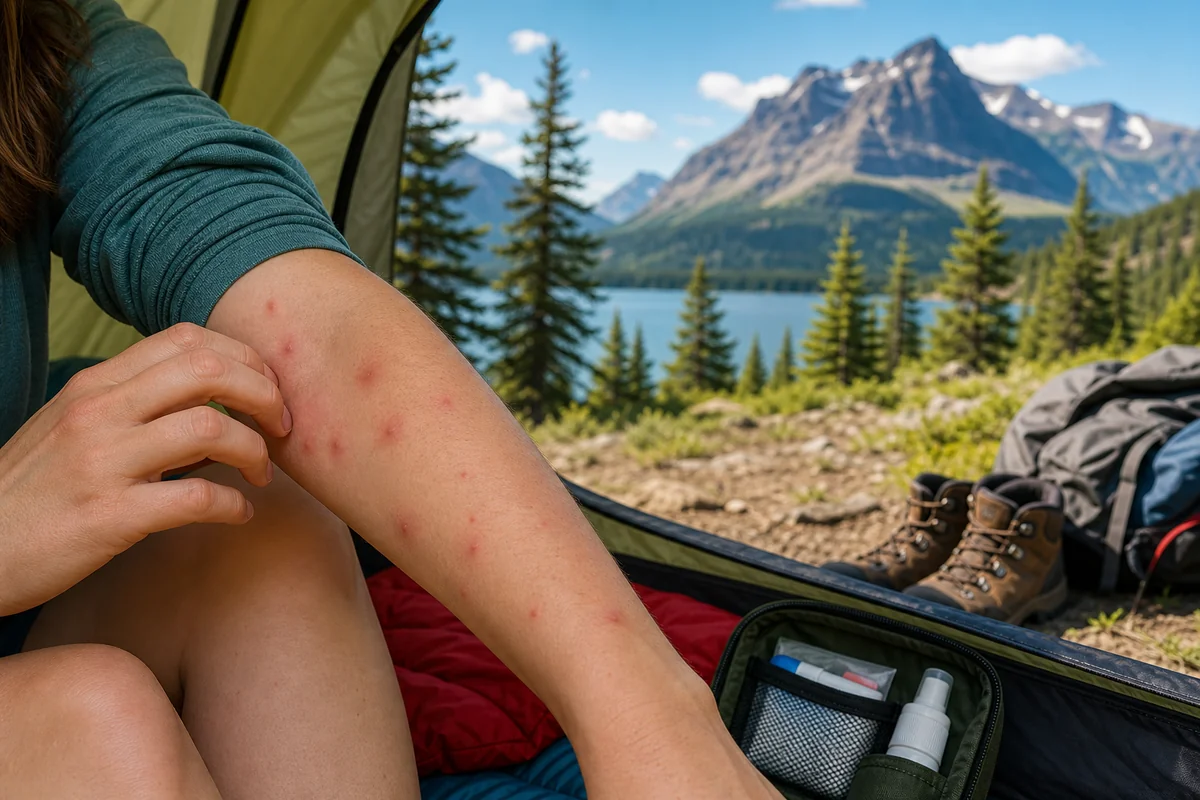
For ID help and what each bite looks like, see our Montana bug bites guide.
Mosquitoes: The Ubiquitous Nemesis
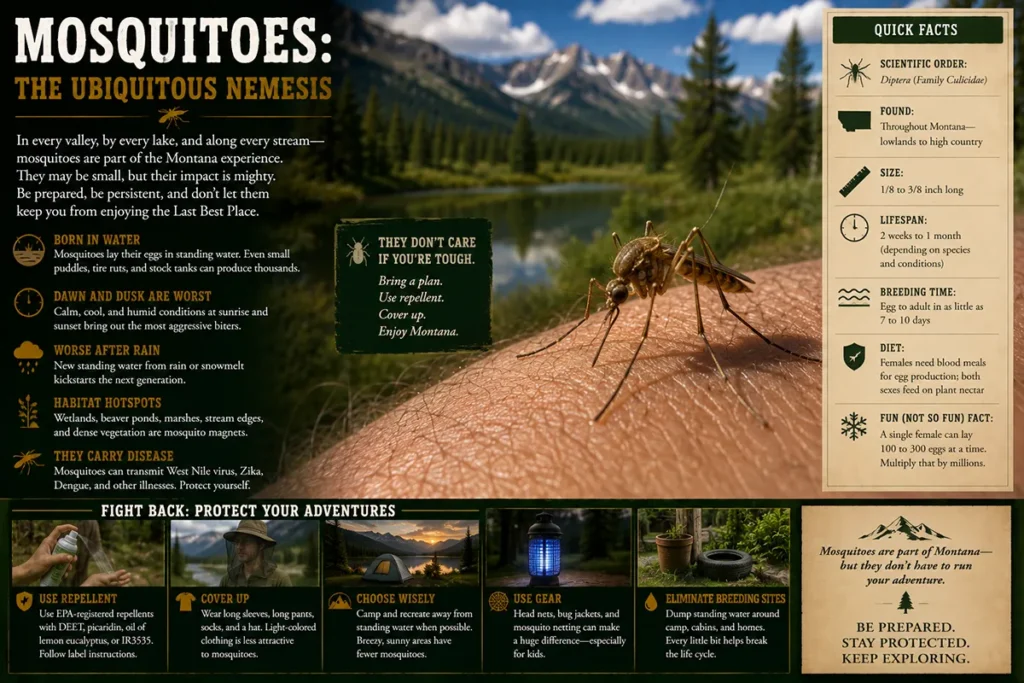
Montana has over 50 mosquito species, and during peak season in marshy areas you can encounter thousands per acre.
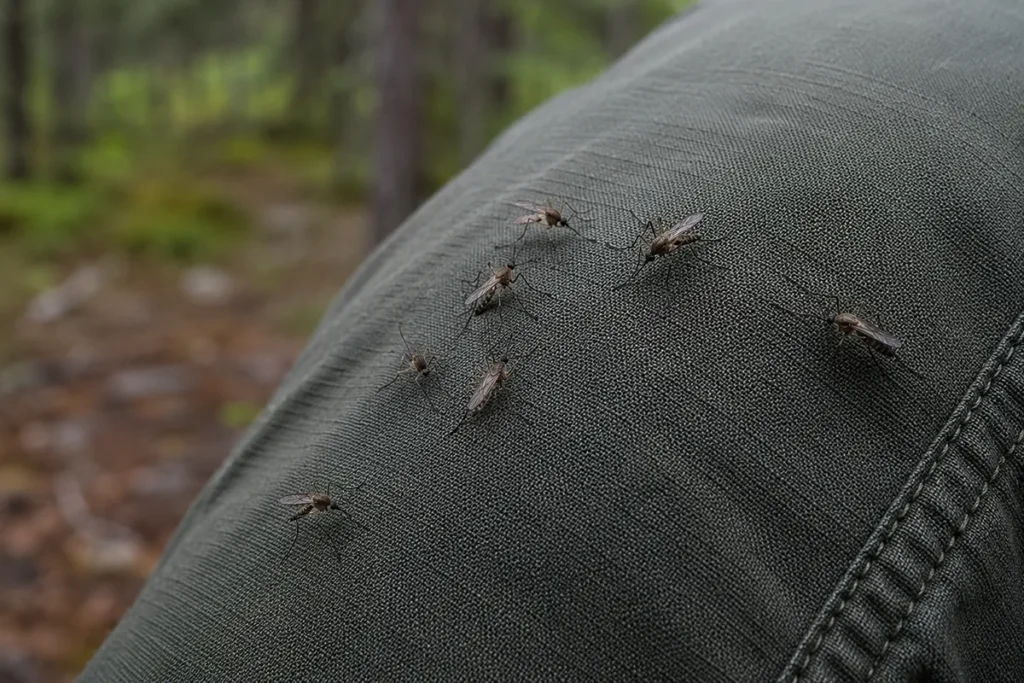
The species you’ll meet most are the common house mosquito, the woodland mosquito, and the floodwater mosquito — the last one is the most aggressive, hatching in huge waves after rivers flood with snowmelt.
Mosquitoes are worst in the western valleys: around Kalispell, Missoula, the Paradise Valley, and the Seeley Lake corridor.
Anywhere with irrigation, beaver ponds, or slow-moving water is mosquito central. They’re most active at dawn and dusk but don’t disappear at midday in shaded forests.
Black Flies: The Underestimated Terror
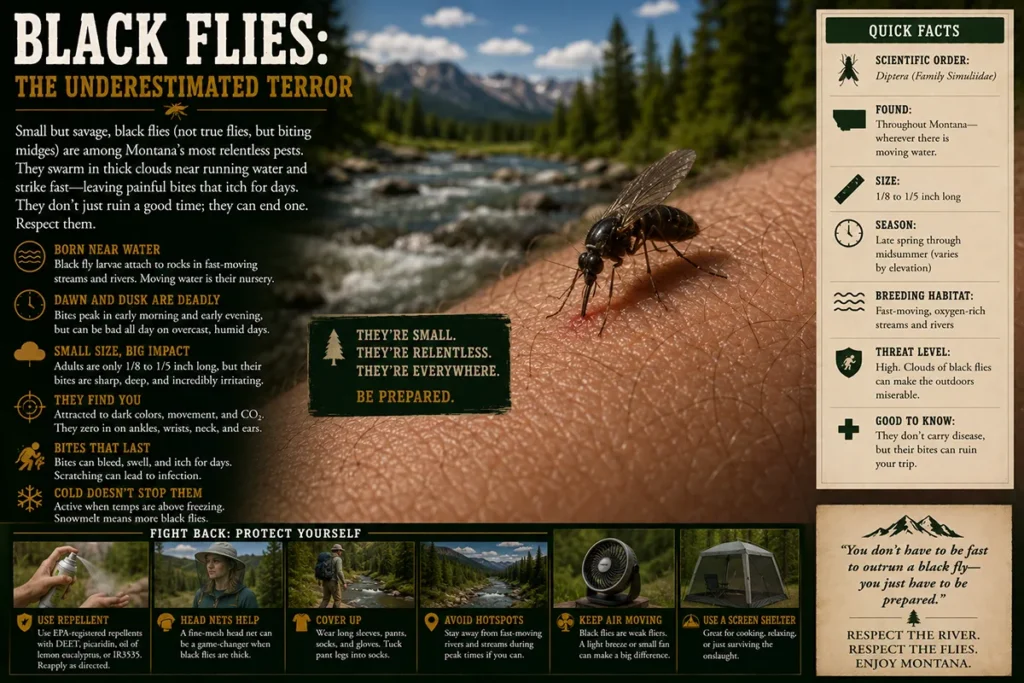
Many visitors prepare for mosquitoes and get blindsided by black flies. These tiny insects (sometimes called “buffalo gnats”) leave bites that swell, bleed, and itch for days.
They’re attracted to movement and dark colors, and they love to crawl into hairlines, ears, and any gap in clothing.
Black flies need clean, flowing water to breed, which means they’re worst along Montana’s blue-ribbon trout streams.
The Missouri River near Craig, the Blackfoot, the lower Madison, and the Bitterroot all produce serious black fly swarms in late May and June.
They’re also notably less responsive to DEET than mosquitoes — physical barriers and permethrin-treated clothing matter more here.
Horse Flies and Deer Flies: The Daytime Attackers
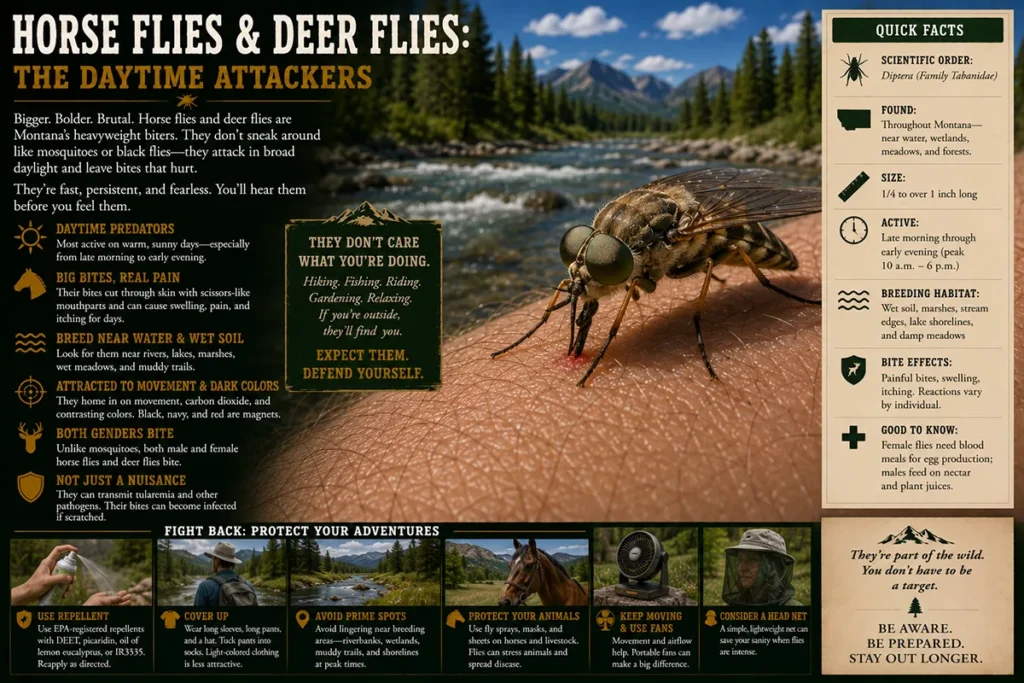
While mosquitoes and black flies give you some relief during the bright midday hours, horse flies and deer flies take over. They’re heat-activated, most active between 10 AM and 4 PM on warm sunny days.
I’ve developed what I call the “deer fly dance” — constantly moving and swatting while hiking through open meadows in July.
They circle your head persistently, waiting for an opening to land and bite. The good news: they’re less common in deep forest. The bad news: Montana has a lot of open meadows.
No-see-ums: Tiny and Brutal
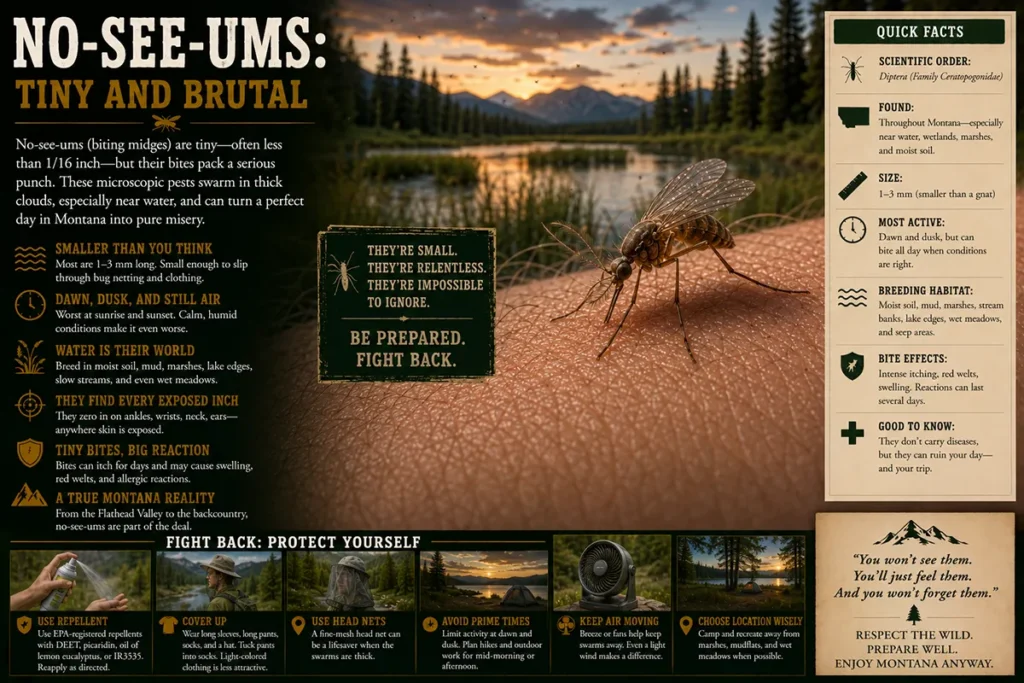
So small they pass through standard mosquito netting — which is why a “no-see-um mesh” tent is genuinely worth the upgrade. Their bites itch out of proportion to their size and often appear in clusters at the hairline, ankles, or anywhere skin meets fabric. Most intense at lakeshore campsites at dusk.
Ticks: The Silent Threat
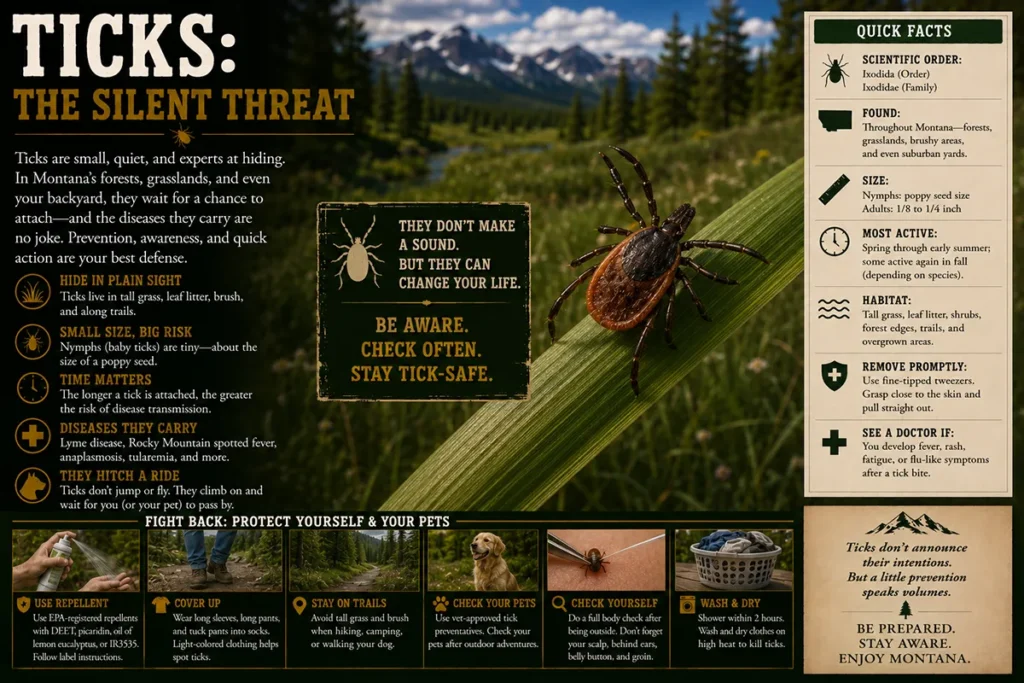
Ticks deserve their own section because the concern isn’t discomfort — it’s disease. Montana’s primary tick is the Rocky Mountain wood tick (Dermacentor andersoni), which can transmit Rocky Mountain spotted fever, tularemia, and Colorado tick fever.
Here’s a correction that’s worth making clearly: Lyme disease is extremely rare in Montana. Most Montana Lyme cases are travel-acquired in patients who picked up the disease elsewhere.
Black-legged ticks (Ixodes scapularis, the Lyme vector) are not established in Montana. Other Montana travel sites occasionally claim otherwise — Montana DPHHS surveillance does not support it.
Ticks are most active when temperatures are between 40 and 70°F, making spring and early summer the primary risk window. I now do thorough tick checks after every hike and shower as soon as possible.
They turn up in surprising places — including, in one memorable case, behind my knee three days after the hike.
The Disease Question: West Nile, Tick-Borne, and What Travelers Should Actually Worry About
This is the section other Montana bug guides usually skip. Knowing the real disease picture lets you calibrate worry correctly.
West Nile Virus
Montana reports roughly 10 to 25 confirmed human West Nile virus cases per year, with risk heavily concentrated where irrigation meets the eastern plains.
The Yellowstone River corridor through Billings, the Bighorn River bottoms, the Charles M. Russell National Wildlife Refuge along the Missouri, and irrigated valleys east of the Continental Divide carry the bulk of transmission.
The vector is Culex tarsalis, a mosquito that breeds in stagnant agricultural water and is most active at dusk and after dark.
Practical takeaway: eastern Montana evenings near rivers and irrigated fields are when WNV exposure risk is highest. Wear long sleeves and use repellent during evening hours in those areas.
Symptoms usually appear 2–14 days after exposure: fever, headache, body aches. Most cases are mild, but a small fraction develop serious neurological complications. See a doctor if you develop flu-like symptoms after evening outdoor exposure in WNV regions.
Tick-Borne Illnesses in Montana
The Rocky Mountain wood tick can transmit:
- Rocky Mountain spotted fever (RMSF) — bacterial, treatable with antibiotics; symptoms typically appear 2–14 days after a bite (fever, rash, headache).
- Tularemia — bacterial, treatable but serious if not caught early.
- Colorado tick fever — viral, generally self-limiting but unpleasant.
The Bitterroot Valley historically had the highest concentration of RMSF in North America. Modern case counts are much lower than the early-20th-century peak, but the disease is still present. Always do thorough tick checks after hiking in grasslands or forest edges.
Mosquitoes That Aren’t a Problem Here
Montana does not have established populations of Aedes aegypti or Aedes albopictus — the mosquitoes that carry dengue, Zika, yellow fever, and chikungunya elsewhere in North America.
Cool nights and dry summers keep these tropical-zone mosquitoes from establishing. Eastern Equine Encephalitis is also extremely rare here.
For broader natural-hazard context, see our Montana natural disasters guide.
Proven Bug Defense Strategies
After years of experimentation, here’s what actually works.
DEET, Picaridin, or Permethrin — Which One?
Different chemicals, different jobs:
DEET (25–30%) remains the most reliable single repellent for Montana’s mix of mosquitoes, black flies, and ticks. Higher than 30% gives you longer protection between reapplications but no additional repelling power. EPA-registered for safe topical use on skin.
Picaridin (20%) is nearly as effective as DEET against mosquitoes and ticks, slightly less effective against black flies. It’s odorless, non-greasy, and doesn’t dissolve plastics or synthetic fabrics. If you’re handling fishing line, polarized sunglasses, or rain gear, picaridin is the better choice.
Permethrin is for clothing only — never skin. It kills or repels insects on contact and survives multiple wash cycles (typically 6 weeks or 6 washes per application). The combination of permethrin-treated clothing + DEET or picaridin on exposed skin is the gold standard for serious Montana backcountry trips.
Natural alternatives (citronella, lemon eucalyptus oil) work in light bug conditions but fail at peak Montana intensity. Consider them a supplement, not a replacement.
Physical Barriers: When Chemistry Isn’t Enough
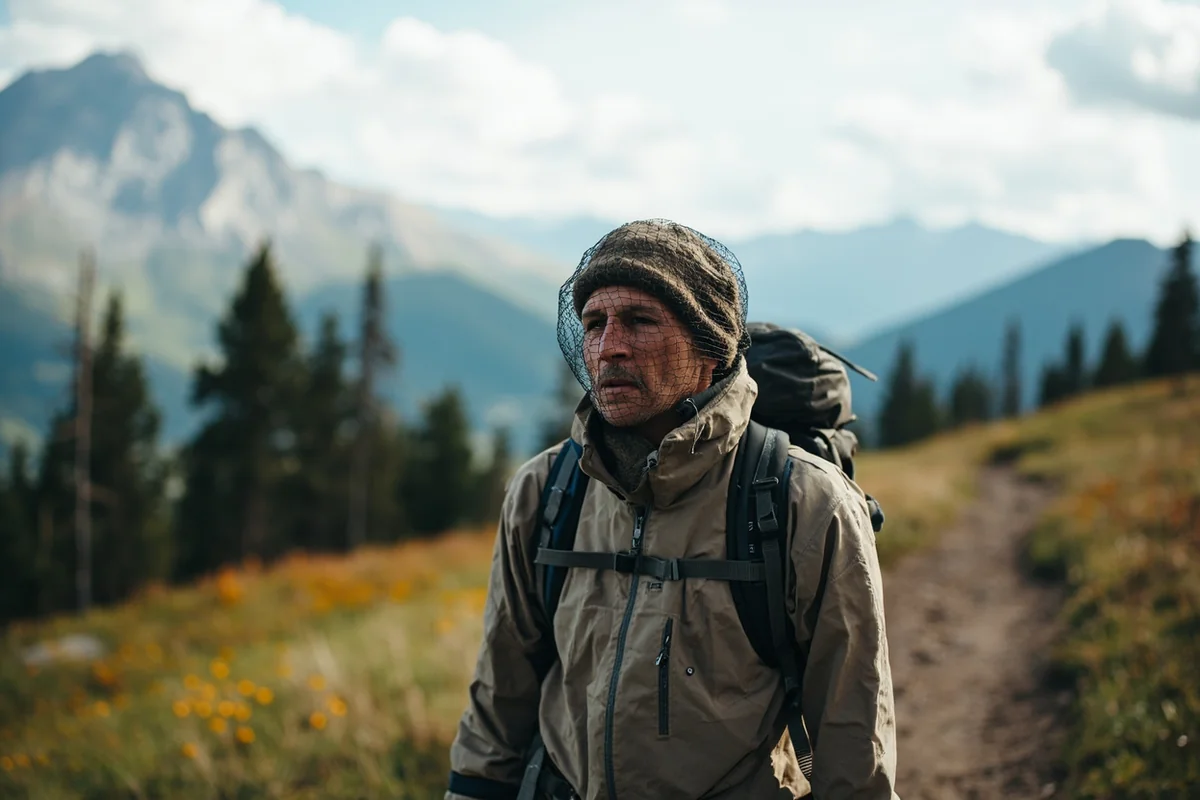
During June trips to Glacier, a head net is no longer optional in my pack. A simple mesh net that fits over a hat transforms an unbearable hike into a manageable one. Sea to Summit makes a Nano version that weighs almost nothing.
Long sleeves and long pants are non-negotiable during bug season, even when it’s warm. Lightweight, light-colored, quick-drying fabrics are best — bugs are attracted to dark colors. Tucking pants into socks looks dorky but prevents ticks and biting flies from accessing your legs.
Strategic Timing
When I’m planning hikes in bug-heavy areas, I try to hit the trail by 6 AM and be done by 10 AM, or start in the early afternoon and finish before the dusk feeding frenzy. The worst windows are typically 6–9 AM and the two hours before sunset.
Wind is your friend. Bugs struggle to fly in winds above 5–10 mph. On breezy days, exposed ridgelines and open hilltops offer relief that valleys and forests can’t provide.
See our best hikes in Glacier National Park guide for trails that take advantage of this — the Highline Trail and ridge-walks in general are noticeably less buggy than valley-floor routes.
Regional Bug Variations Across Montana
Not all of Montana experiences bugs equally. Here’s what to expect by region.
Glacier National Park and the Flathead Valley
This is ground zero for Montana’s worst bug conditions. The combination of countless lakes, streams, marshes, and heavy precipitation creates ideal breeding habitat.
The Going-to-the-Sun Road corridor and trails around Lake McDonald are particularly notorious in June. Higher-elevation trails like Highline and Ptarmigan Tunnel still have bugs but benefit from alpine breezes.
The Many Glacier area is slightly less intense than the Lake McDonald side, possibly due to drainage patterns and more exposed terrain.
Whitefish and Polson sit in the bug-heavy Flathead corridor — plan accordingly for any June or early-July visit.
Greater Yellowstone and the Paradise Valley
Paradise Valley, the Gallatin Canyon, and areas around Big Sky can be buggy but generally rank a step below Glacier in intensity.
The Lamar Valley in Yellowstone itself is surprisingly manageable — the open, windswept terrain and large grazing herds distribute bug pressure. Cooke City at higher elevation tends to be lighter on bugs by mid-July.
Geothermal areas around Old Faithful can be surprisingly mosquito-heavy: warm ground extends the breeding season locally.
Eastern Montana
The plains and breaks of eastern Montana present a different bug profile. Mosquitoes are less intense overall due to drier conditions, but they concentrate heavily around stock ponds, river bottoms, and irrigated areas.
Horse flies and deer flies are more problematic here than in the mountains. Eastern MT is also where West Nile virus risk concentrates — see the disease section above.
Southwest Montana
The Bitterroot Valley, Anaconda-Pintler Wilderness, and Big Hole Valley have moderate bug pressure. The higher you go in the Pioneer or Beaverhead Mountains, the better it gets. Alpine basins above 9,000 feet have brief but real bug seasons — usually just a few weeks in July.
For broader trip planning across regions, see our things to do in Montana hub and Montana trip planning guide.
Bug-Free Destinations in Montana
If you absolutely have to travel in June or July and want to minimize bug exposure, the following work well:
- Above 8,500 feet. The Beartooths above Mystic Lake, Trapper Peak in the Bitterroots, the alpine zone of the Crazy Mountains. Mosquito populations thin sharply at altitude.
- Eastern Montana grasslands in late June. Dry, breezy, and limited standing water. Watch for ticks in grass, but biting flies are sparse.
- Exposed ridgelines anywhere. Wind keeps the air moving and bugs grounded.
- Cities themselves. Downtown Bozeman, Helena, and Billings have minimal bugs even in peak season — irrigation, mowing, and pavement disrupt breeding habitat.
- The first hour after a steady rain. Bugs take time to recover. Useful tactical window.
Camping Through Bug Season
Camping during bug season requires extra planning.
Campsite selection: Pick elevated, breezy locations away from standing water. Ridgelines and hilltops are ideal; valley bottoms near streams are worst. Scout campsites in the evening when bugs are most active — what looks like a perfect spot at noon can be a nightmare at dusk.
Tent strategy: A tent with fine no-see-um mesh is essential. Standard mosquito netting lets no-see-ums waltz through. Enter and exit the tent quickly during peak bug hours. Never cook near the tent — it attracts insects and bears alike. (For broader campsite wildlife considerations, see our Montana bear guide.)
Repellent stations: Thermacell devices create a small protected zone using heated repellent mats. They work well in calm conditions but are useless in any wind.
Campfires: Provide some relief — many bugs avoid smoke. But Montana’s summer fire restrictions often prohibit campfires, especially during drought years. Check current restrictions before relying on this.
Fishing and Water Activities
Anglers face a particular challenge — the best fishing often coincides with peak bug season, and you’re standing in or near water where bugs breed.
Waders help by covering your legs. A long-sleeved sun shirt, neck gaiter, and cap with a back flap (a “fishing shroud”) provide additional coverage.
Fishing guides often recommend buff-style face coverings that can be pulled up quickly when black flies swarm — they interfere with casting slightly but prevent bites around the face.
Float fishing is better than bank fishing for bug exposure — the movement across the water creates airflow that discourages mosquitoes. Bank fishing in calm water at dusk is the worst-case scenario.
What to Pack: Bug Season Essentials
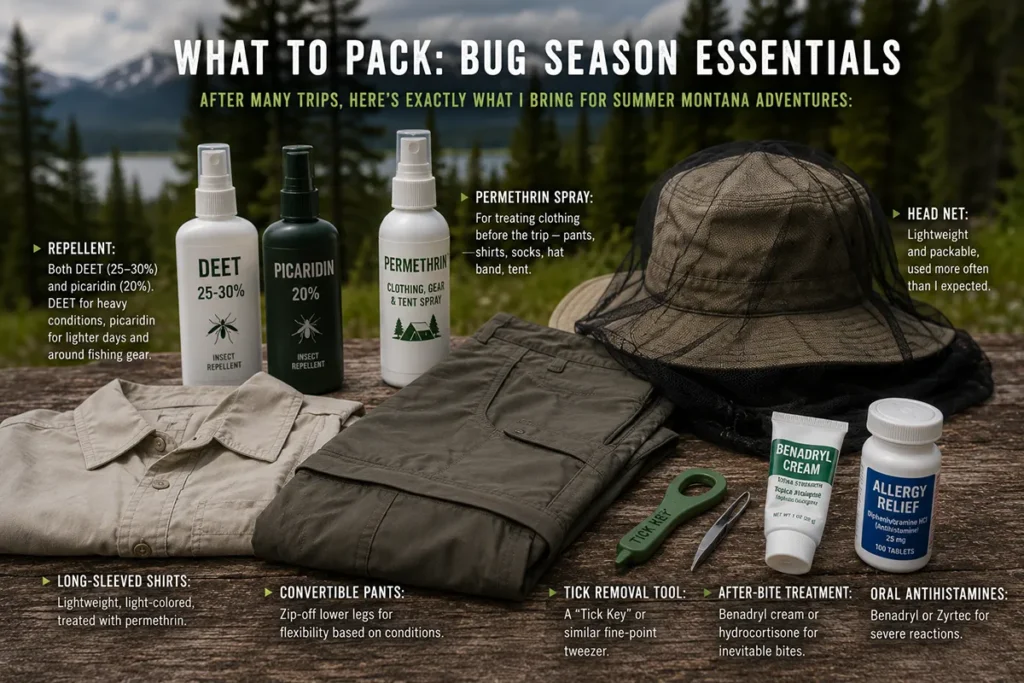
After many trips, here’s exactly what I bring for summer Montana adventures:
- Repellent: Both DEET (25–30%) and picaridin (20%). DEET for heavy conditions, picaridin for lighter days and around fishing gear.
- Permethrin spray: For treating clothing before the trip — pants, shirts, socks, hat band, tent.
- Head net: Lightweight and packable, used more often than I expected.
- Long-sleeved shirts: Lightweight, light-colored, treated with permethrin.
- Convertible pants: Zip-off lower legs for flexibility based on conditions.
- Tick removal tool: A “Tick Key” or similar fine-point tweezer.
- After-bite treatment: Benadryl cream or hydrocortisone for inevitable bites.
- Oral antihistamines: Benadryl or Zyrtec for severe reactions.
Where to Buy Bug Gear in Montana If You Forgot Yours
Travelers who fly in and realize they forgot supplies have decent options:
- Major Montana airports (Bozeman Yellowstone International, Glacier Park International, Missoula International) all have at least one shop selling DEET wipes and basic repellent. Selection is limited and prices are high.
- Walmart / Target in Missoula, Bozeman, Kalispell, Billings, and most regional cities carry full repellent lines, permethrin, and basic head nets.
- REI Bozeman is the single best stop for serious gear — permethrin spray, picaridin, head nets, treated clothing, and tick removal tools all in one location.
- Local outdoor shops in Whitefish, Helena, Bozeman, and Missoula typically stock everything you need plus regionally appropriate advice.
- Drug stores (CVS, Walgreens, Albertsons pharmacy) cover the basics for emergencies — DEET, hydrocortisone cream, oral antihistamines.
Don’t count on rural-town convenience stores. Once you’re outside the major regional centers, gear options drop sharply.
When Bug Season Shouldn’t Stop You
I don’t want to scare anyone away from summer in Montana. With proper preparation, even June trips can be remarkable.
Some of my best Montana memories happened during peak bug season — a grizzly with cubs at Two Medicine, the salmonfly hatch on the Madison, sunset from Logan Pass with the sky turning orange across the Continental Divide.
The bugs are manageable. They’re just another element of the wild landscape that makes Montana the place it is.
For more bug-cluster reading, see our companion guides to Montana insects, Montana moths, Montana stink bugs, Montana spiders, and Montana rattlesnakes (technically not bugs, but the same “what bites in Montana” question).
Three Pieces of Advice
If I could give just three pieces of advice to someone planning a Montana trip during bug season:
First, factor bugs into planning, but don’t let them dictate the trip. A June trip to Glacier needs different expectations than a September visit — but a well-prepared June trip is still extraordinary.
Second, invest in real protection and use it consistently. The difference between prepared and unprepared is stark. I’ve watched it play out at trailheads dozens of times.
Third, if your dates are flexible, shift to late August or September. The bug equation changes dramatically while the weather and wildlife viewing stay excellent — see Montana in September for what you gain by waiting.
For broader timing context, see Montana summer and our Montana weather guide.
Frequently Asked Questions
When is bug season in Montana and when is it worst?
Montana bug season runs from mid-May through early August, with June being the worst month statewide. Mosquitoes and black flies peak first, followed by horse flies and deer flies into late July. Bug pressure drops dramatically by mid-August, and late August through October is essentially bug-free.
What bugs should I worry about most in Montana?
Mosquitoes, black flies, deer flies, and horse flies for biting nuisance. Ticks (Rocky Mountain wood tick) for disease risk. Higher-stakes concerns: West Nile virus from Culex tarsalis mosquitoes in eastern Montana irrigated valleys, and Rocky Mountain spotted fever from infected ticks anywhere with grassland-forest edge.
Is Lyme disease a risk in Montana?
Locally acquired Lyme disease is extremely rare in Montana. The black-legged tick that carries Lyme is not established here. Almost all Lyme cases in Montana residents are travel-acquired from other regions. The Montana tick to actually worry about is the Rocky Mountain wood tick.
What’s the best bug spray for a Montana trip?
DEET at 25–30% concentration is the most reliable single repellent for Montana’s mix of mosquitoes, black flies, and ticks. Picaridin at 20% is nearly as effective and feels less greasy. For backcountry trips, treat clothing with permethrin and use DEET or picaridin on exposed skin — that combination is the gold standard.
Are mosquitoes bad in Glacier National Park during summer?
Yes — mosquitoes in Glacier can be intense from mid-June through July, especially around Lake McDonald, McDonald Creek, and Avalanche Lake. Mornings and evenings are the worst windows. Higher trails like Highline get noticeably less bug pressure thanks to alpine breezes. The Many Glacier side is slightly easier than the Lake McDonald side.
Where in Montana can I avoid bugs entirely in summer?
Above 8,500 feet (alpine basins in the Beartooths, Bitterroots, and Crazies), eastern Montana grasslands in late June, exposed ridgelines anywhere, downtown areas of major cities, and the first hour after a steady rain. The forested high country above timberline stays largely mosquito-free even at peak season.
Do I need bug protection in Yellowstone and the Lamar Valley?
Yellowstone bug pressure is generally a step below Glacier’s. The Lamar Valley itself is surprisingly manageable — open, windswept terrain distributes bug pressure. The geothermal areas around Old Faithful can be surprisingly mosquito-heavy because the warm ground extends the breeding season.
What time of day are bugs worst in Montana?
Mosquitoes and black flies are most aggressive at dawn (6–9 AM) and the two hours before sunset. Horse flies and deer flies do the opposite — peak from about 10 AM to 4 PM on warm sunny days. There’s no single safe window, but midday hiking on breezy, exposed terrain is generally the safest combination.
Do I need to worry about West Nile virus in Montana?
Risk is real but modest. Montana reports roughly 10–25 confirmed human cases per year, concentrated along the Yellowstone River corridor and irrigated eastern valleys. Risk peaks in late summer (August). Use repellent during evening hours in eastern Montana near rivers and irrigated fields — and see a doctor if you develop flu-like symptoms 2–14 days after exposure.