Fact-checking note: All population data verified against the U.S. Census Bureau 2020 decennial census and the Montana Census and Economic Information Center (CEIC). County affiliations verified against the Montana Association of Counties (MACo). ZIP codes verified against USPS data. Last comprehensive review: June 16, 2026.
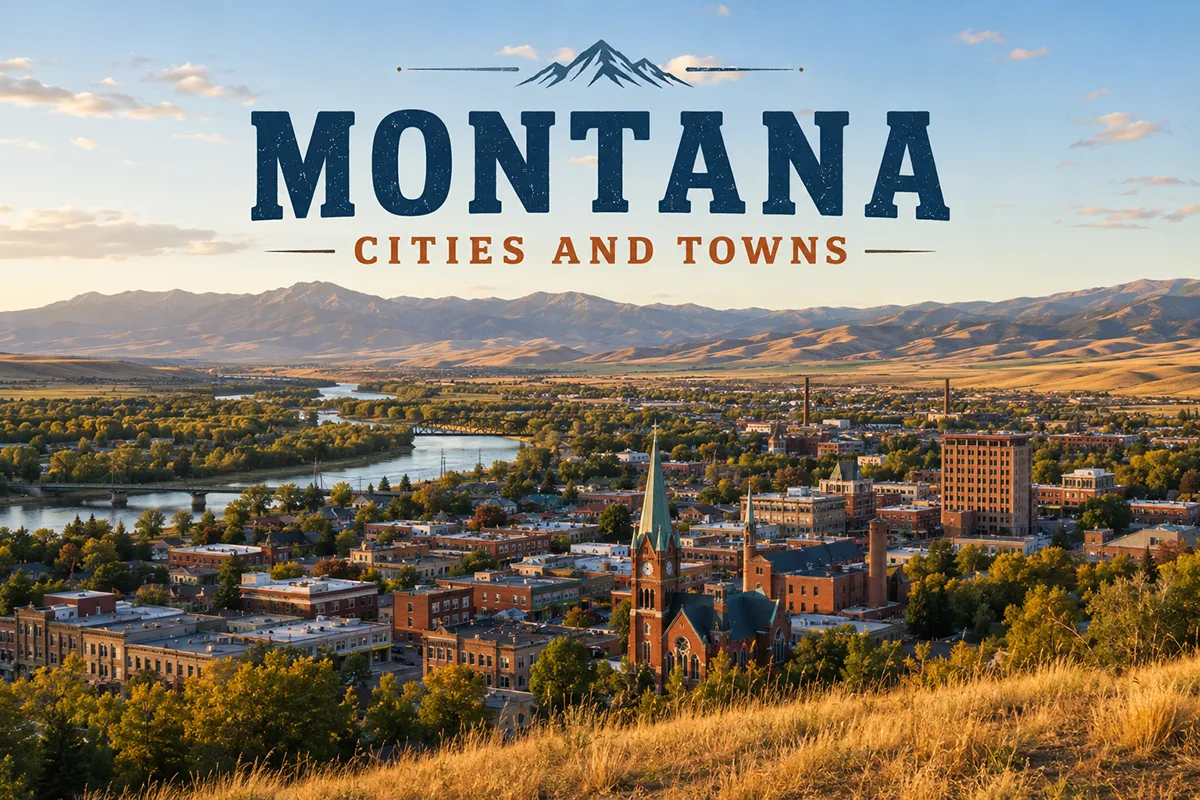
Montana is the fourth-largest state in the country with one of the smallest populations — a combination that creates more than 360 distinct named places, from cities of 117,000+ to ghost towns of 19. This is the complete guide to every Montana city, town, and community worth knowing, organized by region, alphabet, county, and population. Browse by Montana counties.
- Montana has 129 incorporated municipalities — 51 cities, 76 towns, and 2 consolidated city-county governments — plus more than 200 unincorporated communities and CDPs.
- The largest city is Billings (117,116); the smallest incorporated town is Ismay (19).
- The largest unincorporated community/CDP is Evergreen at 9,206 — larger than Belgrade, Anaconda, or Havre.
- Only one Montana city has more than 100,000 residents (Billings). The state has eight cities over 10,000 and dozens of small towns under 1,000.
- This guide includes the full A–Z directory with county and ZIP code per town, the complete population tables for both incorporated and unincorporated places, regional groupings, a Cities-by-County cross-reference, a Tribal Reservations section, and editorial notes on the top 25 places to know.
Liked this article?
Add Roaming Montana as a preferred source so you see more of our articles and guides on Google.
Montana Cities and Towns at a Glance
| Total incorporated municipalities | 129 |
|---|---|
| Cities | 51 |
| Towns | 76 |
| Consolidated city-county governments | 2 (Butte–Silver Bow, Anaconda–Deer Lodge) |
| Unincorporated communities | 200+ |
| State population (2020 census) | 1,084,225 |
| State population (2024 estimate) | ~1,137,000 |
| Largest city | Billings (117,116) |
| Smallest incorporated town | Ismay (19) |
| Largest unincorporated CDP | Evergreen (9,206) |
| Capital city | Helena (34,690) |
| State area | 147,040 sq miles (4th largest in U.S.) |
| Counties | 56 |
| Official tourism regions | 6 |
| ZIP codes statewide | 293 (all begin with “59”) |
| Area code statewide | 406 (single area code) |
| Tribal reservations | 7 |
| Time zone | Mountain Time (MST/MDT) |
How Montana Defines a “City” vs a “Town”
Quick legal distinction that explains why so many of these places look identical on a map but are categorized differently. Under Montana law (Title 7, Chapter 1, Part 41 of the Montana Code Annotated):
- A first-class city has at least 10,000 residents
- A second-class city has 5,000–9,999 residents
- A third-class city has 1,000–4,999 residents
- A town has between 300 and 999 residents
- Below 300, places remain unincorporated communities
Two municipalities — Butte–Silver Bow and Anaconda–Deer Lodge — operate as consolidated city-county governments. The official names include both the city and the county, hence the hyphenated naming.
There are also more than 200 unincorporated communities and Census Designated Places (CDPs) — Big Sky, Bigfork, Evergreen, Lockwood, Orchard Homes, Lolo, Four Corners, and many more. These places have functioning post offices, businesses, and identities, but no local government. Some (like Evergreen at 9,206 and Lockwood at 7,195) are larger and more prominent than many incorporated cities.
Interactive Montana Map with Towns and Cities
The interactive map below shows every Montana city, town, and major unincorporated community covered in this guide. Click any pin for the population, county, and a link to the detailed town page.
Montana Cities Map
Every Montana City & Town
All 184 places in this guide, plotted across Big Sky Country. Search a town, filter by region or size, and tap any dot for the full local guide.
Color shows the official Montana tourism region. Dot size reflects 2020 census population.
Click any pin on the map to see population, county, ZIP code, and a link to the full town guide.
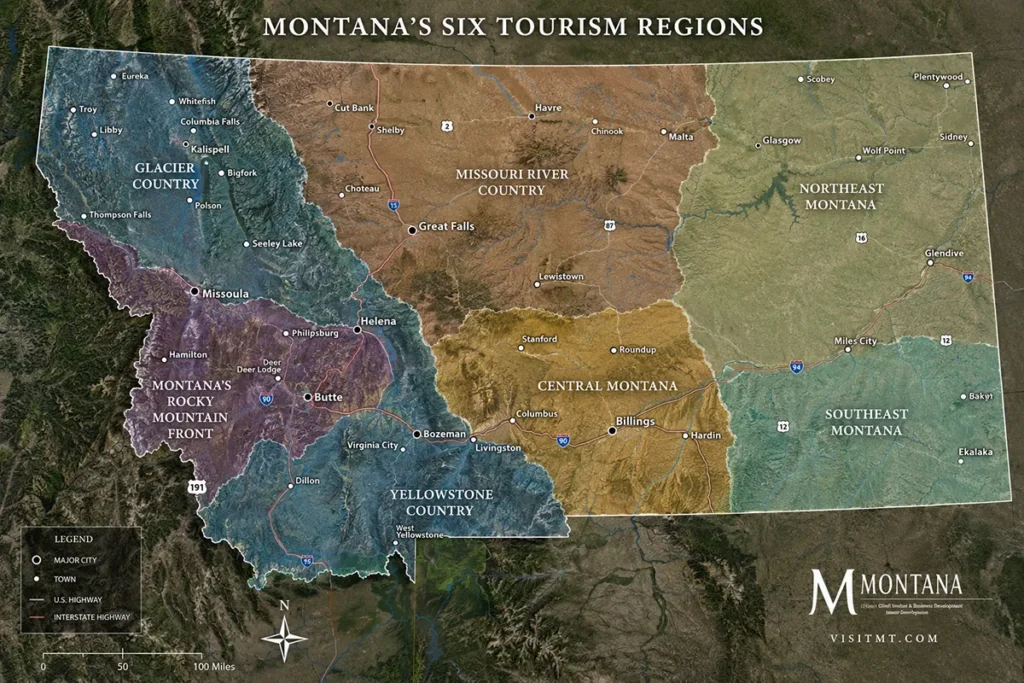
Montana’s 6 Official Tourism Regions
Montana’s tourism is officially organized into six regions. Here are the main towns in each, which is the most useful framing for trip planners.
1. Glacier Country (Northwest Montana)
Anchored by Glacier National Park and Flathead Lake. The tourism heart of the state.
Main towns: Kalispell, Whitefish, Columbia Falls, Bigfork, Polson, Evergreen, Lakeside, Hungry Horse, West Glacier, Missoula, Hamilton, Stevensville, Florence, Lolo, Libby, Troy, Eureka, Thompson Falls, Plains, Superior, Noxon, Trout Creek, St. Ignatius, Ronan, Pablo, Arlee.
2. Yellowstone Country (South-Central Montana)
Gateway to Yellowstone National Park.
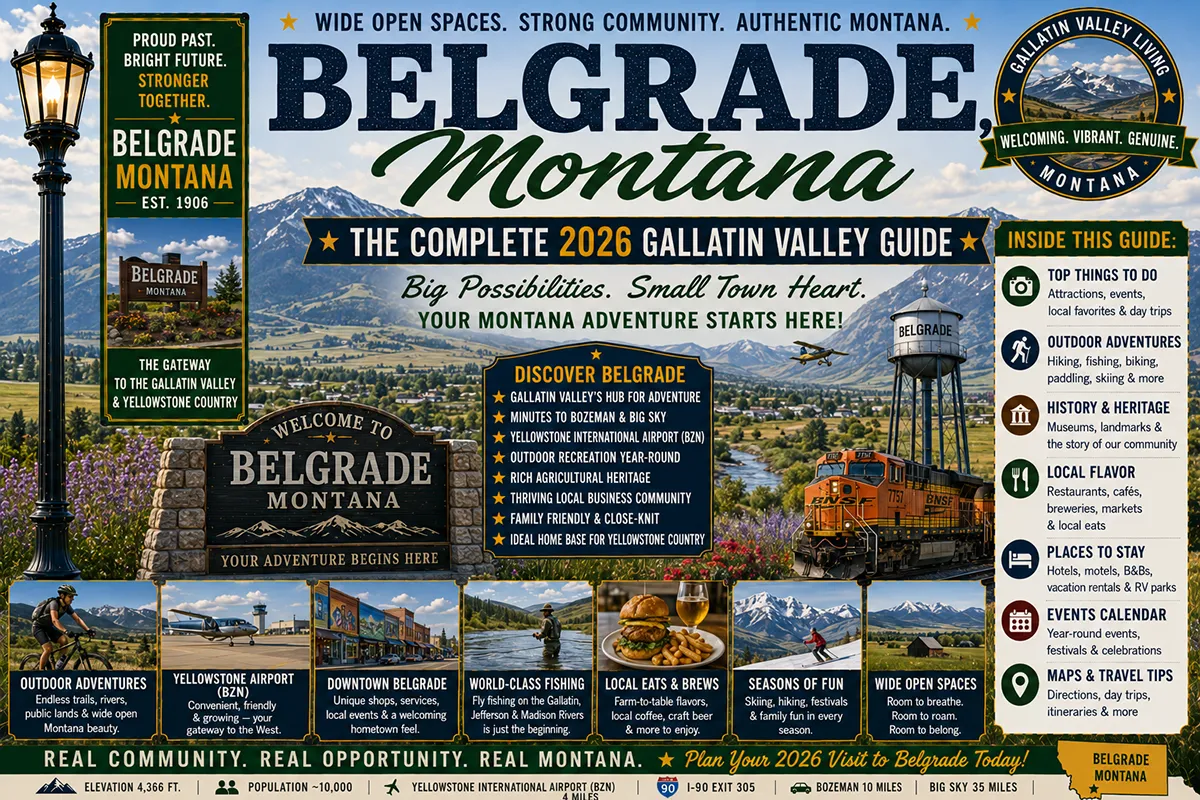
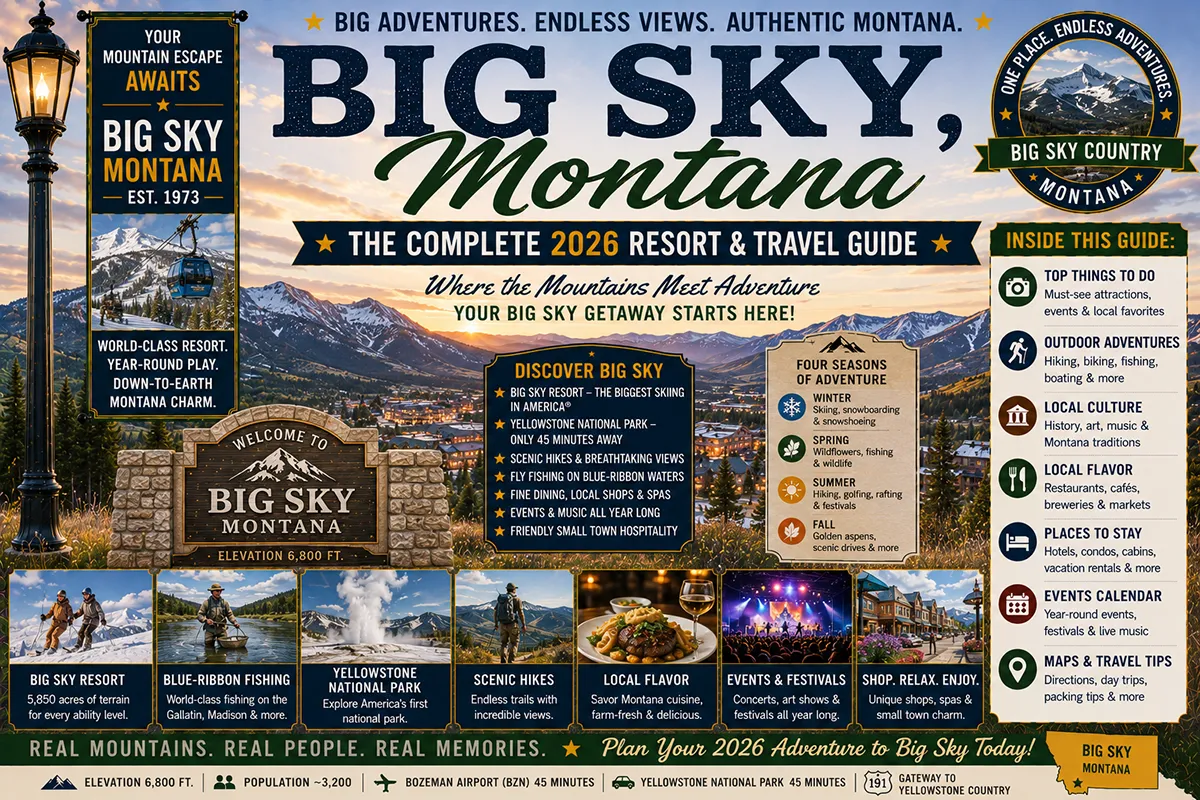
Main towns: Bozeman, Belgrade, Manhattan, Three Forks, Churchill, Big Sky, Gallatin Gateway, Four Corners, Livingston, Pray, Gardiner, Cooke City, Silver Gate, Red Lodge, Big Timber, Columbus, Park City, Absarokee, Joliet, Fromberg, Bridger, Bearcreek, Laurel, Lockwood, Clyde Park, Wilsall.
3. Central Montana
The wide-open middle of the state, ranching country.
Main towns: Great Falls, Black Eagle, Lewistown, Fort Benton, Choteau, Augusta, Stanford, Hobson, Moore, Harlowton, Judith Gap, Roundup, Lavina, Melstone, Ryegate, Belt, Cascade, Vaughn, Denton, Winifred, Winnett, Roy, Grass Range, Geraldine, Neihart, White Sulphur Springs, Martinsdale, Townsend, Big Sandy.
4. Southwest Montana
Mining heritage, hot springs, and Yellowstone-adjacent backcountry.
Main towns: Helena, East Helena, Butte, Walkerville, Anaconda, Dillon, Lima, Philipsburg, Deer Lodge, Drummond, Ennis, Twin Bridges, Sheridan, Virginia City, Nevada City, Whitehall, Boulder, Lincoln, Wolf Creek, Clancy, Montana City, Jefferson City, Hot Springs.
5. Missouri River Country (Northeast Montana)
Vast plains, the Missouri River, and the Fort Peck Reservoir.
Main towns: Glasgow, Wolf Point, Sidney, Plentywood, Malta, Scobey, Culbertson, Poplar, Saco, Nashua, Fort Peck, Medicine Lake, Westby, Outlook, Froid, Bainville, Brockton, Flaxville, Opheim, Zortman, Dodson.
6. Southeast Montana
Badlands, Custer’s Last Stand country, and the Powder River.
Main towns: Miles City, Glendive, Forsyth, Hardin, Colstrip, Baker, Ekalaka, Broadus, Wibaux, Terry, Ashland, Lame Deer, Busby, Lodge Grass, Plevna, Hysham, Ismay, Ryegate.
For more on planning a trip through these regions, see my guide to the 27 best things to do in Montana and the Montana travel map.

Complete A–Z List of Montana Cities and Towns
Click any town below for a detailed guide. County and primary ZIP code shown after each name.
A
Absarokee (Stillwater, 59001) · Alberton (Mineral, 59820) · Anaconda (Deer Lodge, 59711) · Arlee (Lake, 59821) · Ashland (Rosebud, 59003) · Augusta (Lewis and Clark, 59410)
B
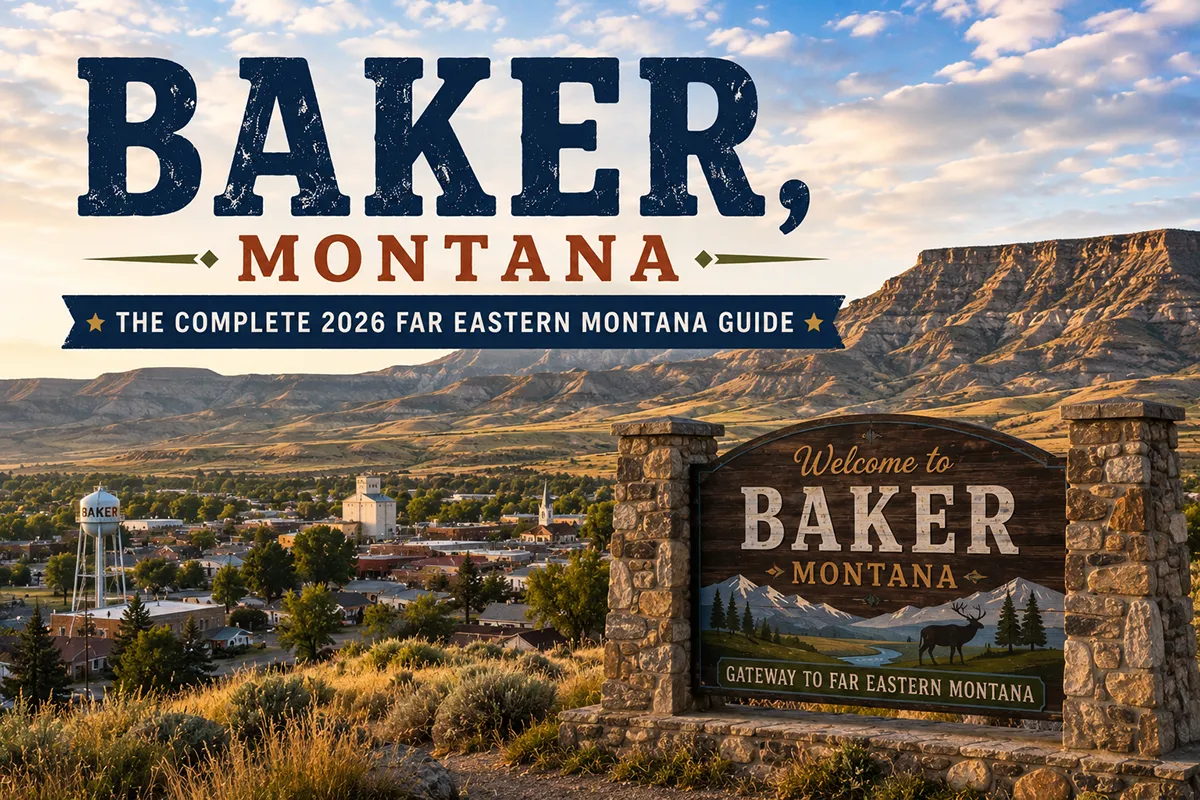
Bainville (Roosevelt, 59212) · Baker (Fallon, 59313) · Bearcreek (Carbon, 59007) · Belgrade (Gallatin, 59714) · Belt (Cascade, 59412) · Bigfork (Flathead, 59911) · Big Sandy (Chouteau, 59520) · Big Sky (Gallatin/Madison, 59716) · Big Timber (Sweet Grass, 59011) · Billings (Yellowstone, 59101) · Black Eagle (Cascade, 59414) · Bonner (Missoula, 59823) · Boulder (Jefferson, 59632) · Bozeman (Gallatin, 59715) · Bridger (Carbon, 59014) · Broadus (Powder River, 59317) · Broadview (Yellowstone, 59015) · Brockton (Roosevelt, 59213) · Browning (Glacier, 59417) · Busby (Big Horn, 59016) · Butte (Silver Bow, 59701) · Bynum (Teton, 59419)
C
Carlton (Missoula, 59847) · Cascade (Cascade, 59421) · Charlo (Lake, 59824) · Chester (Liberty, 59522) · Chinook (Blaine, 59523) · Choteau (Teton, 59422) · Churchill (Gallatin, 59741) · Circle (McCone, 59215) · Clancy (Jefferson, 59634) · Clinton (Missoula, 59825) · Clyde Park (Park, 59018) · Colstrip (Rosebud, 59323) · Columbia Falls (Flathead, 59912) · Columbus (Stillwater, 59019) · Condon (Missoula, 59826) · Conrad (Pondera, 59425) · Cooke City (Park, 59020) · Corvallis (Ravalli, 59828) · Culbertson (Roosevelt, 59218) · Cut Bank (Glacier, 59427)
D
Darby (Ravalli, 59829) · Deer Lodge (Powell, 59722) · Denton (Fergus, 59430) · Dillon (Beaverhead, 59725) · Dodson (Phillips, 59524) · Drummond (Granite, 59832) · Dutton (Teton, 59433)
E
East Glacier Park Village (Glacier, 59434) · East Helena (Lewis and Clark, 59635) · East Missoula (Missoula, 59802) · Ekalaka (Carter, 59324) · Ennis (Madison, 59729) · Eureka (Lincoln, 59917) · Evergreen (Flathead, 59901)
F
Fairfield (Teton, 59436) · Fairview (Richland, 59221) · Flaxville (Daniels, 59222) · Florence (Ravalli, 59833) · Forsyth (Rosebud, 59327) · Fort Benton (Chouteau, 59442) · Fort Peck (Valley, 59223) · Four Corners (Gallatin, 59718) · Frenchtown (Missoula, 59834) · Froid (Roosevelt, 59226) · Fromberg (Carbon, 59029)
G
Gallatin Gateway (Gallatin, 59730) · Gardiner (Park, 59030) · Geraldine (Chouteau, 59446) · Glasgow (Valley, 59230) · Glendive (Dawson, 59330) · Grass Range (Fergus, 59032) · Great Falls (Cascade, 59401)
H
Hamilton (Ravalli, 59840) · Hardin (Big Horn, 59034) · Harlem (Blaine, 59526) · Harlowton (Wheatland, 59036) · Havre (Hill, 59501) · Hays (Blaine, 59527) · Heart Butte (Pondera, 59448) · Helena (Lewis and Clark, 59601) · Hingham (Hill, 59528) · Hobson (Judith Basin, 59452) · Hot Springs (Sanders, 59845) · Hungry Horse (Flathead, 59919) · Hysham (Treasure, 59038)
I
Ismay (Custer, 59336)
J
Jefferson City (Jefferson, 59638) · Joliet (Carbon, 59041) · Jordan (Garfield, 59337) · Judith Gap (Wheatland, 59453)
K
Kalispell (Flathead, 59901) · Kevin (Toole, 59454)
L
Lakeside (Flathead, 59922) · Lame Deer (Rosebud, 59043) · Laurel (Yellowstone, 59044) · Lavina (Golden Valley, 59046) · Lewistown (Fergus, 59457) · Libby (Lincoln, 59923) · Lima (Beaverhead, 59739) · Lincoln (Lewis and Clark, 59639) · Livingston (Park, 59047) · Lockwood (Yellowstone, 59101) · Lodge Grass (Big Horn, 59050) · Lolo (Missoula, 59847)
M
Malta (Phillips, 59538) · Manhattan (Gallatin, 59741) · Marion (Flathead, 59925) · Martinsdale (Meagher, 59053) · Medicine Lake (Sheridan, 59247) · Melstone (Musselshell, 59054) · Miles City (Custer, 59301) · Missoula (Missoula, 59801) · Montana City (Jefferson, 59634) · Moore (Fergus, 59464)
N
Nashua (Valley, 59248) · Neihart (Cascade, 59465) · Nevada City (Madison, 59755) · Noxon (Sanders, 59853)
O
Opheim (Valley, 59250) · Orchard Homes (Missoula, 59804) · Outlook (Sheridan, 59252)
P
Pablo (Lake, 59855) · Park City (Stillwater, 59063) · Philipsburg (Granite, 59858) · Pinesdale (Ravalli, 59841) · Plains (Sanders, 59859) · Plentywood (Sheridan, 59254) · Plevna (Fallon, 59344) · Polson (Lake, 59860) · Poplar (Roosevelt, 59255) · Pray (Park, 59065)
R
Red Lodge (Carbon, 59068) · Rexford (Lincoln, 59930) · Richey (Dawson, 59259) · Ronan (Lake, 59864) · Roundup (Musselshell, 59072) · Roy (Fergus, 59471) · Ryegate (Golden Valley, 59074)
S
Saco (Phillips, 59261) · Scobey (Daniels, 59263) · Seeley Lake (Missoula, 59868) · Shelby (Toole, 59474) · Sheridan (Madison, 59749) · Sidney (Richland, 59270) · Silver Gate (Park, 59081) · Somers (Flathead, 59932) · St. Ignatius (Lake, 59865) · Stanford (Judith Basin, 59479) · Stevensville (Ravalli, 59870) · Sunburst (Toole, 59482) · Superior (Mineral, 59872)
T
Terry (Prairie, 59349) · Thompson Falls (Sanders, 59873) · Three Forks (Gallatin, 59752) · Townsend (Broadwater, 59644) · Trout Creek (Sanders, 59874) · Troy (Lincoln, 59935) · Twin Bridges (Madison, 59754)
V
Valier (Pondera, 59486) · Vaughn (Cascade, 59487) · Victor (Ravalli, 59875) · Virginia City (Madison, 59755)
W
Walkerville (Silver Bow, 59701) · West Glacier (Flathead, 59936) · West Yellowstone (Gallatin, 59758) · Westby (Sheridan, 59275) · White Sulphur Springs (Meagher, 59645) · Whitefish (Flathead, 59937) · Whitehall (Jefferson, 59759) · Wibaux (Wibaux, 59353) · Wilsall (Park, 59086) · Winifred (Fergus, 59489) · Winnett (Petroleum, 59087) · Wolf Creek (Lewis and Clark, 59648) · Wolf Point (Roosevelt, 59201)
Z
Zortman (Phillips, 59546)
Montana Cities by County
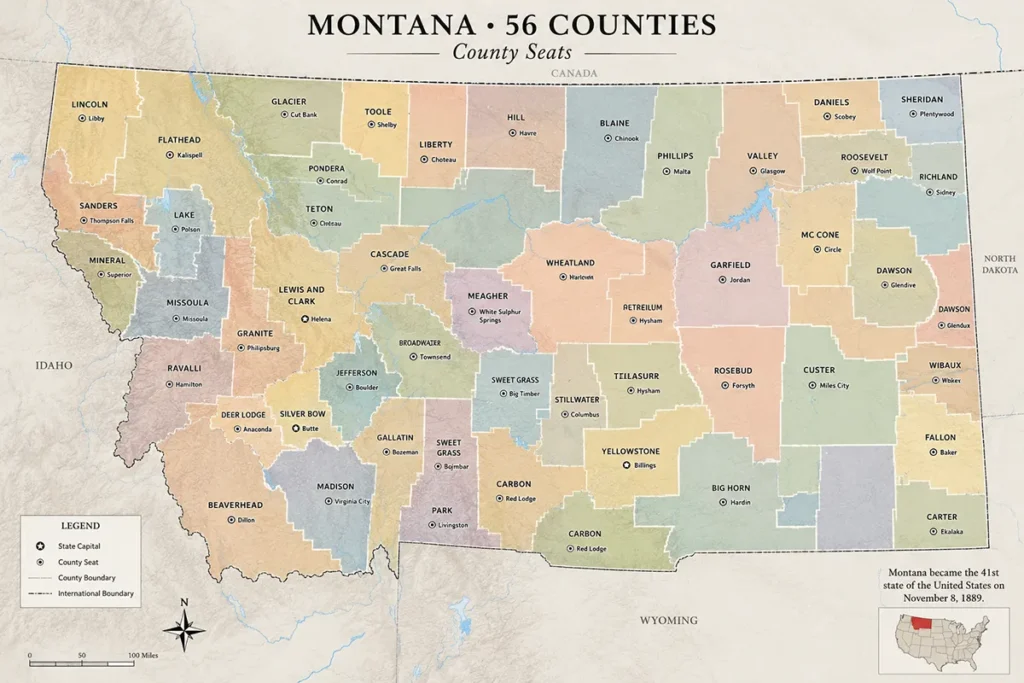
Montana has 56 counties. Below is every Montana city, town, and major unincorporated community organized by county. This is the most useful framing for understanding administrative geography and is searchable for queries like “towns in Gallatin County Montana” or “cities in Yellowstone County.”
Beaverhead County (Seat: Dillon)
Big Horn County (Seat: Hardin)
Hardin · Lodge Grass · Busby
Blaine County (Seat: Chinook)
Broadwater County (Seat: Townsend)
Carbon County (Seat: Red Lodge)
Red Lodge · Joliet · Bridger · Fromberg · Bearcreek
Carter County (Seat: Ekalaka)
Cascade County (Seat: Great Falls)
Great Falls · Black Eagle · Vaughn · Cascade · Belt · Neihart
Chouteau County (Seat: Fort Benton)
Fort Benton · Big Sandy · Geraldine
Custer County (Seat: Miles City)
Daniels County (Seat: Scobey)
Dawson County (Seat: Glendive)
Deer Lodge County (Consolidated with Anaconda)
Fallon County (Seat: Baker)
Fergus County (Seat: Lewistown)
Lewistown · Denton · Grass Range · Moore · Roy · Winifred
Flathead County (Seat: Kalispell)
Kalispell · Whitefish · Columbia Falls · Evergreen · Bigfork · Hungry Horse · West Glacier · Lakeside · Somers · Marion
Gallatin County (Seat: Bozeman)
Bozeman · Belgrade · Manhattan · West Yellowstone · Three Forks · Big Sky · Gallatin Gateway · Four Corners · Churchill
Garfield County (Seat: Jordan)
Glacier County (Seat: Cut Bank)
Cut Bank · Browning · East Glacier Park Village
Golden Valley County (Seat: Ryegate)
Granite County (Seat: Philipsburg)
Hill County (Seat: Havre)
Jefferson County (Seat: Boulder)
Boulder · Whitehall · Clancy · Jefferson City · Montana City
Judith Basin County (Seat: Stanford)
Lake County (Seat: Polson)
Polson · Ronan · St. Ignatius · Pablo · Charlo · Arlee
Lewis and Clark County (Seat: Helena)
Helena · East Helena · Augusta · Lincoln · Wolf Creek
Liberty County (Seat: Chester)
Lincoln County (Seat: Libby)
Libby · Troy · Eureka · Rexford
Madison County (Seat: Virginia City)
Virginia City · Ennis · Twin Bridges · Sheridan · Nevada City
McCone County (Seat: Circle)
Meagher County (Seat: White Sulphur Springs)
White Sulphur Springs · Martinsdale
Mineral County (Seat: Superior)
Missoula County (Seat: Missoula)
Missoula · Orchard Homes · East Missoula · Lolo · Bonner · Frenchtown · Seeley Lake · Clinton · Condon · Carlton
Musselshell County (Seat: Roundup)
Park County (Seat: Livingston)
Livingston · Gardiner · Cooke City · Silver Gate · Pray · Clyde Park · Wilsall
Petroleum County (Seat: Winnett)
Phillips County (Seat: Malta)
Malta · Saco · Dodson · Zortman
Pondera County (Seat: Conrad)
Conrad · Valier · Heart Butte
Powder River County (Seat: Broadus)
Powell County (Seat: Deer Lodge)
Prairie County (Seat: Terry)
Ravalli County (Seat: Hamilton)
Hamilton · Stevensville · Darby · Florence · Victor · Corvallis · Pinesdale
Richland County (Seat: Sidney)
Roosevelt County (Seat: Wolf Point)
Wolf Point · Poplar · Culbertson · Brockton · Bainville · Froid
Rosebud County (Seat: Forsyth)
Forsyth · Colstrip · Lame Deer · Ashland
Sanders County (Seat: Thompson Falls)
Thompson Falls · Plains · Hot Springs · Noxon · Trout Creek
Sheridan County (Seat: Plentywood)
Plentywood · Westby · Medicine Lake · Outlook
Silver Bow County (Consolidated with Butte)
Stillwater County (Seat: Columbus)
Columbus · Absarokee · Park City
Sweet Grass County (Seat: Big Timber)
Teton County (Seat: Choteau)
Choteau · Fairfield · Dutton · Bynum
Toole County (Seat: Shelby)
Treasure County (Seat: Hysham)
Valley County (Seat: Glasgow)
Glasgow · Fort Peck · Nashua · Opheim
Wheatland County (Seat: Harlowton)
Wibaux County (Seat: Wibaux)
Yellowstone County (Seat: Billings)
Billings · Laurel · Lockwood · Broadview
Note: Counties not listed have no incorporated municipalities or CDPs currently covered in this guide. Several counties (notably Lake, Glacier, Roosevelt, Big Horn, Rosebud, and Blaine) contain portions of Indian reservations governed by sovereign tribal nations — see the Tribal Reservations section below.
Montana Towns on Tribal Reservations
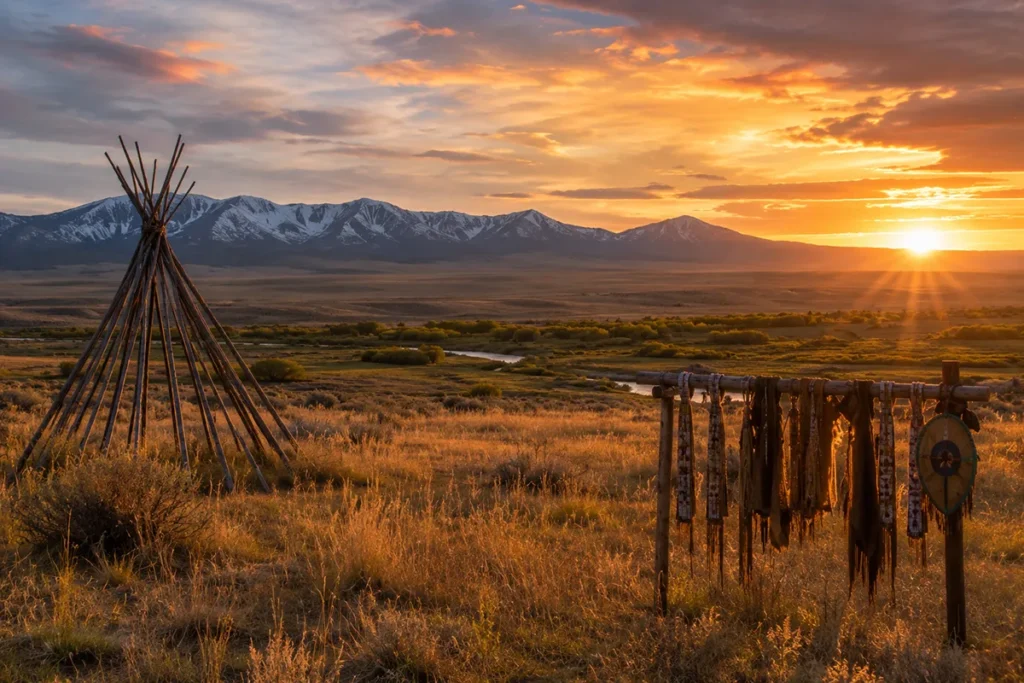
Seven federally recognized Indian reservations cover approximately 8% of Montana’s land area. The reservations are sovereign tribal nations with their own governments, courts, and laws — visiting protocol, jurisdictional realities, and cultural context all matter. Below are the reservations and their main communities.
1. Blackfeet Indian Reservation
- Tribe: Blackfeet Nation (Niitsitapi / Amskapi Piikani — Southern Piikuni)
- Size: ~1.5 million acres
- Headquarters: Browning
- Counties: Glacier, Pondera
- Main communities: Browning · East Glacier Park Village · Heart Butte · Babb · St. Mary · Starr School
Notable context: The reservation borders Glacier National Park on its eastern side. The substantial Badger-Two Medicine sacred area in the southwest corner of the reservation is one of the most spiritually significant Indigenous landscapes in North America.
2. Crow Indian Reservation
- Tribe: Apsáalooke (Crow) Nation
- Size: ~2.3 million acres (largest reservation in Montana)
- Headquarters: Crow Agency
- Counties: Big Horn, Yellowstone, Treasure
- Main communities: Hardin · Lodge Grass · Crow Agency · Pryor · St. Xavier · Wyola
Notable context: The reservation contains the Little Bighorn Battlefield National Monument (site of the 1876 battle) and the substantial annual Crow Fair held every August at Crow Agency — substantial one of the largest Native American gatherings in North America.
3. Confederated Salish and Kootenai (CSKT) — Flathead Indian Reservation
- Tribes: Bitterroot Salish, Pend d’Oreille, and Kootenai
- Size: ~1.3 million acres
- Headquarters: Pablo
- Counties: Lake, Sanders, Missoula, Flathead
- Main communities: Polson · Ronan · St. Ignatius · Pablo · Arlee · Charlo · Hot Springs · Elmo · Dixon
Notable context: The CSKT was the substantial first tribal nation in the United States to purchase and operate a federal hydroelectric dam (the Kerr Dam, now SKQ Dam, on the lower Flathead River). The reservation contains the southern half of substantial Flathead Lake — the largest natural freshwater lake west of the Mississippi.
4. Fort Belknap Indian Reservation
- Tribes: Aaniiih (Gros Ventre) and Nakoda (Assiniboine)
- Size: ~675,000 acres
- Headquarters: Harlem (Fort Belknap Agency)
- Counties: Blaine, Phillips
- Main communities: Hays · Harlem (Agency adjacent) · Lodge Pole · Fort Belknap Agency
Notable context: Site of the substantial Snake Butte Bison Range — substantial Aaniiih buffalo restoration project that has substantially grown from 27 founding animals to 500+. The reservation is bordered on the south by the Little Rocky Mountains, which were substantially transferred from tribal control by the 1895 Grinnell coercive agreement — see the Zortman post for substantial honest framing of that history.
5. Fort Peck Indian Reservation
- Tribes: Assiniboine and Sioux (Dakota and Lakota)
- Size: ~2.1 million acres (second-largest in Montana)
- Headquarters: Poplar
- Counties: Roosevelt, Daniels, Valley, Sheridan
- Main communities: Wolf Point · Poplar · Brockton · Fort Kipp · Frazer · Oswego
Notable context: Fort Peck’s substantial annual Wadopana Powwow (one of the substantial oldest traditional powwows in North America, established 1969) and the substantial Fort Peck Theatre at the Fort Peck Dam.
6. Northern Cheyenne Indian Reservation
- Tribe: Northern Cheyenne (Tsétsêhéstâhese)
- Size: ~444,000 acres
- Headquarters: Lame Deer
- Counties: Rosebud, Big Horn
- Main communities: Lame Deer · Busby · Ashland (just east of reservation boundary) · Birney · Muddy
Notable context: Northern Cheyenne heritage includes substantial Chief Two Moons (one of three Indigenous leaders whose features inspired the substantial Buffalo Nickel of 1913-1938) and the substantial 1993 repatriation of remains from Fort Robinson. St. Labre Indian School at Ashland reached a substantial $11 million settlement with Northern Cheyenne and Crow plaintiffs in 2019 over historical abuse.
7. Rocky Boy’s Indian Reservation
- Tribe: Chippewa Cree
- Size: ~122,000 acres (smallest reservation in Montana)
- Headquarters: Box Elder (Rocky Boy Agency)
- County: Hill (with portions in Chouteau)
- Main communities: Rocky Boy Agency · Box Elder · Parker School
Notable context: Established 1916 — the substantial last reservation created in Montana. Named for Chief Stone Child (“Rocky Boy”), a Chippewa leader who substantially advocated for the reservation’s creation.
For substantial broader Indigenous heritage context, see my Montana history hub.
The 25 Most Important Montana Towns (Editorial Picks)
Population is only one measure. Here are the 25 Montana towns most worth knowing — for travelers, history, or sheer character — with my honest take on each.
1. Billings (117,116)
Montana’s largest city by a wide margin, anchoring the south-central plains. A genuine regional capital with the state’s best hospital system, an underrated cliff-edge geology (the Rims), and the gateway to Beartooth Highway and Pictograph Cave State Park.
2. Missoula (76,848)
Home to the University of Montana, the most liberal and artsy town in the state. Three rivers converge here. Excellent food scene, the best independent bookstores in Montana, and a strong literary heritage — this is Norman Maclean country.
3. Bozeman (56,123 — growing fast)
Yellowstone gateway and the fastest-growing major city in the state. Tech money has reshaped Bozeman in the last decade. Excellent breweries, world-class fly fishing on the Gallatin and Madison, and the Museum of the Rockies (one of the best dinosaur collections in the world).
4. Great Falls (60,442)
A blue-collar river town anchored by Malmstrom Air Force Base and the namesake falls of the Missouri River. Charlie Russell country — the C.M. Russell Museum is excellent. Less touristy than the western towns.
5. Butte (35,133)
Once one of the richest cities in America thanks to copper mining. Today, Butte is a remarkable open-air museum of Gilded Age architecture, with the Berkeley Pit Superfund site as a reminder of the costs. The historic district is unlike anywhere else in the West.
6. Helena (34,690) — State Capital
The state capital, gold-rush founded, with the Cathedral of St. Helena and the Last Chance Gulch pedestrian mall. Genuinely underrated by tourists. See my full guide to things to do in Helena.
7. Kalispell (26,225)
The largest city in northwest Montana and the practical base for many Glacier visitors. More of a working town than touristy Whitefish.
8. Whitefish (8,706)
A genuinely charming resort town near Glacier National Park. Ski mountain access at Whitefish Mountain Resort, walkable downtown, and Whitefish Lake on the edge of town. Crowded in peak summer.
9. Bigfork (~5,000, unincorporated)
Often called Montana’s prettiest small town. Sits at the north end of Flathead Lake, with an arts scene that punches well above its weight. Summer-resort feel.
10. Polson (5,253)
The southern gateway to Flathead Lake. More functional than picturesque, but the best base for lake activities on a budget.
11. Livingston (8,040)
A real Western town near Yellowstone’s north entrance, with art galleries, fly-fishing shops, and Murray Bar saloon. Featured in Jim Harrison and Tom McGuane’s fiction.
12. Hamilton (5,074)
The county seat of Ravalli County, in the Bitterroot Valley. Wide-streeted, affordable, and surrounded by extraordinary terrain.
13. Gardiner (~870)
The gateway to Yellowstone’s North Entrance and the Roosevelt Arch. Small, scrappy, and the practical base for Lamar Valley wolf-watching. See my Lamar Valley Montana guide for trip planning.
14. Cooke City (~75)
Tiny outpost at Yellowstone’s Northeast Entrance — the best base for serious wildlife watchers. Reached by the Beartooth Highway in summer and the only Yellowstone road plowed in winter.
15. Silver Gate (~20)
Even smaller than Cooke City, three miles closer to the park. Pure backcountry mountain hamlet.
16. Red Lodge (2,378)
The northern terminus of Beartooth Highway, with a beautifully preserved downtown and Red Lodge Mountain ski area. One of the most charming small towns in the state.
17. West Yellowstone (1,380)
Yellowstone’s busiest entrance. Functional more than charming — but the Grizzly & Wolf Discovery Center is here, and snowmobile culture takes over in winter.
18. West Glacier (unincorporated)
The main western entrance to Glacier National Park. See my Going-to-the-Sun Road guide for context on the surrounding gateway communities.
19. Lewistown (5,902)
The geographic center of Montana, in the heart of the central plains. Ranching country, surprising depth of restaurants for the size, and a strong sense of historical identity.
20. Miles City (8,354)
The largest town in eastern Montana, famous for the Bucking Horse Sale every May — the West’s most authentic rodeo and horse-trading weekend.
21. Glendive (4,873)
Gateway to Makoshika State Park and Montana’s badlands country. Often skipped by travelers; shouldn’t be.
22. Sidney (6,302)
Bakken oil-field town on the North Dakota border. Has experienced boom-and-bust cycles tied to oil prices.
23. Dillon (4,408)
College town (University of Montana Western) in the southwest mountains. Gateway to the Big Hole and the Pioneer Mountains.
24. Philipsburg (916)
Restored mining town turned candy-and-gemstone destination. The Sweet Palace candy store and surrounding sapphire mines draw thousands of summer visitors.
25. Virginia City & Nevada City (~225 combined)
Living-history twin towns from Montana’s gold-rush days. Wooden boardwalks, period-costumed interpreters, and historic buildings still in use. The closest you’ll come to time-travel in Montana.
Complete Population Data: Incorporated Montana Municipalities
The table below shows all incorporated Montana municipalities with population data from the 2020 U.S. Census, plus county and primary ZIP code.
Sources: U.S. Census Bureau (2020) and Montana Census and Economic Information Center (CEIC). 2024 estimates are provisional from CEIC.
Note: Updated estimates are released annually — verify current population for individual towns where exact numbers matter.
| Rank | City / Town | County | Primary ZIP | 2020 Pop | 2024 Est. | Change (vs 2010) | % Change |
|---|---|---|---|---|---|---|---|
| 1 | Billings | Yellowstone | 59101 | 117,116 | ~120,000 | 7,531 | 6.9% |
| 2 | Missoula | Missoula | 59801 | 76,848 | ~79,000 | 9,144 | 13.5% |
| 3 | Great Falls | Cascade | 59401 | 60,442 | ~61,000 | 1,963 | 3.4% |
| 4 | Bozeman | Gallatin | 59715 | 56,123 | ~59,000 | 18,479 | 49.1% |
| 5 | Butte–Silver Bow | Silver Bow | 59701 | 35,133 | ~35,500 | 1,608 | 4.8% |
| 6 | Helena | Lewis and Clark | 59601 | 34,690 | ~35,500 | 6,094 | 21.3% |
| 7 | Kalispell | Flathead | 59901 | 26,225 | ~28,000 | 6,533 | 33.2% |
| 8 | Belgrade | Gallatin | 59714 | 11,031 | ~11,800 | 3,672 | 49.9% |
| 9 | Havre | Hill | 59501 | 9,719 | ~9,700 | -91 | -0.9% |
| 10 | Anaconda–Deer Lodge | Deer Lodge | 59711 | 9,421 | ~9,400 | 137 | 1.5% |
| 11 | Whitefish | Flathead | 59937 | 8,706 | ~9,100 | 2,366 | 37.3% |
| 12 | Miles City | Custer | 59301 | 8,354 | ~8,400 | 144 | 1.8% |
| 13 | Livingston | Park | 59047 | 8,040 | ~8,100 | 333 | 4.3% |
| 14 | Laurel | Yellowstone | 59044 | 6,718 | ~6,700 | -27 | -0.4% |
| 15 | Sidney | Richland | 59270 | 6,302 | ~6,300 | 1,118 | 21.6% |
| 16 | Columbia Falls | Flathead | 59912 | 6,278 | ~6,400 | 1,191 | 23.4% |
| 17 | Lewistown | Fergus | 59457 | 5,902 | ~5,900 | 12 | 0.2% |
| 18 | Polson | Lake | 59860 | 5,253 | ~5,400 | 524 | 11.1% |
| 19 | Hamilton | Ravalli | 59840 | 5,074 | ~5,150 | 564 | 12.5% |
| 20 | Glendive | Dawson | 59330 | 4,873 | ~4,850 | -52 | -1.1% |
| 21 | Dillon | Beaverhead | 59725 | 4,408 | ~4,450 | 274 | 6.6% |
| 22 | Hardin | Big Horn | 59034 | 3,742 | ~3,750 | 81 | 2.2% |
| 23 | Glasgow | Valley | 59230 | 3,363 | ~3,400 | 113 | 3.5% |
| 24 | Cut Bank | Glacier | 59427 | 3,032 | ~3,000 | -22 | -0.7% |
| 25 | Shelby | Toole | 59474 | 3,007 | ~3,000 | 31 | 1.0% |
| 26 | Libby | Lincoln | 59923 | 2,872 | ~2,900 | 244 | 9.3% |
| 27 | Deer Lodge | Powell | 59722 | 2,810 | ~2,800 | 22 | 0.8% |
| 28 | Wolf Point | Roosevelt | 59201 | 2,656 | ~2,600 | -65 | -2.4% |
| 29 | Conrad | Pondera | 59425 | 2,425 | ~2,400 | -20 | -0.8% |
| 30 | Red Lodge | Carbon | 59068 | 2,378 | ~2,450 | 122 | 5.4% |
| 31 | Colstrip | Rosebud | 59323 | 2,243 | ~2,200 | -103 | -4.4% |
| 32 | Townsend | Broadwater | 59644 | 2,236 | ~2,300 | 152 | 7.3% |
| 33 | Ronan | Lake | 59864 | 2,184 | ~2,200 | 92 | 4.4% |
| 34 | East Helena | Lewis and Clark | 59635 | 2,164 | ~2,250 | 257 | 13.5% |
| 35 | Stevensville | Ravalli | 59870 | 2,155 | ~2,200 | 199 | 10.2% |
| 36 | Columbus | Stillwater | 59019 | 2,135 | ~2,170 | 167 | 8.5% |
| 37 | Three Forks | Gallatin | 59752 | 2,059 | ~2,150 | 175 | 9.3% |
| 38 | Manhattan | Gallatin | 59741 | 2,030 | ~2,150 | 510 | 33.6% |
| 39 | Baker | Fallon | 59313 | 1,901 | ~1,880 | -41 | -2.1% |
| 40 | Roundup | Musselshell | 59072 | 1,880 | ~1,900 | 92 | 5.1% |
| 41 | Malta | Phillips | 59538 | 1,857 | ~1,830 | -140 | -7.0% |
| 42 | Choteau | Teton | 59422 | 1,762 | ~1,780 | 53 | 3.1% |
| 43 | Forsyth | Rosebud | 59327 | 1,757 | ~1,740 | -20 | -1.1% |
| 44 | Plentywood | Sheridan | 59254 | 1,720 | ~1,700 | -16 | -0.9% |
| 45 | Big Timber | Sweet Grass | 59011 | 1,696 | ~1,720 | 55 | 3.4% |
| 46 | Eureka | Lincoln | 59917 | 1,485 | ~1,500 | 33 | 2.3% |
| 47 | Thompson Falls | Sanders | 59873 | 1,449 | ~1,500 | 134 | 10.2% |
| 48 | Fort Benton | Chouteau | 59442 | 1,448 | ~1,470 | 84 | 6.2% |
| 49 | West Yellowstone | Gallatin | 59758 | 1,380 | ~1,420 | 109 | 8.6% |
| 50 | Boulder | Jefferson | 59632 | 1,309 | ~1,330 | 26 | 2.0% |
| 51 | Chinook | Blaine | 59523 | 1,233 | ~1,210 | -54 | -4.2% |
| 52 | Whitehall | Jefferson | 59759 | 1,173 | ~1,170 | -19 | -1.6% |
| 53 | Plains | Sanders | 59859 | 1,154 | ~1,180 | 106 | 10.1% |
| 54 | Ennis | Madison | 59729 | 1,074 | ~1,120 | 235 | 28.0% |
| 55 | Pinesdale | Ravalli | 59841 | 1,045 | ~1,080 | 161 | 18.2% |
| 56 | Browning | Glacier | 59417 | 1,016 | ~1,000 | -62 | -5.8% |
| 57 | Harlowton | Wheatland | 59036 | 1,005 | ~1,000 | 8 | 0.8% |
| 58 | Troy | Lincoln | 59935 | 991 | ~1,010 | 53 | 5.7% |
| 59 | Scobey | Daniels | 59263 | 970 | ~980 | 30 | 3.2% |
| 60 | White Sulphur Springs | Meagher | 59645 | 923 | ~920 | -16 | -1.7% |
| 61 | Philipsburg | Granite | 59858 | 916 | ~940 | 96 | 11.7% |
| 62 | Superior | Mineral | 59872 | 905 | ~920 | 92 | 11.3% |
| 63 | Fairview | Richland | 59221 | 886 | ~890 | 138 | 18.4% |
| 64 | Chester | Liberty | 59522 | 874 | ~870 | -73 | -7.7% |
| 65 | St. Ignatius | Lake | 59865 | 851 | ~860 | 60 | 7.6% |
| 66 | Poplar | Roosevelt | 59255 | 838 | ~830 | -48 | -5.4% |
| 67 | Darby | Ravalli | 59829 | 834 | ~850 | 90 | 12.1% |
| 68 | Culbertson | Roosevelt | 59218 | 791 | ~790 | -3 | -0.4% |
| 69 | Harlem | Blaine | 59526 | 783 | ~790 | 35 | 4.7% |
| 70 | Bridger | Carbon | 59014 | 776 | ~785 | 70 | 9.9% |
| 71 | Sheridan | Madison | 59749 | 776 | ~790 | 105 | 15.6% |
| 72 | Fairfield | Teton | 59436 | 740 | ~750 | 51 | 7.4% |
| 73 | Walkerville | Silver Bow | 59701 | 717 | ~720 | 41 | 6.1% |
| 74 | Cascade | Cascade | 59421 | 680 | ~680 | -8 | -1.2% |
| 75 | Joliet | Carbon | 59041 | 671 | ~680 | 79 | 13.3% |
| 76 | Circle | McCone | 59215 | 603 | ~610 | 16 | 2.7% |
| 77 | Hot Springs | Sanders | 59845 | 591 | ~600 | 47 | 8.6% |
| 78 | Wibaux | Wibaux | 59353 | 580 | ~580 | 3 | 0.5% |
| 79 | Belt | Cascade | 59412 | 572 | ~580 | 39 | 7.3% |
| 80 | Big Sandy | Chouteau | 59520 | 569 | ~570 | 9 | 1.6% |
| 81 | Terry | Prairie | 59349 | 554 | ~550 | -2 | -0.4% |
| 82 | Valier | Pondera | 59486 | 478 | ~480 | -8 | -1.6% |
| 83 | Fromberg | Carbon | 59029 | 473 | ~480 | 32 | 7.3% |
| 84 | Alberton | Mineral | 59820 | 468 | ~490 | 95 | 25.5% |
| 85 | Broadus | Powder River | 59317 | 466 | ~470 | -2 | -0.4% |
| 86 | Lodge Grass | Big Horn | 59050 | 445 | ~450 | 17 | 4.0% |
| 87 | Twin Bridges | Madison | 59754 | 438 | ~445 | 38 | 9.5% |
| 88 | Stanford | Judith Basin | 59479 | 392 | ~395 | 6 | 1.6% |
| 89 | Jordan | Garfield | 59337 | 391 | ~395 | 28 | 7.7% |
| 90 | Ekalaka | Carter | 59324 | 370 | ~375 | 38 | 11.4% |
| 91 | Drummond | Granite | 59832 | 332 | ~335 | -34 | -9.3% |
| 92 | Sunburst | Toole | 59482 | 331 | ~330 | -41 | -11.0% |
| 93 | Dutton | Teton | 59433 | 328 | ~335 | 38 | 13.1% |
| 94 | Bainville | Roosevelt | 59212 | 319 | ~310 | 153 | 92.2% |
| 95 | Clyde Park | Park | 59018 | 315 | ~325 | 24 | 8.2% |
| 96 | Hysham | Treasure | 59038 | 309 | ~310 | 9 | 3.0% |
| 97 | Nashua | Valley | 59248 | 288 | ~290 | 35 | 13.8% |
| 98 | Geraldine | Chouteau | 59446 | 253 | ~255 | 12 | 5.0% |
| 99 | Fort Peck | Valley | 59223 | 239 | ~240 | 6 | 2.6% |
| 100 | Ryegate | Golden Valley | 59074 | 237 | ~235 | -8 | -3.3% |
| 101 | Denton | Fergus | 59430 | 236 | ~235 | -19 | -7.4% |
| 102 | Hobson | Judith Basin | 59452 | 231 | ~230 | -13 | -5.3% |
| 103 | Lima | Beaverhead | 59739 | 229 | ~230 | 5 | 2.2% |
| 104 | Virginia City | Madison | 59755 | 228 | ~230 | 39 | 20.6% |
| 105 | Medicine Lake | Sheridan | 59247 | 221 | ~220 | -1 | -0.5% |
| 106 | Froid | Roosevelt | 59226 | 207 | ~205 | 12 | 6.2% |
| 107 | Winifred | Fergus | 59489 | 198 | ~200 | 47 | 31.1% |
| 108 | Winnett | Petroleum | 59087 | 192 | ~195 | 8 | 4.3% |
| 109 | Saco | Phillips | 59261 | 188 | ~185 | -10 | -5.1% |
| 110 | Moore | Fergus | 59464 | 184 | ~185 | 41 | 28.7% |
| 111 | Broadview | Yellowstone | 59015 | 184 | ~190 | 26 | 16.5% |
| 112 | Richey | Dawson | 59259 | 171 | ~170 | -7 | -3.9% |
| 113 | Lavina | Golden Valley | 59046 | 170 | ~170 | -16 | -8.6% |
| 114 | Rexford | Lincoln | 59930 | 163 | ~170 | 50 | 44.2% |
| 115 | Westby | Sheridan | 59275 | 154 | ~150 | -16 | -9.4% |
| 116 | Plevna | Fallon | 59344 | 143 | ~145 | 6 | 4.4% |
| 117 | Kevin | Toole | 59454 | 138 | ~135 | -16 | -10.4% |
| 118 | Judith Gap | Wheatland | 59453 | 129 | ~130 | 12 | 10.3% |
| 119 | Hingham | Hill | 59528 | 120 | ~120 | -19 | -13.7% |
| 120 | Dodson | Phillips | 59524 | 118 | ~120 | 23 | 24.2% |
| 121 | Melstone | Musselshell | 59054 | 113 | ~115 | 17 | 17.7% |
| 122 | Grass Range | Fergus | 59032 | 107 | ~105 | 5 | 4.9% |
| 123 | Bearcreek | Carbon | 59007 | 88 | ~90 | 9 | 11.4% |
| 124 | Opheim | Valley | 59250 | 84 | ~80 | -7 | -7.7% |
| 125 | Flaxville | Daniels | 59222 | 67 | ~65 | -3 | -4.3% |
| 126 | Neihart | Cascade | 59465 | 50 | ~50 | -1 | -2.0% |
| 127 | Outlook | Sheridan | 59252 | 48 | ~50 | -1 | -2.0% |
| 128 | Ismay | Custer | 59336 | 19 | ~20 | -1 | -5.0% |
Figures shown are 2020 U.S. Census Bureau data and provisional 2024 CEIC estimates. For the most current annual estimates, see the Montana Census and Economic Information Center. This table is updated periodically.
Major Unincorporated Communities and Census Designated Places (CDPs)
Several of Montana’s most prominent and populous places are unincorporated — meaning they have no local government but function as substantial communities. Evergreen (north of Kalispell) is actually larger than 9 of the 10 largest incorporated cities in the state. This table covers all the major unincorporated communities and CDPs covered in this guide.
| CDP / Unincorporated Community | County | Primary ZIP | 2020 Pop (est.) | Notable Context |
|---|---|---|---|---|
| Evergreen | Flathead | 59901 | 9,206 | Larger than Belgrade; 2nd largest in Flathead County |
| Lockwood | Yellowstone | 59101 | 7,195 | 2nd largest in Billings metropolitan area |
| Orchard Homes | Missoula | 59804 | 5,377 | Missoula’s substantial western suburb |
| Bigfork | Flathead | 59911 | ~5,000 | Flathead Lake arts community |
| Lolo | Missoula | 59847 | 4,037 | Missoula’s southern suburb; Lolo Hot Springs |
| Helena Valley (West Central) | Lewis and Clark | 59601 | ~7,800 | Helena’s western suburbs |
| Big Sky | Gallatin/Madison | 59716 | ~3,300 | Major ski resort |
| Montana City | Jefferson | 59634 | 2,918 | South of Helena; oldest paleoindian site |
| Carlton | Missoula | 59847 | ~2,800 | Bitterroot Valley community |
| East Missoula | Missoula | 59802 | 2,465 | Eastern entrance to Missoula |
| Bonner | Missoula | 59823 | 1,663 | Clark Fork-Blackfoot confluence |
| Four Corners | Gallatin | 59718 | ~2,000 | Bozeman suburb (fastest-growing) |
| Gallatin Gateway | Gallatin | 59730 | ~900 | Big Sky corridor |
| Pray | Park | 59065 | ~700 | Paradise Valley; Chico Hot Springs |
| Marion | Flathead | 59925 | 1,119 | Great Northern Railway heritage |
| Hays | Blaine | 59527 | ~700 | Fort Belknap Reservation |
| Heart Butte | Pondera | 59448 | 621 | Blackfeet Reservation |
| Clancy | Jefferson | 59634 | ~1,800 | South Helena suburb |
| Lakeside | Flathead | 59922 | ~2,600 | Flathead Lake’s west shore |
| Somers | Flathead | 59932 | ~900 | Flathead Lake’s northern tip |
| Cooke City | Park | 59020 | ~75 | Yellowstone NE Entrance |
| Silver Gate | Park | 59081 | ~20 | Yellowstone NE Entrance |
| West Glacier | Flathead | 59936 | ~220 | Glacier NP main entrance |
| East Glacier Park Village | Glacier | 59434 | 363 | Glacier NP eastern gateway |
| Hungry Horse | Flathead | 59919 | ~830 | Hungry Horse Dam |
| Pablo | Lake | 59855 | 2,254 | CSKT Tribal HQ |
| Charlo | Lake | 59824 | ~430 | National Bison Range community |
| Arlee | Lake | 59821 | ~640 | Flathead Reservation southern gateway |
| Lame Deer | Rosebud | 59043 | 2,049 | Northern Cheyenne Tribal HQ |
| Ashland | Rosebud | 59003 | ~480 | St. Labre Indian School |
| Busby | Big Horn | 59016 | ~640 | Northern Cheyenne; Two Moons monument |
| Black Eagle | Cascade | 59414 | 905 | Historic 506 ft Big Stack |
| Vaughn | Cascade | 59487 | ~600 | Robert Vaughn 1869 homestead |
| Park City | Stillwater | 59063 | ~1,000 | Lewis & Clark canoe camp site |
| Trout Creek | Sanders | 59874 | 277 | Huckleberry Capital of Montana |
| Noxon | Sanders | 59853 | ~225 | Cabinet Mountains gateway |
| Jefferson City | Jefferson | 59638 | ~310 | First Jefferson County seat |
| Churchill | Gallatin | 59741 | ~1,030 | Dutch settlement heritage |
| Wilsall | Park | 59086 | ~230 | Shields River Valley |
| Clyde Park | Park | 59018 | ~310 | Shields River Valley |
| Martinsdale | Meagher | 59053 | ~70 | Charles M. Bair Family Museum |
| Roy | Fergus | 59471 | ~80 | UL Bend National Wildlife Refuge gateway |
| Bynum | Teton | 59419 | ~30 | Two Medicine Dinosaur Center |
| Condon | Missoula | 59826 | ~440 | Swan Valley |
| Seeley Lake | Missoula | 59868 | 1,659 | Seeley-Swan Valley recreation gateway |
| Wolf Creek | Lewis and Clark | 59648 | ~330 | Missouri River fishing access |
| Lincoln | Lewis and Clark | 59639 | 990 | Blackfoot River; Unabomber cabin site |
| Zortman | Phillips | 59546 | ~60 | Mining ghost town; Pegasus Gold legacy |
CDP populations are 2020 U.S. Census Bureau estimates. Unincorporated community populations are approximate, based on local sources.
Montana Towns by Other Rankings
Population isn’t the only way to think about Montana’s places. Here are some alternative rankings worth knowing.
Fastest-Growing Montana Cities (2010 → 2020)
- Bainville — +92.2% (oil-boom growth from a low base)
- Belgrade — +49.9%
- Bozeman — +49.1%
- Rexford — +44.2%
- Whitefish — +37.3%
- Manhattan — +33.6%
- Kalispell — +33.2%
- Winifred — +31.1%
- Moore — +28.7%
- Ennis — +28.0%
Bozeman, Belgrade, Kalispell, and Whitefish growth reflects a broader Western migration trend driven by remote work, lifestyle priorities, and outdoor amenities.
Largest Montana Cities by Area
Cities annex differently, so land area sometimes diverges from population significantly:
- Anaconda–Deer Lodge (consolidated city-county) — 740+ sq miles
- Butte–Silver Bow (consolidated city-county) — 716 sq miles
- Billings — ~45 sq miles
- Missoula — ~30 sq miles
- Great Falls — ~22 sq miles
- Bozeman — ~20 sq miles
- Helena — ~16 sq miles
- Kalispell — ~11 sq miles
- Whitefish — ~6 sq miles
- Shelby — ~3 sq miles
The two consolidated city-county governments dominate the area rankings by an enormous margin.
Smallest Incorporated Towns in Montana
- Ismay — 19
- Outlook — 48
- Neihart — 50
- Flaxville — 67
- Opheim — 84
- Bearcreek — 88
- Grass Range — 107
- Melstone — 113
- Dodson — 118
- Hingham — 120
Ismay‘s tiny population is the source of one of Montana’s most charming small-town stories — the town temporarily renamed itself “Joe, Montana” in 1993 to honor the quarterback during his football career.
Best-Known Unincorporated Communities
Several of Montana’s most prominent places aren’t incorporated:
- Big Sky — major ski resort and unincorporated town
- Bigfork — arts town on Flathead Lake
- Evergreen — Montana’s largest unincorporated community (9,206)
- Lockwood — Billings’ largest suburb
- Cooke City — Yellowstone gateway
- Silver Gate — Yellowstone gateway
- West Glacier — Glacier gateway
- Pray — Paradise Valley, home to Chico Hot Springs
- Lakeside — Flathead Lake village
- Lolo — Missoula-adjacent community
- Four Corners — fast-growing Bozeman suburb
- Gallatin Gateway — Bozeman-adjacent
- Orchard Homes — Missoula’s western suburb (5,377)
Geographic Quick-Reference: Montana Town Extremes
Quick reference for “extreme geography” questions about Montana’s cities and towns:
| Distinction | Town | Notes |
|---|---|---|
| Northernmost incorporated town | Sunburst (Toole County) | ~7 miles from Canadian border |
| Northernmost town near border | Sweet Grass (Toole County) | Customs port-of-entry |
| Southernmost incorporated town | Lima (Beaverhead County) | Near Idaho border |
| Easternmost incorporated town | Westby (Sheridan County) | On the North Dakota border |
| Westernmost incorporated town | Heron (Sanders County) | Near Idaho border |
| Highest elevation town | Cooke City (Park County) | ~7,608 ft |
| 2nd highest elevation town | Silver Gate (Park County) | ~7,400 ft |
| Lowest elevation town | Troy (Lincoln County) | ~1,892 ft |
| Oldest continuously-settled town | Stevensville (Ravalli County) | St. Mary’s Mission founded 1841 |
| First Montana Territory capital | Bannack (Beaverhead County, now ghost town) | 1864 |
| State capital | Helena (Lewis and Clark County) | Since 1875 |
| Largest by population | Billings (Yellowstone County) | 117,116 (2020) |
| Largest by area | Anaconda–Deer Lodge | 740+ sq mi (consolidated) |
| Smallest incorporated | Ismay (Custer County) | 19 residents |
| Most isolated town | Jordan (Garfield County) | Garfield Co. has no traffic lights |
| Most remote major town | Ekalaka (Carter County) | Closest interstate is 90+ mi |
| Closest to Yellowstone NE entrance | Silver Gate | ~1 mile to park boundary |
| Closest to Glacier NP | West Glacier | Adjacent to park entrance |
| Largest at higher elevation | Bozeman | 4,820 ft |
| Largest unincorporated | Evergreen (Flathead County) | 9,206 — bigger than Belgrade |
Best Montana Towns for Travelers
If you’re planning a trip rather than relocating, the relevant question isn’t size — it’s character and convenience. My honest recommendations by traveler type:
Best Base for Glacier National Park
Whitefish — charming, walkable, well-supplied. Kalispell for a cheaper alternative. West Glacier for park-adjacent convenience. East Glacier Park Village if you’re entering from the east side.
Best Base for Yellowstone
Gardiner for North Entrance access; West Yellowstone for west and geyser basins; Cooke City for serious wildlife watchers at the Northeast Entrance.
Best Mountain Resort Town
Whitefish or Big Sky — different vibes (Whitefish more authentic, Big Sky more polished and expensive).
Best Historic Town
Virginia City, Nevada City, Philipsburg, Bannack, or Butte — all preserve Montana’s mining and frontier history in different ways.
Best Small Town for Authentic Montana
Livingston, Lewistown, Augusta, Choteau, Big Timber, or Stanford — working towns with real character.
Best for Foodies and Culture
Missoula wins by a wide margin. Bozeman is a close second.
Best for Off-the-Grid Quiet
Cooke City, Silver Gate, Lincoln, Augusta, Jordan, or Ekalaka — places where cell service drops out and the night sky takes over.
Best for Native American Heritage
Browning (Blackfeet), Pablo (CSKT Tribal Headquarters and People’s Center museum), Crow Agency (Crow Tribal HQ and Little Bighorn Battlefield), Lame Deer (Northern Cheyenne), Hays (Fort Belknap).
Best College Towns
Missoula (University of Montana), Bozeman (Montana State University), Dillon (University of Montana Western), Havre (MSU-Northern), Billings (MSU Billings).
When to Visit Montana’s Towns
Montana’s seasons hit different towns differently. Mountain towns (Whitefish, Big Sky, Cooke City) shine in summer and winter.
Plains towns (Miles City, Glendive, Sidney) are best in late spring and fall — summer can be scorching, winter brutal. Tourist towns (Gardiner, West Yellowstone) are insanely crowded July–August and lovely in shoulder seasons.
For full season-by-season planning, see my best time to visit Montana guide.
What I Wish I’d Known Researching Montana Towns
A few honest observations after years of writing about this state:
The biggest “cities” are still small. Even Billings (117,116) is closer in scale to a midsize college town than to anywhere most travelers would call a city. Pack expectations accordingly.
Distances are deceptive. Towns that look close on a map are often two hours apart. Always double-check driving times — Montana is 559 miles wide. See my Montana size guide for more context.
Many “towns” have no services. Some incorporated towns have under 100 residents and no gas station, motel, or restaurant. Don’t plan a road-trip overnight in a town under 500 without checking specifically.
The largest “place” isn’t always an incorporated city. Evergreen (9,206), Lockwood (7,195), and Orchard Homes (5,377) are all unincorporated CDPs larger than dozens of incorporated cities. Search results often skip them — but they’re real places with real populations and substantial services.
Tribal nations operate as separate governments. Many of the most prominent Montana communities (Browning, Pablo, Lame Deer, Crow Agency, Hays, Heart Butte) sit on reservation land governed by sovereign tribal nations. Visiting protocols, jurisdictional realities, and cultural context matter — research before visiting.
Town names repeat with neighboring states. Manhattan, Hot Springs, Lincoln, Helena, Big Timber — there are towns by these names in other states too. Always specify “Montana” when searching to get the right place.
Some “ghost towns” still have residents. Virginia City (228), Nevada City (~5 year-round), Zortman (~60), Bannack (0 — true ghost town) all have different levels of contemporary occupation. The “ghost town” label gets used loosely.
For broader trip planning resources, see the where Montana is located guide and the full 27 best things to do in Montana hub.
Conclusion
There’s a Montana for every kind of traveler — the urbanish hum of Missoula, the polished resort glow of Whitefish, the working-cattle reality of Augusta, the time-warp wooden boardwalks of Virginia City, the snowmobile-and-grizzly outpost of Cooke City, the substantial paleoindian-site-and-Henry-Kaiser-cement-plant heritage of Montana City, the 130-year railroad-and-huckleberry character of Trout Creek. This list won’t tell you which one is right for you, but it’ll show you the full scope of choices.
Bookmark this page — it’s updated as new census data is released and as I publish detailed guides for each town. If there’s a Montana town you want covered in depth, drop the name in the comments and I’ll move it up the list.
Frequently Asked Questions
How many cities and towns are in Montana?
Montana has 129 incorporated municipalities — 51 cities, 76 towns, and 2 consolidated city-county governments (Butte–Silver Bow and Anaconda–Deer Lodge). In addition, there are more than 200 unincorporated communities and Census Designated Places, including substantial places like Evergreen (9,206), Lockwood (7,195), Orchard Homes (5,377), Big Sky, Bigfork, Cooke City, and West Glacier.
What is the largest city in Montana?
Billings is the largest city in Montana with a population of 117,116 (2020 census). It’s the only Montana city with more than 100,000 residents. The next-largest cities are Missoula (76,848), Great Falls (60,442), Bozeman (56,123), and Butte–Silver Bow (35,133).
What is the smallest town in Montana?
Ismay is the smallest incorporated town in Montana with a 2020 census population of 19 residents. The town briefly renamed itself “Joe, Montana” in 1993 to honor NFL quarterback Joe Montana — a publicity stunt that briefly made it one of the most famous tiny towns in America.
What is the capital of Montana?
Helena is the capital of Montana, with a population of 34,690 (2020 census). Helena was founded during the 1864 gold rush as “Last Chance Gulch” and became the territorial capital in 1875 and the state capital when Montana achieved statehood in 1889.
What is the fastest-growing city in Montana?
Bozeman is the fastest-growing major city in Montana, with population growth of approximately 49.1% between 2010 and 2020. Belgrade (adjacent to Bozeman) grew at similar rates (+49.9%), and Whitefish (+37.3%), Kalispell (+33.2%), and Manhattan (+33.6%) all saw growth above 30% during the same period. The growth is driven largely by remote-work migration and outdoor-amenity demand. The fastest-growing tiny town was Bainville at +92.2% (from a low base of 166).
What is the population of Montana?
Montana’s population is approximately 1.08 million as of the 2020 U.S. Census (1,084,225 exact), making it the 44th most populous state. Montana is the 4th largest state by area but one of the least densely populated, with roughly 7 people per square mile. The 2024 estimate is approximately 1.137 million.
What’s the difference between a Montana city and a Montana town?
Under Montana law, a city has at least 1,000 residents while a town has between 300 and 999. Cities are further divided into first class (10,000+), second class (5,000–9,999), and third class (1,000–4,999). Below 300 residents, places typically remain unincorporated communities.
How many first-class cities are in Montana?
Montana has 7 first-class cities (10,000+ residents): Billings, Missoula, Great Falls, Bozeman, Butte–Silver Bow, Helena, Kalispell, and Belgrade. Belgrade joined the first-class category after the 2020 census when it crossed the 10,000-resident threshold.
What is the oldest town in Montana?
Stevensville is generally considered Montana’s oldest continuously-settled town. It was founded in 1841 as St. Mary’s Mission by Jesuit Father Pierre-Jean De Smet, making it 23 years older than Montana Territory itself (established 1864). The original mission church still stands in downtown Stevensville. Bannack (now a ghost town and state park in Beaverhead County) was founded in 1862 and became Montana’s first territorial capital, but it isn’t continuously inhabited as a community today.
What is the highest elevation town in Montana?
Cooke City (Park County) is the highest-elevation incorporated community in Montana at approximately 7,608 feet. Its neighbor Silver Gate is at approximately 7,400 feet. Both sit at the substantial entrance to Yellowstone National Park’s Northeast Entrance, accessed via the substantial Beartooth Highway in summer.
What is the northernmost town in Montana?
The northernmost incorporated town in Montana is Sunburst (Toole County), approximately 7 miles from the Canadian border. The northernmost named place near the border itself is Sweet Grass (also Toole County), which serves as a U.S. Customs port-of-entry but is not incorporated.
Are Big Sky and Bigfork official Montana cities?
No — both Big Sky and Bigfork are unincorporated communities, despite being prominent destinations. Big Sky (~3,300 residents) is best known as a major ski resort south of Bozeman, sitting on both sides of the Gallatin–Madison county line. Bigfork (~5,000) is a popular arts and lakefront village at the north end of Flathead Lake. Neither has a city government; both are governed at the county level.
What is the largest unincorporated community in Montana?
Evergreen (Flathead County, north of Kalispell) is Montana’s largest unincorporated Census Designated Place with 9,206 residents (2020 census) — substantial larger than Belgrade, Whitefish, or Havre, all of which are incorporated cities. The substantial Lockwood CDP (Yellowstone County, east of Billings) is the second-largest at 7,195, and Orchard Homes (Missoula County) is third at 5,377.
What are the major regions of Montana?
Montana is officially divided into six tourism regions: Glacier Country (northwest), Yellowstone Country (south central), Central Montana, Southwest Montana, Missouri River Country (northeast), and Southeast Montana. Each region has distinct geography, culture, and a primary set of anchor towns.
How many tribal reservations are in Montana?
Montana has 7 federally recognized Indian reservations, covering approximately 8% of the state’s land area: Blackfeet (headquartered at Browning), Crow (Crow Agency, Big Horn County), Confederated Salish and Kootenai / Flathead (Pablo), Fort Belknap (Harlem), Fort Peck (Poplar), Northern Cheyenne (Lame Deer), and Rocky Boy’s (Box Elder). Each is a sovereign tribal nation with its own government.
How many counties are in Montana?
Montana has 56 counties. The largest by population is Yellowstone County (home to Billings) with approximately 172,000 residents. The smallest is Petroleum County (home to Winnett) with approximately 500 residents. The largest county by area is Beaverhead County at 5,543 square miles; the smallest is Silver Bow County (consolidated with Butte) at 718 square miles.
What ZIP codes does Montana use?
Montana uses 293 ZIP codes ranging from 59001 (Absarokee) to 59937 (Whitefish). All Montana ZIP codes begin with the digits “59” — making Montana one of only a few states where every ZIP code shares the same two-digit prefix. Montana also has a single area code statewide: 406.
What’s the best Montana town for tourists to visit?
The answer depends on what you’re looking for. Whitefish offers the best combination of charm, walkability, and Glacier access. Bozeman is the best urban-feeling base for Yellowstone. Missoula has the strongest food and arts scene. Red Lodge is a charming small mountain town. Virginia City offers immersive frontier history. For a complete breakdown, see my guide to the 27 best things to do in Montana.
Data & Services Overview
- U.S. Census Bureau: Provides demographic and economic data, including Montana’s population, median age, and economic statistics.
- Montana CEIC: The Census and Economic Information Center is the State Data Center that provides localized maps, demographic datasets, and business economic data.
- USPS: Uses U.S. Census Bureau data to manage zip codes and route mail. You can find local post offices and PO box availability using the USPS Location Finder.
- Montana Code Annotated: The codified state laws of Montana, which formally established agencies like the CEIC.
Sources
- U.S. Census Bureau. (n.d.). QuickFacts: Montana. U.S. Census Bureau QuickFacts
- Montana Department of Commerce. (n.d.). Census and Economic Information Center. Montana Department of Commerce Data + Research
- United States Postal Service. (n.d.). Find USPS Locations. USPS Location Finder
- Montana State Legislature. (n.d.). Montana Code Annotated (MCA). Montana Legislature Statutes