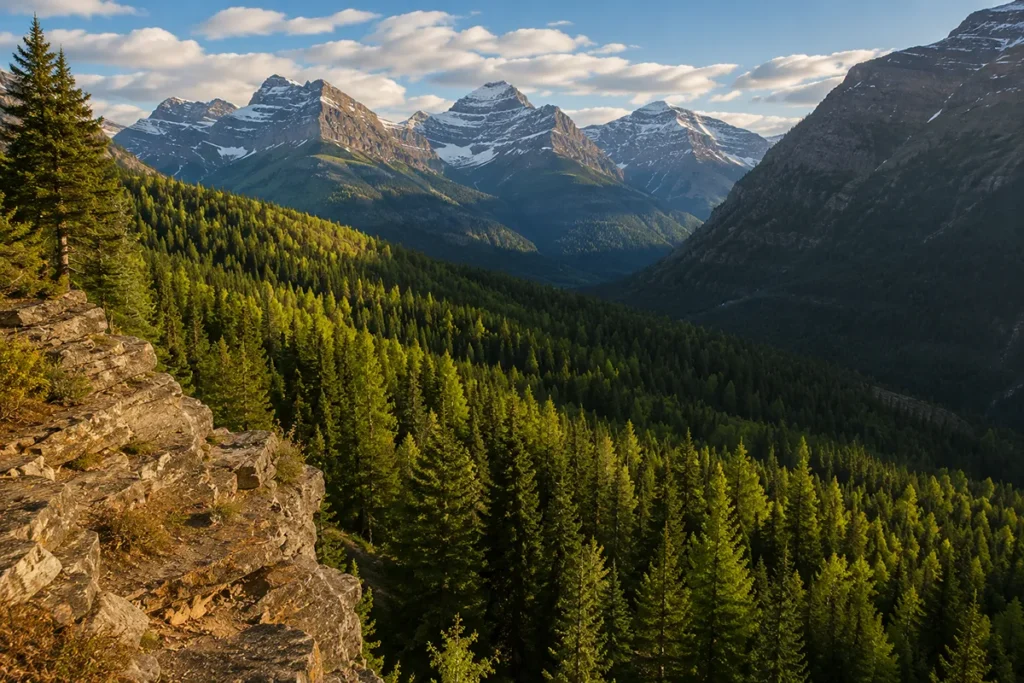
Standing on a cliff in Glacier National Park last August, I watched the morning sun illuminate a forest that cascaded down the mountainside in five distinct shades of green — each shade a different conifer species. That moment is when Montana’s “pine trees” stopped being scenery for me and became characters in a 10,000-year-old story.
If you’re planning to experience Montana nature attractions, understanding the trees around you transforms every trail from a simple walk into an immersive experience.
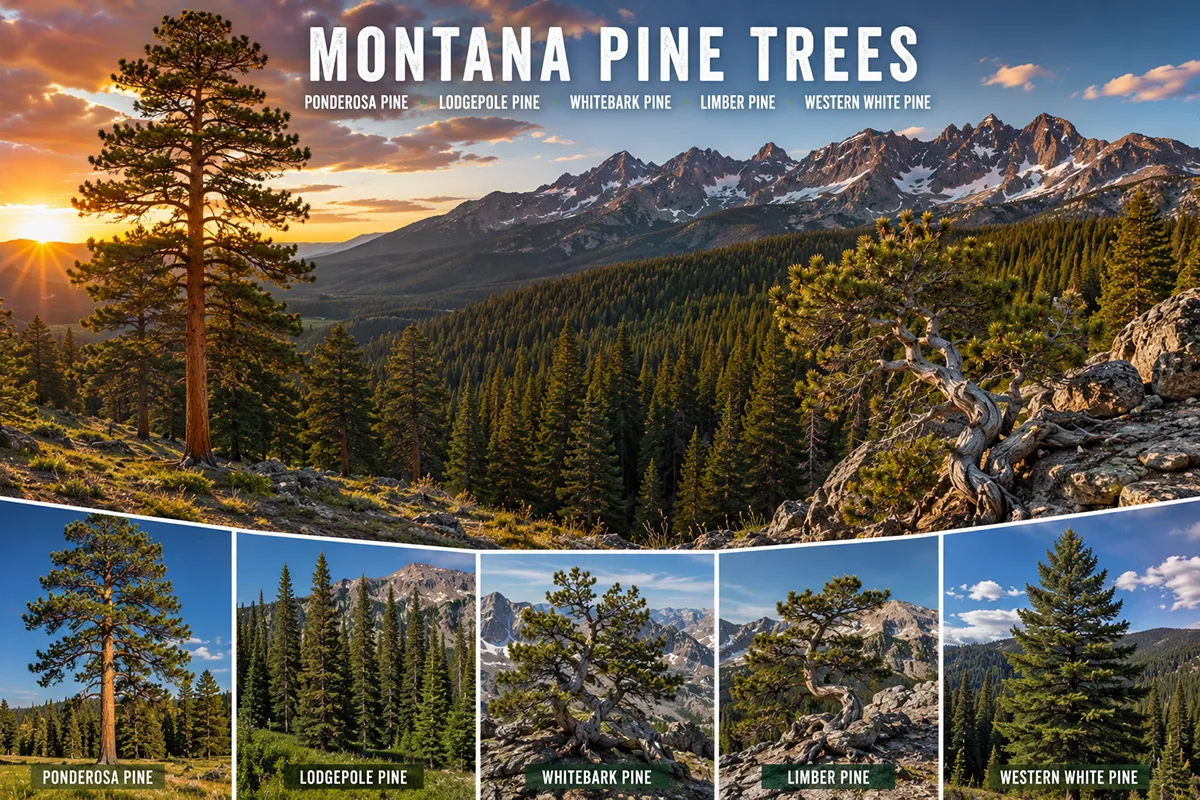
- Most people use “pine trees” loosely to describe any evergreen conifer — but in Montana that catch-all covers 5 true pines plus 10 closely related species (firs, spruces, larches, hemlock, cedar, and juniper). This guide covers all 15.
- The single most useful Montana tree to recognize is the ponderosa pine — it’s the state tree (designated 1949), its puzzle-piece orange bark smells like vanilla, and you can ID it from a moving car at 60 mph.
- Best identification windows: late May through early October. The visual highlight is late September to mid-October when western larch turns gold across northwest Montana.
- Whitebark pine was officially listed as threatened under the Endangered Species Act in December 2022 — viewing its alpine habitat now carries real conservation weight.
- Top viewing zones: Glacier National Park, the Bitterroot, the Seeley-Swan Valley, the Cabinet Mountains, and the Rocky Mountain Front.
Liked this article?
Add Roaming Montana as a preferred source so you see more of our articles and guides on Google.
Pine, Conifer, or Evergreen? A 30-Second Primer
Before diving in, the terminology trap that catches almost every visitor:
- “Conifer” = any cone-bearing tree. Covers pines, firs, spruces, larches, hemlock, cedar, juniper, yew.
- “Pine” (true pine) = the genus Pinus specifically. True pines have needles in bundles of 2, 3, or 5.
- “Evergreen” = describes any tree that keeps its leaves/needles year-round. Most conifers are evergreen, but western larch and alpine larch are notable Montana exceptions — they drop their needles every fall.
Casual usage calls all of these “pine trees.” Botanically, only 5 of Montana’s 15 conifers in this guide are true pines. The other 10 belong in the same broad family but are technically firs, spruces, larches, hemlock, cedar, or juniper.
The full guide that follows organizes them in groups so you can keep both versions of the truth straight.
Montana Conifers At a Glance
| # | Species | Needle Bundles | Cone Size | Typical Elevation | Best Viewing |
|---|---|---|---|---|---|
| 1 | Ponderosa Pine | 3 | 3–6 in | 3,000–7,000 ft | Bitterroot Valley, Missoula, Helena |
| 2 | Lodgepole Pine | 2 | 1–2 in | 5,000–9,000 ft | Yellowstone region, Lee Metcalf Wilderness |
| 3 | Whitebark Pine | 5 | 2–3 in | 7,500–10,000 ft | Logan Pass, Hidden Lake Trail |
| 4 | Limber Pine | 5 | 3–6 in | 5,500–9,000 ft | Rocky Mountain Front, Pine Butte Swamp |
| 5 | Western White Pine | 5 | 5–10 in | 2,000–6,000 ft | Cabinet Mountains, Ross Creek |
| 6 | Douglas-fir | Solo (flat) | 2–4 in | 2,000–7,000 ft | Rattlesnake Wilderness, Bob Marshall |
| 7 | Subalpine Fir | Solo (flat) | 2–4 in (upright) | 6,000–9,000 ft | Glacier NP backcountry, Bob Marshall |
| 8 | Grand Fir | Solo (flat) | 2–4 in (upright) | 1,500–5,000 ft | Kootenai, Lolo, Flathead NF |
| 9 | Engelmann Spruce | Solo (4-sided) | 1–2 in | 5,000–10,000 ft | Subalpine basins, stream corridors |
| 10 | White Spruce | Solo (4-sided) | 1–2 in | 3,000–6,000 ft | Northeastern Montana |
| 11 | Western Larch | Tufted (10–30) | 1 in | 2,000–7,000 ft | Seeley-Swan Valley, Glacier west side |
| 12 | Alpine Larch | Tufted (30–40) | 1–2 in | 6,000–9,500 ft | Anaconda-Pintler, Beartooths timberline |
| 13 | Western Red Cedar | Scale-like sprays | ½ in | 1,500–4,500 ft | Ross Creek Cedars, Kootenai NF |
| 14 | Western Hemlock | Solo (flat, short) | ½–1 in | 1,500–4,500 ft | Yaak Valley, far NW Montana |
| 15 | Rocky Mountain Juniper | Scale-like | Berry-like cones | 2,500–7,500 ft | Missouri Breaks, Billings rimrocks |
For broader context on Montana’s full tree palette (including deciduous species), see our companion guide to native Montana trees.
The 5 True Pines of Montana
These five species belong to the genus Pinus — Montana’s only botanically “true” pines.
1. Ponderosa Pine (Pinus ponderosa) — The Montana State Tree
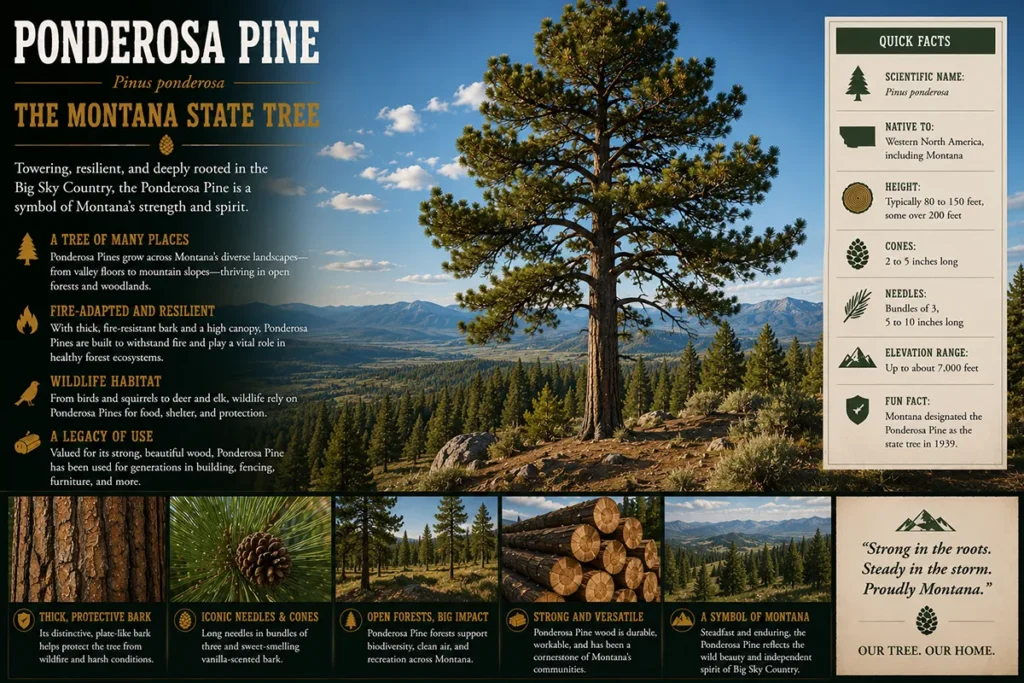
If you only learn to identify one conifer in Montana, make it the ponderosa pine. It’s the Montana state tree, designated officially in 1949 after Helena schoolchildren picked it in a statewide vote back in 1908.
It dominates the state’s lower elevations west of the Continental Divide and spills into eastern Montana along the breaks and badlands.
The bark gives them away instantly. Older ponderosas develop thick, plated bark in shades of orange, cinnamon, and yellow — patterns that look like jigsaw puzzle pieces.
The older the tree, the more orange the bark. I once spent twenty minutes photographing bark patterns on a single ancient specimen in the Bitterroot Valley.
Here’s the trick that delights everyone I share it with: press your nose into the bark crevices of a sun-warmed ponderosa. The scent is unmistakably vanilla or butterscotch. On hot summer afternoons, you can sometimes catch the aroma from several feet away.
Needles: 3 per bundle, 5–10 inches long.
Cones: 3–6 inches, prickly to the touch.
Best viewing: the Blackfoot-Clearwater Wildlife Management Area off Highway 200, the lower Missoula trails, and the open ponderosa savannas around Helena.
For the full state-symbol story, see Montana state symbols.
2. Lodgepole Pine (Pinus contorta)
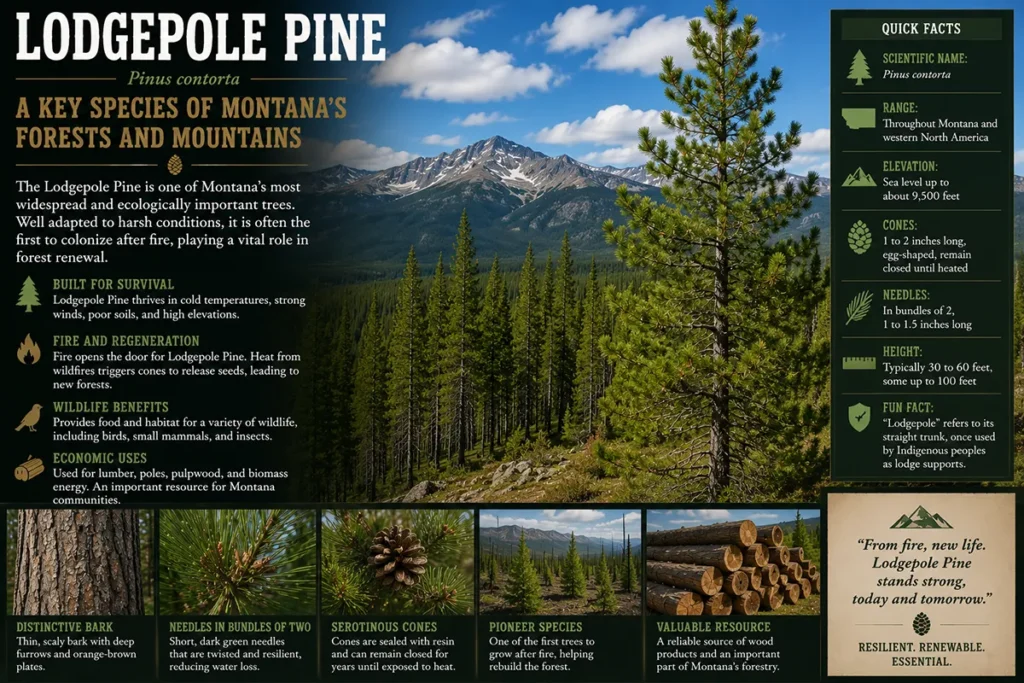
Drive through Yellowstone country or hike almost any mid-elevation trail in Montana and you’ll walk through lodgepole pine forests. These are the trees that form dense, uniform stands — sometimes called “dog-hair” forests because the trunks grow so close together.
Backpacking through the Lee Metcalf Wilderness one July, lodgepole dominated probably 70% of my route between 6,000 and 8,000 feet. Their straight trunks and modest stature (rarely exceeding 80 feet) made off-trail navigation easy.
The name comes from their historic use by Plains tribes for tipi poles — their uniform straight growth was ideal. You can still see preserved lodgepole structures at the Museum of the Plains Indian in Browning.
One adaptation worth knowing: many lodgepole cones are serotinous, meaning they’re sealed with resin and only open after fire.
Walk through any post-fire lodgepole regeneration zone and you’ll see this adaptation in action — thousands of young trees sprouting in unison.
For broader context on what fire does in these forests, see our Montana wildfires overview.
Needles: 2 per bundle, 1–3 inches, often twisted.
Cones: 1–2 inches, lopsided, often persistent on the tree for decades.
3. Whitebark Pine (Pinus albicaulis) — Threatened, Iconic
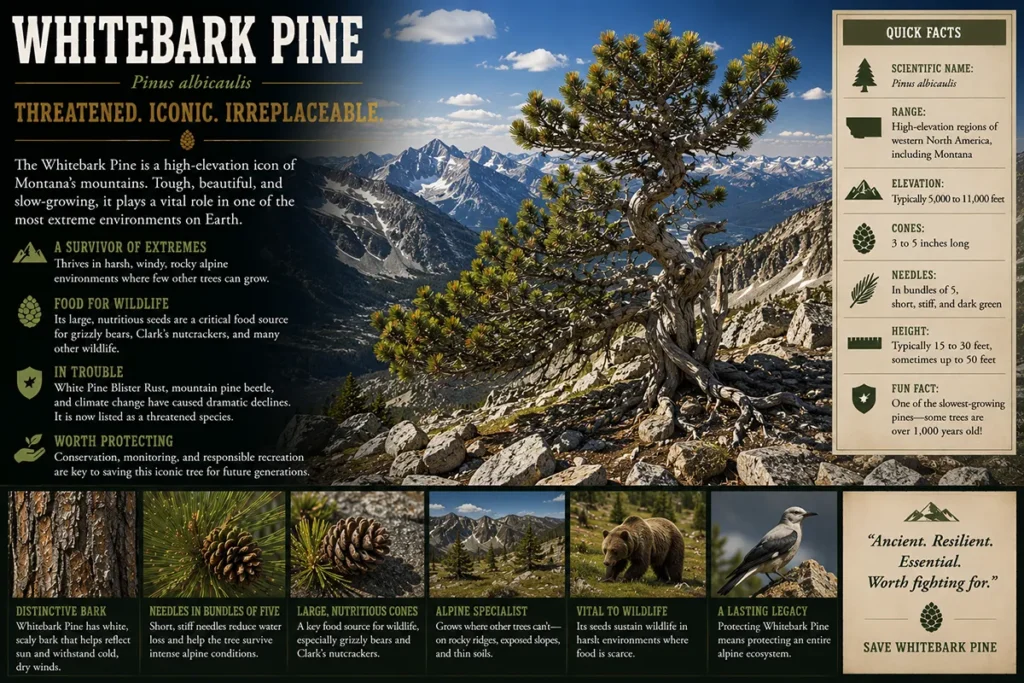
This high-elevation specialist holds a special place in my heart because finding them requires effort. They grow near timberline, typically above 7,500 feet. Every whitebark pine I’ve encountered has felt earned.
During a hike to Pitamakan Pass in Glacier National Park, I reached a ridge where gnarled, wind-twisted whitebark pines clung to exposed rocky slopes. Some were clearly centuries old, their forms sculpted by mountain winds into natural bonsai.
In December 2022, whitebark pine was officially listed as threatened under the Endangered Species Act — the first widely distributed tree to receive that protection.
A combination of white pine blister rust (an introduced European fungal disease), mountain pine beetle outbreaks, and climate change has killed huge numbers across the species’ range.
Their large, nutritious seeds are critical food for Clark’s nutcrackers and grizzly bears — the nutcracker is in fact the primary seed disperser, caching seeds in soil where some sprout into the next generation.
The whole ecosystem rides on this single relationship. See our Montana bear guide and Montana bird species for more.
Best viewing: alpine areas of Glacier along Going-to-the-Sun Road, especially the Hidden Lake Trail from Logan Pass. For the broader Glacier hiking landscape, see our best hikes in Glacier National Park.
4. Limber Pine (Pinus flexilis)
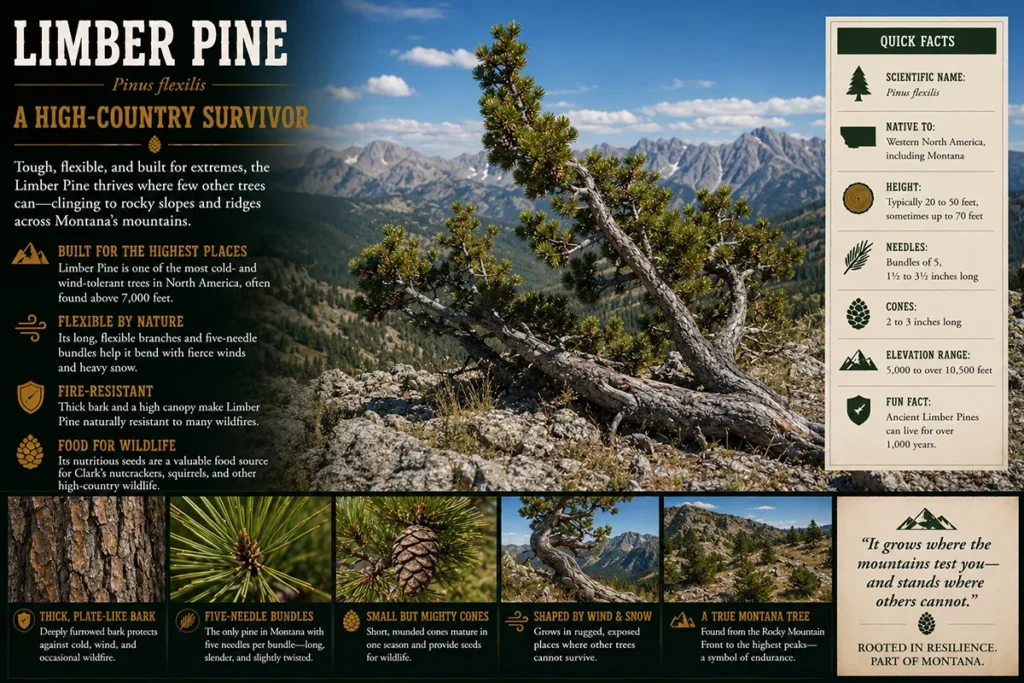
The limber pine earns its name from remarkably flexible young branches — you can bend them into complete circles without breaking.
I discovered this firsthand during a wind-battered hike along the Rocky Mountain Front near Choteau, where limber pines grow on exposed ridges that would destroy more rigid species.
These five-needle pines occupy the ecological niche between the lower ponderosa zone and the higher whitebark zone.
In Montana they’re most common along the eastern slopes of the Continental Divide — places like the Pine Butte Swamp Preserve and the broader Rocky Mountain Front.
Needles: 5 per bundle, 1.5–3 inches.
Cones: 3–6 inches.
5. Western White Pine (Pinus monticola)
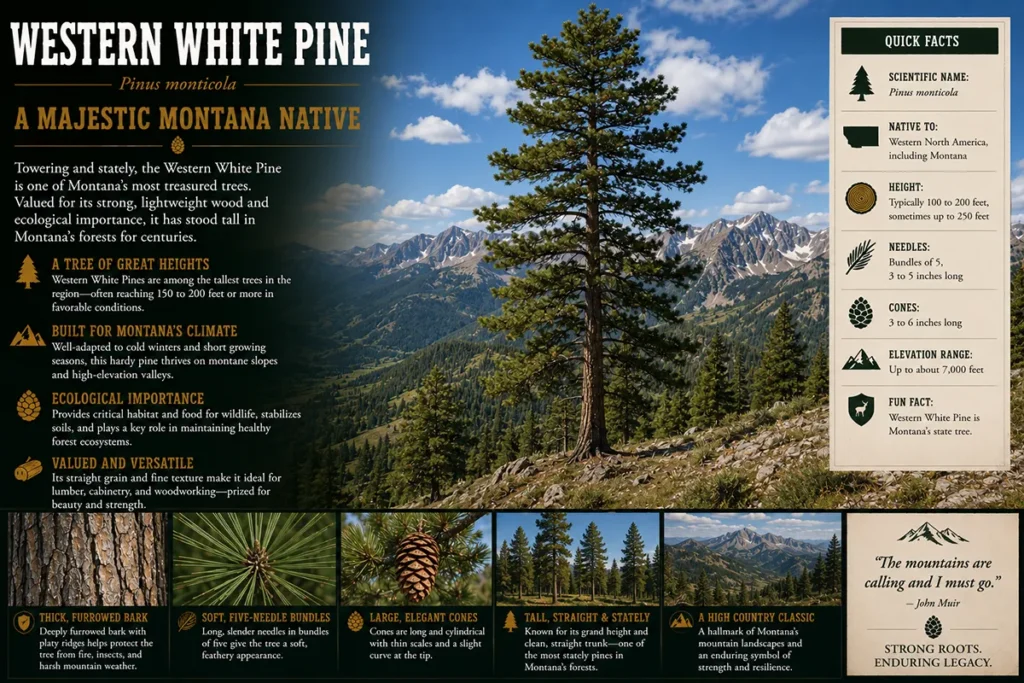
The king of Montana pines in terms of size. Individual western white pines have historically reached 200 feet tall with trunks over six feet in diameter.
White pine blister rust devastated the species through the 20th century, but restoration with rust-resistant seedlings is slowly paying off.
The best surviving stands are in the Cabinet Mountains Wilderness and Kootenai National Forest. The Ross Creek Giant Cedars Scenic Area near Troy, famous for its cedars, also contains impressive white pines in the surrounding forest.
The drive from Libby is one of Montana’s best half-day outings if old-growth conifer is what you came for.
Needles: 5 per bundle, 2–4 inches.
Cones: 5–10 inches long — the longest of any Montana pine.
The Firs (and the Tree That Isn’t a Fir)
6. Douglas-fir (Pseudotsuga menziesii)
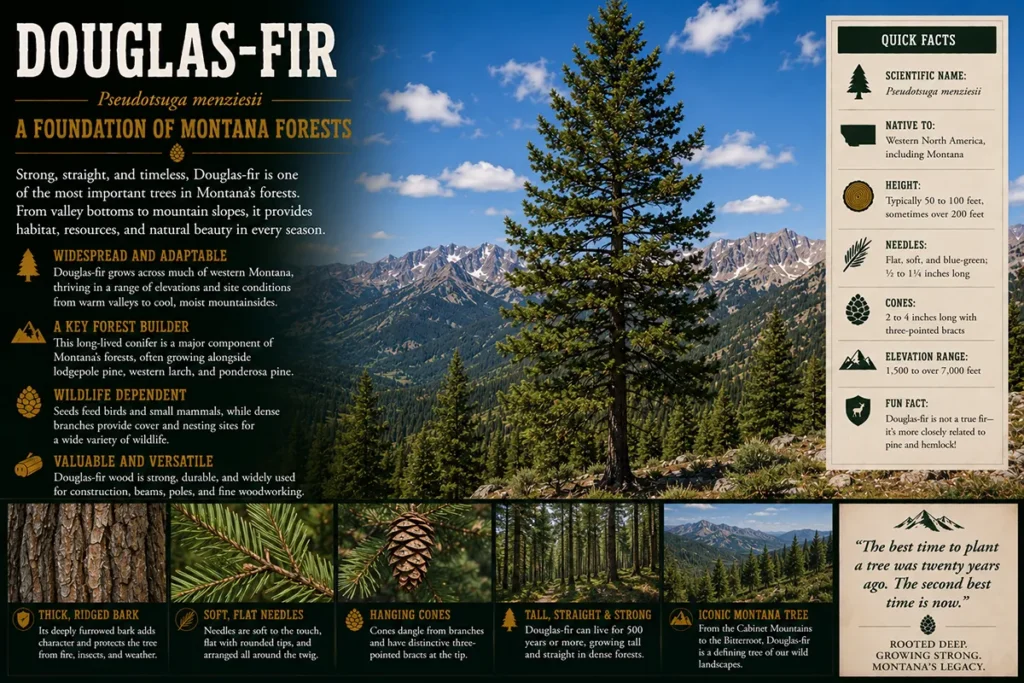
Here’s where botanical naming gets fun: Douglas-fir is not a true fir. It’s not a pine, spruce, or hemlock either — it has its own genus (Pseudotsuga, “false hemlock”). The hyphen in “Douglas-fir” is intentional and tells you it’s a category-defier.
The single most reliable ID is the cone. Douglas-fir cones have three-pointed bracts protruding between the scales — an old forestry mnemonic describes these as resembling “the hind feet and tails of mice hiding from a cat.” Once you see it you cannot unsee it.
Douglas-fir is one of Montana’s most economically important timber species and lives 500+ years in protected old-growth stands. Mature stands in the Rattlesnake Wilderness near Missoula have that cathedral quality — massive trunks supporting a high canopy that filters light into green-gold beams.
7. Subalpine Fir (Abies lasiocarpa)
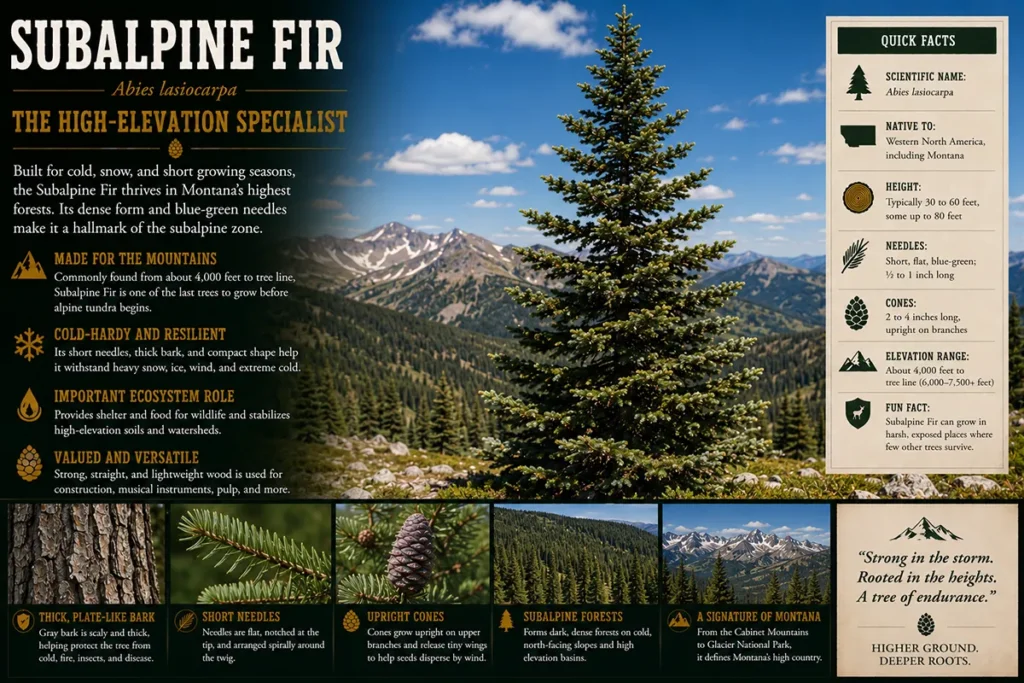
The classic Christmas-tree silhouette of Montana’s high country — narrow, spire-shaped crowns that resolve into needle-thin tops. Subalpine fir dominates the zone just below timberline between roughly 6,000 and 9,000 feet.
Touch the bark and you’ll find resin blisters — small pockets of sticky, aromatic pitch. Their needles are soft, flat, curve gently upward, and smell distinctly resinous when crushed. Cones grow upright on the branches (a fir trait) and disintegrate on the tree rather than falling whole.
Best viewing: any subalpine basin in Glacier National Park, the Bob Marshall, or the Beartooths above ~7,000 feet.
8. Grand Fir (Abies grandis)
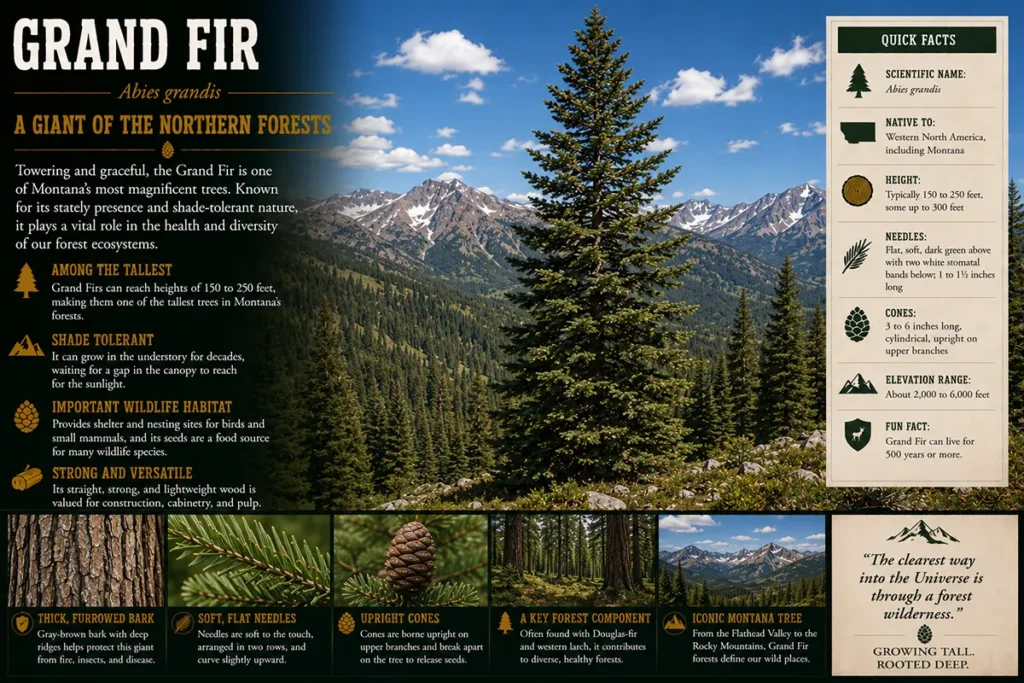
Western Montana’s moister climates support grand fir, which lives up to its name with specimens reaching 200+ feet. The needles are notably flat and shiny, arranged in two distinct rows on either side of the twig like comb teeth.
Grand fir has the most pleasant scent of any Montana conifer, in my opinion. Crush a needle and you’ll get a citrusy, fresh fragrance — nothing like the standard “pine” smell.
Best viewing: the wet forests of the Kootenai, Lolo, and Flathead National Forests, often alongside western red cedar and western hemlock.
The Spruces
9. Engelmann Spruce (Picea engelmannii)
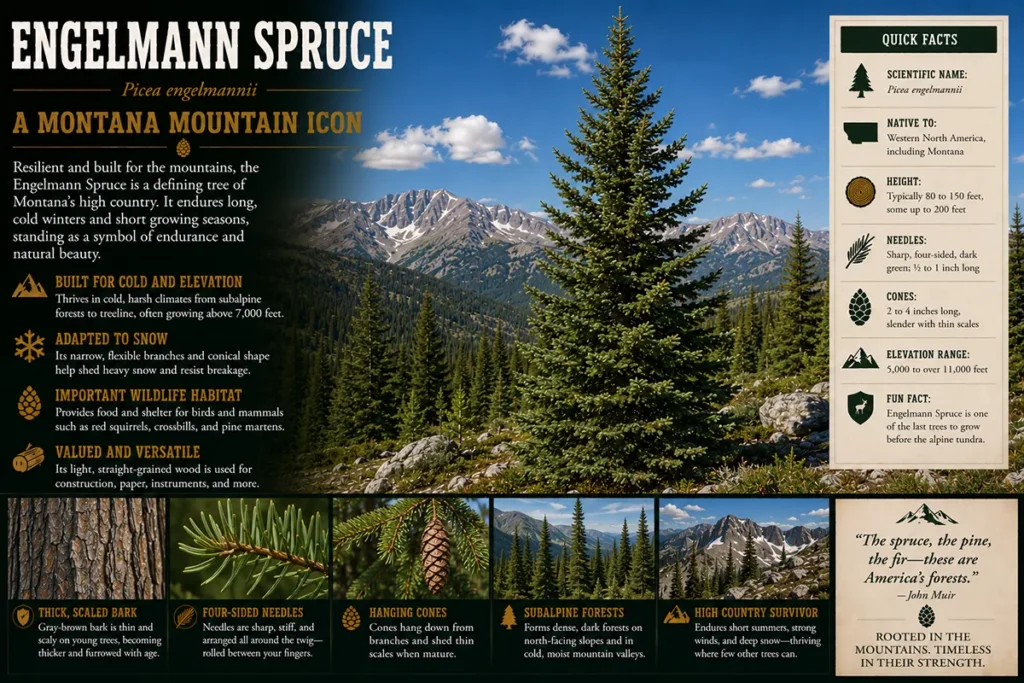
If you hike Montana’s high-country streams and wet subalpine basins, you encounter Engelmann spruce constantly. They thrive in cold, moist conditions that stress other species.
The simple field trick: spruce needles are four-sided and roll between your fingers (firs are flat and don’t roll). They’re also sharp — grab a spruce branch carelessly and you’ll understand why foresters call them “prickly spruces.”
Engelmann spruce wood has remarkable acoustic properties, and instrument makers prize it for guitar tops and violin bellies. Some of the best tonewood in the world is harvested in northwest Montana.
10. White Spruce (Picea glauca) — The Eastern Montana Native
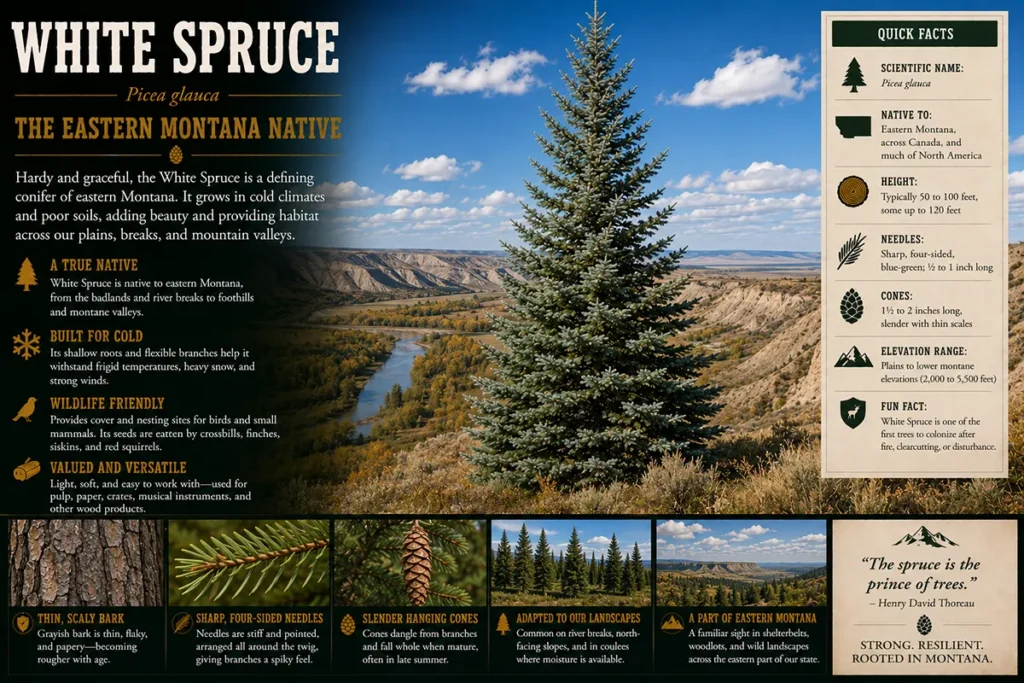
Most Montana tree guides miss this one entirely. White spruce ranges into northeastern Montana from the Canadian boreal forest, occurring in pockets along streams and northeast-facing slopes.
It’s not as common as Engelmann spruce statewide, but it’s reliably present in the northeast corner of the state — places most travel guides don’t bother covering.
White spruce needles are 4-sided like Engelmann’s but the cones are shorter and the tree grows in lower-elevation, more open conditions.
A note on blue spruce: Colorado blue spruce (Picea pungens) is widely planted as an ornamental across Montana parks, cemeteries, and front yards, and there’s a small native population in the extreme southwestern corner of the state. But it’s nowhere near as ecologically significant in Montana as either Engelmann or white spruce.
The Larches — Montana’s Deciduous Conifers
Two species, both native, both shed needles in fall. This is the only group of Montana conifers that goes bare for winter.
11. Western Larch (Larix occidentalis)
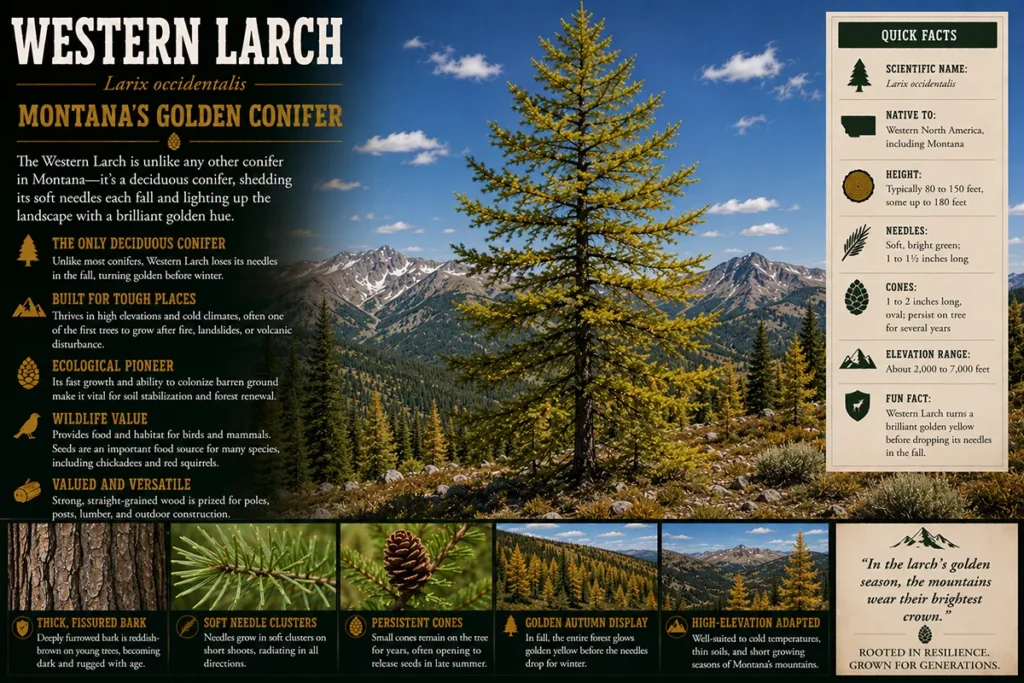
Montana’s most surprising tree — a conifer that drops its needles every fall. First-time visitors sometimes worry the trees are dying in late October. They’re not. They’re announcing one of the most underrated autumn spectacles in the American West.
The Seeley Lake area offers the most accessible western larch viewing along Highway 83 in late September through mid-October.
The Forest Service’s “Larch Walk” interpretive trail near Seeley Lake features individual giants over 1,000 years old — one specimen known as “Gus” stands 162 feet tall with a trunk diameter over 7 feet, making it the largest known western larch in the world.
Larch needles grow in distinctive tufted clusters on short spur shoots (10–30 needles per cluster), making identification easy any time of year. Even in winter, those stubby spurs are visible on the bare branches.
For trip planning around fall larch season, see Montana in September and Montana in October.
12. Alpine Larch (Larix lyallii) — The High-Country Hidden Gem
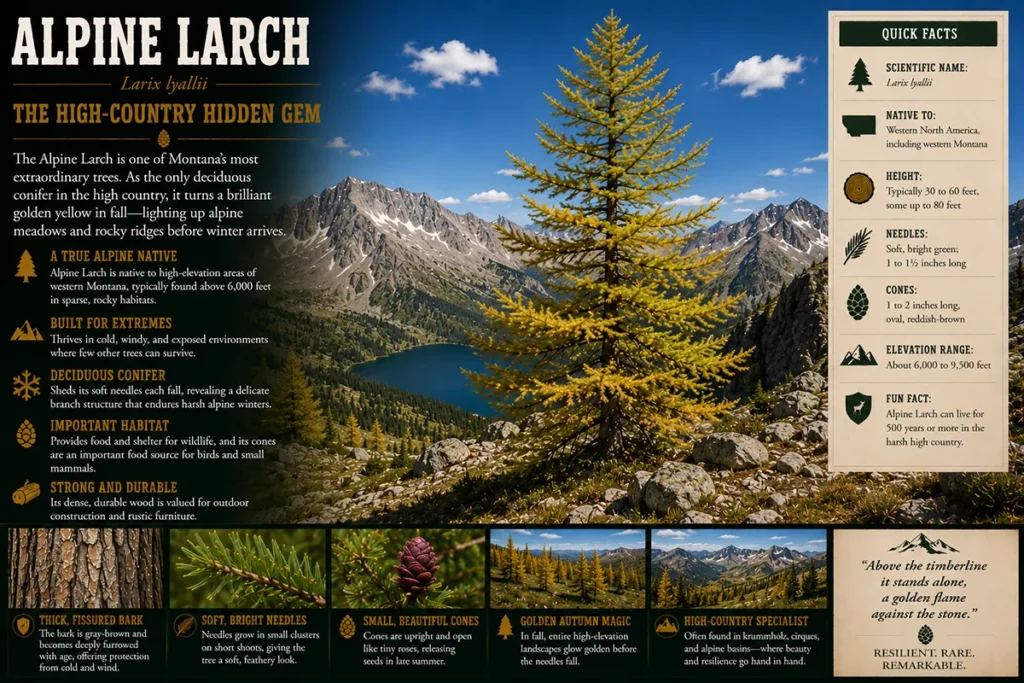
This is the species nearly every other Montana tree guide misses. Alpine larch grows only at and just above timberline, between roughly 6,000 and 9,500 feet — far higher than western larch. The needles cluster in even denser tufts (30–40 per spur) and the twigs are noticeably hairy under a hand lens.
Alpine larch is found in pockets of the Anaconda-Pintler Wilderness, the Beartooth Plateau, and select parts of the Bitterroot Range.
Reaching them requires real backcountry hiking, but in late September the gold of alpine larch against early snow is one of the most beautiful sights in Montana — and almost nobody knows to look for it.
The Cedar, the Hemlock, and the Juniper
13. Western Red Cedar (Thuja plicata)
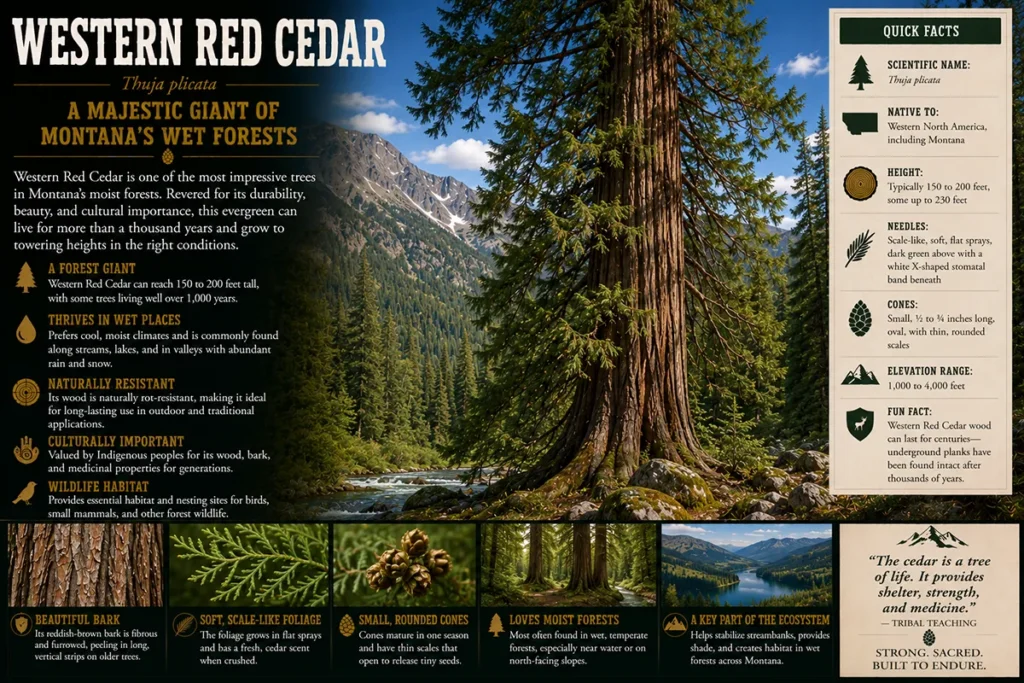
Montana sits at the eastern edge of western red cedar’s range, but the populations here are spectacular. These giants thrive in the state’s moist northwestern valleys, where some specimens exceed 1,000 years in age.
The Ross Creek Giant Cedars Scenic Area near Troy contains the most accessible old-growth cedar grove in Montana. The interpretive trail there passes trees over 12 feet in diameter — trunks so massive that without a wide-angle lens you can’t photograph them from inside 50 feet.
Cedar bark is stringy and fibrous, traditionally used by Indigenous peoples for rope, baskets, and clothing. The foliage grows in flat, scale-like sprays rather than needles. The scent is distinctive and long-lasting.
14. Western Hemlock (Tsuga heterophylla) — Montana’s Pacific Outpost
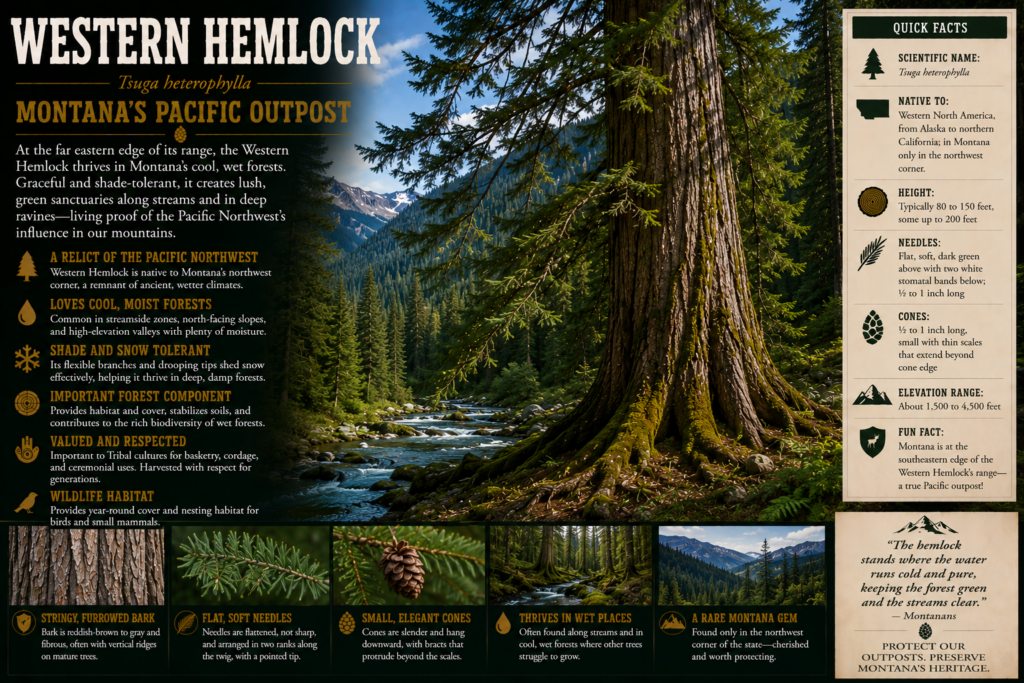
Western hemlock barely reaches Montana — only the extreme northwest corner around the Yaak Valley and the Kootenai National Forest has it. This is the easternmost outpost of a Pacific Northwest forest type that more famously dominates coastal Washington and the Olympic Peninsula.
The species is identifiable by its drooping leader (the topmost shoot), short flat needles of variable length on each twig, and small egg-shaped cones less than an inch long.
If you see a tall, lacy-looking conifer with a nodding top in far northwest Montana, it’s almost certainly western hemlock — and seeing it there means you’ve effectively walked into a sliver of Pacific Northwest rainforest 500 miles inland.
15. Rocky Mountain Juniper (Juniperus scopulorum)
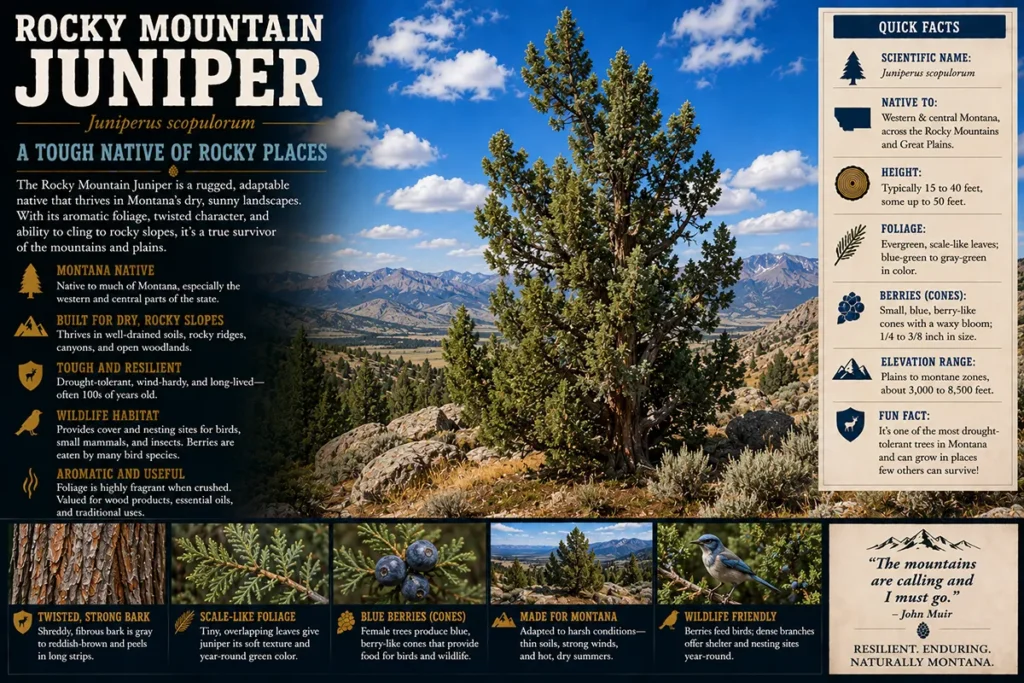
Montana’s only native juniper species thrives in conditions too harsh for other conifers — dry hillsides, rocky outcrops, and windswept ridges. They’re especially common in eastern Montana’s breaks and badlands.
Junipers in the Missouri Breaks cling to eroded cliff faces, their exposed roots gripping crumbling sandstone. Some specimens are barely six feet tall but clearly ancient — gnarled, weathered survivors.
The blue-gray “berries” (technically fleshy cones) give gin its distinctive flavor and provide critical winter food for cedar waxwings and other birds. For accessible juniper viewing, the rimrocks around Bozeman, Billings, Great Falls, and Helena all support extensive populations.
How to Identify Montana Conifers in 30 Seconds
After a few thousand miles in Montana forests, this is the mental flowchart I actually use:
- Are the needles in bundles, or attached singly to the twig?
- Bundles → true pine (genus Pinus) or larch. Go to step 2.
- Singly → fir, Douglas-fir, spruce, or hemlock. Go to step 3.
- Scale-like (not needles at all) → cedar or juniper. Go to step 4.
- How many needles per bundle?
- 2 → Lodgepole pine
- 3 → Ponderosa pine (and bark like orange puzzle pieces)
- 5 → Whitebark, limber, or western white pine — distinguish by elevation and cone size
- 10+ per spur shoot → Larch (deciduous, gold in fall)
- Roll a needle between your fingers.
- Sharp, 4-sided, rolls easily → spruce
- Flat, won’t roll → fir, Douglas-fir, or hemlock. Look at the cone:
- “Mouse-tail” bracts sticking out → Douglas-fir
- Upright cones that fall apart on the tree → true fir (subalpine or grand)
- Tiny ½–1-inch cones, drooping leader at top of tree → western hemlock
- Scale-like foliage?
- Flat sprays of scales, massive trunk → western red cedar
- Tighter scales, blue-gray berries → Rocky Mountain juniper
That’s it. With practice this becomes second nature within a week of paying attention on trails.
Best Seasons for Tree Exploration
Late May through early July: Fresh needle growth, brightest colors. Pollen season can be intense — I’ve seen yellow pollen coating everything near lodgepole stands. See best time to visit Montana for broader seasonal context.
July and August: Peak hiking season. The only window for reliable high-country whitebark pine and alpine larch access. Cones are developing but not mature.
Late September through mid-October: Mature cones on the ground for easy examination, western larch gold show across the Seeley-Swan, and crisp temperatures that make lower-elevation tree-hunting genuinely pleasant. This is my favorite tree-spotting window of the year.
November through April: Surprisingly valuable. Tree shapes and bark become more prominent without distracting foliage. Snowshoeing through conifer forests offers a unique perspective on bark and silhouette.
Practical Tips From Years on the Trail
Carry a 10x hand lens. Costs under $10 online and lets you examine needle cross-sections, cone scales, and bark textures in detail. I keep one on my keychain.
Count needle bundles first. It’s the single most diagnostic feature for true pines and rules out three-quarters of possibilities in five seconds.
Use elevation to narrow your options. Above 8,000 feet → no ponderosa. Below 5,000 feet → no whitebark or alpine larch. Above 6,000 feet on the Continental Divide → look for subalpine fir and Engelmann spruce together.
Photograph what confuses you. I keep a “mystery trees” album on my phone for later review against field guides. Half the time, the issue resolves the moment I see the photo at home.
Smell the bark of a sun-warmed ponderosa. Vanilla. Once.
Conservation Concerns You Should Know About
Montana’s conifer forests face significant pressure from climate change, introduced diseases, and insect outbreaks. As visitors, the most useful thing you can do is follow Leave No Trace principles and avoid transporting firewood between regions — beetles and diseases hitchhike inside dead wood. Buy firewood local to where you’re camping.
White pine blister rust affects all five-needle pines — whitebark, limber, and western white. The disease was accidentally introduced from Europe in the early 1900s on infected nursery stock. Today, geneticists are working to identify and propagate rust-resistant individuals.
Mountain pine beetle outbreaks have killed millions of acres of lodgepole and ponderosa pine across Montana. The standing red-and-gray patches you see from highways are partly natural beetle dynamics intensified by warmer winters that no longer kill back beetle populations the way they once did.
For broader fire and forest ecology context, see our Montana fire history overview.
Where to Learn More on the Ground
Montana’s Forest Service ranger districts run free interpretive programs and guided nature walks during summer months — the Spotted Bear Ranger District (Flathead NF) and the Superior Ranger District (Lolo NF) both run excellent programs.
The Montana Natural Heritage Program’s field guide at fieldguide.mt.gov maintains detailed species accounts and distribution maps online — the best free resource for serious tree identification in the state.
For hands-on learning, the University of Montana’s Lubrecht Experimental Forest near Missoula offers public programs and a labeled demonstration forest.
For more places where trees, wildlife, and landscape come together as a single experience, see our Montana nature attractions, beautiful places in Montana, and Montana wildlife refuges guides.
A Final Thought
I’ve stood in Montana’s conifer forests more times than I can count, looked up at the canopy, and felt genuinely humbled by these organisms.
Some of the ponderosas I’ve leaned against were already old when Lewis and Clark passed through. Some whitebark pines were seedlings when Shakespeare was writing plays. The cedars in Ross Creek were growing during the fall of the Roman Empire.
Understanding the 15 species in this guide will transform how you experience a Montana hike. A simple trail becomes a walk through ecological zones. A scenic drive becomes a rolling field guide. A campsite becomes a specific community of species, each adapted to that exact spot over thousands of years.
Bring a hand lens, count some needles, smell some bark, and discover a forest that’s far more varied than “a bunch of pine trees.”
Frequently Asked Questions
How many pine tree species are native to Montana?
Five species are true pines (genus Pinus): ponderosa, lodgepole, whitebark, limber, and western white. If you broaden “pine tree” to include the other conifers most people loosely call pines, Montana has 15 native species in this guide — adding Douglas-fir, two true firs, two spruces, two larches, western red cedar, western hemlock, and Rocky Mountain juniper.
What is the Montana state tree?
The ponderosa pine (Pinus ponderosa). It was officially designated as Montana’s state tree in 1949, though Helena schoolchildren had already selected it in a 1908 statewide vote.
How can I tell pine trees apart in Montana while hiking?
The single fastest field method is counting needles per bundle. Lodgepole pine has 2 needles per bundle, ponderosa has 3, and the five-needle pines (whitebark, limber, western white) have 5. After that, elevation and cone size resolve almost every remaining question — see the comparison table earlier in this guide.
Where can I see old-growth pine and conifer forests in Montana?
The most accessible old-growth groves are the Ross Creek Giant Cedars Scenic Area near Troy (1,000+ year-old cedars), the Seeley-Swan Valley (including the world’s largest western larch), the Rattlesnake Wilderness near Missoula (mature Douglas-fir), and the west side of Glacier National Park (mixed old-growth).
Are there any endangered pine trees in Montana?
Yes. Whitebark pine was officially listed as threatened under the Endangered Species Act in December 2022 — the first widely distributed tree species to receive that protection. Its alpine habitat in Glacier National Park, the Beartooths, and other high ranges is increasingly important for both conservation and visitor education.
When is the best time to see western larch turn gold?
Late September through mid-October, with peak color usually in the first two weeks of October. The Seeley-Swan Valley along Highway 83 is the most accessible viewing corridor. Glacier’s west side and the lower Kootenai drainages also light up in the same window.
What’s the difference between Douglas-fir and a true fir?
Douglas-fir belongs to its own genus (Pseudotsuga) — it’s not technically a fir at all. The hyphen in “Douglas-fir” is intentional and signals the category problem. The easiest field difference is the cone: Douglas-fir cones have visible three-pointed bracts (“mouse tails”) sticking out between the scales, while true fir cones (subalpine fir, grand fir) sit upright on the branch and fall apart on the tree rather than dropping intact.
Why are so many lodgepole pines dead and red in Montana?
Mountain pine beetle outbreaks over the past two decades have killed millions of acres of lodgepole pine. The red and gray patches you see from highways are the visible aftermath. The outbreaks are partly natural but intensified by warmer winters that no longer kill back beetle populations the way historical Montana winters did.
Do any Montana conifers drop their needles in fall?
Yes — Montana has two native deciduous conifers, both larches: western larch at lower and middle elevations, and alpine larch at and above timberline. Both turn brilliant gold in fall before dropping their needles entirely for winter, then grow fresh needles each spring.
Sources