

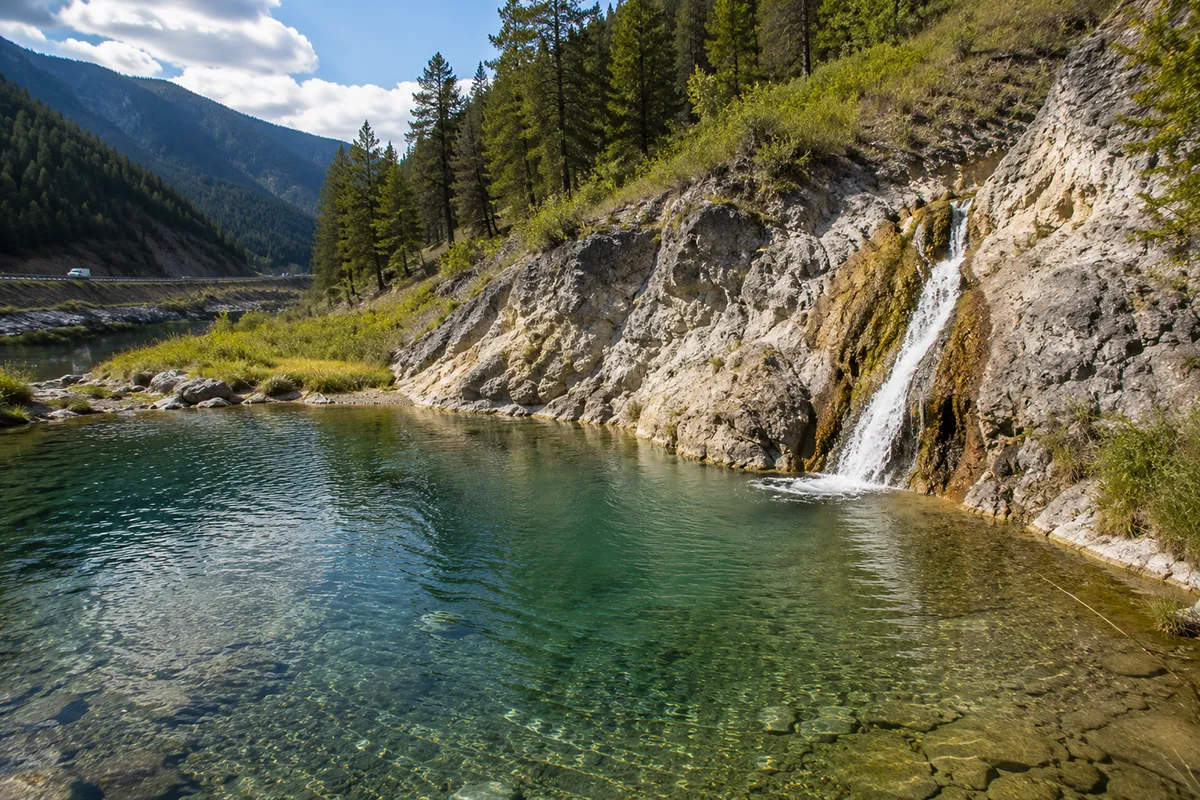
The first time I scrambled down to Nimrod Hot Springs and saw that turquoise pool tucked into the canyon wall — interstate traffic humming half a mile behind me, the Clark Fork River winding past below — I understood why locals have been quietly visiting this spot for generations.
It’s not a remote wilderness soak. It’s not even a hot soak in the traditional sense. But it is one of the strangest, prettiest, and most accessible natural pools in western Montana.
Among all the Montana hot springs I’ve explored over the years, few have left such a lasting impression of genuine wilderness immersion.
- Nimrod Hot Springs is a free, primitive natural pool on private land near Bryne, Montana — just off I-90 Exit 138 (Bearmouth), about 35–40 miles east of Missoula along the Clark Fork River.
- It’s a deep turquoise pool in a rock formation, not a wooden soaking box. Water temperature is around 70°F (21°C) — closer to a swimming hole than a “hot” spring.
- The pool is deep enough for cliff jumping, and has a small underwater cave below the rocks that experienced swimmers explore.
- Access is easy: any standard car can reach the parking pullout, followed by a ~½-mile walk along the river side of I-90.
- The springs sit on private land owned by the Czorny family. Access has been tolerated for decades but is at risk if visitors trash the area. Pack out everything.
- Best months: late June through September, when air temperatures make the cool water feel refreshing rather than chilly.
Liked this article?
Add Roaming Montana as a preferred source so you see more of our articles and guides on Google.
A Note on the Confusion Around Nimrod
If you’ve been researching Nimrod Hot Springs online, you may have encountered conflicting information about where it is. Some sources describe it as a remote backcountry hot spring near Ovando, off Highway 200, requiring 4WD and a long forest-road drive.
That’s not this place. That description belongs to a different (and largely fictional) location. Real Nimrod Hot Springs is the natural pool along the Clark Fork River described in this guide — accessible from I-90, reachable in any car, and characterized by clear blue water that’s cool enough to swim in rather than soak.
I’m being explicit about this because the geography matters: following the wrong directions sends visitors over an hour in the wrong direction. The details below are the verified, real ones.
What Nimrod Hot Springs Actually Is
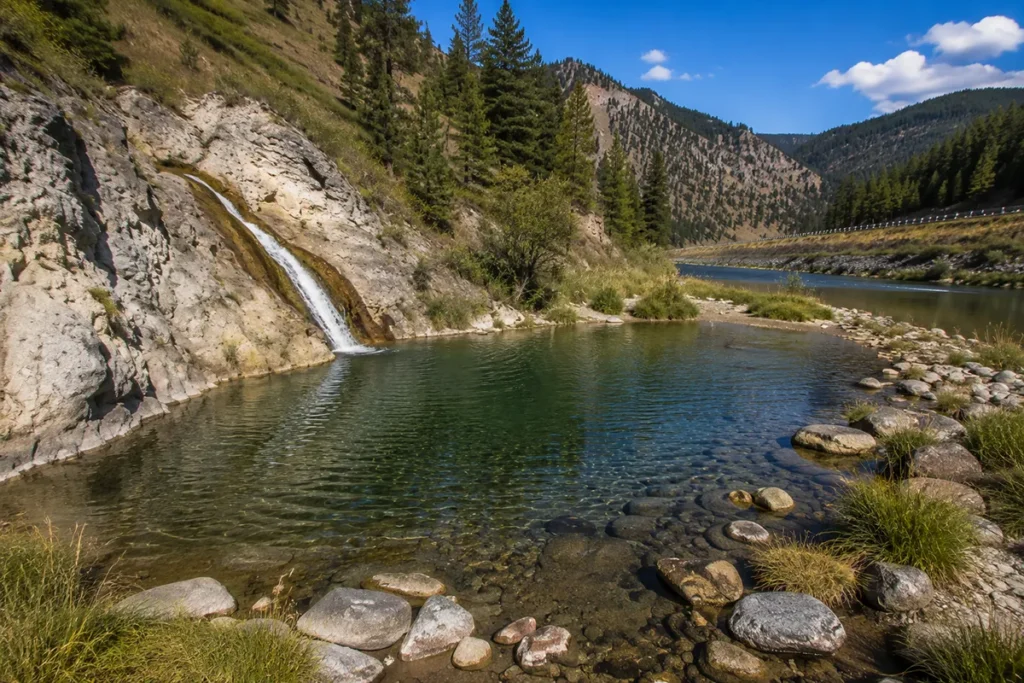
Nimrod Hot Springs isn’t a hot spring in the conventional sense. The water temperature hovers around 70°F (21°C) year-round — geothermally warmed enough to stay liquid through winter, but cool enough that most visitors come here to swim, not to soak.
What you actually get when you arrive:
- A large, deep natural pool at the base of a tan rock formation
- Crystal-clear turquoise water that reveals how deep the pool actually is
- A small underwater cave at the bottom of the rocks that experienced swimmers can free-dive into (a rope helps with the climb back out)
- A rock cascade where the thermal water flows down into the pool
- The Clark Fork River running just below the pool’s elevation
- Canyon walls and pine trees framing the scene
This is closer to Montana’s natural swimming holes than to a Bozeman-style developed soaking pool. If you arrive expecting a hot soak, you’ll be cold. If you arrive expecting a stunning swimming hole, you’ll be delighted.
For travelers looking for actual hot soaks, see our hub guide to Montana hot springs or the best natural hot springs in Montana roundup.
Where Nimrod Hot Springs Is Located
The springs are near the unincorporated community of Bryne, Montana (sometimes referenced by the nearby Bearmouth highway exit), along the Clark Fork River. The location sits between Missoula and Drummond on Interstate 90.
Approximate coordinates: 46.705° N, -113.457° W
Closest cities:
- Missoula — about 35–40 miles west (35–45 minute drive)
- Drummond — about 15 miles east
- Helena — about 90 miles east
The pool is on private land owned by the Czorny family, and the surrounding area includes Lolo National Forest land. Public access has been tolerated for decades, but the family has openly considered closing access due to trash and disrespect from visitors. Treating this place well is non-negotiable.
How to Get There — Step-by-Step Directions From Missoula
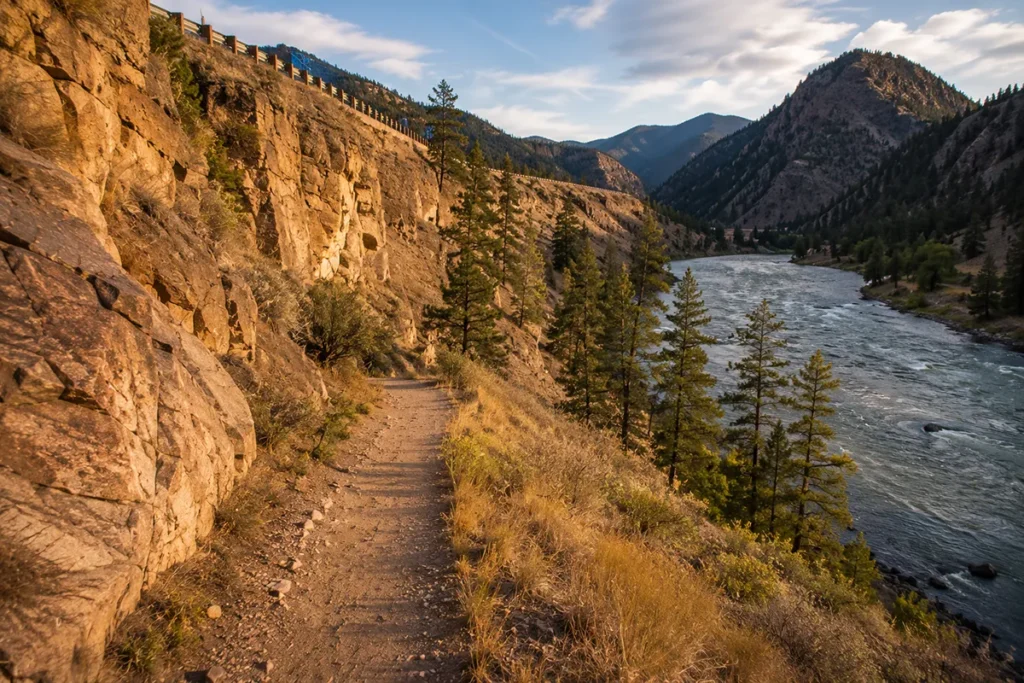
These are the directions actual visitors use:
- From Missoula, head east on Interstate 90.
- Take Exit 138 (Bearmouth).
- After exiting, head north (cross over the interstate if needed) and turn onto Drummond Frontage Road.
- Watch for a “Fishing Access” sign and turn left at it.
- Continue a short distance — within about 1,500 feet you’ll find a small parking area / pullout, often marked by a berm at the end of the dirt road.
- From the parking area, walk west on foot, paralleling the highway, for approximately half a mile. The walk is flat and easy.
- At the end, duck under a fence — this is the access point regulars have used for years. You’ll see the pool below you.
Don’t park along I-90 itself. Cars left on the interstate shoulder routinely get ticketed or towed. The legal parking is at the Fishing Access pullout described above.
Driving from Drummond: Take I-90 west to the same Exit 138 (Bearmouth), then follow the same directions from step 3 onward. Allow about 20 minutes from Drummond.
Vehicle and Access Reality
Unlike many primitive Montana hot springs, Nimrod requires no special vehicle. A regular sedan handles the route fine. You don’t need 4WD, high clearance, or any backcountry driving experience.
The challenging part isn’t the drive — it’s the unmarked nature of the access and the responsibility that comes with visiting private land informally. Bring proper footwear for the walk (the half-mile path is dirt and gravel along the railroad and highway shoulder), and be prepared for the lack of facilities at the pool itself.
The Pool, the Cliff Jump, and the Underwater Cave
The Nimrod pool is genuinely unusual among Montana’s geothermal features. Three things make it stand out.
The Pool Itself
The main pool is large, deep, and consistently clear. The turquoise color comes from the mineral content and depth — the bottom drops sharply enough that you can’t easily walk across the pool. Most visitors enter from the rocks along the canyon side and swim across.
The water flows through a rock cascade from the source spring uphill, which keeps it gently moving and helps maintain the clarity. There’s no algae buildup, no mossy surfaces — just clean, cold-warm water in a striking natural setting.
Cliff Jumping
The depth of the pool makes Nimrod one of the few Montana hot springs where cliff jumping is part of the experience. The rock formations around the pool offer multiple jump heights, from a modest 6-foot ledge to higher drops experienced jumpers use.
Important safety notes:
- Always check the depth before jumping. Water levels fluctuate seasonally — what’s safe in July may not be safe in late September.
- Look for submerged rocks or debris.
- Don’t jump alone. There’s no cell service for emergencies.
- If you’re not confident in your swimming abilities, don’t jump. The cold water can shock even strong swimmers.
The Underwater Cave
This is the feature most visitors don’t know about until they arrive. Below the rocks at one end of the pool is a small underwater cave. Experienced swimmers can free-dive down a few feet, swim into the cave, and surface inside.
A rope is usually anchored in place to help swimmers pull themselves out after exploring. The cave is small and confined — only attempt this if you’re an experienced swimmer comfortable with brief breath-hold dives.
Do not attempt the cave with scuba gear unless you’re an experienced cave diver. The space is small enough that improper navigation can become dangerous quickly.
Water Temperature — Set Expectations Correctly
Nimrod’s water temperature is the single most misunderstood thing about this spring. The most reliable sources consistently report:
- Year-round temperature: approximately 70°F (21°C)
- Some seasonal variation, slightly warmer in fall after months of geothermal recharge, slightly cooler in spring after snowmelt runs through
- A few sources report 86–93°F, but on-the-ground accounts almost uniformly describe the water as “cool” or “refreshing,” not “hot”
What this means in practice:
- In a 90°F summer afternoon, the 70°F water feels wonderful — exactly what a hot day calls for.
- In a 50°F shoulder season morning, the water feels distinctly cold. Bring a towel and warm layers for after.
- In winter, the air temperature can drop well below freezing while the pool remains liquid. Visiting is possible but requires real cold-water tolerance.
Compare this to a true Montana hot spring like Quinn’s (90–106°F) or Bozeman Hot Springs (59–106°F across multiple pools) or Norris Hot Springs (~106°F), and Nimrod is in a completely different category — more swimming hole than soak.
Practical Info
| Detail | Information |
|---|---|
| Location | Near Bryne, Montana — I-90 Exit 138 (Bearmouth) |
| Distance from Missoula | ~35–40 miles east (~45 minute drive) |
| Cost | Free |
| Water Temperature | ~70°F (21°C) year-round |
| Pool Type | Deep natural pool with rock formation, cliff jumping, underwater cave |
| Facilities | None — no restrooms, no changing rooms, no trash bins |
| Cell Service | Intermittent; do not count on it |
| Vehicle | Any standard car |
| Walk-in distance | ~½ mile flat walk from parking |
| Best Season | Late June through September |
| Clothing Policy | Mixed — bring a swimsuit |
Best Times to Visit
Summer (June – August) — Prime Time
The single best window for Nimrod. Daytime temperatures in the Bearmouth canyon regularly climb into the 80s and 90s, which makes the 70°F water feel ideal. The pool is at its clearest, cliff jumping is enjoyable, and the underwater cave is comfortably accessible to confident swimmers.
For broader summer trip planning, see our Montana summer and best time to visit Montana guides.
Spring (May – June) — Variable
Snowmelt and spring runoff can affect the pool’s clarity and the Clark Fork’s flow. The water still holds its temperature, but the surrounding canyon can be muddy after rain. Bugs are also peak in early June — see our Montana bug season guide.
Fall (September – Early October) — Underrated
September is often my favorite month at Nimrod. The air is still warm, the crowds drop sharply after Labor Day, and the cottonwoods along the Clark Fork start to turn gold. Bring warmer clothes for after the swim.
Winter (November – April) — Possible but Demanding
The pool stays liquid year-round and the access road is open, but expect single-digit air temperatures, ice on the rock surfaces, and a serious risk of cold-shock if you enter the water unprepared. This is not a beginner-friendly winter outing.
What to Bring
For a day visit, plan to be self-sufficient:
- Swimsuit (essential — clothing policies vary, but most visitors wear suits)
- Water shoes or sandals for the rocky pool edges
- Two towels — one for drying, one for sitting on
- Drinking water (the pool water is not for drinking)
- Snacks for after the swim
- Sunscreen — the canyon walls reflect sun and burn happens fast
- A small trash bag — pack out everything, including anything you find that others left
- Change of dry clothes, especially in shoulder seasons
- Bug spray in summer — see Montana bug season for context
- Bear spray if you’re hiking beyond the pool — this is Western Montana and bear country starts at the canyon edge (see our Montana bear guide)
Etiquette and Why It Matters Here Specifically
Nimrod’s continued public access is genuinely fragile. The pool is on private land, and the Czorny family has openly noted increased trash and considered closing access. Hot springs in similar situations across Montana have been closed by frustrated landowners — once shut, they typically don’t reopen.
Pack out everything. Every wrapper, bottle cap, towel tag, and cigarette butt. If you bring it in, it leaves with you.
Pack out what others left. Yes, even though it’s not yours. Even one cleaner-than-arrival visit per traveler makes a real difference.
Don’t blast music. This isn’t a party venue. People come here for the quiet.
Don’t build fires or modify the rocks. Improvements that seem helpful can damage the natural feature and antagonize the landowner.
Don’t post precise GPS coordinates and “secret spot” social media content. This single behavior has accelerated the closure of more Montana hot springs than any other. Nimrod is known enough — but reckless promotion will end public access.
Nimrod vs. Other Montana Hot Springs — Choosing Right
Because Nimrod is more swimming hole than soak, it’s worth comparing to actual hot springs so you choose the right destination.
If you want a true primitive hot soak:
- Renova Hot Springs near Twin Bridges — primitive, hot, rocky
- Potosi Hot Springs near Pony — primitive cabin retreat, hot mineral pool
If you want a developed near-Missoula hot soak:
- Lolo Hot Springs — 45 miles SW of Missoula, developed pools
- Quinn’s Hot Springs Resort — 60 miles NW of Missoula on the Clark Fork, seven pools
If you want classic Montana resort soaks:
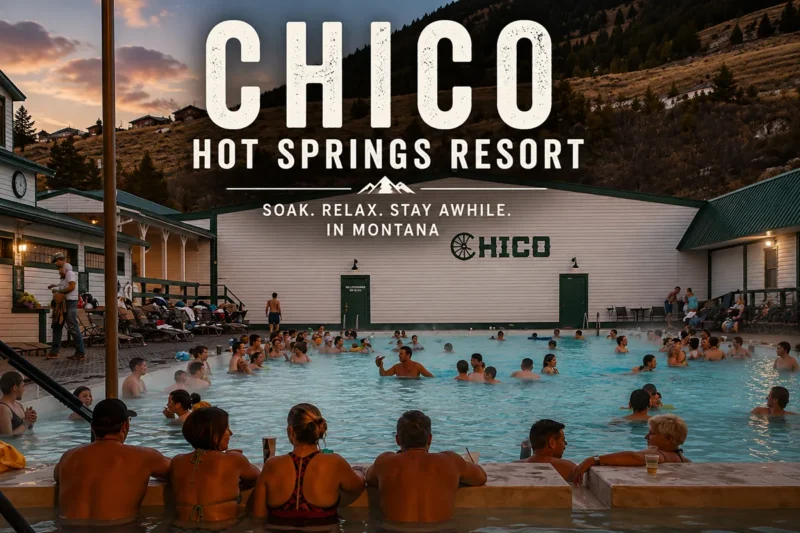
- Chico Hot Springs Resort — Paradise Valley
- Symes Hot Springs Hotel — Hot Springs, Montana
- Bozeman Hot Springs — 12 pools, modern complex
If you want a warm spring rather than a hot one (Nimrod’s actual category):
- Gigantic Warm Springs — near Great Falls
If you want unique private soaking:
- Wild Horse Hot Springs — near Hot Springs, MT
- Big Medicine Hot Springs — Camas
- Elkhorn Hot Springs — Pioneer Mountains
If you’re in Helena:
- Broadwater Hot Springs — west of downtown
- Norris Hot Springs — between Bozeman and Helena, modest day-use spring
Combining Nimrod With a Larger Trip
Because Nimrod is so close to I-90 and only a half-day commitment at most, it pairs naturally with broader western Montana plans.
From Missoula: Easy half-day round trip. Pair with downtown Missoula time, a Clark Fork riverfront walk, or dinner in town.
Drummond and Old Montana corridor: Drummond, 15 miles east, is the historic ranching crossroads worth a stop for lunch at a classic small-town diner. From there, continue east toward Deer Lodge and the Old Montana State Prison.
Rock Creek detour: Rock Creek Road runs south from I-90 near Clinton, a few miles west of Bearmouth, and offers some of the best fly fishing in Montana plus dispersed camping options.
Heading further: From Nimrod, you can continue east on I-90 to Bozeman, or west back to Missoula for the night. For broader logistics, see our Montana trip planning guide and things to do in Montana hub.
Safety Considerations
The water is cold. Even on hot days, 70°F water can cause cold-water shock if you enter quickly without acclimating. Get in gradually.
No lifeguards. No phone coverage. No quick rescue. Treat this like remote backcountry water — because it effectively is.
Cliff jumping risks. Always check water depth before jumping. Water levels change seasonally and rocks shift over time.
The underwater cave is a real hazard for inexperienced swimmers. Don’t enter it unless you’re confident in your free-diving and you’ve watched others do it first.
Highway proximity. The walk in parallels I-90 and the railroad. Stay aware. Don’t cross the tracks. Keep kids close.
Wildlife. Bear sightings are not common at the pool itself but the surrounding canyon is bear habitat. See our Montana bear guide for basics.
Final Thoughts on Nimrod Hot Springs
Nimrod is one of those Montana places that defies easy categorization. It’s not a hot soak. It’s not a developed resort. It’s not a remote wilderness pilgrimage. It’s a strange, beautiful turquoise pool in a canyon along the Clark Fork — visible from the interstate, free to visit, and somehow still feeling like a secret despite being well-known to locals.
If you arrive with realistic expectations — a cool natural swimming pool with an interesting geology and minimal facilities — you’ll leave thinking it’s one of the best half-day stops in western Montana. If you arrive expecting a 105°F soak in a wooden tub, you’ll be disappointed.
Go in summer. Bring a towel and a trash bag. Treat the Czorny family’s land with respect. Drive safe on the way back.
Frequently Asked Questions
Where exactly is Nimrod Hot Springs located?
Nimrod Hot Springs is on the Clark Fork River near the small community of Bryne, Montana, off Interstate 90 at Exit 138 (Bearmouth) — approximately 35–40 miles east of Missoula. It is not off Highway 200 near Ovando, despite some sources incorrectly placing it there.
Is Nimrod Hot Springs actually a hot spring?
Technically it’s a warm spring — the water hovers around 70°F (21°C) year-round, much cooler than typical Montana hot springs (which usually run 100°F+). It’s better thought of as a heated natural swimming hole than a soaking hot spring.
Is Nimrod Hot Springs free to visit?
Yes, Nimrod is free. There are no admission fees and no facilities. It sits on private land owned by the Czorny family, and informal public access is tolerated as long as visitors pack out their trash and respect the property.
How do you actually get to Nimrod Hot Springs?
Take I-90 to Exit 138 (Bearmouth), head north onto Drummond Frontage Road, turn left at the “Fishing Access” sign, and park within ~1,500 feet at a small pullout. From there, walk approximately ½ mile west paralleling the highway. The walk is flat and easy.
Do you need 4WD to reach Nimrod Hot Springs?
No. Any standard car can reach the parking area. The access is from the Bearmouth I-90 exit, not a remote forest road. The “4WD required” descriptions you may have seen apply to a different location entirely.
Can you go cliff jumping at Nimrod Hot Springs?
Yes, the pool is deep enough for cliff jumping from multiple heights, and it’s one of the activities the springs are known for. Always check current water depth before jumping, look for submerged debris, and never jump alone. There is no cell service for emergencies.
Is there really an underwater cave at Nimrod?
Yes. There’s a small underwater cave at one end of the pool, accessible by free-diving a short distance beneath the rocks. A rope is typically anchored to help swimmers climb back out. Only attempt this if you’re an experienced swimmer comfortable with brief breath-hold dives.
What’s the best time of year to visit Nimrod Hot Springs?
Late June through September is the prime window. Summer air temperatures make the 70°F water feel refreshing rather than cold. September is particularly underrated for fewer crowds and cottonwood color. Winter visits are possible but require serious cold-water tolerance.
Are there facilities at Nimrod Hot Springs?
None. No restrooms, no changing rooms, no trash bins, no signs, no staff. You need to bring everything you’ll need and pack out everything you bring.
How does Nimrod compare to other hot springs near Missoula?
Nimrod is the closest free natural pool to Missoula, but it’s much cooler than developed hot springs. For actual hot soaking near Missoula, Lolo Hot Springs (45 miles SW) and Quinn’s Hot Springs Resort (60 miles NW) offer developed pools at 90–106°F.

Closed to the public per facebook post from Granite County Sheriff’s Office. Landowner does not want anyone on the property and violators will be prosecuted.