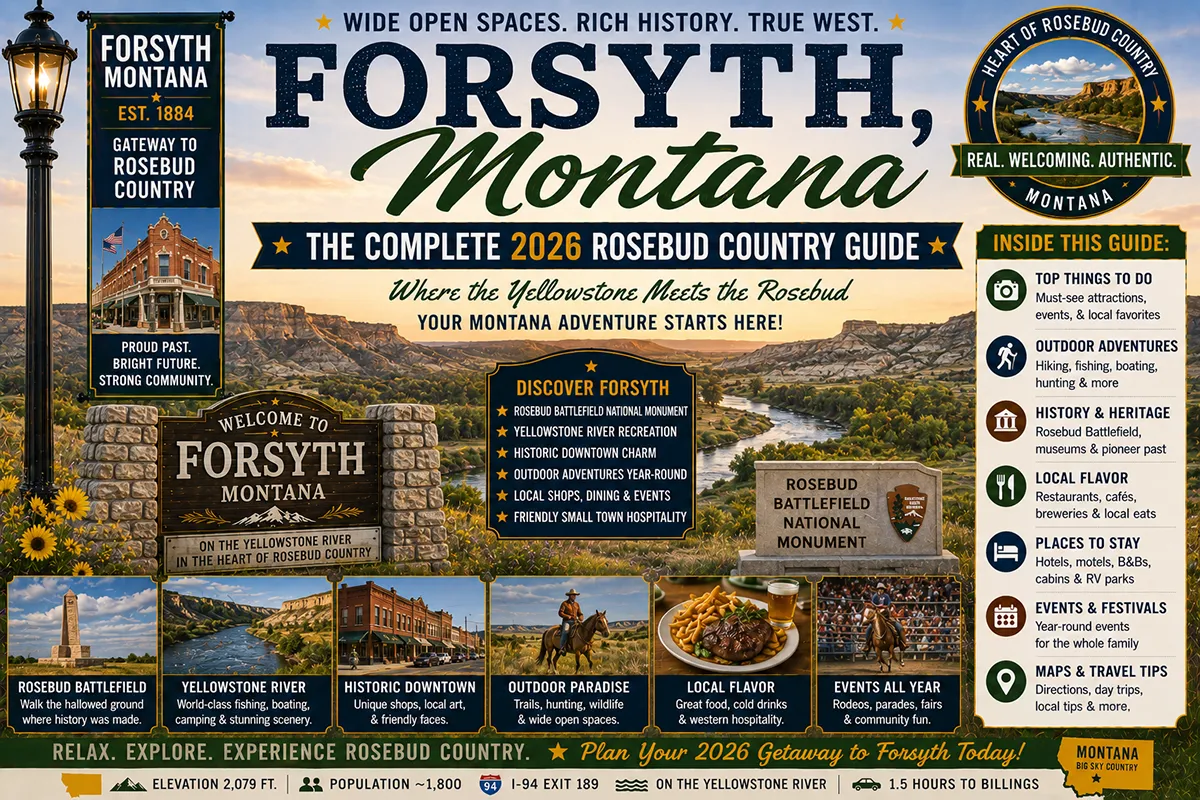
Most travelers on I-94 blow past Forsyth doing 80 mph, watching the Yellowstone River appear and disappear to the south. That’s a mistake.
The courthouse square in Forsyth — a 1912 Classical Revival building anchoring one of the most intact county seat squares in eastern Montana — is the kind of thing you only find by stopping.
The Yellowstone River access at Forsyth Park is free. The Pioneer Museum is free. And 35 miles north, Colstrip is one of the most dramatically industrial landscapes in the Mountain West.
TL;DR
- Forsyth (~1,800) is the county seat of Rosebud County — a genuine eastern Montana county seat town on the Yellowstone River between Miles City and Glendive on I-94.
- Best for I-94 road trippers needing a stop with actual substance — the courthouse square, Pioneer Museum, and Yellowstone River park are all worth an hour each.
- Gateway to Colstrip (35 miles north) — Montana’s coal-energy hub, with one of the most striking industrial landscapes in the state.
- Very low SERP competition — almost nothing quality exists for this keyword.
Liked this article?
Add Roaming Montana as a preferred source so you see more of our articles and guides on Google.
Forsyth at a Glance
| Population (2020) | ~1,800 |
|---|---|
| County | Rosebud County (county seat) |
| Region | Southeast Montana (Custer Country) |
| Elevation | 2,513 ft |
| I-94 exits | Exit 93 and Exit 95 |
| Distance to Miles City | ~70 miles (~1 hour west) |
| Distance to Glendive | ~115 miles (~1.5 hours east) |
| Distance to Colstrip | ~35 miles (~40 min north) |
| Best for | I-94 road trip stop, courthouse architecture, Yellowstone River, Colstrip industrial heritage |
What Makes Forsyth Different
Forsyth was established as a Northern Pacific Railroad town in 1882 and has served as Rosebud County’s seat ever since. The county is one of the most geographically interesting in eastern Montana — the Yellowstone River cuts through the south, the coal-bearing Bull Mountains rise to the north, and the Northern Cheyenne Reservation borders the county to the south.
The courthouse was built in 1912 — Classical Revival style, brick and stone, with proportions that communicate civic permanence. The square around it is well maintained.
This might sound like faint praise, but in eastern Montana where many county seats have struggled economically, a well-kept courthouse square is genuinely notable.
Colstrip, 35 miles north, is the other defining feature of Rosebud County. Four coal-fired power plants (two now retired) and a surface coal mine created a planned community in the 1970s that looks like a company town dropped into the Montana prairie.
The mine and plant at their peak employed thousands and provided power to the Pacific Northwest. The story of Colstrip — and its ongoing transition as coal power declines — is one of the most economically significant stories in contemporary Montana.
For broader trip context, see my Montana cities and towns hub.
The Top 10 Things to Do In & Around Forsyth
1. Rosebud County Courthouse
The 1912 Classical Revival courthouse is the centerpiece of the county seat square. Walk around the exterior, read the historical markers, and appreciate the civic ambition that produced a building like this in a remote railroad town of a few hundred people. The interior (during business hours) is worth a brief look.
2. Rosebud County Pioneer Museum
Free regional history museum covering the Rosebud Valley’s Indigenous history (Northern Cheyenne, Crow), the homestead era, the cattle and sheep ranching periods, and the Northern Pacific Railroad’s role in opening the region. Well-organized for a small museum.
3. Forsyth Park & Yellowstone River
A well-maintained city park on the south side of Forsyth with direct Yellowstone River access, riverside walking paths, picnic areas, and a swimming pool (seasonal). The Yellowstone here is wide, slow, and lined with cottonwoods — classic lower Yellowstone character.
4. Fly Fish or Bank Fish the Yellowstone
Walleye, catfish, sauger, and some trout in the lower Yellowstone near Forsyth. Multiple fishing access sites. The river is wide enough here that bank fishing is productive without a boat.
5. Drive to Colstrip (35 miles north)
The company coal town built in the 1970s to house workers at the Colstrip power plants and mine. The planned town has an eerie uniformity; the adjacent mine and plant facilities (visible from public roads) are enormous. The Colstrip Museum covers the town’s industrial and community history.
6. Carnegie Library Building
Forsyth has a Carnegie library (1916), one of the last built in Montana before Carnegie’s library philanthropy wound down. Still operating as the public library.
7. St. Philip’s Episcopal Church
An 1882 wood-frame church — one of the oldest surviving structures in Forsyth, built the same year the town was platted.
8. Northern Cheyenne Reservation Day Trip (1 hour south)
US-212 south from Forsyth leads to Lame Deer, capital of the Northern Cheyenne Nation. See the Lame Deer guide.
9. Bull Mountains Scenic Drive
The Bull Mountains north of Forsyth (en route to Colstrip) are low but distinctive — dry ponderosa pine forest rising from the eastern Montana grasslands. Forest roads provide access for hiking and wildlife viewing.
10. Rosebud Creek Access
Rosebud Creek flows into the Yellowstone a few miles east of Forsyth — historically significant as the site of the Battle of the Rosebud (June 17, 1876, just 8 days before the Little Bighorn). A historical marker commemorates the battle.
Where to Stay
| Hotel | Vibe | Price | Best For |
|---|---|---|---|
| Speedway Inn | Local motel, reliable | $90–130 | Most travelers |
| Rails Inn Forsyth | I-94 adjacent, functional | $85–125 | Road trippers |
| Western Motel | Budget basic | $75–110 | Very budget |
| Camping at Forsyth Park | Riverside camping | $15–25 | Campers |
Forsyth is one of Montana’s most affordable overnight stops — under $130/night for anything in town.
Where to Eat
- Speedway Bar & Grill — the local institution; burgers, steaks, cold beer
- Howdy’s — diner standards; reliable breakfast and lunch
- Rosebud Club Bar — bar food and local gathering spot
- Pizza — limited chain options
Forsyth’s dining options are limited but functional. Miles City (70 miles west) has more variety.
Getting There
Forsyth sits directly on I-94 between Miles City and Glendive.
From Miles City: 70 miles east on I-94, about 1 hour (Exit 93 or 95).
From Glendive: 115 miles west on I-94, about 1.5 hours.
From Billings: ~175 miles east on I-90 then I-94, about 2.5 hours.
What Forsyth Unlocks
Colstrip (35 min north)
Montana’s coal energy hub — the planned company town and surface mine are one of the most striking industrial landscapes in the state.
Miles City (1 hour west)
Bucking Horse Sale, Range Riders Museum, Montana Bar. See Miles City guide.
Glendive (1.5 hours east)
Makoshika State Park, Montana’s largest state park. See Glendive guide.
Northern Cheyenne Reservation (1 hour south)
Lame Deer and the Northern Cheyenne Nation’s cultural heartland. See Lame Deer guide.
Battle of the Rosebud Site (near Rosebud Creek, east of town)
Historical marker for the June 17, 1876 battle — 8 days before Little Bighorn.
When to Visit
Summer (June–August) — best weather, full park facilities, Yellowstone River swimming and fishing.
Fall (September–October) — excellent fishing, hunting season, dramatic light on the Yellowstone bottomlands.
Spring (April–May) — Rosebud Creek can be excellent for early fishing.
Winter — cold and very quiet; the courthouse interior visits still work.
Personal Tips
Stop at the courthouse first. It orients you to the town’s geography and sets the historical context for everything else.
Forsyth Park in the evening is underrated. The Yellowstone at sunset from the park is genuinely beautiful — cottonwood trees, wide river, quiet.
Drive to Colstrip if the story interests you. The scale of the coal operation — even with two plants retired — is hard to grasp without seeing it. The Colstrip Museum provides essential context.
The Rosebud Creek marker is worth finding. East of town, near the Rosebud-Yellowstone confluence. The Battle of the Rosebud is overshadowed by the Little Bighorn but was a significant military engagement.
Use Forsyth as an I-94 overnight break. If you’re driving I-94 from Billings to Bismarck or vice versa, Forsyth is the smartest overnight between Miles City and Glendive.
Forsyth Quick Facts
| Founded | 1882 (Northern Pacific Railroad) |
|---|---|
| Named for | General James W. Forsyth, U.S. Army |
| County | Rosebud County — named for wild roses along the Rosebud Creek |
| Average summer high | 88°F |
| Average winter low | 7°F |
| I-94 exits | 93 and 95 |
Conclusion
Forsyth isn’t going to anyone’s top ten list. What it offers is the authentic eastern Montana county seat experience — a well-preserved courthouse square, a good Pioneer Museum, the Yellowstone River in a park you can actually use, and the extraordinary industrial landscape of Colstrip a half-hour north. For I-94 travelers, it’s the smartest stop between Miles City and Glendive.
Have a Forsyth question? Drop it in the comments — I read every one.
Frequently Asked Questions
Is Forsyth Montana worth visiting?
Yes as an I-94 stop — Forsyth is worth 1–3 hours for the Rosebud County Courthouse (one of eastern Montana’s finest), Forsyth Park on the Yellowstone River, and the Rosebud County Pioneer Museum. Combined with a drive to Colstrip (35 miles north), it’s a genuinely worthwhile detour from the interstate.
What is Colstrip Montana?
Colstrip is a company town 35 miles north of Forsyth, built in the 1970s by the Montana Power Company to house workers at four coal-fired power plants and a surface coal mine. At its peak, the plants provided significant electricity to the Pacific Northwest. Two of the four plants have retired, with the remaining units undergoing transition. The Colstrip Museum covers the town’s unique history.
How far is Forsyth from Miles City?
Forsyth is approximately 70 miles east of Miles City on I-94 — about a 1-hour drive.
What happened at the Battle of the Rosebud near Forsyth?
On June 17, 1876 — eight days before the Battle of the Little Bighorn — Colonel George Crook led about 1,300 soldiers and Crow and Shoshone scouts against a large force of Lakota and Northern Cheyenne warriors near Rosebud Creek, about 30 miles south of present-day Forsyth. The battle was inconclusive but forced Crook to withdraw, preventing him from joining Custer’s column before Little Bighorn.
What fishing is available near Forsyth Montana?
The Yellowstone River near Forsyth provides walleye, sauger, channel catfish, and some trout fishing at multiple public access sites. Rosebud Creek (entering the Yellowstone east of town) offers additional access. The fishing is eastern-Montana-style warm-water species fishing rather than the mountain trout fishing of western Montana.
Is there camping in Forsyth Montana?
Yes — Forsyth Park on the Yellowstone River has a campground with basic facilities. Rates are very affordable (typically $15–25/night). RV and tent camping available. The riverside setting makes it one of the better campgrounds in eastern Montana for the price.