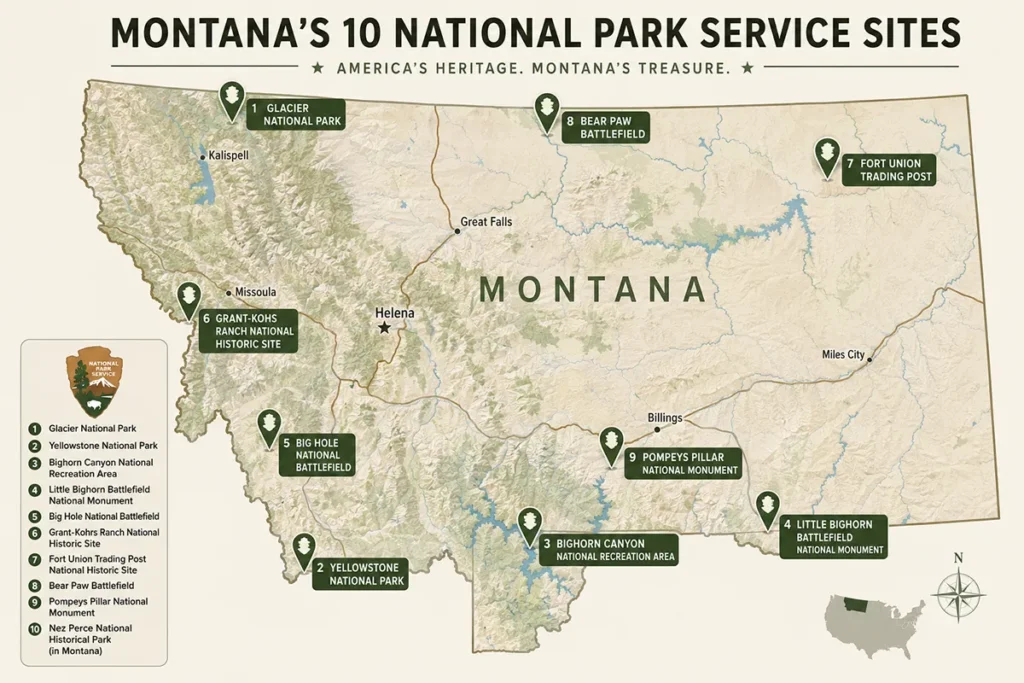
Ask ten Montana travel writers how many national parks Montana has and you’ll get ten different answers — anywhere from 2 to 10. The truth is more useful than any of them.
TL;DR: Montana has 2 actual National Parks — Glacier and Yellowstone — and 8 additional National Park Service units that include battlefields, monuments, historic sites, and a recreation area. Glacier and Yellowstone deserve their fame and 90% of your park-time budget. The other eight are worthwhile detours if they align with your interests (Native American history, cattle-ranching heritage, fur trade, Lewis & Clark) — and a few are honest skips for most casual travelers. This guide covers all of them, with current fees, recent reservation changes, and which ones I’d actually drive out of my way to see.
I’ve spent the better part of a decade road-tripping Montana’s federal lands, and the question I get most isn’t “which one is best?” — it’s “which ones can I skip?” Because the truth is, Montana is huge.
Glacier and Yellowstone alone are 600 miles apart, and trying to squeeze in every NPS plaque between them turns a great trip into a checklist exercise. So this guide is structured the way I’d actually plan a Montana parks trip: the two big ones first, then the others sorted by who they’re genuinely worth it for.
A quick housekeeping note: the federal designation matters. “National Park” is a specific Congressional designation given to only 63 places in the U.S. Montana has two of them.
Everything else on this list is a “unit” of the National Park Service — battlefields, recreation areas, monuments, and historic sites. They’re all administered by the same agency, but their character, scale, and visitor experience vary enormously.
Liked this article?
Add Roaming Montana as a preferred source so you see more of our articles and guides on Google.
Quick Comparison: All 10 NPS Sites in Montana
| Site | Type | Best For | Time Needed | Entry Fee [verify 2026] |
|---|---|---|---|---|
| Glacier National Park | National Park | First-timers, hikers, scenic drives | 3–7 days | $35/vehicle |
| Yellowstone National Park | National Park | Wildlife, geothermal, families | 3–7 days | $35/vehicle |
| Bighorn Canyon NRA | National Recreation Area | Boaters, wild horse viewing | 1–2 days | Free |
| Little Bighorn Battlefield NM | National Monument | History buffs, Native American history | 2–4 hours | $25/vehicle |
| Big Hole National Battlefield | National Battlefield | Nez Perce history, solitude | 2–3 hours | Free |
| Grant-Kohrs Ranch NHS | National Historic Site | Cattle country, families | 2–3 hours | Free |
| Fort Union Trading Post NHS | National Historic Site | Fur trade history, remote travel | 2–3 hours | Free |
| Nez Perce National Historical Park | National Historical Park | Indigenous history (multi-site) | 1–2 days | Free |
| Lewis & Clark NHT (affiliated) | National Historic Trail | Lewis & Clark followers | Self-paced | Free |
| Ice Age Floods Geologic Trail (affiliated) | National Geologic Trail | Geology nerds | Self-paced | Free |
Montana’s Two True National Parks
1. Glacier National Park — The Crown of the Continent
If you have time for only one Montana national park, make it Glacier. I’ve been in June when half the Going-to-the-Sun Road was still buried in snow, and I’ve been in late August when the larches turned the high country gold. Both times I left planning my return trip.
The summary below is the pillar overview — for the full breakdown of entrances, seasons, wildlife, lodging, and itineraries, see my complete guide to Glacier National Park.
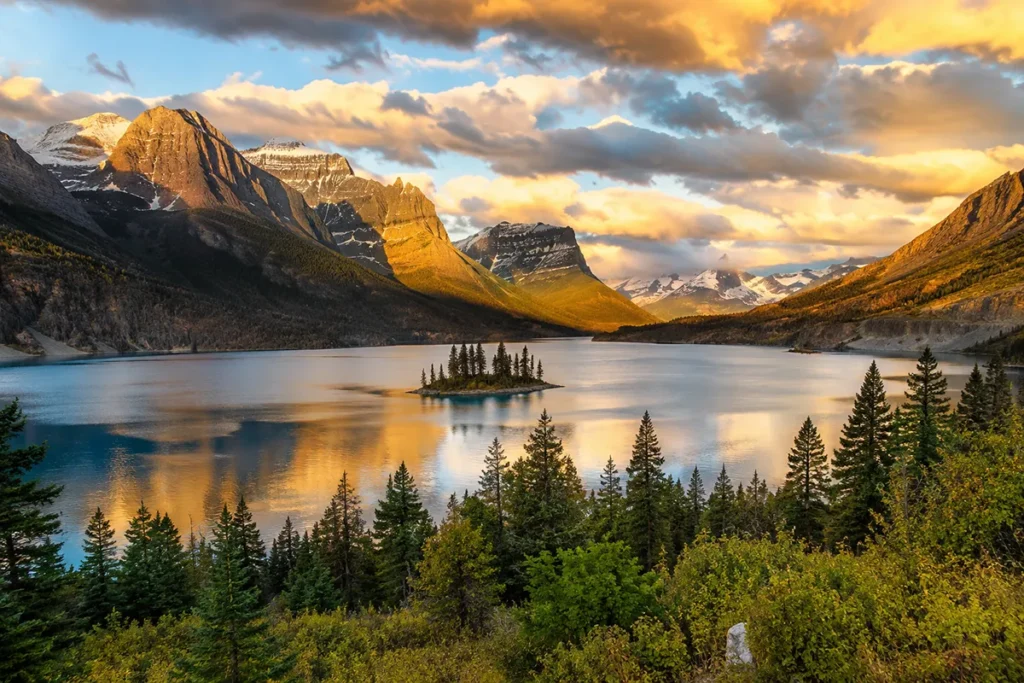
Glacier covers just over a million acres in the northwest corner of Montana, butting up against Canada (it’s actually the U.S. half of Waterton-Glacier International Peace Park).
The scenery genuinely justifies the hype — alpine lakes the color of antifreeze, hanging valleys, grizzlies and mountain goats you’ll likely see from the road, and a single iconic drive that crosses the Continental Divide.
Why it’s special: Glacier feels wilder than most Lower 48 parks. The biodiversity is staggering — it sits at the convergence of three major ecosystems — and the trail system delivers everything from wheelchair-accessible boardwalks to the kind of multi-day backpacking traverses that change how you think about wilderness.
What I’d prioritize on a first visit:
- Read my complete Glacier National Park guide before you book anything — it covers entrance strategy, peak-season reservations, and season-by-season conditions
- Drive Going-to-the-Sun Road end to end (see my full guide to driving Going-to-the-Sun Road — the timed-entry system is real)
- Hike at least one classic trail — Highline, Hidden Lake, Avalanche Lake, or Iceberg Lake. My breakdown of the 16 best hikes in Glacier covers difficulty, crowds, and which to skip
- Stay at least one night inside or near the park — see where to stay in Glacier National Park for the full breakdown by entrance
Gateway towns: West side — Columbia Falls, Whitefish, and Kalispell. East side — East Glacier Park Village and Browning.
Heads-up for 2026: Glacier has used a timed vehicle reservation system for Going-to-the-Sun Road and several other corridors during peak season for the past several years. The specifics shift annually, so always check the current year’s rules before you book. [verify current 2026 reservation system on NPS.gov]
2. Yellowstone National Park — The First One
Yellowstone became the world’s first national park in 1872. Most visitors enter via Wyoming (south or east), but Montana actually owns three of the five entrances: West, North (Gardiner), and Northeast (Cooke City).
And in my opinion, the Montana-accessed side of Yellowstone is the better side — particularly for wildlife.
This section is the pillar-level overview — for the full Montana-focused Yellowstone deep dive (entrances, geyser basins, road loops, wildlife seasons, and where to base), see my complete guide to Yellowstone National Park.
The northern range of Yellowstone — Lamar Valley specifically — is where you go when you want to see wolves.
I’ve spent dawns parked along the Lamar with binoculars and a thermos, and the experience of watching a wolf pack move across a meadow at first light is something every wildlife traveler should put on their list.
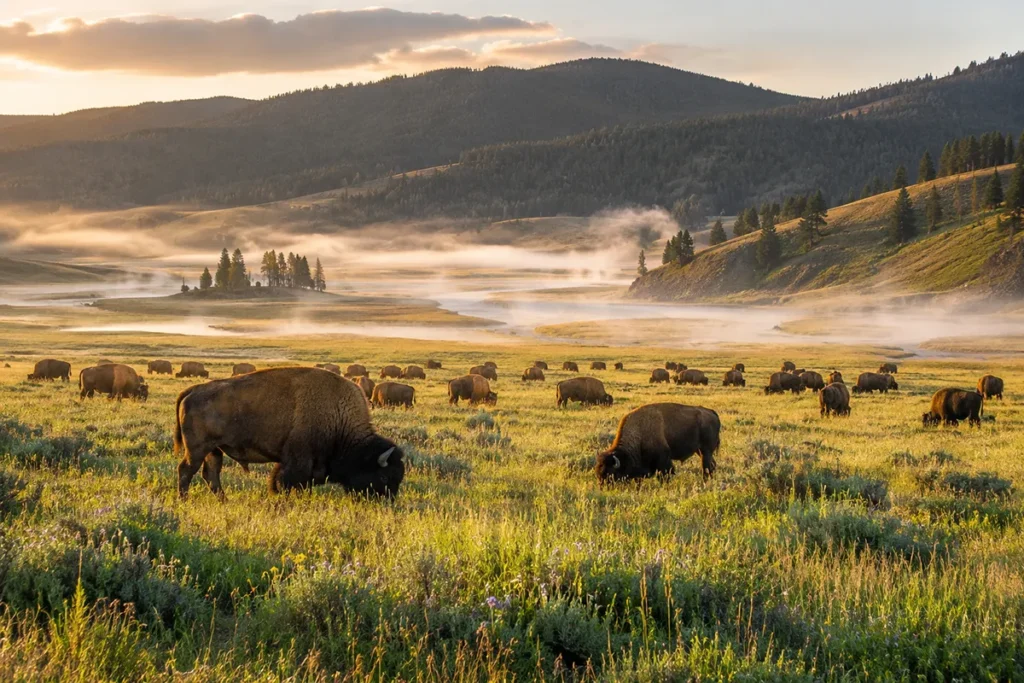
Why it’s special: Yellowstone is the only place in the Lower 48 with a functioning, intact ecosystem of its original predators and prey. Wolves, grizzlies, bison herds in the thousands, elk, pronghorn, and a geological showcase you can’t replicate anywhere else on Earth.
What I’d prioritize on the Montana side:
- Start with my complete Yellowstone National Park guide for full routing, road loops, and where to base
- Lamar Valley at dawn for wolves and bison — see the full Lamar Valley breakdown
- Wolf-watching specifically — my Yellowstone wolf watching guide covers gear, timing, and where the packs actually are
- Mammoth Hot Springs near the North Entrance
- Boiling River (when open) near Gardiner
- The Beartooth Highway from Cooke City — one of the greatest scenic drives in America
- A stop at the Grizzly and Wolf Discovery Center in West Yellowstone if you want guaranteed viewing of the big predators
Gateway towns (all Montana): West Yellowstone, Gardiner, Cooke City. For lodging strategy, where to stay in Yellowstone breaks down the tradeoffs by entrance.
Heads-up: Yellowstone is enormous (2.2 million acres). Pick a focus — north loop or south loop — rather than trying to see everything. The major 2022 flooding damaged the road between Gardiner and Mammoth; access has been restored, but the corridor still looks different than older guidebooks describe.
Montana’s Battlefields and Monuments
3. Little Bighorn Battlefield National Monument
This is the most-visited NPS site in Montana after the two big parks, and it deserves the traffic. The Battle of the Little Bighorn — Custer’s Last Stand — happened here on June 25–26, 1876, when an alliance of Lakota, Cheyenne, and Arapaho warriors defeated the U.S. 7th Cavalry.
The monument preserves the battlefield essentially as it was, with white markers showing where individual soldiers fell.
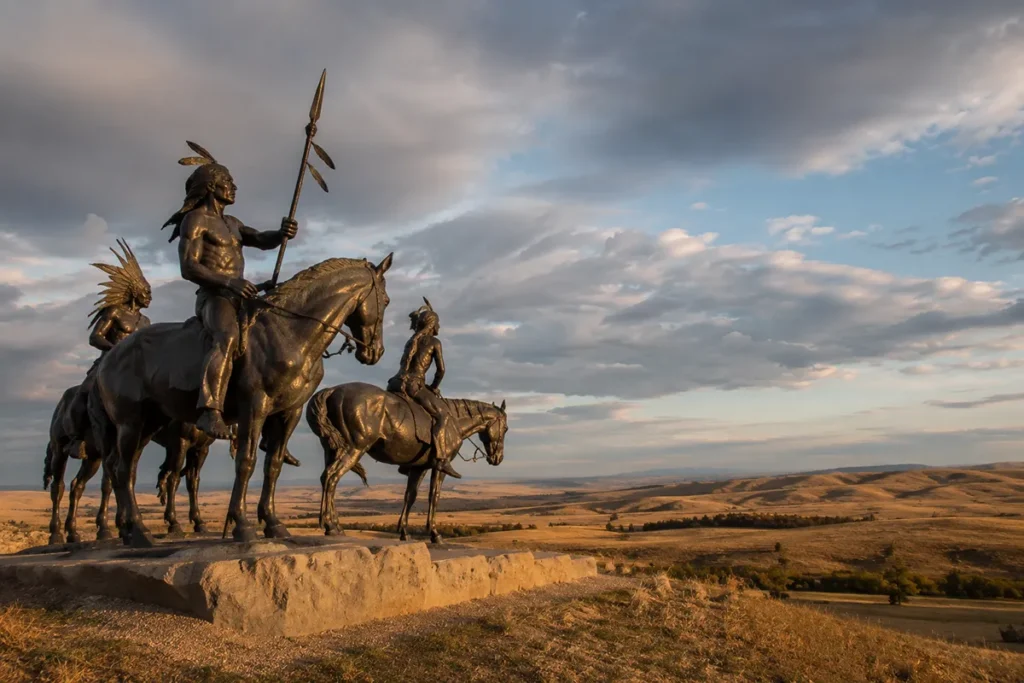
I’ve been three times, and the ranger talks are excellent — the NPS has done significant work over the past few decades to present both the U.S. military and Native American perspectives with equal weight. The Indian Memorial, dedicated in 2003, is a moving counterpart to the original Custer monument.
Location: Near Hardin, about an hour east of Billings.
Time needed: 2–4 hours, ideally including a ranger-led talk.
Entry fee: $25/vehicle [verify 2026]
My honest take: Worth a half-day detour for any traveler interested in American history. The interpretive evolution at this site over the last 30 years is itself a story worth understanding. Pair with Montana’s history overview for context. If you’re already in the Billings–Hardin corridor, pair this with a half-day at Pictograph Cave State Park — the 2,000-year-old rock art is the older counterpart to the battlefield’s story.
4. Big Hole National Battlefield
Big Hole is the harder counterpart to Little Bighorn — smaller, more remote, and emotionally heavier. On August 9, 1877, U.S. Army troops attacked a sleeping Nez Perce encampment during the tribe’s flight toward Canada. Roughly 90 Nez Perce were killed, mostly women, children, and elders.
The site is administered as part of the Nez Perce National Historical Park (see below) but functions as a standalone battlefield. There’s a visitor center, a short trail down to the tipi-frame memorials marking the camp, and a sniper pit on the hillside above. Cell service is essentially nonexistent.
Location: Western Montana, near Wisdom, off Highway 43. Nearest town with services is Dillon.
Time needed: 2–3 hours
Entry fee: Free
My honest take: This is one of the most affecting NPS sites in Montana, but it’s specifically for travelers who want to engage with difficult American history. Not a casual stop. Pair Big Hole with Bannack State Park, Montana’s best-preserved ghost town and the state’s original territorial capital — it’s about 60 miles east near Dillon and makes a natural same-day combination with the battlefield.
Montana’s National Recreation Area
5. Bighorn Canyon National Recreation Area
Bighorn Canyon straddles the Montana-Wyoming border and is genuinely one of Montana’s least-known scenic stunners. Picture 1,000-foot canyon walls dropping into a deep-blue reservoir, almost no crowds, and wild horses you can usually spot from the road in the Pryor Mountains.
For the full breakdown of districts, access points, and where to stay, see my complete Bighorn Canyon guide.
The recreation area has two districts — the North District (Montana side, accessed from Hardin) and the South District (Wyoming side, accessed from Lovell).
Most of the photogenic canyon overlooks are in the South District, but the North District offers Yellowtail Dam, the Afterbay fishery, and access to several historic ranches.
Time needed: 1–2 days for a real visit
Entry fee: Free
My honest take: This is the most under-rated NPS site in Montana. If you’re going to be in Billings or making the eastern Montana loop, build in an overnight here. Mid-week, mid-summer, I’ve had viewpoints entirely to myself.
Montana’s Historic Sites
6. Grant-Kohrs Ranch National Historic Site
Grant-Kohrs is the Montana cowboy story made tangible. Conrad Kohrs ran a cattle empire from this Deer Lodge ranch in the late 1800s — at its peak, controlling 10 million acres across four states and Canada.
The NPS preserved the ranch buildings, the original ranch house, and a working herd of longhorn cattle, and rangers conduct demonstrations of period ranching practices.
Location: Deer Lodge, right off I-90 between Butte and Missoula.
Time needed: 2–3 hours
Entry fee: Free
My honest take: Best NPS site in Montana for families with kids. The chuck-wagon demonstrations, blacksmith shop, and proximity to the longhorn herd make it genuinely engaging in a way that battlefield visits aren’t for younger travelers. Pair with Montana’s gold rush and pioneer history for full context.
7. Fort Union Trading Post National Historic Site
Fort Union is what the American fur trade actually looked like — a reconstructed 1828 trading post at the confluence of the Missouri and Yellowstone Rivers, on the Montana-North Dakota border.
From 1828 to 1867, this was the most important fur trading post on the Upper Missouri, where the American Fur Company traded with the Assiniboine, Crow, Cree, Blackfeet, and other Northern Plains tribes.
The reconstruction is excellent — full-scale, historically accurate, and based on extensive archaeology. Demonstrations run during the summer season.
Location: Far northeast Montana, near Sidney. Genuinely remote — you’re not stopping by accident.
Time needed: 2–3 hours
Entry fee: Free
My honest take: Wonderful for fur-trade history buffs and Lewis & Clark followers. For most casual travelers, the drive isn’t worth it unless you’re already in the area. If you are, don’t miss it. Coming from or heading to the Glendive area? Pair Fort Union with Makoshika State Park — Montana’s largest state park, with badlands formations and dinosaur fossils eroding right out of the hillsides. They’re the two essential stops on any far-east Montana itinerary.
Montana’s Multi-Site National Historical Park
8. Nez Perce National Historical Park
The Nez Perce National Historical Park is unusual: 38 sites spread across Idaho, Oregon, Washington, and Montana. Three of them are in Montana — Big Hole (covered above), Bear Paw Battlefield (where Chief Joseph surrendered in October 1877, near Chinook), and Canyon Creek.
The park tells the story of the Nez Perce people and the 1877 flight — a 1,170-mile attempt to reach Canada that ended 40 miles short of the border at Bear Paw.
My honest take: Bear Paw Battlefield is the most overlooked of the three Montana sites and arguably the most significant — it’s where Joseph delivered his famous surrender speech. If you’ve visited Big Hole, completing the trilogy with Bear Paw and Canyon Creek deepens the story considerably.
Honorable Mentions: Affiliated NPS Areas and the One Everyone Forgets
9. Lewis & Clark National Historic Trail
The Lewis & Clark NHT isn’t a destination — it’s a 4,900-mile NPS-administered trail across 16 states. Montana contains roughly 1,000 miles of it, more than any other state.
Major Montana interpretive stops include the Lewis & Clark Interpretive Center in Great Falls (paired with Giant Springs State Park right next door — one of the largest freshwater springs in the U.S. and a Lewis & Clark mention in the expedition journals), Pompeys Pillar (see below), Travelers’ Rest in Lolo, and the Gates of the Mountains near Helena.
If you’re driving the corridor between Great Falls and the Bob Marshall Wilderness, Sluice Boxes State Park is a worthwhile add — a limestone canyon along an old railroad bed, almost no crowds. Key historical events in Montana covers the route in depth.
10. Ice Age Floods National Geologic Trail
Even more obscure: this NPS-affiliated geologic trail commemorates the catastrophic Glacial Lake Missoula floods at the end of the last Ice Age, when an ice dam in Montana repeatedly failed and unleashed walls of water across the Pacific Northwest. The Montana Natural History Center in Missoula is the main interpretive stop on the Montana side.
The One Everyone Forgets: Pompeys Pillar National Monument
Pompeys Pillar is technically managed by the Bureau of Land Management, not the National Park Service, so most “Montana National Parks” roundups skip it.
But it became a National Monument in 2001 and is one of the only places along the entire Lewis & Clark route with physical evidence the expedition was there — William Clark carved his name and the date (July 25, 1806) into the sandstone, and it’s still legible behind protective glass.
Location: About 30 minutes east of Billings along the Yellowstone River.
My honest take: If you’re driving I-94 east of Billings — toward Miles City or beyond — this is a 90-minute detour that adds genuine historical depth to the trip. Combine Pompeys Pillar with Pictograph Cave State Park (also just outside Billings) for a half-day of layered Montana history — Native rock art going back two millennia, then the 1806 William Clark signature. Few travelers connect these two sites, but they belong together.
Personal Tips: What I Wish I’d Known Before Visiting Montana’s NPS Sites
A few things I learned the hard way:
Glacier and Yellowstone are 600 miles apart. Plan at least 8–10 hours of driving between them. People underestimate this constantly. If you only have a week, do one well. If you have two weeks, do both with at least one buffer day. See my full Montana trip planning guide for routing options.
Cell service is unreliable at every site except Glacier’s busiest corridors. Download offline maps before you leave town. This is doubly true for Bighorn Canyon, Bear Paw, Fort Union, and Big Hole.
Shoulder seasons (May, September) are genuinely better than peak summer. Less crowding, full road access for most sites, and Montana’s weather is more pleasant than people expect. Best time to visit Montana covers the month-by-month tradeoffs.
Pack for bears at Glacier and Yellowstone — seriously. Bear spray is not optional in either park. My Montana bear guide covers what to carry and how to use it.
The “free” sites aren’t free of effort. Big Hole, Bear Paw, and Fort Union require real driving. Plan fuel and food stops carefully.
Eastern Montana is its own thing. Bighorn Canyon, Little Bighorn, Pompeys Pillar, and Fort Union form a natural eastern Montana loop. Don’t try to bundle them into a Glacier-Yellowstone trip — make a dedicated east-Montana run.
The bug seasons are real. Montana’s bug season guide is worth reading before any June trip — mosquitoes can be aggressive in the high country.
How to Choose: Which Sites Match Your Trip
First-time Montana visitor with 5–7 days: Glacier + drive to Yellowstone via Great Falls or Missoula. Add Lewis & Clark Caverns State Park as a Three Forks stop between the two parks — Montana’s first state park and the most accessible cavern tour in the Northwest.
History-focused traveler: Little Bighorn, Big Hole, Bear Paw, Grant-Kohrs, and Pompeys Pillar — paired with Bannack State Park (territorial capital ghost town) and Pictograph Cave State Park (ancient rock art). This is the deepest-history loop in Montana.
Family with kids under 12: Yellowstone north loop, Grant-Kohrs Ranch, Glacier (with kid-friendly hikes). Add Lewis & Clark Caverns — the cavern tour is universally a hit with kids 6+ — and Lone Pine State Park for an easy nature stop near Kalispell.
Wildlife photographer: Yellowstone’s Lamar Valley and Glacier’s Many Glacier area. Everything else is incidental — but Bighorn Canyon’s wild horses in the Pryor Mountains are worth a side trip.
Solitude-seeker: Bighorn Canyon, Bear Paw, and Fort Union. You’ll have them almost to yourself outside July. Pair with Sluice Boxes State Park and Makoshika State Park for the lowest-traffic Montana itinerary I can construct.
Geology / paleontology focus: Yellowstone (geothermal), Lewis & Clark Caverns (limestone formations), and Makoshika State Park (dinosaur fossils and badlands). This is the strangest, most underrated Montana itinerary.
Two-week Montana grand tour: All ten NPS sites, plus every state park child in this list. This is when Montana’s state parks pillar guide becomes essential reading.
Pair Your NPS Visit with a Montana State Park
Most travelers stop their planning at the NPS sites. That’s a mistake — Montana’s state parks are often closer, less crowded, and tell parts of the Montana story the federal sites don’t cover. Here’s the pairing I recommend by region:
| NPS Site | Pair With | Why It Works |
|---|---|---|
| Glacier National Park | Lone Pine State Park | Right in Kalispell — easy nature stop on Glacier rest days |
| Yellowstone National Park | Lewis & Clark Caverns | On the Three Forks–Bozeman corridor between the parks |
| Big Hole National Battlefield | Bannack State Park | Territorial-era ghost town 60 miles east, same-day pairing |
| Bighorn Canyon NRA | Pictograph Cave State Park | Both near Billings; ancient art + dramatic geology |
| Little Bighorn Battlefield NM | Pictograph Cave State Park | Layered Native American history, same corridor |
| Fort Union Trading Post NHS | Makoshika State Park | The two essentials of far-east Montana |
| Pompeys Pillar NM | Pictograph Cave State Park | Two-millennia history loop right outside Billings |
| Lewis & Clark NHT (Great Falls) | Giant Springs State Park | Adjacent to the Interpretive Center; literally on the trail |
| Lewis & Clark NHT (central MT) | Sluice Boxes State Park | Limestone canyon between Great Falls and the Belt Mountains |
| Grant-Kohrs Ranch NHS | Bannack State Park | Both tell southwest Montana’s 1800s economic story |
For the full breakdown of each of these state parks — fees, seasons, what to do, where to stay — see my Montana state parks pillar guide.
Practical Info Box
| Topic | Quick Answer |
|---|---|
| How many National Parks in Montana? | 2 true National Parks (Glacier, Yellowstone); 8 additional NPS units |
| Best months overall | Mid-July through early September |
| Cheapest entry strategy | $80 America the Beautiful Pass covers all federal sites for 12 months |
| Best base for Glacier | West Glacier, Columbia Falls, or Whitefish |
| Best base for Yellowstone (MT side) | West Yellowstone or Gardiner |
| Best base for eastern MT NPS loop | Billings |
| Closest airports | Glacier Park Intl (FCA), Bozeman Yellowstone (BZN), Billings Logan (BIL) — see Montana airports |
| Free NPS sites in MT | Big Hole, Grant-Kohrs, Fort Union, Bighorn Canyon, Nez Perce sites |
| Sites requiring reservations [verify 2026] | Glacier (vehicle reservation for several corridors in peak season) |
Conclusion: How to Actually Use This Guide
If you take one thing away from this post, let it be the framing: Montana doesn’t really have 8 or 10 “national parks.” It has two world-class National Parks — Glacier and Yellowstone — and a thoughtfully curated set of historic and recreational NPS units that fill in the rest of the state’s story.
The two big parks justify entire trips on their own. The other eight are best understood as add-ons for travelers whose interests align with what they preserve.
My personal advice: don’t try to checkbox-collect them. Pick the two big ones if it’s your first Montana trip, add 1–2 supporting NPS sites that match your travel style, and save the rest for a return visit. This is the kind of state that rewards depth over breadth.
Pin this post for your trip planning. If you’re starting from scratch, my deep-dive guides to Glacier National Park and Yellowstone National Park are the natural next reads, and Montana’s state parks pillar guide covers the 50+ state-managed sites that complement these federal lands.
For broader planning, see my Montana bucket list, things to do in Montana, and Montana’s six tourism regions. Questions about a specific site? Drop them in the comments — I’ll answer from experience.
Written by Sarah Bennett, who has spent the last decade road-tripping Montana’s federal lands and still hasn’t seen all of them.
FAQs About Montana National Parks
How many national parks are actually in Montana?
Montana is home to two official National Parks: Glacier National Park and Yellowstone National Park. While Yellowstone is primary associated with Wyoming, over 3 percent of its landmass—including the busy North and Northeast entrances—sits firmly inside the Montana border.
In addition to the main two parks, Montana hosts several other National Park Service designations, including Little Bighorn Battlefield National Monument, Bighorn Canyon National Recreation Area, and the Ice Age Floods National Geologic Trail.
Can you visit Glacier and Yellowstone in one trip?
Yes, but it requires a solid road trip itinerary. The drive between Yellowstone’s North Entrance (Gardiner, MT) and Glacier’s South Entrance (West Glacier, MT) takes roughly 6 to 7 hours without stopping, covering about 380 miles. To fully experience both parks without burning out from driving, you will want to dedicate at least 8 to 10 days total for the trip.
Which park is better to visit: Glacier or Yellowstone?
It depends entirely on what kind of outdoor experience you are looking for:
Choose Glacier if: You want rugged, dramatic alpine scenery, steep glacial-carved valleys, high-altitude hiking trails, and gorgeous historic chalets. It is an absolute paradise for backcountry hikers and scenery enthusiasts.
Choose Yellowstone if: You want to see unique geothermal features (geysers, hot springs, and mud pots) and unparalleled wildlife viewing. If seeing wild bison, grizzly bears, and wolves in wide-open valleys is your priority, Yellowstone wins.
Do I need a vehicle reservation to enter Montana’s national parks?
Glacier National Park: Yes, Glacier utilizes a strict seasonal vehicle reservation system (typically from late May through early September) for its most popular corridors, including the legendary Going-to-the-Sun Road and the North Fork area. Be sure to check the latest National Park Service updates for exact release windows, as these passes sell out within minutes.
Yellowstone National Park: No, Yellowstone does not currently require vehicle reservations to enter, though you will still need a standard park entrance pass or an America the Beautiful Interagency Pass.
What is the best month to visit the national parks in Montana?
The ideal window is mid-July through late August. While June is beautiful, high-altitude mountain passes—specifically Going-to-the-Sun Road in Glacier and Dunraven Pass in Yellowstone—are often blocked by snow well into late June or early July. By mid-July, the snow has cleared, hiking trails are fully open, and seasonal shuttle systems are operating at 100 percent capacity.
Pro-Tip for Roaming Montana Readers: If you want to avoid the massive summer crowds, September is an incredible time to visit. The weather cools down, the fall foliage turns a brilliant gold, and wildlife becomes highly active, though you do risk early seasonal snowstorms.
Are bears a major safety issue in Montana’s parks?
Both Glacier and Yellowstone are prime territory for both black bears and grizzly bears. While attacks are incredibly rare, bear safety is a serious matter. Always carry EPA-approved bear spray in an easily accessible hip or chest holster (not buried deep inside your backpack), know how to use it, make plenty of noise while hiking, and strictly follow all park rules regarding food storage.
Written by Sarah Bennett, who has spent the last decade road-tripping Montana’s federal lands and still hasn’t seen all of them.