

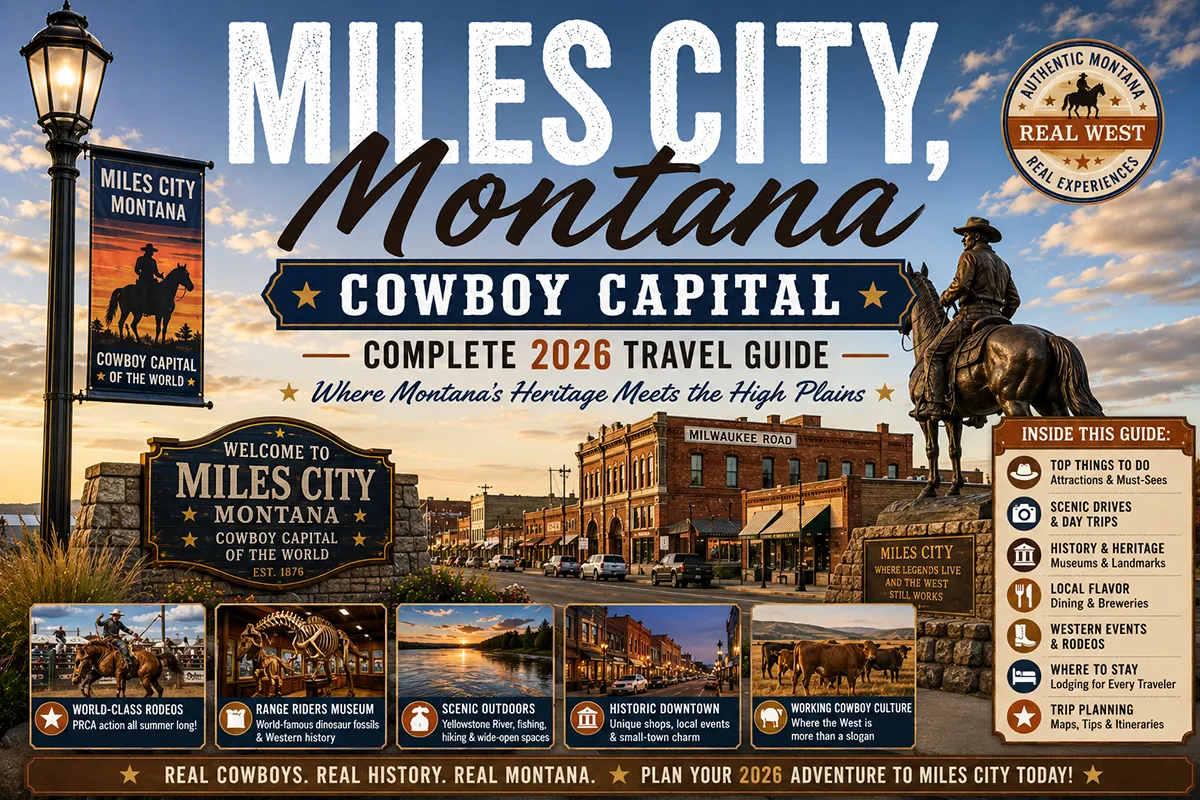
When the Army shifted its post two miles west in the late 1870s, the saloons and storekeepers of Miles City packed up and followed. The town has been chasing horses, cattle and a good party ever since.
TL;DR
- Miles City (population 8,354 in the 2020 census) sits where the Tongue River meets the Yellowstone, roughly 144 miles east of Billings on I-94, in the Southeast Montana tourism region.
- The headline event is the Bucking Horse Sale, held the third full weekend of May. It ran four days for its 75th anniversary in 2026, and hotels sold out.
- The rest of the year, the draws are the Range Riders Museum (seasonal, closed Tuesdays), the 1908 Montana Bar, the WaterWorks Art Museum, Pirogue Island State Park and Tongue River Winery.
- Plan on one night at minimum. Summer highs average near 89°F, January lows average near 9°F, and a few attractions close for winter.
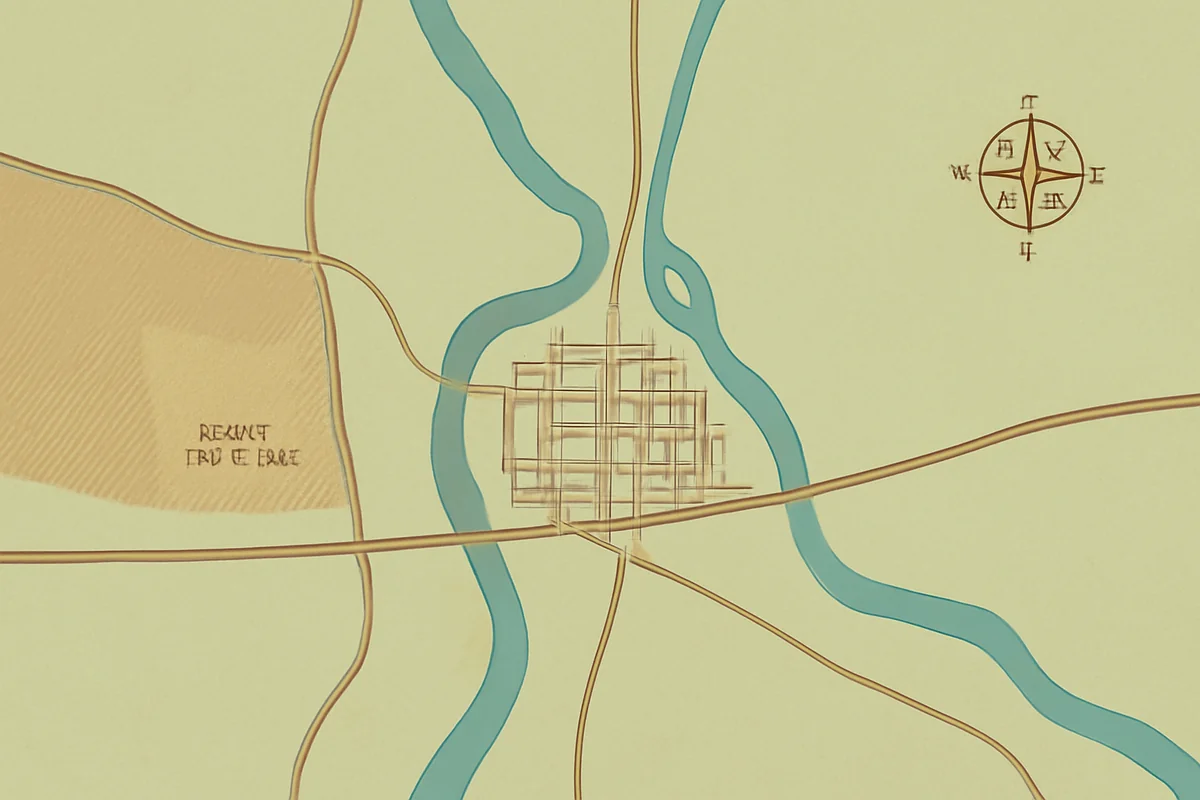
Drivers on I-94 see Miles City as a cluster of exit signs. Pull off at Exit 135 instead, and the approach tells the story in order: a state fish hatchery, the log buildings of the Range Riders Museum, the Eastern Montana Fairgrounds, and then about seven blocks of historic Main Street with hotels, bars and shops. Exit 138 is the other option, and it leads to South Haynes Avenue, where most chain motels sit.
The town is not a postcard. It is a working livestock hub that happens to have a remarkable past: a military cantonment, a cattle shipping point for Texas herds, the center of a horse trade large enough to supply an army, and the birthplace of a rodeo-stock sale that has no real equivalent. It remains the commercial hub of southeastern Montana, and the saddle shops, stockyards and sale barns are still part of daily life.
This guide covers what the town actually offers in each season, what changes between a quiet Tuesday in February and Bucking Horse Sale weekend, and where the details in older travel articles no longer hold up. For the wider picture, see the Montana cities and towns hub and the Southeast Montana regional guide.
Liked this article?
Add Roaming Montana as a preferred source so you see more of our articles and guides on Google.
Miles City at a Glance
| Detail | Fact |
|---|---|
| Population | 8,354 (2020 census); Custer County 11,867 |
| Elevation | 2,362 feet |
| County seat of | Custer County |
| Tourism region | Southeast Montana (historically “Custer Country”) |
| Rivers | Tongue River meets the Yellowstone at town |
| Interstate | I-94, Exits 135, 138 and 141 |
| Distance to Billings | About 144 miles |
| Distance to Glendive | About 76 miles |
| Climate | Cold semi-arid; about 12.9 inches of precipitation a year |
| Signature event | World Famous Miles City Bucking Horse Sale, third full weekend in May |
Where the Rivers Meet: How a Fort Became a Cow Town
A cantonment, then a fort, then a town that followed
The Battle of the Little Bighorn in June 1876 reshaped eastern Montana within weeks. The Army sent Colonel Nelson A. Miles to the confluence of the Tongue and Yellowstone Rivers, where a temporary post called the Tongue River Cantonment appeared in 1876. A permanent fort went up on higher ground two miles west and was named Fort Keogh in November 1878, after Captain Myles Keogh, one of Custer’s officers killed at the battle. His horse, Comanche, was the only survivor found on Custer’s part of the field.
Where soldiers go, merchants follow. Miles reportedly grew tired of the whiskey trade around the post and evicted the sutlers in spring 1877. They moved about two miles east and platted the first Miles City, often called Milestown. When the cantonment relocated west, the town shifted with it to its present site. The last residents of “Old Miles City” held on until 1900. The town was incorporated in 1887, and Custer County’s court first met here in 1879.
The honest part of this history is the fort’s purpose. Fort Keogh was a base for military campaigns against the Lakota and Northern Cheyenne after the 1876 battle, and its commander used it to bring remaining Native bands under Army control through the 1880s. The Northern Cheyenne Reservation and the town of Lame Deer lie to the south in the same region, and Southeast Montana tourism now presents Crow and Cheyenne perspectives alongside the Army narrative.
Texas herds, the stockgrowers and the horse trade
Livestock speculation brought thousands of cattle to open range in the late 1880s, and the railroad extended through the area. Northern Pacific track crossed the Tongue River in 1881, about a mile from the junction with the Yellowstone, and Texas herds were driven to Miles City to fatten on free grass before being loaded onto trains for Chicago. The Montana Stockgrowers Association was founded in town in 1884, which cemented Miles City as the administrative center of the state’s cattle industry.
Horses followed cattle. Fort Keogh became a remount station in 1909 and supplied thousands of horses during World War I, and regional accounts say Miles City briefly became the largest horse market in the world. Saddle makers clustered here too. One historic shop, covered below, turned out 1,937 saddles in 1916 alone.
What Fort Keogh is today
The military reservation was transferred to the U.S. Department of Agriculture in 1924. Today it is the USDA Agricultural Research Service’s Fort Keogh Livestock and Range Research Laboratory, on roughly 55,000 acres west of town. Researchers there pioneered methods for genetic evaluation of beef cattle in the 1930s and showed the value of crossbreeding for beef efficiency in the late 1930s.
Of roughly 100 buildings at the fort in the late 1800s, only a handful survive, and the grounds are an active research station rather than a visitor attraction. The Range Riders Museum holds the best public exhibit on the fort’s military days.
The Bucking Horse Sale: What Actually Happens
The accidental origin story
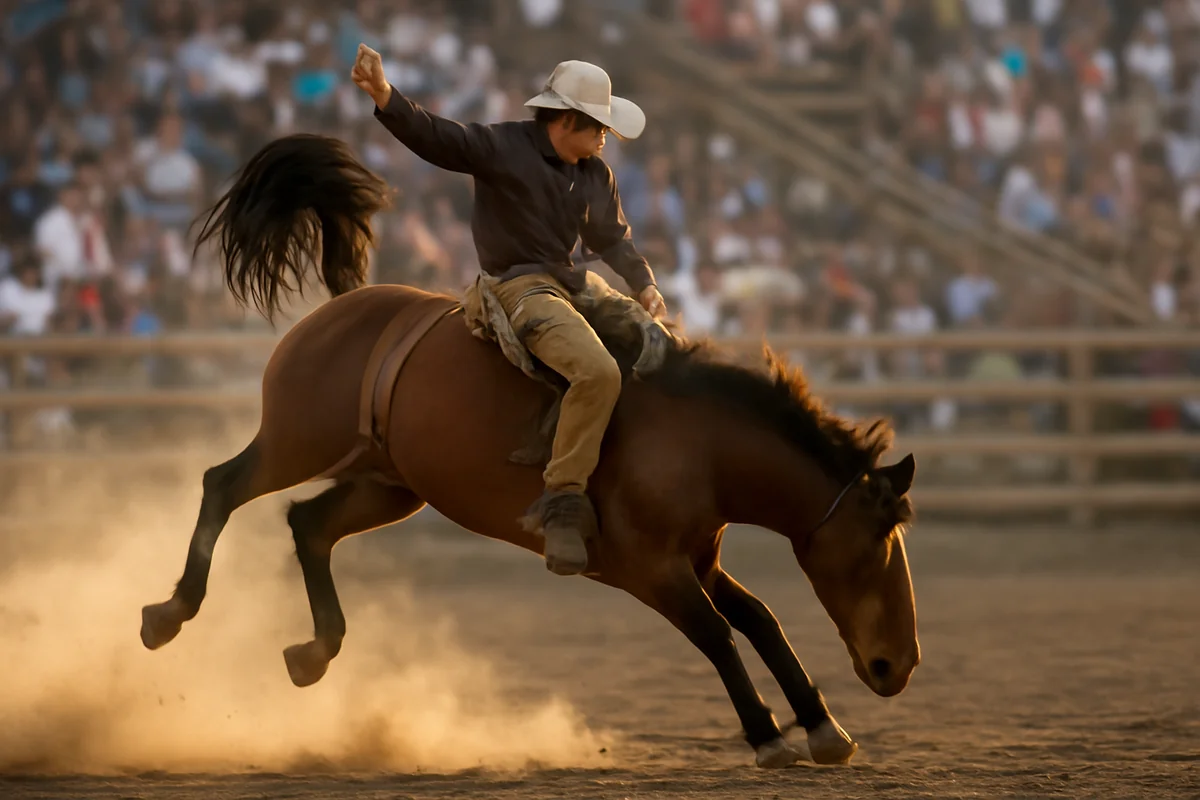
The sale began with a deal that went sideways in a useful way. According to Montana rancher and writer John Moore, Les Boe of the Miles City livestock operation went to Ekalaka to buy yearling steers from a man known as Heavy Lester. Lester threw in about 35 head of bucking horses, and Boe had no idea what to do with them. Someone suggested a sale. An unofficial one ran in 1950, and the first official Bucking Horse Sale followed in 1951, timed with the opening of the new salesyard across the Tongue River. For the Ekalaka end of the story, see the Ekalaka town guide.
By 2026, the event had reached its 75th year. The organizers note it was skipped only once, during the COVID year. Montana’s Department of Commerce used the anniversary to point out that rodeo is now Montana’s official state sport.
How the four days are structured
The weekend runs Thursday through Sunday, and the official schedule shifts slightly from year to year. The 2026 event ran May 14 through 17 at the Eastern Montana Fairgrounds, and the pattern is a reliable guide:
- Thursday: Kickoff concert, with gates opening at 5 p.m. in 2026.
- Friday: Trade show, horse racing, and the bucking bull sale.
- Saturday: The Main Street parade at 9 a.m., the Cowboy Breakfast at the Range Riders Museum’s Memorial Hall, the bucking horse futurity, the sale itself in the afternoon, wild horse races and a street dance downtown. Saturday is the only day that still includes the traditional horse sale.
- Sunday: The PRCA-sanctioned Xtreme Broncs match, where top saddle bronc riders compete head to head.
The festival also includes pari-mutuel horse racing, a large Western trade show, live concerts and a Sunday brunch hosted by the WaterWorks Art Museum. Organizers call the whole thing “Cowboy Mardi Gras,” and published estimates put attendance near 20,000 visitors in a town of 8,354 people.
Lodging and logistics on sale weekend
Hotels in town sold out ahead of the 2026 sale, according to the local newspaper’s preview coverage. Anyone planning a 2027 trip should book lodging as early as the reservation window allows and treat Billings, Forsyth and Glendive as fallback bases. The drive from Billings is about two hours each way, so a day trip is feasible but means missing the best of the street dances.
Ticketing for the concert and rodeo sessions runs through the official Bucking Horse Sale website.
If May is not on the calendar
Miles City still runs weekly livestock auctions, and the Eastern Montana Fair in August brings its own PRCA rodeo, a demolition derby and concerts to the fairgrounds, typically drawing about 17,000 people. A bluegrass festival has also run in the fall. Visitors who miss May are not missing the town, only its biggest weekend.
An Afternoon on Main Street
Main Street is compact and walkable, with a historic district that runs for roughly seven blocks. A slow afternoon covers it comfortably.
The Montana Bar
At 612 Main Street, the Montana Bar is the town’s best-known room. Some older web copy gives its opening as 1902, but the Miles City Area Chamber of Commerce and National Geographic both date it to 1908, when James Kenney bought his bar and moved it into the building. The building itself dates to the 1890s and was enlarged in 1914, according to Frommer’s.
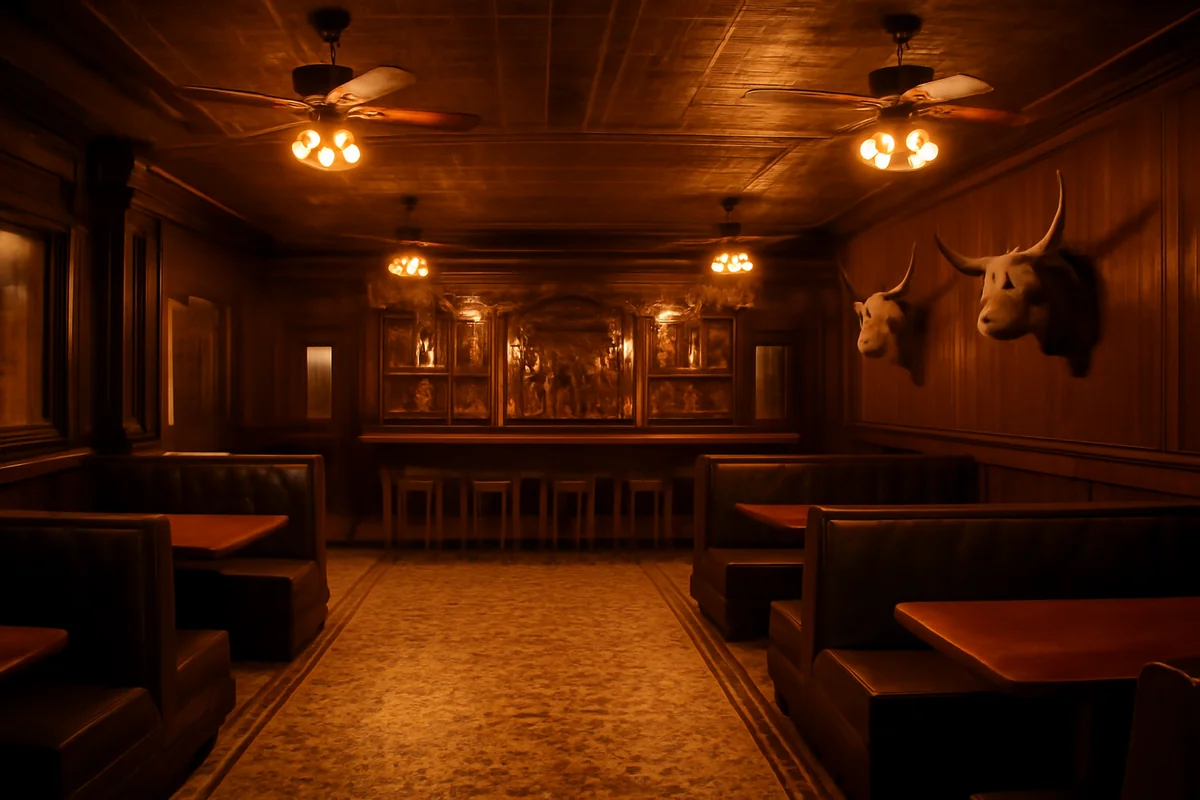
The details are what draw people: a pressed-tin ceiling, a multicolored tile floor, horsehide-covered booths, three mounted longhorn steers over wooden tables, a bullet hole in a leaded-glass panel, and a 1914 National Cash Register double-drawer till that still sits on the back bar. A Montana-shaped neon sign marks the entrance, and the owner’s name, James Kenney, is set in tile at the door. The bar closed for nearly four years in the late 1980s before a group of stockholders brought it back.
Food service at the Montana Bar has changed over the years, with the room moving between steakhouse and straight saloon. Bucking Horse Sale weekend is wall-to-wall, so an off-weekend visit is the better way to see the room itself.
Historic Miles City Saddlery
The saddlery dates to August 1909, when employees of the Coggshall Saddlery bought the business and formed the Miles City Saddlery Co. In 1916, the company made 1,937 saddles. Between 1910 and the Depression, as many as 40 saddle makers worked in town, and Miles City was said to have more saddle shops than anywhere on earth.
The shop on Main Street changed hands and was renovated in 2024. It now sells Western wear, souvenirs and Montana-made products, and older listings that describe it as a working custom-saddle studio may be out of date.
Smaller stops downtown
Vintage and Rustics in Montana, an antique and vintage store spanning much of a block, fills an hour of browsing and includes the Remember When Cafe. The Olive Hotel, a historic landmark with its own state marker, stands a few hundred feet from the Montana Bar.
Range Riders Museum: Plan Two Hours or Six
The Range Riders Museum was founded in 1939 by actual range riders, and it is still run on community support without county tax dollars. It has grown into a 13-building complex that starts with the original log building dedicated in 1942.
The collection includes:
- The Bert and Mamie Clark gun collection, a headline exhibit.
- A Wagon Depot filled with antique vehicles.
- A one-room schoolhouse and a pioneer home moved in from a homestead.
- A reconstructed Main Street of “Old Milestown.”
- A Fort Keogh exhibit that includes U.S. Army uniforms from the post.
- Oddities that draw laughs, including a case of 1,500 tobacco pouches and a famously ancient doughnut.
Hours. The museum’s own website lists April 15 through October 15, 8 a.m. to 5 p.m., six days a week, closed Tuesdays. A local airport webpage lists a different schedule, so the museum’s official site should be treated as the final word. The museum has also held free open-house days, such as its Pioneer Day on September 13, 2025.
The museum also hosts the Cowboy Breakfast on the Saturday morning of Bucking Horse Sale as a fundraiser, which is one of the most pleasant ways to start the busiest day of the year.
WaterWorks Art Museum: Art in a Former Water Plant
The WaterWorks Art Museum is housed in what used to be Miles City’s drinking water plant. Congress had to approve the project because it sat on federal land, and the plant began pumping Yellowstone River water in December 1911. It operated for more than 60 years, until 1974, when the Custer County Art and Heritage Center leased the building. The museum has been open to the public since 1977 and carries the newer WaterWorks name.
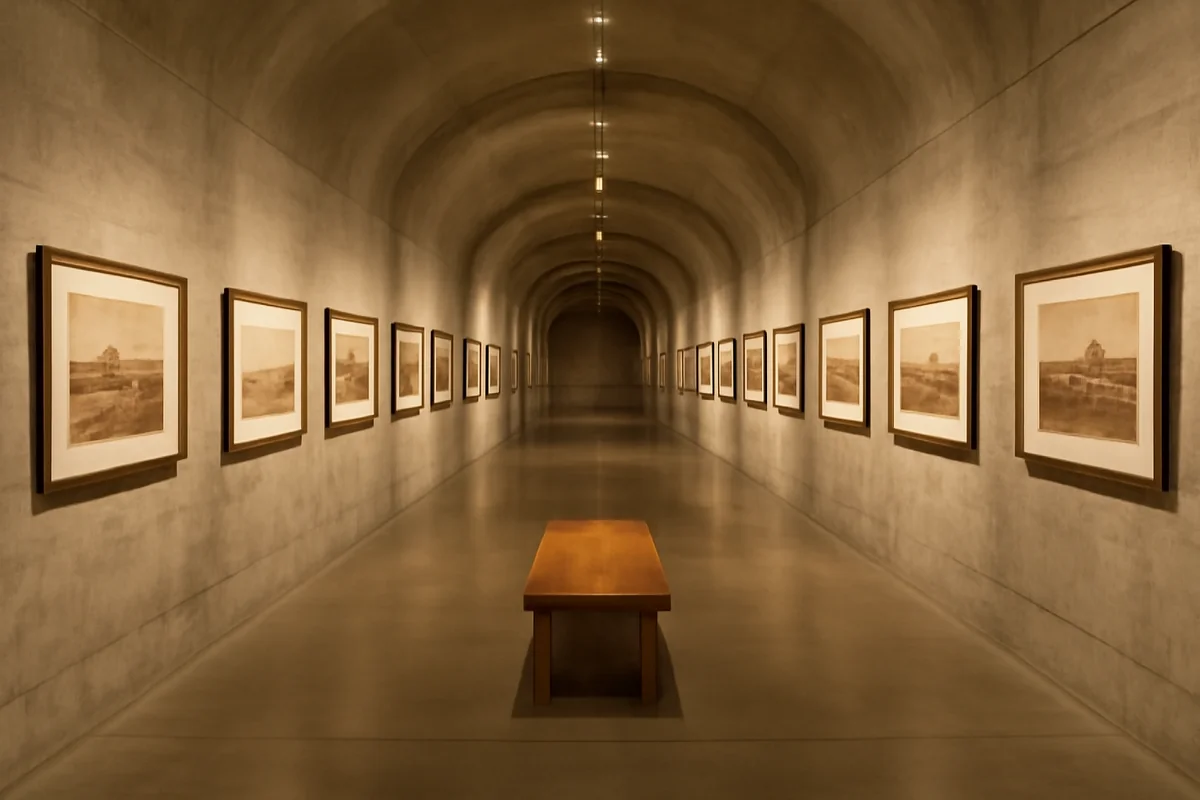
The building is on the National Register of Historic Places, and it has a feature few art museums share: the galleries occupy former concrete settling tanks, so there are no windows and no natural light. The effect feels more like a bunker than a white cube, and the permanent collection earns the visit. It includes a large public collection of vintage L.A. Huffman photographs from the 1800s, along with work by Evelyn Cameron, Edward Curtis and Christian Barthelmess. For more on Cameron, see Terry, where a heritage center honors her photography of eastern Montana ranch life.
Hours. One regional listing gives May through September hours of 9 a.m. to 5 p.m. Tuesday through Sunday and October through April hours of 1 p.m. to 5 p.m. Tuesday through Sunday, closed Mondays. The museum sits about a third of a mile west of Main Street on Waterplant Road, in a park overlooking the Yellowstone.
Outdoors Around Miles City
Pirogue Island State Park
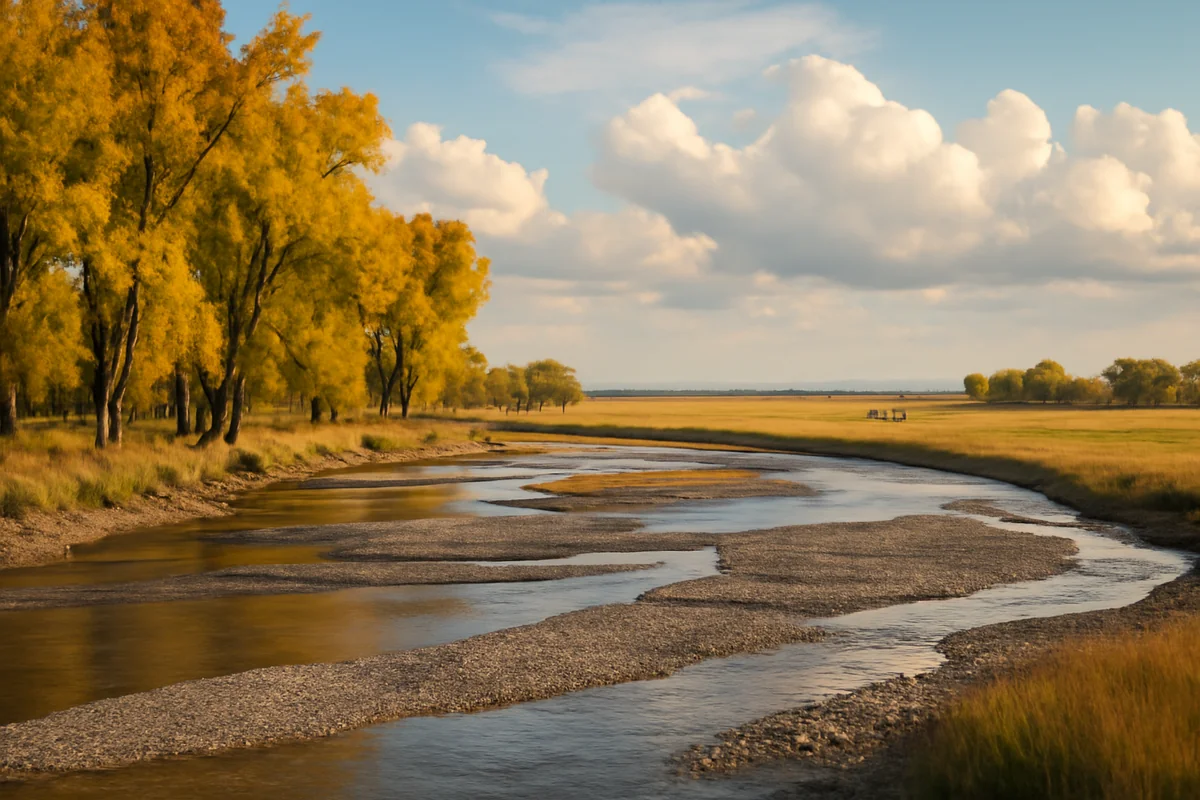
A cottonwood-covered island in the Yellowstone River, 269 acres, with 2.8 miles of designated trails and eight interpretive signs. Bald eagles, waterfowl, white-tailed deer and mule deer are the usual wildlife, and moss agates turn up for patient hunters. See the Montana agate guide for background on the stone. It is also a possible site of Captain William Clark’s camp on July 29, 1806, during the Lewis and Clark return trip.
Access is the catch. To reach the island, visitors cross a side channel of the river. Montana Fish, Wildlife and Parks says mid-August through early April is the best time to cross, and the Montana State Parks Foundation notes that crossing is not recommended if water is flowing. There is no visitor center, no camping and no staff on site.
The day-use fee is $8 per vehicle and $4 for walk-ins, bicycles and bus passengers, with a waiver for Montana residents who pay the state parks fee with vehicle registration. From Miles City, go about one mile north on Montana 22, then roughly two miles east on Kinsey Road, then south on a county road.
Spotted Eagle Recreation Area
Spotted Eagle, a city-owned 123-acre property with a 23-acre lake, sits just west of town behind the Eastern Montana Fairgrounds. It has picnic tables, grills, a nature trail and a snowmobile trail, and swimming is allowed without lifeguards. It is named for a Sioux chief who camped his people nearby in the 1870s, and it is a good spot for a picnic lunch between museums.
On the Tongue and the Yellowstone
The Tongue River is shallow, and tubing near 12 Mile Dam is a local summer pastime. Anglers should recalibrate expectations. Wikipedia’s town entry notes that both rivers produce mostly catfish, carp and a minnow-like fish locals call shiners, and the state fish hatchery by the highway stocks regional reservoirs. Some visitor sources imply trout fishing. The Miles City stretch is a warm-water fishery.
Tongue River Winery
Tongue River Winery bills itself as the only commercial vineyard in the eastern three-quarters of Montana. The vineyard dates to 2004 and the winery to 2010. The three-acre property also grows haskap berries, cherries, apples, pears, raspberries and plums, and the owners make wine only from fruit that grows in Montana or an adjacent state. The 2017 Marquette won a Jefferson Cup, reported to be the first for a Marquette wine in the United States. Popular bottles include Tongue Tied (a dry red) and a rhubarb wine.
Tastings are free and the owners have offered tours of the vineyard. The address on the Chamber of Commerce listing is 99 Morning Star Lane, about two miles from I-94. Hours differ by source, so call ahead. The property also runs a two-room bed and breakfast.
Where to Sleep
Lodging in Miles City falls into two clusters, and choosing between them is mostly about whether the trip is about convenience or atmosphere.
Exit 138, South Haynes Avenue. This strip has most chain properties. Listings include the Best Western War Bonnet Inn (also appearing as SureStay by Best Western), Sleep Inn & Suites, Super 8, Miles City Hotel & Suites, Fairbridge Inn & Suites and Econo Lodge, plus Travelodge and Motel 6. The War Bonnet has an indoor pool and hot tub, and it sits two blocks north of the exit.
Downtown and Exit 135. Staying near Main Street means walking to the Montana Bar and the saddlery. Options here are fewer, so check the Chamber’s lodging page for rentals such as the downtown apartment attached to the historic Montana Theatre.
Camping and RVs. The Miles City KOA operates mid-April through October near the confluence, and Big Sky Camp & RV Park is in town. For broader options, see the best RV parks in Montana. Tongue River Reservoir State Park, roughly an hour and a half south, offers lakeside camping from May through September.
Pricing. One booking site’s recent average for the town was roughly $67 a night, and rates on Bucking Horse Sale weekend run far higher.
Where to Eat and Drink
Dining here is straightforward and the hours are short, so confirm before driving across town.
- Montana Bar for the room itself, more than the menu.
- 600 Cafe at 600 Main Street, a long-running diner with a breakfast counter and hearty plates.
- Montana’s Rib & Chop House on Montana Avenue, one of the town’s steak options. For a statewide comparison, see the best steakhouses in Montana.
- Main Street Grind at 713 Main Street, a local favorite for homemade baked goods made with local honey.
- Remember When Cafe inside Vintage and Rustics in Montana at 813 Main Street.
Many kitchens in small eastern Montana towns close by mid-evening, so a sit-down dinner is better planned than improvised.
Day Trips from Miles City
| Destination | Approximate distance | Why go |
|---|---|---|
| Glendive and Makoshika State Park | About 76 miles east | Montana’s largest state park, with badlands and dinosaur fossils |
| Little Bighorn Battlefield | About 120 to 130 miles; plan on two to three hours | The site of the 1876 battle, now interpreted from Native and military perspectives |
| Forsyth | West on I-94 toward Billings | A Yellowstone River town with a historic downtown |
| Baker | About 82 miles southeast | Gateway to Medicine Rocks State Park |
| Broadus | About 81 miles south | Powder River County seat |
| Billings | About 144 miles west | The region’s airport, food scene and museums |
| Tongue River Reservoir State Park | About 58 to 70 miles south | Walleye, bass and camping near Decker |
Southeast Montana’s Trail to the Little Bighorn adds 19 roadside markers between Miles City and Custer that trace the movements of the Seventh Cavalry. Doing all of them plus the battlefield takes a full day or more. Tongue River Reservoir is a longer drive than the map suggests, so it works best as an overnight rather than a quick detour.
For more regional ideas, the Southeast Montana guide covers the whole area, and the top things to do in Miles City post goes deeper on individual activities.
Miles City by Season
The weather numbers come from National Weather Service 1991 to 2020 normals recorded at the Miles City Airport.
| Month | Average high | Average low | Notes |
|---|---|---|---|
| January | 30.1°F | 8.9°F | Record low of -38°F |
| April | 58.1°F | 32.9°F | Museums reopen April 15 |
| May | 68.1°F | 42.9°F | Wettest month at 2.73 inches; Bucking Horse Sale |
| July | 88.7°F | 59.6°F | Record high of 115°F |
| October | 59.0°F | 33.8°F | Museums close October 15 |
The town averages about 12.9 inches of precipitation a year and about 29.5 inches of snow, and the climate is classified as cold semi-arid. May is both the busiest and the wettest month, which is why rain has wiped out racing at past sales. Pack layers for the sale and expect mud near the fairgrounds if it rains.
Spring. The best Pirogue Island crossing window ends in early April, and the channel is more likely to be running afterward. The Range Riders Museum opens mid-April.
Summer. Hot and dry. River edges can be buggy, so see the Montana bug season guide. Tubing and Spotted Eagle are best from late June through August.
Fall. Cooler and quieter, with the museum season ending in mid-October. Hunting is a major visitor draw across the region.
Winter. Quiet and cold. The Montana Bar and downtown stay open, but the Range Riders Museum is closed and the WaterWorks Art Museum runs shorter afternoon hours. For broader seasonal planning, see Montana in May and the statewide Montana weather guide.
A Few Oddities Worth Knowing
Miles City collects strange footnotes.
- In March 1944, an ice jam on the Yellowstone caused flooding that reached the town. A B-17 bomber was dispatched from Rapid City, South Dakota, and cleared the jam with 250-pound bombs.
- The city holds the record for the highest mean sea level pressure in the contiguous United States: 31.42 inches of mercury on December 24, 1983.
- Guinness World Records lists a 15-inch snowflake recorded at Fort Keogh in January 1887, but there is no corroborating evidence, so treat it as legend.
- KYUS-TV launched in 1969 and was once noted as the smallest network affiliate in the country.
- The microbiologist Maurice Hilleman, known for his work on vaccines, was born in Miles City.
Local Knowledge: What Most Visitors Learn Too Late
Enter at Exit 135 for the full effect. The sequence of the hatchery, museum, fairgrounds and historic blocks tells the town’s story in order. Exit 138 is faster but misses it.
The museum is seasonal. A winter drive-through means the Range Riders Museum is closed, and a Tuesday means it is closed all season. The WaterWorks Art Museum is closed Mondays.
Pirogue Island is a wading trip, not a walk. Bring water shoes, check river flow first, and have a backup plan if the channel is running.
The sale is the weekend, not the week. Visitors who arrive Tuesday for a Saturday event find the town quiet. Thursday through Sunday is when it fills.
Dates vary by source. The Montana Bar is dated to 1908 by the Chamber and National Geographic, the waterworks building is cited as both 1910 and 1911 (pumping began in December 1911), and the town belongs to the Southeast Montana tourism region rather than Missouri River Country.
Hours are short. Small-town eastern Montana runs early. Call ahead for the winery, the saddlery and any kitchen after 8 p.m.
Airports. Miles City Airport (Frank Wiley Field) is public-use, but commercial service has been limited or absent in recent years, so Billings Logan International is the practical airport. See the Montana airports guide. Jefferson Lines bus service also stops in town.
Practical Info: Miles City at a Glance
| Item | Details |
|---|---|
| Best season | Mid-May for the Bucking Horse Sale; June through September for warm-weather sightseeing |
| Getting there | I-94, Exits 135, 138 and 141; Montana Highway 59 north-south; Jefferson Lines bus; Billings Logan International is the practical airport |
| Range Riders Museum | 435 L.P. Anderson Road; April 15 to October 15, 8 a.m. to 5 p.m., closed Tuesdays |
| WaterWorks Art Museum | 85 Waterplant Road; closed Mondays; hours vary by season |
| Pirogue Island State Park | $8 per vehicle, $4 walk-in; no camping; best crossing mid-August to early April |
| Tongue River Winery | 99 Morning Star Lane; call ahead |
| Bucking Horse Sale | Third full weekend of May; Eastern Montana Fairgrounds, 42 Garryowen Road |
| Bring | Layers, water shoes for Pirogue Island, sun protection, drinking water |
| Nearby | Glendive and Makoshika State Park, Forsyth, Baker, Broadus, Ekalaka, Little Bighorn Battlefield |
Frequently Asked Questions
What is Miles City, Montana known for?
It is known for the World Famous Miles City Bucking Horse Sale each May, its cattle and horse-trading history, the Range Riders Museum, the historic Montana Bar and its location where the Tongue and Yellowstone Rivers meet.
When is the Miles City Bucking Horse Sale?
The sale is held the third full weekend of May at the Eastern Montana Fairgrounds. The 75th anniversary in 2026 ran May 14 through 17, and the actual sale takes place on Saturday. Confirm dates for the next event on the official site.
How far is Miles City from Billings?
Miles City is about 144 miles east of Billings on I-94, roughly a two-hour drive.
Is Miles City worth an overnight stop?
For travelers crossing eastern Montana on I-94, yes. A night allows the Range Riders Museum, a Main Street walk and the Montana Bar without rushing, and lodging is typically modest outside event weekends.
When is the best time to visit Miles City?
Mid-May suits those who want the Bucking Horse Sale and can book early. June through September offers warm weather and full museum hours, while winter is quiet with several attractions closed.
One Last Look at a Working Western Town
Miles City does not stage its history for visitors. The saddle shop is a store, the Montana Bar is a bar, the sale barn is still a sale barn, and the research station on the old fort grounds still studies cattle. That is the draw, and also the reason a little planning pays off. Go in May for the spectacle, or choose a quieter September weekday while the museums are still open through mid-October.
Pin this guide for your Montana road trip, explore the full list of Montana cities and towns, and drop any Miles City questions in the comments.
Sources and further reading
- Miles City Area Chamber of Commerce
- Visit Southeast Montana
- Range Riders Museum
- Montana FWP: Pirogue Island State Park
- Montana Department of Commerce: Bucking Horse Sale 75th anniversary release
- USDA ARS Fort Keogh Livestock and Range Research Laboratory history
- National Weather Service 1991 to 2020 climate normals, Miles City Airport
