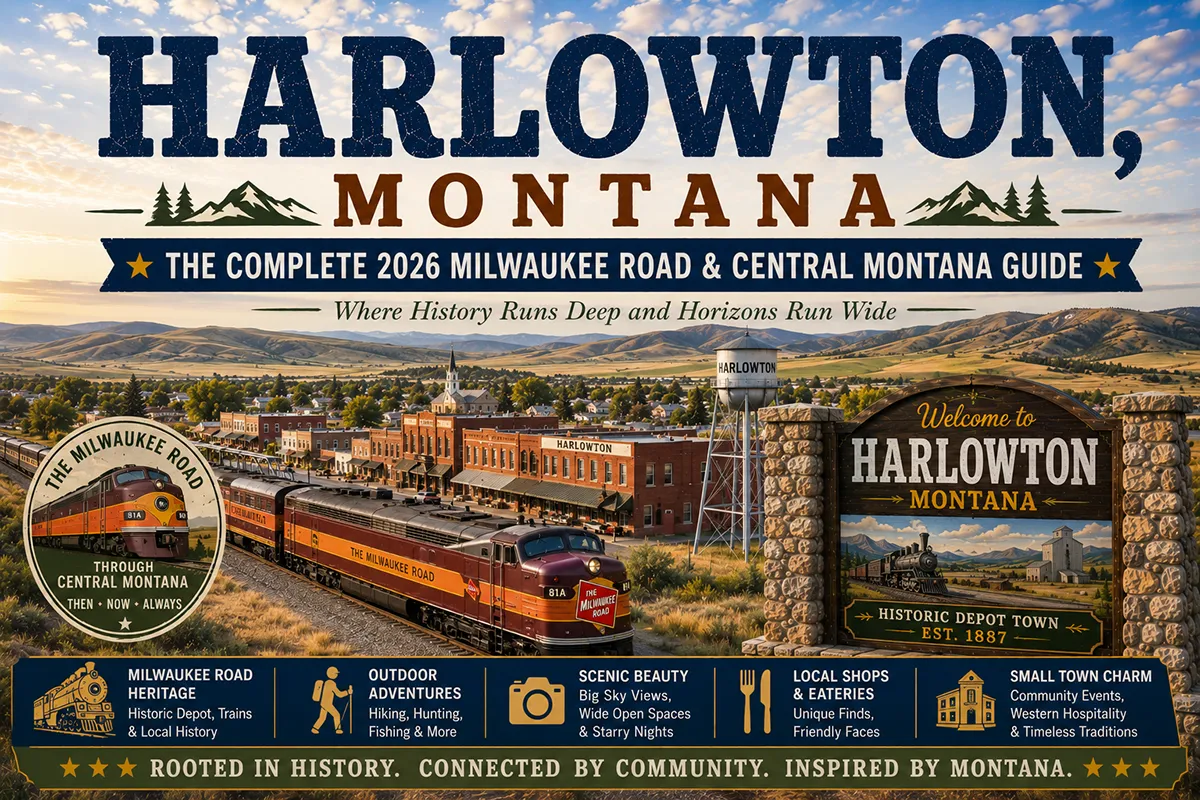
From 1914 to 1974, Harlowton was the eastern terminus of the Milwaukee Road’s electrified rail operations — the most ambitious electrification project in American railroad history.
Electric locomotives replaced steam on this segment because Montana’s grades required immense power and the region’s rivers provided cheap hydroelectric generation.
A 1915 General Electric E57B electric locomotive still stands on a concrete pad at the corner of US-12 and Main Street. Most people drive past it without recognizing what they’re looking at. It’s a monument to one of America’s most extraordinary industrial experiments.
TL;DR
- Harlowton (~900) is the county seat of Wheatland County in central Montana, on US-12 between Billings and Helena.
- Was the eastern terminus of the Milwaukee Road’s electrified railway (1914–1974) — an E57B locomotive stands on Main Street as a memorial.
- Upper Musselshell Museum houses “Ava” — a replica skeleton of Avaceratops lammersi, a dinosaur found on Careless Creek north of town.
- The Judith Gap Wind Energy Center north of town is one of Montana’s largest wind farms — a dramatic modern landscape.
- Best for: railroad history enthusiasts, dinosaur trail visitors, US-12 corridor travelers.
Liked this article?
Add Roaming Montana as a preferred source so you see more of our articles and guides on Google.
Harlowton at a Glance
| Population | ~900 | | County | Wheatland County (county seat) | | Distance to Billings | ~120 miles east (~2 hours) | | Distance to Helena | ~115 miles west (~2 hours) | | Distance to Lewistown | ~75 miles northeast (~1.25 hours) | | US-12 position | Midpoint of central Montana corridor |
What Makes Harlowton Different
The Milwaukee Road electrification story is the most important SERP gap here. Between 1914 and 1974, the Chicago, Milwaukee, St. Paul and Pacific Railroad ran electric trains between Harlowton and Avery, Idaho — a 440-mile electrified corridor through some of North America’s most difficult mountain terrain.
The technology was revolutionary; the locomotives were purpose-built by General Electric. When the railroad went bankrupt and dismantled in 1980, the overhead wire infrastructure disappeared. But the locomotive on Main Street remains.
The Upper Musselshell Museum is genuinely worth time. “Ava” — a life-size replica of Avaceratops lammersi found on Careless Creek north of Harlowton in 1981 — is the centerpiece.
Eddie Cole found the original fossils; the dinosaur was named after his wife. The museum also has a horse-drawn hearse with a “special passenger,” a saloon replica, and an extensive gun collection.
The Top Things to Do
1. Milwaukee Road E57B Electric Locomotive (Main Street)
The free, outdoor exhibit at US-12 and Main Street. The E57B electric locomotive represented the state of the art in 1914 railway technology. Interpretive signs explain the electrification project’s history.
2. Upper Musselshell Museum (“Ava”)
Two limestone buildings in downtown Harlowton — the original 1909 museum building and the Marshall Building (1906). “Ava” the Avaceratops lammersi replica anchors the dinosaur exhibit. Also: gun collection, horse-drawn hearse, Plains Indian artifacts, pioneer room. Free or minimal admission.
3. Milwaukee Depot Museum
The restored 1908 Milwaukee Road depot — exhibits on the railroad’s history and its importance to central Montana. Adjacent to a small park with the Smoking Boomer Rail Trail.
4. Judith Gap Wind Energy Center
North of Harlowton on US-191 toward Judith Gap — one of Montana’s largest wind farms, with dozens of turbines visible from the highway. A striking modern industrial landscape on the open plains.
5. Musselshell River Fishing Access
The Musselshell flows through Harlowton — 5-acre fishing access site for day use on the river.
6. Jawbone Creek Golf Course
A 9-hole links-style course with two sets of tees near Harlowton.
7. Galey’s Brewery
Harlowton’s local craft brewery — try the “Harlo Music Project Lager” and other local offerings.
8. Deadman’s Basin Reservoir (30 miles east on US-12)
A Bureau of Reclamation reservoir east of Harlowton — boating, fishing, camping on the central Montana plains.
9. Chief Joseph’s Nez Perce Route (Judith Gap area)
Chief Joseph led the Nez Perce through Judith Gap during their 1877 flight toward Canada — historical markers along US-191.
10. Two Dot (18 miles south)
A tiny ranching community named for rancher George “Two Dot” Wilson — whose cattle brand was simply two dots. Classic central Montana character.
Where to Stay & Eat
- Country Side Motel — reliable basic motel ($90–140)
- Corral Motel — budget option ($75–110)
- Musselshell Steakhouse — best dinner in Harlowton
- Galey’s Brewery — beer and food
Getting There
US-12 midpoint between Billings (120 miles east, ~2 hours) and Helena (115 miles west, ~2 hours). Also US-191 north to Lewistown (75 miles, ~1.25 hours).
Quick Facts
Founded 1900 (Montana Railroad). Named for Richard Harlow, Montana Railroad founder. Milwaukee Road electrification: 1914–1974. “Ava” the Avaceratops: discovered 1981 on Careless Creek. Average summer high: 82°F.
Frequently Asked Questions
Is Harlowton Montana worth visiting?
Worth a 2-hour stop for the Milwaukee Road E57B electric locomotive (the most important artifact of the historic electrification project), the Upper Musselshell Museum (including “Ava” the Avaceratops replica), and genuine central Montana character. For railroad history enthusiasts, Harlowton is a pilgrimage site.
What is the Milwaukee Road connection to Harlowton?
From 1914 to 1974, Harlowton served as the eastern terminus of the Milwaukee Road’s remarkable electrified railway — a 440-mile electric rail corridor from Harlowton, Montana to Avery, Idaho. The electrification used hydroelectric power and GE-built electric locomotives. The E57B locomotive on Harlowton’s Main Street commemorates this history.
What is “Ava” at the Upper Musselshell Museum?
“Ava” is a life-size replica skeleton of Avaceratops lammersi — a ceratopsian dinosaur (horned, like Triceratops but smaller) found on Careless Creek north of Harlowton in 1981 by rancher Eddie Cole. The dinosaur was named for Cole’s wife. The original fossils are significant to paleontology; the replica is on display at the Upper Musselshell Museum.