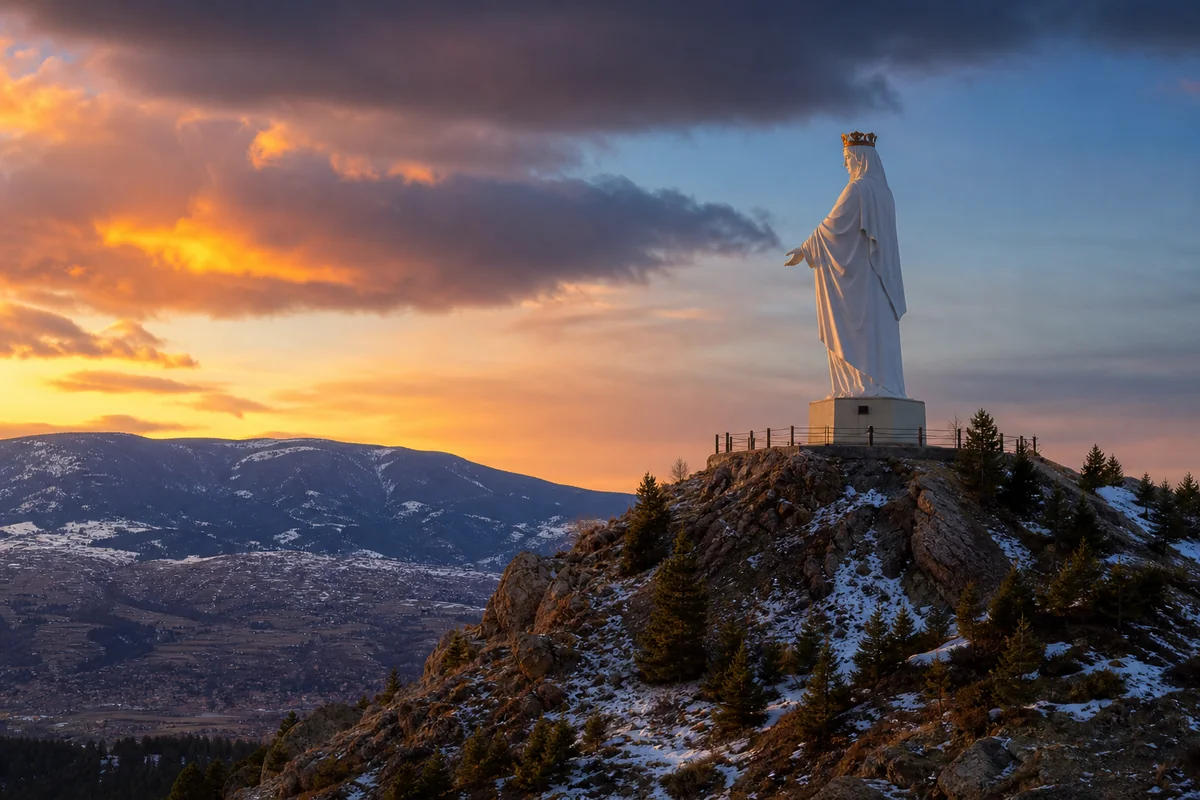
The first time I saw Our Lady of the Rockies, I was driving into Butte from the east on I-90 just as the sun was setting behind the Continental Divide.
That massive white figure, perched impossibly high on the ridge, seemed to glow against the darkening sky—and I literally pulled over to the shoulder just to stare. In that moment, I understood why this statue means so much to the people of this hardscrabble mining town.
- Our Lady of the Rockies stands 90 feet tall on the Continental Divide, making it the fourth tallest statue in the United States
- Bus tours depart from the gift shop at 3100 Harrison Avenue and run June through September (reservations required)
- The statue was built entirely by volunteers over six years and completed in 1985
- Evening tours offer the best lighting for photos; bring layers as temperatures drop significantly at 8,510 feet
- The statue is non-denominational and dedicated to all mothers, despite its name
- Allow 2-3 hours for the complete tour experience including the visitor center

Liked this article?
Add Roaming Montana as a preferred source so you see more of our articles and guides on Google.
Why Our Lady of the Rockies Should Be on Your Montana Itinerary
I’ll be honest—when I first read about a 90-foot statue of Mary overlooking a former copper mining town, I wasn’t sure what to expect. Would it feel like a kitschy roadside attraction? Would it be overly religious for a non-denominational traveler like myself?
What I discovered during my visit last summer completely changed my perspective. This isn’t just a statue—it’s a monument to human determination, community spirit, and the remarkable things that happen when ordinary people refuse to give up on an extraordinary dream.
Standing at 8,510 feet on the East Ridge of the Continental Divide, Our Lady of the Rockies is taller than the Christ the Redeemer statue in Rio de Janeiro. Let that sink in for a moment.
The Incredible Story Behind the Statue
Every great monument has a story, but the origin of Our Lady of the Rockies hits different. It began in 1979 with a Butte man named Bob O’Bill, whose wife Joycee was seriously ill.
Bob made a simple promise: if his wife recovered, he would build a small statue of the Virgin Mary on their property. Joycee did recover, and Bob started working on his five-foot statue.
Word spread through Butte’s tight-knit community. Other men—many of them unemployed miners dealing with the devastating closure of the Anaconda Company mines—wanted to help. Someone suggested making it bigger. Then bigger still.
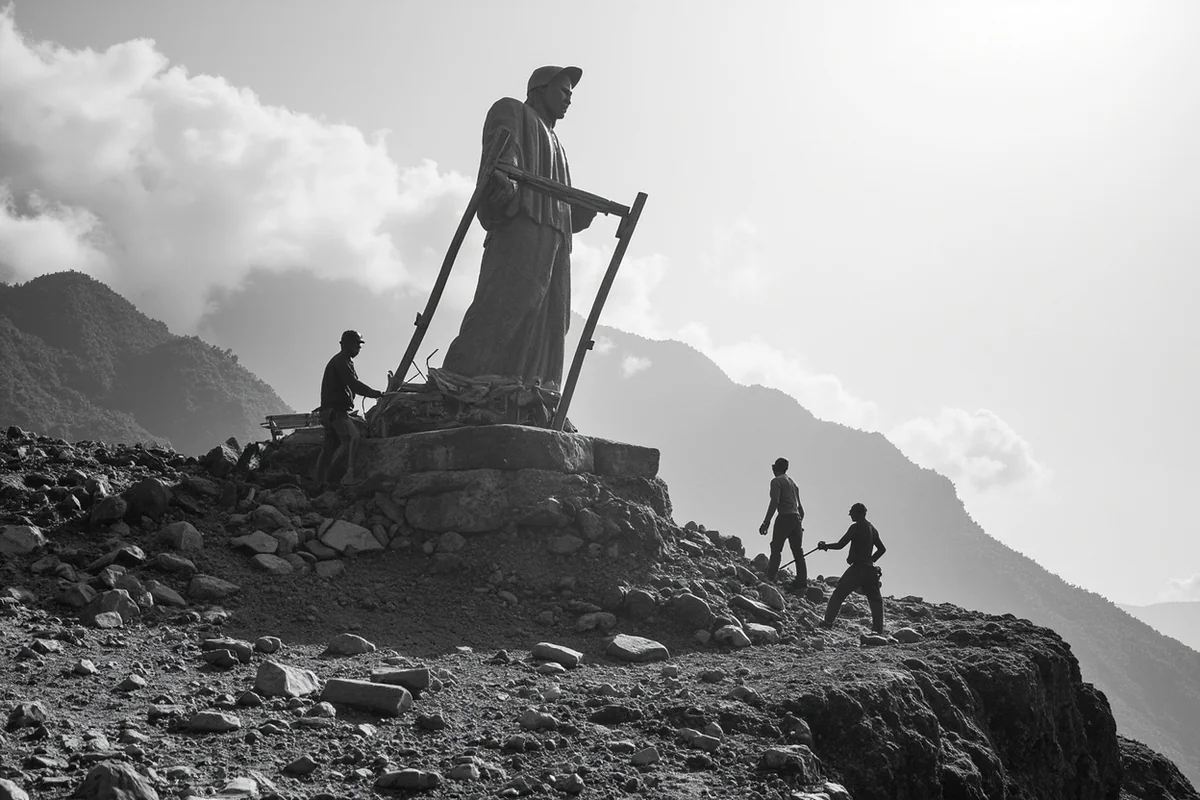
What started as one man’s personal promise transformed into a six-year community project involving over 400 volunteers. These weren’t professional statue builders—they were welders, electricians, carpenters, and former hardrock miners who donated their skills, their time, and their hearts.
Built Without a Single Cent of Public Money
This detail amazed me during my tour: the entire project was funded by private donations and completed without any government assistance. The statue’s metal frame contains repurposed materials, including metal from old mining equipment—a fitting tribute in a town built on copper.
When I asked our guide about the cost, she explained that calculating a dollar amount is nearly impossible because so much labor and material was donated. Conservative estimates put it at several million dollars in equivalent value.
The most dramatic moment came on December 20, 1985, when a National Guard helicopter airlifted the statue’s head to the mountaintop. Our guide showed us photos of that day—Butte residents gathered in the freezing cold, watching as the final piece was set in place.
How to Visit Our Lady of the Rockies
There are essentially two ways to experience this monument, and I strongly recommend both if your schedule allows.
Option 1: The Bus Tour to the Summit
The official tour is the only way most visitors can reach the statue’s base. Private vehicles aren’t allowed on the access road, and trust me—you wouldn’t want to drive it anyway.
Tours depart from the Our Lady of the Rockies Gift Shop at 3100 Harrison Avenue in Butte. When I visited last August, I booked the evening tour specifically for better lighting, and it was absolutely worth it.
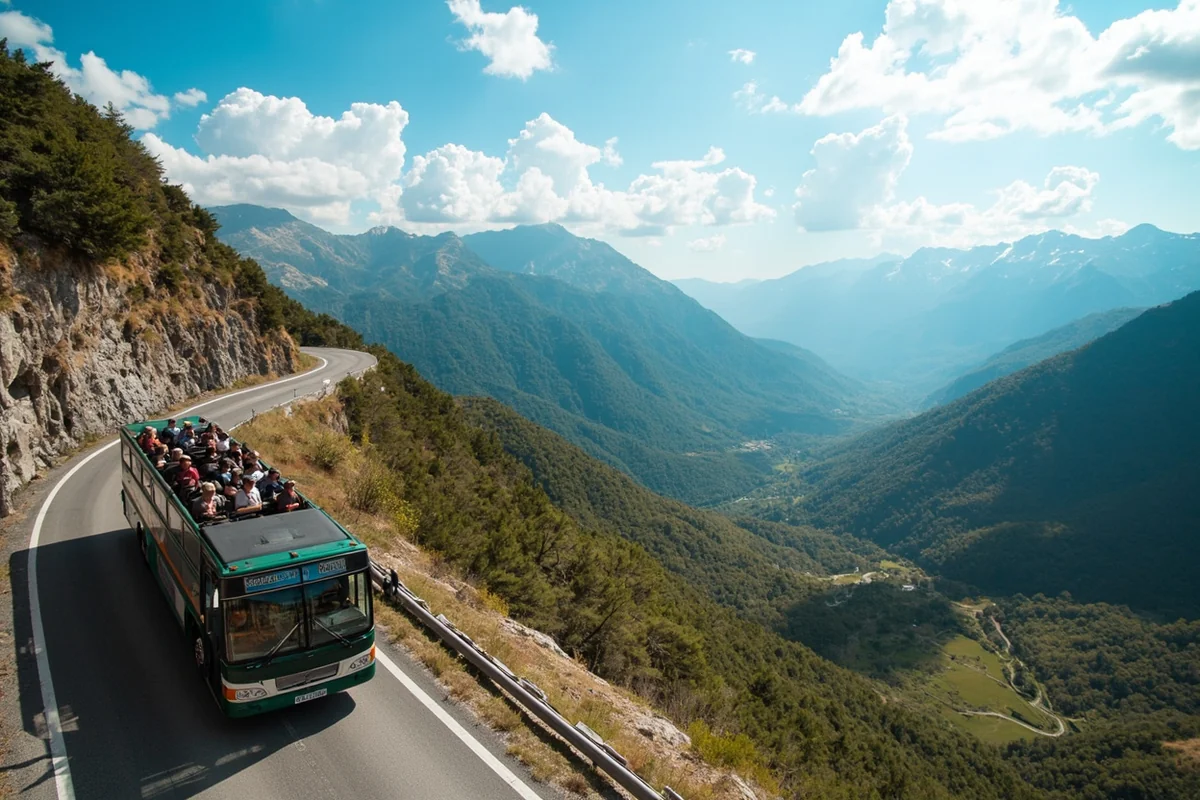
The bus ride takes about 45 minutes each way along a winding gravel road that gains over 3,000 feet in elevation. Our driver, a lifelong Butte resident named Mike, narrated the journey with stories I couldn’t find in any guidebook.
| Tour Detail | Information |
|---|---|
| Season | June through September (weather dependent) |
| Tour Duration | Approximately 2-2.5 hours total |
| Departure Times | 10 AM and 2 PM daily; evening tours available select days |
| Adult Price (2024) | $22 per person |
| Senior/Military | $20 per person |
| Children (13-17) | $15 per person |
| Children (5-12) | $10 per person |
| Under 5 | Free |
| Reservations | Strongly recommended; call (406) 782-1221 |
Option 2: Viewing from Butte
You don’t have to take the tour to appreciate the statue—it’s visible from much of Butte and the surrounding valley. During my three days in town, I found myself constantly looking up at the ridge.
The best free viewing spots I discovered:
- Stodden Park – The open fields provide unobstructed views, and it’s a lovely spot for a picnic while gazing up at the statue
- Big Butte – If you hike the “M” trail, you’ll get eye-level views across the valley
- Continental Drive – Driving along this road at sunset offers spectacular photo opportunities
- The Berkeley Pit viewing platform – While you’re there for the pit, look east to see the statue from a different angle
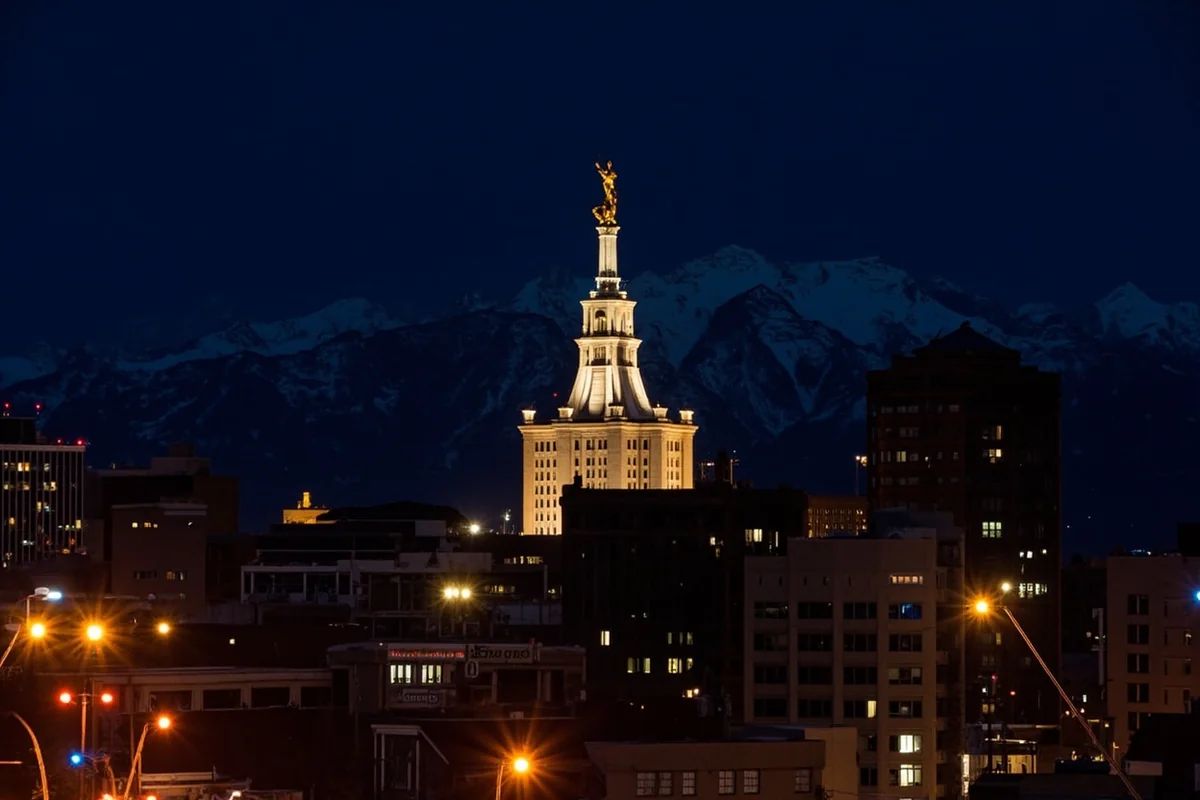
At night, the statue is illuminated with floodlights that make it visible for miles. Driving into Butte after dark, that glowing figure on the mountaintop is genuinely awe-inspiring.
What to Expect at the Summit
When the bus finally reaches the top, you’re given about 30 minutes at the statue’s base. That might not sound like much, but it’s genuinely enough time to walk around, take photos, and absorb the experience.
The first thing that struck me was the scale. Photographs don’t prepare you for standing at the feet of a 90-foot figure. Her head alone weighs 30 tons. The entire statue weighs approximately 80 tons.
The Statue Up Close
Made of steel and painted white, Our Lady of the Rockies depicts Mary in a simple pose, her hands slightly extended at her sides. Unlike many religious statues, there’s no elaborate crown or detailed facial features—the design is deliberately abstract and universal.
I found this artistic choice deeply moving. From the valley, she’s recognizably a woman with arms outstretched. Up close, her face is smooth and blank, allowing visitors of any faith (or no faith) to project their own meaning onto her form.
Our guide emphasized that the statue is non-denominational, dedicated to all mothers everywhere. This was intentional from the beginning—the founders wanted the monument to welcome everyone, regardless of religious background.
The Views Will Stop You in Your Tracks
Let’s be real: even if the statue somehow didn’t interest you, the panoramic views from 8,510 feet would make the trip worthwhile.
On a clear day, I could see for what felt like forever in every direction. The Butte valley spread out below like a relief map, the Berkeley Pit a distinctive turquoise scar on the landscape. To the west, the Pintler Mountains rose in jagged peaks still dusted with snow despite the August heat.
Our guide pointed out Deer Lodge to the north and explained that on exceptionally clear days, you can see portions of three different mountain ranges. The Continental Divide runs directly beneath your feet—rain falling on one side of the ridge eventually reaches the Pacific, while rain on the other side flows to the Atlantic.

Practical Tips I Learned the Hard Way
After my visit—and conversations with locals and other tourists—I compiled these essential tips that I wish I’d known beforehand.
Dress in Layers (Seriously)
When I boarded the bus, it was a comfortable 78°F in Butte. At the summit, the temperature had dropped to 54°F with a stiff wind. I watched several visitors shivering in shorts and tank tops while I smugly pulled on the fleece I’d almost left in the car.
Even in midsummer, bring:
- A warm jacket or fleece
- Long pants (or pack them in your bag)
- Closed-toe shoes with decent grip
- Sunglasses and sunscreen (the UV intensity at altitude is no joke)
Book Ahead for Weekend and Evening Tours
I showed up on a Thursday hoping to snag a spot on the afternoon tour. No problem. But a couple I met had tried to do the same thing on Saturday and found all tours booked solid.
Summer weekends and evening tours fill up fast. Call at least a few days ahead, especially if you’re traveling in July or August.
The Gift Shop Is Worth Your Time
I’m usually not a gift shop person, but the Our Lady of the Rockies visitor center surprised me. Beyond the typical souvenirs, there’s a small museum with original construction photographs, volunteer stories, and artifacts from the building process.
Take 15-20 minutes before your tour to browse the displays. The context makes the summit experience much more meaningful.
Consider Your Physical Limitations
While you don’t need to hike to reach the statue (the bus does all the work), the summit area isn’t perfectly accessible. There are uneven surfaces, some inclines, and limited seating.
Visitors with mobility challenges should call ahead to discuss their needs. The staff are accommodating, but it helps to know what to expect.
Connecting the Statue to Butte’s Larger Story
You can’t fully appreciate Our Lady of the Rockies without understanding something about Butte itself. During my time there, I came to see the statue as inseparable from the town’s identity.
A Community That Needed Hope
In the 1970s and early 1980s, Butte was reeling. The Anaconda Company, which had employed generations of miners, was shutting down operations. Thousands of men suddenly found themselves without work in a town where mining wasn’t just an occupation—it was a way of life.
The statue project gave unemployed workers something meaningful to do. Former colleagues who might otherwise have scattered found a reason to collaborate again. The skills they’d used underground—welding, rigging, problem-solving under challenging conditions—translated directly to building a monument on a mountaintop.
When I learned this history, the statue took on a completely different meaning. It’s not just a religious symbol or a tourist attraction. It’s proof of what Butte’s people could accomplish even when their world was falling apart.
Pair Your Visit with the Berkeley Pit
Here’s an itinerary suggestion: visit the Berkeley Pit viewing platform before your Our Lady tour. The contrast is striking and intentional.
The Berkeley Pit is an open-pit copper mine that operated from 1955 to 1982, leaving behind a mile-wide, 1,780-foot deep hole that’s now filling with toxic water. It’s a Superfund site, a monument to extraction, and genuinely one of the most fascinating and disturbing things I’ve ever seen.
Then take the bus up to Our Lady of the Rockies—built by the same community, during the same era, but representing something entirely different: creation instead of extraction, hope instead of devastation.
Standing at both sites in the same day gave me a profound sense of Butte’s complicated legacy. I can’t recommend this pairing enough.
The Best Time to Visit
Tours run June through September, with some weather-dependent flexibility at the edges of the season. Each month offers different advantages.
June
Pros: Wildflowers blooming on the hillsides, longer daylight hours, cooler temperatures even in the valley. Cons: Lingering snow can occasionally delay the season’s start, and some services in Butte are still ramping up.
July and August
Pros: Warmest weather, most reliable tour schedules, Butte’s events calendar is packed with festivals and activities. Cons: Peak tourist season means more crowded tours and higher hotel prices. Book everything in advance.
September
Pros: Stunning fall colors beginning to emerge, fewer crowds, crisp mountain air, potential for dramatic weather (which makes for incredible photos). Cons: Tours may be canceled due to early snow or wind. Shorter days mean fewer tour options.
I visited in mid-August and found it perfect, though next time I’d love to try early September for the fall light.
Where to Stay in Butte
Butte isn’t Bozeman or Whitefish—you won’t find luxury resorts or boutique hotels. What you will find is honest, affordable lodging with character.
During my visit, I stayed at the Finlen Hotel, a historic property right on Broadway. Built in 1924, it’s showing its age in some ways, but the location can’t be beat for exploring downtown Butte, and the building has genuine old-school charm.
Other solid options include:
- Best Western Plus Butte Plaza Inn – Modern, reliable, and close to the Our Lady gift shop
- Hampton Inn Butte – Standard chain hotel with consistent quality
- Copper King Mansion – A bed and breakfast in a restored 1888 Victorian mansion for a more unique experience
Pro tip: Whatever you choose, book a room facing east if possible. Waking up to see Our Lady glowing in the morning sun was a highlight I hadn’t anticipated.
Where to Eat Before or After Your Tour
Butte’s dining scene reflects its working-class, multi-ethnic heritage. Waves of Irish, Italian, Finnish, Chinese, and Eastern European immigrants left their mark on local cuisine.
After my tour, I was starving and made my way to Pork Chop John’s—a Butte institution since 1924. Their signature pork chop sandwich (breaded, fried, served on a bun with pickles and onion) is exactly as delicious and unpretentious as it sounds.
Other recommendations:
- The Uptown Café – Excellent breakfast and lunch; try the pasty (a savory meat-and-potato pastry brought by Cornish miners)
- Casagranda’s Steakhouse – Classic Montana steakhouse experience
- Pekin Noodle Parlor – The oldest continuously operating Chinese restaurant in America, still serving from the original building
- Hanging Five – Good craft beer and surprisingly good tacos
Combining Our Lady with a Broader Montana Trip
Butte sits conveniently along the I-90 corridor, making it easy to incorporate into larger Montana adventures.
Coming from Missoula (West)
The drive from Missoula to Butte takes about 90 minutes and passes through stunning mountain scenery. I’d suggest spending a night in Butte to avoid rushing the Our Lady experience.
Heading to Bozeman (East)
Bozeman is about 80 minutes east of Butte. If you’re coming from Yellowstone or planning to visit the park, Butte makes an excellent overnight stop to break up the drive.
Day Trip from Helena
The state capital is only 65 miles north. You could easily visit Our Lady as a day trip from Helena, though Butte deserves more time if you can spare it.
Accessibility and Special Considerations
The tour operators are accommodating, but here’s what you should know:
The tour buses can accommodate wheelchairs with advance notice. Call ahead to arrange assistance. The summit area has gravel surfaces and some uneven terrain—not impossible for wheelchairs, but challenging in spots.
There are no restrooms at the summit. Use the facilities at the gift shop before boarding the bus.
The elevation (8,510 feet) may affect visitors with heart or respiratory conditions. The ascent is gradual via the bus, but the thinner air at the top is noticeable. Take it easy, stay hydrated, and don’t push yourself.
Photography Tips
I’m an amateur photographer, but I came away with some shots I’m genuinely proud of. Here’s what I learned:
From the Valley
The golden hour before sunset provides the best lighting for photographing the statue from Butte. The statue faces roughly southwest, so evening light illuminates her directly. A telephoto lens (200mm or longer) helps fill the frame.
At the Summit
Wide-angle lenses capture both the statue and the surrounding landscape. Don’t forget to turn around—the views away from the statue are equally spectacular. Midday light creates harsh shadows on the white surface, so morning or evening tours are better for photography.
At Night
If you’re staying in Butte, find a dark spot away from streetlights to photograph the illuminated statue. A tripod is essential; exposures of several seconds capture the glow beautifully.
What Other Visitors Say
I talked to several people during my tour, and their reactions ranged widely. A Catholic family from Minnesota found profound spiritual meaning in the visit. An atheist couple from Portland told me they came “for the engineering” and left unexpectedly moved by the community story.
A retired miner named Joe, who’d actually worked on the construction crew in the 1980s, was taking his grandchildren up for the first time. Watching him point out specific welds he remembered making—his voice cracking with emotion—was one of the most memorable moments of my entire Montana trip.
The common thread among everyone I spoke with: the experience exceeded their expectations. Come with an open mind, and you’ll find something meaningful regardless of your background.
Is Our Lady of the Rockies Worth Visiting?
I went into this experience with genuine skepticism. I left as an evangelist.
Our Lady of the Rockies is worth your time whether you’re religious or secular, whether you’re interested in Montana history or just looking for something different, whether you have two hours or two days.
It’s worth the $22 bus fare. It’s worth the 45-minute winding road. It’s worth pulling over on I-90 to stare up at that improbable white figure standing guard over a town that refused to give up.
In a world of manufactured attractions and curated Instagram moments, Our Lady of the Rockies is refreshingly real. It exists because ordinary people decided to build something extraordinary, not for tourists or profit, but because they believed it mattered.
When you stand at her feet, 8,500 feet above sea level, wind whipping across the Continental Divide, the Butte valley spread out below—you’ll understand why they were right.
Frequently Asked Questions
How tall is Our Lady of the Rockies and how does it compare to the Statue of Liberty?
Our Lady of the Rockies stands 90 feet tall, making it the third-tallest statue in the United States. When you factor in its mountaintop perch at 8,510 feet elevation, the statue’s head actually sits higher above sea level than the Statue of Liberty, which is 305 feet including the pedestal.
How do you get to Our Lady of the Rockies in Butte Montana?
You can only reach the statue via guided bus tours that depart from the Our Lady of the Rockies Gift Shop at 3100 Harrison Avenue in Butte. The 2.5-hour tour travels up a winding mountain road that’s not accessible to private vehicles. I recommend booking in advance during summer months as tours fill up quickly.
How much do Our Lady of the Rockies bus tours cost?
Tour prices are around $25-30 for adults and $15-20 for children, though I’d suggest checking the official website for current rates. The tour includes transportation up the mountain, time at the statue for photos, and informative commentary about the statue’s inspiring construction story.
What is the best time of year to visit Our Lady of the Rockies?
Tours typically run from June through September when mountain roads are accessible. I found late summer offers the best combination of clear weather and wildflower blooms along the route. Morning tours often provide better visibility before afternoon clouds roll in over the Continental Divide.
Can you hike to Our Lady of the Rockies statue?
There is no official hiking trail to the statue, and the private road is closed to foot traffic for safety reasons. The guided bus tour is the only authorized way to visit the statue up close. However, you can view the statue from various points around Butte, especially at night when it’s illuminated.
What should I bring on the Our Lady of the Rockies tour?
Bring layers since temperatures at 8,500 feet can be 15-20 degrees cooler than in Butte, even in summer. I’d also recommend sturdy shoes for walking around the statue site, sunscreen, water, and a camera with good zoom capability for capturing the panoramic views of the Continental Divide.
What is the story behind Our Lady of the Rockies statue?
The statue was built entirely by volunteers between 1979 and 1985 as a non-denominational tribute to women everywhere, particularly mothers. Local Butte resident Bob O’Bill conceived the idea after his wife recovered from illness. The statue was airlifted to its mountaintop location by National Guard helicopters, making it a remarkable community achievement.