On July 25, 1805, Meriwether Lewis stood at the confluence of three rivers in present-day Montana and decided this was where the Missouri River began. He named them the Jefferson (for the president who sent them), the Madison (for the Secretary of State), and the Gallatin (for the Treasury Secretary).
Together, they became the Missouri — the longest river in North America. The spot where he stood is now Missouri Headwaters State Park, 3 miles east of Three Forks. It’s one of the most historically significant places in the American West.
TL;DR
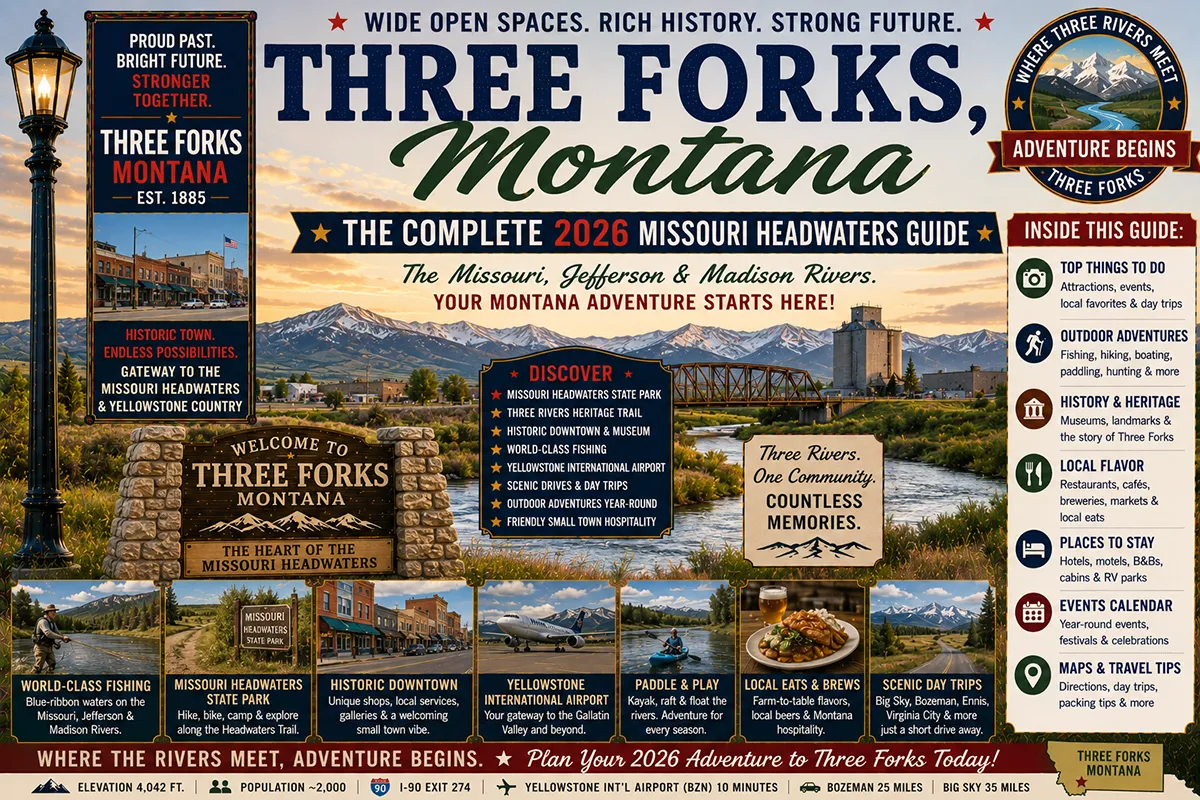
- Three Forks (~2,000) is a small southwest Montana town at the confluence of the Madison, Jefferson, and Gallatin Rivers — where they join to form the Missouri River.
- Missouri Headwaters State Park is the single most important Lewis & Clark site in Montana — where the Corps named the Missouri on July 25, 1805.
- Lewis and Clark Caverns State Park is 20 miles west — Montana’s oldest and most visited state park, with exceptional limestone cave tours.
- The Sacajawea Hotel (1910) is one of Montana’s most historically significant surviving hotels, recently renovated.
- Best for: Lewis & Clark travelers, history enthusiasts, Bozeman day-trippers, and anyone driving I-90 between Butte and Bozeman.
Liked this article?
Add Roaming Montana as a preferred source so you see more of our articles and guides on Google.
Three Forks at a Glance
| Population (2020) | ~2,000 |
|---|---|
| County | Gallatin County |
| Region | Southwest Montana |
| Elevation | 4,064 ft |
| Distance to Bozeman | ~30 miles (~35 min) |
| Distance to Butte | ~65 miles (~1 hour via I-90) |
| Distance to Helena | ~65 miles via I-90/US-12 |
| Best for | Lewis & Clark history, Missouri Headwaters, Lewis and Clark Caverns, historic hotel |
What Makes Three Forks Different
Three Forks is one of the most historically important small towns in Montana — it just doesn’t get treated that way.
The Missouri Headwaters is the beginning of the Missouri River, the principal tributary of the Mississippi, and together the Missouri-Mississippi system drains the central third of the North American continent.
Lewis and Clark spent days here trying to figure out which branch to follow west. Sacajawea recognized the country — this was near her homeland — and was able to guide the expedition.
The town that grew up near this confluence is quiet and agricultural. The Sacajawea Hotel was built in 1910 to serve travelers on the Milwaukee Road railroad. It’s been through difficult decades but was thoughtfully renovated in recent years and is now one of Montana’s most charming small historic hotels.
For broader trip context, see my Montana cities and towns hub.
The Top 10 Things to Do
1. Missouri Headwaters State Park
The 3-mile drive east of town leads to the state park at the actual confluence. Walking trails connect the three river junctions; interpretive signs cover the Lewis & Clark expedition and the Indigenous history of the site (the Blackfeet, Shoshone, Crow, and Flathead peoples all knew this confluence). The view from the bluff above the confluence is extraordinary. Free.
2. Lewis and Clark Caverns State Park (20 miles west on MT-2)
Montana’s oldest state park and its most visited cave system — guided tours through spectacular limestone formations. The cave maintains a constant cool temperature year-round. Plan 2 hours minimum for the tour. Tickets sell out in summer — book ahead.
3. Stay or Dine at the Sacajawea Hotel
A renovated 1910 hotel named for the Shoshone woman who guided Lewis and Clark. The lobby, dining room, and bar are all worth visiting even if you’re not staying. The hotel’s location in Three Forks makes it an excellent base for both the Headwaters and Lewis and Clark Caverns.
4. Fly Fish the Madison, Jefferson, or Gallatin
All three rivers are accessible near Three Forks — each with different character. The lower Madison (downstream from Ennis Lake) is warm-water and slower; the Jefferson is fly-fishing-friendly; the Gallatin is the classic canyon trout stream running to Bozeman.
5. Hike at Missouri Headwaters State Park
Multiple walking trails on the bluffs and bottomlands. The Headwaters Trail follows the Jefferson and Madison to the confluence — about 2 miles round-trip, easy, historically evocative.
6. Madison Buffalo Jump State Monument
About 8 miles south of Three Forks — a prehistoric buffalo jump (pishkun) used by Indigenous peoples for thousands of years to hunt bison by driving them off a cliff. Self-guided interpretive trails. Free.
7. Three Forks Rodeo
The annual rodeo in Three Forks is a small-town event with genuine agricultural community participation — worth catching if your timing aligns.
8. Willow Creek Café & Saloon (10 miles south)
A legendary Montana roadhouse in the tiny town of Willow Creek — steaks, cold beer, and a saloon that’s been part of the local culture for generations.
9. Pony Ghost Town (30 miles north)
A preserved former silver and gold mining community in the Tobacco Root Mountains — abandoned storefronts and mine infrastructure in an accessible mountain setting.
10. Norris Hot Springs (20 miles east)
Open-air hot spring pool set in a scenic valley east of Three Forks — natural, chemical-free, seasonal. One of Montana’s most atmospheric small hot spring soaks.
Where to Stay
| Hotel | Vibe | Price | Best For |
|---|---|---|---|
| Sacajawea Hotel | Historic 1910, renovated | $180–280 | History lovers, couples |
| Fort Three Forks Motel | Basic motel | $90–140 | Budget |
| Bozeman hotels (30 min) | Full selection | $200–400 | Travelers wanting more |
Where to Eat
- Sacajawea Hotel Dining Room — best in town, locally sourced menu
- Willow Creek Café & Saloon (10 miles south) — legendary Montana steakhouse
- Main Street Bar & Grill — diner basics
- Headwaters Coffee — morning espresso
Getting There
From Bozeman: 30 miles west on I-90, about 35 minutes.
From Butte: 65 miles east on I-90, about 1 hour.
From Helena: 65 miles via I-90 west and US-12.
I-90 Exit: Use Exit 274 (Three Forks) or Exit 267 (Lewis and Clark Caverns access).
What Three Forks Unlocks
Lewis and Clark Caverns (20 min west)
Montana’s most visited cave system.
Norris Hot Springs (20 min east)
Natural hot springs, atmospheric and affordable.
Bozeman (35 min east)
Museum of the Rockies, Main Street, full services.
Madison Buffalo Jump (8 min south)
Prehistoric bison hunting site.
Virginia City / Nevada City (1.5 hours)
Gold rush ghost towns.
Personal Tips
Missouri Headwaters in the morning. The light is best early; the birds are extraordinary in the cottonwood bottomlands at dawn.
Book Lewis and Clark Caverns tickets online. Summer tours sell out. The cave temperature is a constant 50°F — bring a layer regardless of outside temperature.
Sacajawea Hotel for dinner even if not staying. The renovation was well done; the dining room is the best meal in the area.
Combine Three Forks and Lewis and Clark Caverns in a single day from Bozeman — easily done as a 4–6 hour day trip.
Three Forks Quick Facts
| Founded | 1908 | | Named for | The confluence of three rivers forming the Missouri | | Missouri Headwaters | Where Lewis and Clark named the Missouri River (July 25, 1805) | | Average summer high | 84°F | | Average winter low | 10°F |
Conclusion
Three Forks punches well above its size for historical significance. The Missouri Headwaters is genuinely one of the most important sites in American exploration history; Lewis and Clark Caverns is one of Montana’s best day trips; and the Sacajawea Hotel provides a level of accommodation quality unusual for a town of 2,000. Worth far more than a highway exit.
Frequently Asked Questions
Is Three Forks Montana worth visiting?
Yes — Three Forks is worth visiting, particularly for the Missouri Headwaters State Park (where Lewis and Clark named the Missouri River on July 25, 1805), Lewis and Clark Caverns State Park (Montana’s most visited cave system, 20 miles west), and the renovated Sacajawea Hotel (1910). It’s an excellent day trip from Bozeman and a strong overnight on any I-90 road trip.
What is Missouri Headwaters State Park?
Missouri Headwaters State Park is located 3 miles east of Three Forks, at the confluence of the Madison, Jefferson, and Gallatin Rivers where they join to form the Missouri River — the longest river in North America. On July 25, 1805, Meriwether Lewis named the three forks for President Jefferson, Secretary of State Madison, and Treasury Secretary Gallatin. Sacajawea recognized the landscape as near her Shoshone homeland.
How far is Three Forks from Bozeman?
Three Forks is approximately 30 miles west of Bozeman on I-90 — about a 35-minute drive. It makes an easy day trip from Bozeman combining the Headwaters and Lewis and Clark Caverns.
What is the Sacajawea Hotel in Three Forks?
The Sacajawea Hotel is a historic 1910 hotel built to serve travelers on the Milwaukee Road railroad, named for the Shoshone woman who guided the Lewis and Clark expedition through this region. Recently renovated, it now operates as one of Montana’s most charming small historic hotels with a well-regarded dining room.