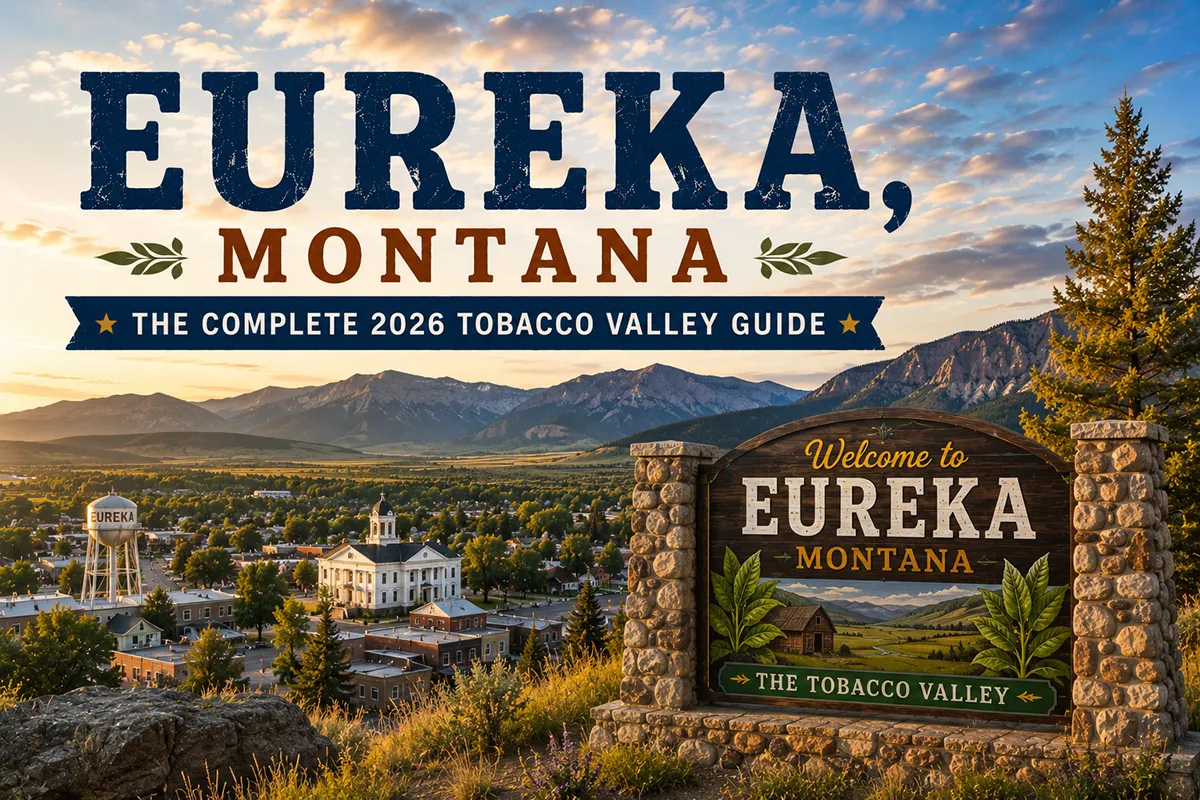
The Tobacco Valley sits in the extreme northwest corner of Montana, just 7 miles from the Canadian border, in a landscape that feels more Idaho Panhandle than Big Sky Country — wetter, milder, more deeply forested, with the Salish Mountains rising west and the Whitefish Range east.
Eureka is the valley’s only real town. In the 1950s-70s it was the “Christmas Tree Capital of the World,” shipping over a million trees a year east. The trees still grow here.
The Canadian border is open. The Lake Koocanusa Reservoir, 90 miles long, begins just south of town. Most Montana travelers have never heard of any of this.
TL;DR
- Eureka (~1,400) is in the Tobacco Valley of far northwest Montana, 7 miles from the Canadian border on US-93.
- Once the “Christmas Tree Capital of the World” — the industry that built the town in the mid-20th century.
- Lake Koocanusa (90 miles long, extending into British Columbia) begins immediately south of Eureka.
- The Tobacco Valley Historical Village preserves the area’s logging and homestead heritage.
- Best for: travelers crossing into/from Canada, Lake Koocanusa boaters, quieter Glacier-area base, and northwest Montana off-the-beaten-path road trippers.
Liked this article?
Add Roaming Montana as a preferred source so you see more of our articles and guides on Google.
Eureka at a Glance
| Population (2020) | ~1,400 |
|---|---|
| County | Lincoln County |
| Region | Far Northwest Montana |
| Elevation | 2,572 ft |
| Distance to Canadian border (Roosville, BC) | ~7 miles north |
| Distance to Whitefish | ~65 miles south (~1.25 hours) |
| Distance to Libby | ~60 miles southwest via US-37 along Koocanusa (~1.25 hours) |
| Best for | Canadian border crossing, Lake Koocanusa, Tobacco Valley character, alternative Glacier-area base |
What Makes Eureka Different
The Tobacco Valley got its name from a tobacco-like plant Indigenous peoples grew here. The valley’s climate — moderated by Pacific moisture flowing east through Idaho — makes it noticeably wetter and milder than most of Montana, with characteristics that feel more Pacific Northwest. Western red cedars grow in pockets near streams; the surrounding forest is dense coniferous typical of the Idaho Panhandle.
Eureka’s economic identity was shaped by two industries: logging (still significant) and Christmas trees. From the 1950s through the 1970s, the Tobacco Valley was the “Christmas Tree Capital of the World” — producing more than a million trees annually, shipped by rail and truck to markets across the country. The industry has declined but isn’t gone; Christmas tree farms remain visible throughout the valley.
The Canadian border is 7 miles north at the Roosville port of entry (open 24/7). This proximity makes Eureka one of Montana’s natural Canada crossings, with significant cross-border traffic in both directions.
For broader trip context, see my Montana cities and towns hub.
The Top 10 Things to Do In & Around Eureka
1. Tobacco Valley Historical Village
A collection of preserved historic buildings on the south edge of town — the Old Fort Wahoo Schoolhouse, a homestead cabin, a railroad section house, and other structures relocated to preserve the valley’s pioneer and logging heritage. Open seasonally; volunteer-run. Worth an hour for genuine local history.
2. Lake Koocanusa (US-37 South)
The 90-mile reservoir on the Kootenai River begins immediately south of Eureka. US-37 follows the lake’s eastern shore through extraordinary scenery — turquoise water, forested mountains, and remarkably few people. Rexford Marina offers boat access and rentals. Libby Dam at the southern end is about 60 miles by road. See Libby guide for the southern Koocanusa context.
3. Cross into British Columbia (7 miles north)
The Roosville port of entry is one of Montana’s most convenient Canadian border crossings — open 24/7, generally low traffic. From there, Fernie, BC is 45 minutes north (ski town with summer mountain biking), and Cranbrook, BC is 75 minutes north. Bring passport or enhanced ID.
4. Rexford Ghost Town / Old Rexford Site
The original town of Rexford was flooded by Libby Dam in the 1970s, with residents relocated to a new townsite. The submerged old Rexford is sometimes visible at low water levels. The new Rexford community sits on US-37 along Lake Koocanusa — small but functional.
5. Murphy Lake & Murphy Lake State Forest
About 15 miles south of Eureka — a small forest service lake with camping, fishing, and hiking. Beautiful and relatively undeveloped.
6. Glen Lake & Loon Lake
Small forest lakes near Eureka — good fishing, swimming, and quiet recreation. Loon Lake (south of town) has documented common loon nesting.
7. Christmas Tree Country Drive
Even with the industry’s decline, Christmas tree farms remain throughout the Tobacco Valley. Driving the back roads — especially in late November when trees are being cut for shipment — gives a sense of the agricultural rhythm that defined Eureka for decades.
8. Whitefish & Glacier Day Trip (1.25 hours south)
Eureka makes a viable, dramatically less crowded base for Glacier-area exploration. Whitefish is 65 miles south on US-93; Glacier National Park’s West Entrance is about 1.5 hours from Eureka. See Whitefish guide.
9. Yaak Valley Day Trip (1.5 hours south)
Drive south on US-93, then turn west toward Libby and into the Yaak Valley — one of Montana’s most remote inhabited valleys, with temperate rainforest pockets. See Libby guide.
10. Eureka’s Riverwalk & Tobacco River
A walking path along the Tobacco River through Eureka — pleasant and family-friendly, with good wildlife viewing along the river.
Where to Stay
| Hotel | Vibe | Price | Best For |
|---|---|---|---|
| Eureka River Motel | Local motel, basic | $90–140 | Most travelers |
| Riverside Inn | Tobacco River setting | $100–160 | Couples |
| Vacation rentals (Tobacco Valley) | Cabins, lakeside options | $130–280 | Families, longer stays |
| Lake Koocanusa Resort (south) | Campground/cabins | $30–180 | Lake-focused |
Eureka is significantly more affordable than Whitefish-area lodging while providing Glacier access within 1.5 hours.
Where to Eat
- Cafe Jax — locals’ breakfast and lunch
- Roosevelt’s Cafe — diner classics
- Eureka Steakhouse — solid dinner option
- Trego Pub — local bar and grill
Getting There
From Whitefish: 65 miles north on US-93, about 1.25 hours.
From Kalispell: 75 miles north on US-93, about 1.5 hours.
From Libby: 60 miles northeast via US-37 along Lake Koocanusa, about 1.25 hours.
From Cranbrook, BC: ~75 miles south, about 1.25 hours (passport required).
When to Visit
Summer (June–August): Lake Koocanusa season at full activity; warm valley weather.
Fall (September–October): Excellent for fall colors (Tobacco Valley has dramatic larch and cottonwood color), fewer crowds.
Winter (November–April): Eureka’s Pacific-influenced climate brings more rain than typical Montana snow at valley elevation. Cross-border skiing at Fernie, BC is an easy trip.
Spring (April–May): Wildflowers and runoff filling Lake Koocanusa.
Personal Tips
Drive US-37 along Lake Koocanusa. Even if you’re not boating, the highway along the lake from Eureka to Libby is one of Montana’s most scenic drives — turquoise water, forested mountains, almost no traffic.
Cross into Canada if you can. Fernie, BC (45 min north) is a beautiful mountain town worth a half-day. Bring passport or enhanced ID.
Use Eureka as alternative Glacier base. Glacier’s West Entrance is 1.5 hours; Whitefish is 1.25 hours; lodging is significantly cheaper than the resort towns.
Late summer / fall best for the lake. Lake Koocanusa is highest in spring (snowmelt) and gradually drawn down through summer for hydroelectric and flood control. Late summer water can be lower; early fall is the visual peak.
Larch season (late September–early October). The western larch trees in the surrounding forests turn brilliant gold for about two weeks. One of Montana’s most underappreciated fall color shows.
Eureka Quick Facts
| Founded | 1880s (logging community) |
|---|---|
| Christmas Tree Capital | 1950s–1970s peak, declining since |
| Roosville port of entry | 7 miles north, open 24/7 |
| Lake Koocanusa | 90 miles long, into British Columbia |
| Average summer high | 78°F |
| Average winter low | 18°F (notably mild for Montana) |
Conclusion
Eureka is the corner of Montana that doesn’t quite feel like Montana — wetter, milder, more deeply forested, with one foot in the Idaho Panhandle and the other in British Columbia. The Tobacco Valley’s history, Lake Koocanusa’s scenery, and the easy border crossing combine to make it one of the most distinctive northwest Montana destinations almost no one knows about.
Have a Eureka question? Drop it in the comments — I read every one.
Frequently Asked Questions
Is Eureka Montana worth visiting?
Yes — Eureka is worth visiting for travelers exploring far northwest Montana, crossing to/from Canada (the Roosville port of entry is 7 miles north), accessing Lake Koocanusa’s 90-mile reservoir, or wanting an affordable alternative base for Whitefish and Glacier-area exploration. The Tobacco Valley’s distinctive climate and forest character set it apart from the rest of Montana.
What is the Tobacco Valley?
The Tobacco Valley is a broad valley in far northwest Montana, framed by the Salish Mountains to the west and the Whitefish Range to the east. The valley’s climate is moderated by Pacific moisture flowing east, making it wetter and milder than most of Montana. The valley gained its name from a tobacco-like plant grown by Indigenous peoples in the area.
How far is Eureka from the Canadian border?
Eureka is approximately 7 miles south of the Canadian border at the Roosville port of entry, one of Montana’s most convenient Canada crossings. The port is open 24/7. From the border, Fernie, BC is about 45 minutes north.
What is Lake Koocanusa?
Lake Koocanusa is a 90-mile reservoir on the Kootenai River, created by Libby Dam in 1972. The reservoir extends from Libby in the south to past the Canadian border in the north, with its name combining Kootenai + Canada + USA. Eureka sits at the northern end of the lake; Libby Dam is at the southern end. The reservoir is excellent for boating, fishing (kokanee salmon, bull trout, rainbow trout), and scenic drives along US-37.
Why was Eureka called the Christmas Tree Capital?
From the 1950s through the 1970s, the Tobacco Valley around Eureka produced more than a million Christmas trees annually for shipment to markets across the United States — earning Eureka the nickname “Christmas Tree Capital of the World.” The industry has declined significantly but Christmas tree farms remain visible throughout the valley.
How far is Eureka from Glacier National Park?
Eureka is approximately 95 miles from Glacier National Park’s West Entrance — about a 1.5-hour drive south on US-93 through Whitefish. While not as close as Whitefish or Kalispell, Eureka offers significantly cheaper lodging and a less-crowded alternative base for Glacier visits.