The Kootenai River crashes through a narrow basalt gorge just east of Libby at a volume and drama that stops most visitors in their tracks. Kootenai Falls isn’t the tallest waterfall in Montana — it’s more of a cathedral-scale rapid, the river compressed into a slot and throwing itself downhill over black rock — but it’s one of the most powerful river spectacles in the state.
The Kootenai people have considered it sacred for thousands of years. In 1993, Hollywood filmed “The River Wild” here with Meryl Streep. You can walk to it in 20 minutes from the highway.
TL;DR
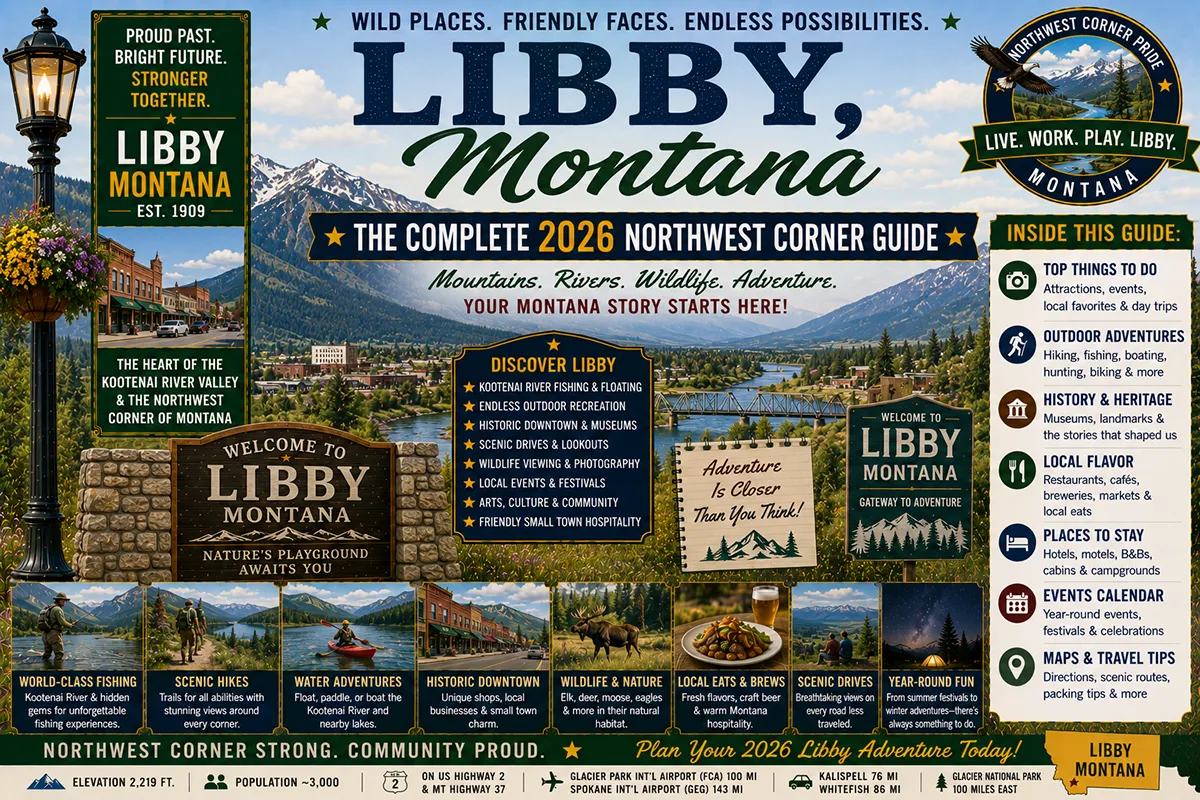
- Libby (~2,700) is the county seat of Lincoln County in Montana’s extreme northwest corner — closer to Spokane, Washington than to Billings, and geographically part of the Inland Northwest rather than the Mountain West proper.
- Kootenai Falls is one of the most powerful river spectacles in Montana — a sacred Kootenai people site and a 20-minute walk from US-2.
- Cabinet Mountains Wilderness offers some of the most rugged and least-crowded wilderness in Montana — grizzly bears, mountain goats, and peaks above 8,700 feet.
- Lake Koocanusa is a 90-mile reservoir on the Kootenai River above Libby Dam — excellent boating, fishing, and camping.
- The Yaak Valley north of Libby is one of the most remote inhabited valleys in the lower 48 — celebrated by writer Rick Bass.
- Best for: serious wilderness hikers, kayakers and boaters, anglers, and travelers wanting extreme northwestern Montana character.
Liked this article?
Add Roaming Montana as a preferred source so you see more of our articles and guides on Google.
Libby at a Glance
| Population (2020) | ~2,700 |
|---|---|
| County | Lincoln County (county seat) |
| Region | Northwest Montana |
| Elevation | 2,096 ft |
| Distance to Kalispell | ~90 miles (~1.5 hours via US-2) |
| Distance to Spokane, WA | ~180 miles (~2.5 hours) |
| Distance to Troy | ~20 miles (~25 min west) |
| Best for | Kootenai Falls, Cabinet Mountains Wilderness, Lake Koocanusa, Yaak Valley |
What Makes Libby Different
Libby’s geography sets it apart from most Montana cities. The town sits in the deep Kootenai River valley, surrounded by the Purcell and Cabinet mountain ranges, in a climate that’s wetter and milder than most of Montana — closer to the Pacific Northwest’s maritime influence than to the continental aridity of central and eastern Montana.
Western red cedars grow here, and in the Yaak Valley to the north, there are temperate rainforest pockets unlike anything else in Montana.
The city’s history includes a profound and painful chapter. From 1919 to 1990, W.R. Grace & Co. operated a vermiculite mine near Libby, using local residents to process ore that turned out to be heavily contaminated with asbestos. Hundreds of Libby residents died of asbestosis and mesothelioma; thousands more were exposed.
The EPA declared it one of the worst industrial contamination disasters in U.S. history and undertook a massive cleanup operation. The contamination has been largely addressed, and the town has moved forward — but the history is part of Libby’s identity and worth understanding before visiting.
The surrounding wilderness, however, is extraordinary.
For broader trip context, see my Montana cities and towns hub.
The Top 10 Things to Do In & Around Libby
1. Kootenai Falls
The centerpiece of any Libby visit. Drive 10 miles east of town on US-2, park at the Kootenai Falls Swinging Bridge trailhead, and walk 10–15 minutes to the falls. The Kootenai River compresses from a wide valley stream into a narrow basalt gorge and drops 60+ feet in a series of cascades. The swinging bridge over the gorge provides dramatic perspectives. Sacred to the Kootenai (Ksanka) people, who maintain a cultural connection to the falls. Filming location for the 1994 film “The River Wild.” Free, accessible year-round.
2. Cabinet Mountains Wilderness
A 94,272-acre wilderness west of Libby — the northernmost portion of the Cabinet-Yaak Ecosystem, one of the most significant grizzly bear recovery areas in the lower 48. Peaks reach 8,738 feet at A Peak. The wilderness has 40+ alpine lakes and dozens of trails. Rock Lake Trail and Bear Lakes Trail are among the most accessible entry points from Libby. Note: This is serious grizzly country — carry bear spray, make noise, and understand the terrain before venturing into the backcountry.
3. Lake Koocanusa
Created by Libby Dam in 1972, Lake Koocanusa (a portmanteau of Kootenai, Canada, and USA — the reservoir extends into British Columbia) is 90 miles long with over 168 miles of shoreline. US-37 north of Libby follows the lake’s west shore for spectacular scenery. Boating, kokanee salmon and bull trout fishing, swimming, and camping at multiple Forest Service sites.
4. Libby Dam & Visitor Center
The dam that created Lake Koocanusa is 422 feet tall and produces significant hydroelectric power. The Army Corps of Engineers visitor center (open Memorial Day through Labor Day) covers the dam’s construction, operation, and the ecology of the Kootenai River system. Free. Worth an hour.
5. Yaak Valley
Drive north from Libby on MT-508 into the Yaak Valley — one of the most remote inhabited valleys in the contiguous United States. Writer Rick Bass has lived here for decades and has written extensively about the Yaak’s extraordinary ecological character (temperate rainforest pockets, wolverines, grizzly bears, rare plant communities). The Yaak River is excellent fishing. The Yaak River Lodge & Dirty Shame Saloon is a legendary remote Montana bar at the end of a long dirt road.
6. Flower Creek Bighorn Sheep Viewing
A resident bighorn sheep herd frequents the cliffs along US-2 east of Libby, particularly visible from late fall through early spring. Pullouts on the highway provide good viewing angles.
7. Hike the Leigh Lake Trail
A 7-mile round-trip trail in the Cabinet Mountains Wilderness leading to Leigh Lake — one of the accessible wilderness lakes with views of cabinet peaks and reasonable difficulty for experienced hikers.
8. Heritage Museum
The Heritage Museum in Libby covers the area’s logging, mining, and homestead history. The museum complex includes a cedar log cabin, a one-room schoolhouse, and exhibits on the Kootenai River valley’s development.
9. Kayak or Raft the Kootenai River
Below Libby Dam, the Kootenai River provides excellent whitewater kayaking and rafting — the tailwater fishery below the dam is also excellent for rainbow and bull trout.
10. Drive the Kootenai National Forest Roads
The Kootenai National Forest surrounds Libby with millions of acres of forest roads — some paved, many gravel — accessing mountain views, wildlife habitat, and dispersed camping. The McGinty Mountain Road and Trego area roads are popular with locals.
Where to Stay
| Hotel | Vibe | Price | Best For |
|---|---|---|---|
| Caboose Motel | Local character, renovated railroad cars | $90–140 | Most travelers, character |
| Sandman Motel | Clean, functional | $80–120 | Budget |
| Venture Motor Inn | Full-service motel | $100–160 | Most travelers |
| Riverview Inn | Near the Kootenai | $90–140 | River-focused |
| Yaak River Lodge | Remote wilderness lodge (Yaak Valley) | $100–200 | Wilderness experience |
| Lake Koocanusa Resort | Lakeside camping/cabins | $50–200 | Lake focus |
Where to Eat
- Venture Motor Inn Restaurant — the reliable full-service dining option in Libby
- Henry’s Restaurant — local institution for breakfast and lunch
- Mountain Peaks Restaurant — steaks and Montana standards
- The Pour House — pub fare and local beer
- Yaak River Lodge / Dirty Shame Saloon (Yaak, 50 min) — legendary remote Montana bar; call ahead for food service hours
- Rosauers and local grocery for self-catering supplies
Getting There & Around
From Kalispell: 90 miles west on US-2, about 1.5 hours through the Kootenai River valley.
From Missoula: ~180 miles via I-90 and US-2, about 3 hours.
From Spokane, WA: ~180 miles east on US-2, about 2.5 hours.
By plane: Glacier Park International Airport (FCA) in Kalispell is the nearest major airport, 1.5 hours east.
Around the area: Libby itself is small and driveable. The surrounding wilderness and lake require a car. High-clearance vehicles recommended for forest road exploration.
What Libby Unlocks
Troy (25 minutes west)
Montana’s lowest-elevation city — milder winters, steelhead fishing on the Kootenai.
Eureka (60 minutes north via US-93)
The Tobacco Valley and Canadian border.
Whitefish & Kalispell (1.5 hours east)
The Flathead Valley, Glacier access.
Idaho Panhandle (via Troy)
Sandpoint, Lake Pend Oreille, and the broader Inland Northwest.
When to Visit
Summer (June–August): Best for Lake Koocanusa, Cabinet Mountains hiking, Kootenai Falls (full water). Warm and pleasant — Libby’s elevation and valley location give it Montana’s mildest summers.
Fall (September–October): Excellent for bighorn sheep viewing (beginning of winter range movement), fishing, and fall colors.
Winter (November–March): Libby’s maritime influence means more rain than snow at valley elevation. Snowmobiling on higher forest roads.
Spring (April–May): Wildflowers in the valley, early fishing season.
Personal Tips
Kootenai Falls is mandatory. Even a 30-minute visit — park, walk, stand at the swinging bridge, feel the spray and the sound — is transformative. Don’t skip it as an I-90 pass-through.
The Yaak Valley deserves a full day. Drive in slowly, stop at the Yaak River, maybe have a beer at the Dirty Shame Saloon. It’s a piece of Montana that’s genuinely disappearing everywhere else.
Cabinet Mountains is serious wilderness. Don’t go without bear spray, navigation tools, and appropriate preparation. Grizzly bears are genuinely present.
Lake Koocanusa’s west shore drive on US-37 is scenic. If you’re going to Eureka, take US-37 along the lake rather than the direct route — the extra 30 minutes rewards you with extraordinary scenery.
Libby’s history matters. If you want to understand the vermiculite contamination, the EPA’s Libby site documentation is thorough and available online. The Center for Asbestos Related Disease (CARD) in Libby is a nationally significant resource for asbestos disease treatment.
Libby Quick Facts
| Founded | 1892 (logging town) |
|---|---|
| Named for | Libby, daughter of a railroad surveyor |
| Major industries | Timber (historical), recreation, healthcare |
| Cabinet Mountains Wilderness | 94,272 acres; grizzly bear habitat |
| Lake Koocanusa length | 90 miles (extends into British Columbia) |
| Average summer high | 82°F |
| Average winter low | 19°F (notably mild for Montana) |
Conclusion
Libby is the corner of Montana that feels least like the rest of Montana — Pacific Northwest moisture, temperate forest, a town forged in timber and scarred by industrial disaster, surrounded by extraordinary wilderness. Kootenai Falls alone is worth the drive. The Cabinet Mountains and the Yaak Valley reward travelers willing to go further.
Have a Libby question? Drop it in the comments — I read every one.
Frequently Asked Questions
Is Libby Montana worth visiting?
Yes — Libby is worth visiting for Kootenai Falls (one of Montana’s most powerful river spectacles, 10 minutes east of town), Cabinet Mountains Wilderness, Lake Koocanusa’s 90-mile reservoir, and the remarkable Yaak Valley north of town. It’s a genuinely distinctive Montana destination with a Northwest character unlike anywhere else in the state.
What happened with the asbestos contamination in Libby Montana?
From 1919 to 1990, the W.R. Grace & Co. vermiculite mine near Libby processed ore heavily contaminated with asbestos. Workers and community members were exposed to deadly asbestos dust for decades. Hundreds died of asbestosis and mesothelioma; thousands more were exposed. The EPA conducted one of the largest Superfund cleanups in U.S. history, and the remediation is largely complete. Town proper is safe to visit; the mine site is not publicly accessible. The Center for Asbestos Related Disease (CARD) continues treating affected community members.
What is Kootenai Falls?
Kootenai Falls is a series of powerful rapids and cascades on the Kootenai River 10 miles east of Libby, accessible via a 15-minute trail from a US-2 pullout. The Kootenai River compresses into a basalt gorge and drops dramatically in one of Montana’s most powerful river spectacles. The falls are sacred to the Kootenai (Ksanka) people and were used as a filming location for the 1994 film “The River Wild.”
What is the Yaak Valley near Libby?
The Yaak Valley is a remote, heavily forested river valley north of Libby in Lincoln County, often called one of the most biologically diverse and least-disturbed valleys in the contiguous United States. The valley has pockets of temperate rainforest, a rare inland wolverine population, and significant grizzly bear habitat. Writer Rick Bass has lived and written about the Yaak for decades. The Yaak River Lodge and Dirty Shame Saloon is the valley’s social hub.
How far is Libby from Kalispell?
Libby is approximately 90 miles west of Kalispell on US-2 — about a 1.5-hour drive through the Kootenai River valley. Glacier Park International Airport (FCA) in Kalispell is the nearest major airport for Libby visitors.