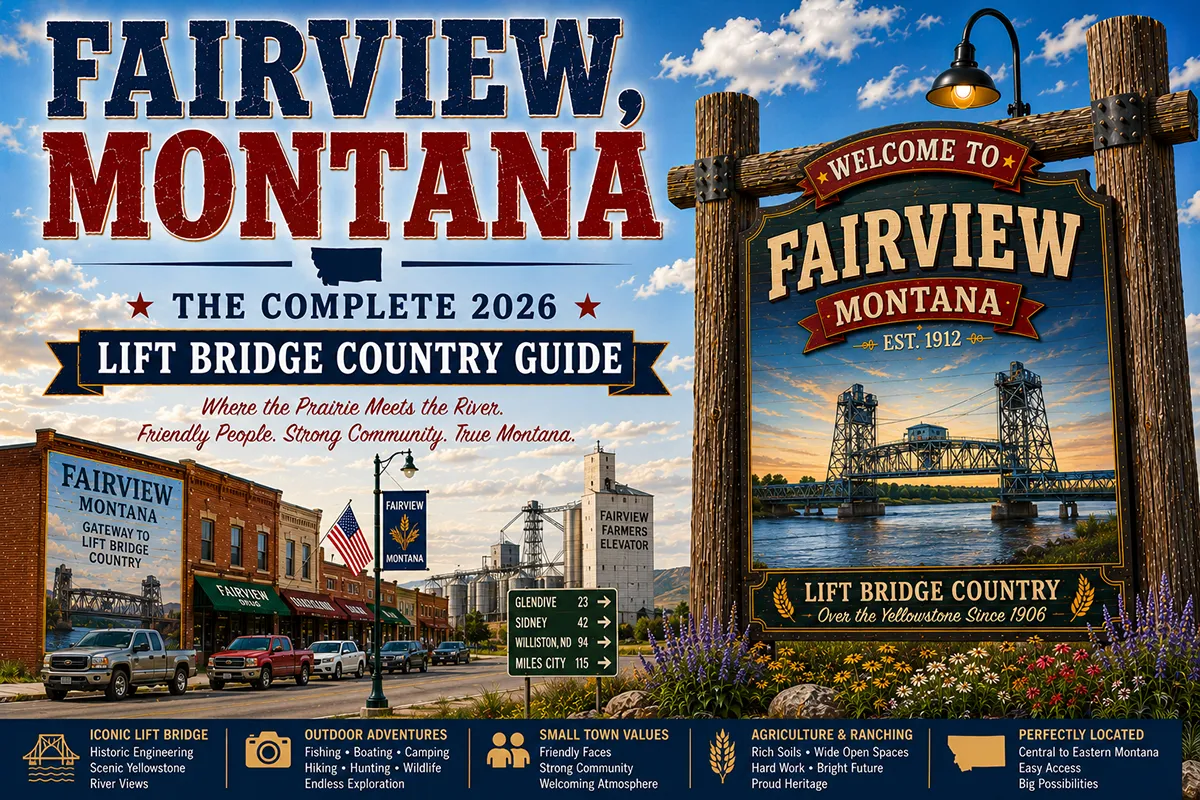
The Fairview Lift Bridge was built in 1913 to accommodate steamboat traffic on the Yellowstone River. It’s a vertical-lift bridge — the kind where the central span rises straight up between two towers to allow tall-masted vessels to pass underneath.
Engineers built it 1,320 feet long and tall enough to let river steamboats through. The problem: by 1913, steamboat traffic on the Yellowstone had already declined so dramatically that the bridge was only raised once — as a test — before being decommissioned for that purpose entirely.
It carried vehicles until 1955 and trains until 1986. It now carries only pedestrians and its own history, listed on the National Register of Historic Places.
The bridge is the kind of engineering monument that defines a small town without the town ever quite knowing how to use it. Walk across it on a summer evening and you’ll find yourself standing above the Yellowstone River on a structure built for a transportation era that had already passed by the time construction was finished.
Fairview has another distinction few travelers know: the eastern edge of the city is in North Dakota. The state line runs through the middle of the community, making Fairview one of a handful of American cities that genuinely straddle a state border.
At the far end of the Fairview Lift Bridge on the North Dakota side is the Cartwright Tunnel — the only train tunnel in North Dakota, still intact though no longer used.
TL;DR
- Fairview (~820, with eastern portion in North Dakota) sits on the Montana-North Dakota border on the Yellowstone River, 10 miles west of Sidney.
- The Fairview Lift Bridge (1913, National Register of Historic Places) was built for steamboats but lifted only once as a test; now a pedestrian landmark with the Cartwright Tunnel (only train tunnel in North Dakota) at its far end.
- The town is Montana’s sugar beet capital — the Yellowstone Valley’s irrigated agriculture is defined by sugar beet production processed at the Sidney Sugars plant.
- The Yellowstone-Missouri Confluence — where Lewis and Clark entered Montana — is nearby.
- Best for: I-94/US-2 corridor travelers, engineering history enthusiasts, paddlefish anglers, and exploring the Montana-North Dakota border country.
Liked this article?
Add Roaming Montana as a preferred source so you see more of our articles and guides on Google.
Fairview at a Glance
| Population (2020) | ~820 |
|---|---|
| County | Richland County (Montana) / Williams County (North Dakota) |
| Region | Far Eastern Montana / Western North Dakota |
| Yellowstone River | Town sits directly on the river |
| Distance to Sidney | ~10 miles west (~12 min) |
| Distance to Williston, ND | ~30 miles east (~35 min) |
| Distance to Glendive | ~55 miles west (~1 hour) |
| Best for | Fairview Lift Bridge, Yellowstone River access, two-state novelty, paddlefish fishing |
What Makes Fairview Different
The Fairview Lift Bridge story is too good to pass up. In 1913, when the bridge was commissioned, the economic planners of Richland County were thinking ahead — they expected the Yellowstone River to carry significant steamboat traffic for decades to come, and they built the bridge accordingly. The vertical-lift mechanism would allow tall-masted vessels to pass.
The only problem was that the steamboat era on the Yellowstone was essentially over by the time the steel was in place. The river’s shifting sandbars, shallow sections, and the arrival of the railroad had rendered regular steamboat navigation impractical years before the bridge opened. The lift span was tested exactly once.
The bridge remained useful for vehicular and rail traffic for decades more, earning its place on the National Register as a significant example of early 20th-century bridge engineering.
When it was finally closed to vehicles and trains, it became what it is today: a 1,320-foot pedestrian walkway over the Yellowstone River, connecting Montana to North Dakota, with the Cartwright Tunnel — still intact, still climbable with a flashlight — at the far end on the North Dakota side.
The two-state character of Fairview is also genuinely distinctive. The Montana-North Dakota border cuts through the community, with residents on the eastern side technically in Williams County, North Dakota. This is unusual enough that locals track which side of the line they live on — different tax structures, different regulations, same Main Street.
Sugar beets define the agricultural identity. The Yellowstone Valley’s irrigation infrastructure — built in the early 1900s by federal reclamation — created one of Montana’s most productive agricultural regions. Sugar beets are the signature crop, processed at the Sidney Sugars plant 10 miles west. Fairview is effectively the sugar beet capital of the broader region.
For broader trip context, see my Montana cities and towns hub.
The Top 10 Things to Do In & Around Fairview
1. Walk the Fairview Lift Bridge
The primary destination. Park at the Montana end and walk the 1,320-foot span over the Yellowstone River. The vertical lift mechanism towers are intact and impressive up close — this is significant industrial architecture from the early 20th century.
At the far end (North Dakota side), the Cartwright Tunnel is accessible with a flashlight. The tunnel is no longer used by trains but is walkable. The complete experience — bridge crossing, tunnel exploration, river views — takes about an hour.
2. Cartwright Tunnel (North Dakota End)
The only train tunnel in North Dakota connects to the Fairview bridge approach on the ND side. Bring a flashlight. It’s dark, atmospheric, and genuinely unusual — walking through a train tunnel that crosses into another state at one end and emerges in open North Dakota prairie at the other.
3. Yellowstone River Fishing (Fairview Area)
The Yellowstone River at Fairview provides access to walleye, catfish, sauger, and seasonal paddlefish. Fairview Bridge State Park (Montana side) has a boat ramp and fishing access.
4. Paddlefish Fishing at Intake (20 miles south via Savage)
The Intake Diversion Dam on the Yellowstone River south of Fairview is one of the premier paddlefish fishing sites in the world. Paddlefish — prehistoric fish that can exceed 100 pounds — are snagged at the base of the dam during their upstream migration in spring.
The season is specific (typically April–June, heavily regulated by FWP). Worth timing a visit around if paddlefish is on the target list.
5. Fairview City Park & Campground
A free campground and RV hookup site in Fairview’s city park — one of the better free camping options in far eastern Montana, right in the community.
6. Day Trip to Sidney (10 minutes west)
Sidney has the MonDak Heritage Center (eastern Montana’s best combined museum and art gallery), the only 18-hole golf course in eastern Montana, and full city services. See Sidney guide.
7. Missouri-Yellowstone Confluence Interpretive Center (30 minutes north)
Near Fort Union Trading Post, the Missouri-Yellowstone Confluence Interpretive Center marks the point where the two great rivers meet — the spot Lewis and Clark reached on April 26, 1805, when they entered Montana. Panoramic river views and significant Lewis & Clark context.
8. Fort Union Trading Post National Historic Site (30 minutes north)
The reconstructed American Fur Company trading post that operated from 1828 to 1867 — one of the most significant fur trade sites in American history. Costumed interpreters and full historical interpretation. See Culbertson guide for broader Fort Union context.
9. Sugar Beet Harvest (Fall)
In September and October, the sugar beet harvest transforms the Fairview area landscape — massive machines pulling beets from the irrigated fields, transport trucks loading at field edges, the Sidney Sugars plant running around the clock. A genuine agricultural spectacle unique to this part of the Northern Plains.
10. Elk Island Recreation Area (northeast of Fairview)
A recreation area northeast of Fairview on the Yellowstone River offering camping, fishing, and wildlife viewing in river bottomland habitat.
Where to Stay
| Hotel | Vibe | Price | Best For |
|---|---|---|---|
| Fairview City Park Campground | Free RV hookups, in-town | Free–$10 | Campers, self-sufficient |
| Wagon Wheel Inn (Fairview) | Local motel | $85–130 | Most travelers |
| Sidney hotels (10 min west) | Full selection | $120–220 | More variety |
| Williston, ND (35 min east) | Full city selection | $130–250 | Energy sector travelers |
Where to Eat
- Double Barrel Saloon — Fairview’s most distinctive dining option; local flavor and reliable meals
- The Drive In — casual food
- Sidney restaurants (10 min west) — 1035 Brewing, Meadowlark Brewing, and the full Sidney dining scene
Getting There & Around
From Sidney: 10 miles east on US-2, about 12 minutes.
From Glendive: 55 miles east on US-2, about 1 hour.
From Williston, ND: 30 miles west on US-2, about 35 minutes.
Bridge access: The Fairview Lift Bridge pedestrian access is from the west (Montana) end. Parking available at the bridge approach.
What Fairview Unlocks
Sidney (10 min west)
MonDak Heritage Center, full services. See Sidney guide.
Missouri-Yellowstone Confluence & Fort Union (30 min north)
The Lewis and Clark entry point into Montana; Fort Union Trading Post NHS.
Paddlefish at Intake (20 min south via Savage)
Spring paddlefish snagging — prehistoric fish up to 100+ pounds.
North Dakota Badlands (2 hours east)
Theodore Roosevelt National Park at Medora.
When to Visit
Spring (April–June): Paddlefish season at Intake; river at full flow; bridge most dramatic with spring water levels.
Summer (June–August): Full recreation season; bridge walking; Yellowstone River fishing.
Fall (September–October): Sugar beet harvest season — the valley’s most dramatic agricultural activity.
Year-round: The bridge is accessible year-round.
Personal Tips
Bring a flashlight for the Cartwright Tunnel. The tunnel is dark and atmospheric — a genuinely unusual experience on the North Dakota side of the bridge. It’s walk-in accessible from the bridge’s eastern end.
The bridge at golden hour. The light on the Yellowstone River from the bridge’s midpoint at sunset is exceptional — the valley opens downstream with the water catching last light.
Call FWP for paddlefish season dates. The paddlefish season at Intake is strictly regulated and the timing varies by year. Contact Montana FWP (fwp.mt.gov) in early spring for current season dates before making the drive.
The two-state novelty is real. Drive the main street and note where the signs shift from Montana to North Dakota regulations. It’s subtle but genuine — different state, same community.
Fairview Quick Facts
| Founded | 1905 | | Named for | The fair view of the surrounding valley | | States | Montana (west) and North Dakota (east) | | Fairview Lift Bridge | Built 1913; 1,320 feet; lifted once; National Register | | Cartwright Tunnel | Only train tunnel in North Dakota | | Average summer high | 89°F | | Average winter low | 2°F |
Conclusion
Fairview is the kind of small town that rewards travelers who know what to look for. The Fairview Lift Bridge — built for a steamboat era that had already passed — is an extraordinary piece of industrial history accessible on foot.
The Cartwright Tunnel on the North Dakota side is one of the more unusual walkable landmarks in the region. And the paddlefish fishery at Intake, the sugar beet harvest, and the Yellowstone-Missouri confluence 30 minutes north give the area genuine depth.
Have a Fairview question? Drop it in the comments — I read every one.
Frequently Asked Questions
Is Fairview Montana worth visiting?
Yes — primarily for the Fairview Lift Bridge (a 1,320-foot pedestrian walkway over the Yellowstone River, National Register of Historic Places, with the Cartwright Tunnel at its North Dakota end) and the paddlefish fishing at Intake (20 miles south). The town’s two-state character and sugar beet agricultural identity make it one of the more distinctive communities in far eastern Montana.
What is the Fairview Lift Bridge?
The Fairview Lift Bridge is a 1913 vertical-lift bridge spanning the Yellowstone River at the Montana-North Dakota border near Fairview. Built to accommodate steamboat traffic, the bridge’s lift span was raised exactly once — as a test — before the steamboat era ended. At 1,320 feet long, it’s listed on the National Register of Historic Places and now serves as a pedestrian walkway, with the Cartwright Tunnel (the only train tunnel in North Dakota) at its far end.
Does Fairview Montana straddle two states?
Yes — Fairview’s eastern portion is in Williams County, North Dakota, making it one of a small number of American communities that genuinely straddles a state line. The Montana-North Dakota border runs through the community. The Fairview Lift Bridge crosses the Yellowstone from Montana to North Dakota.
What is the paddlefish fishing near Fairview?
Paddlefish fishing is available at the Intake Diversion Dam on the Yellowstone River approximately 20 miles south of Fairview (near Savage). Paddlefish — prehistoric, filter-feeding fish that can exceed 100 pounds — are snagged during their spring upstream migration. The season is strictly regulated by Montana FWP; contact FWP for current season dates.