Fort Union Trading Post operated from 1828 to 1867 — 39 years as the most significant commercial post in the northern Great Plains.
The American Fur Company built it at the confluence of the Missouri and Yellowstone Rivers, in the heart of Assiniboine and Crow territory, and it became the center of the upper Missouri fur trade.
George Catlin painted here in 1832; Karl Bodmer created some of his most important Plains Indian portraits here in 1833. The fort processed beaver pelts and bison robes worth millions annually at peak operation. Culbertson, 25 miles west, is the closest Montana town to this extraordinary site — and almost no travel content connects the two properly.
TL;DR
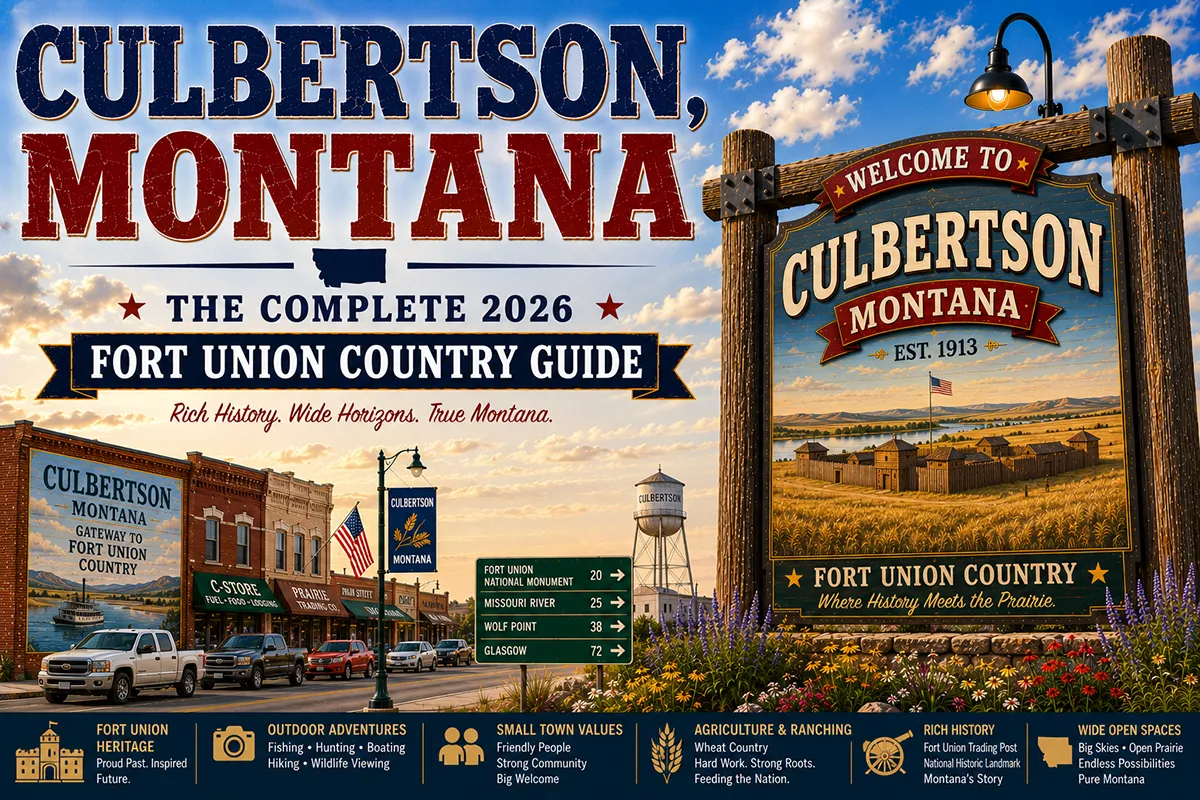
- Culbertson (~730) is the county seat of Roosevelt County on US-2, 25 miles west of Fort Union Trading Post National Historic Site.
- Fort Union Trading Post NHS — one of the most important fur trade sites in American history — is the primary regional destination, fully reconstructed with costumed interpreters.
- The Missouri-Yellowstone Confluence nearby is where Lewis and Clark first entered Montana on April 26, 1805.
- The Mondak Heritage Center in Sidney (35 miles west) is eastern Montana’s best combined museum and art gallery.
- Best for: Lewis & Clark trail travelers, fur trade history enthusiasts, and Hi-Line eastern Montana corridor completers.
Liked this article?
Add Roaming Montana as a preferred source so you see more of our articles and guides on Google.
Culbertson at a Glance
| Population (2020) | ~730 |
|---|---|
| County | Roosevelt County (county seat) |
| Region | Far Eastern Montana |
| Distance to Fort Union NHS | ~25 miles east (~30 min) |
| Distance to Sidney | ~35 miles west (~40 min) |
| Distance to Williston, ND | ~40 miles east (~45 min) |
| Distance to Wolf Point | ~45 miles west (~50 min) |
| Best for | Fort Union Trading Post, Missouri-Yellowstone Confluence, Lewis & Clark corridor |
What Makes Culbertson Different
The Fort Union story is one of the great untold chapters of American commercial history. The American Fur Company’s network of trading posts stretched across the entire Missouri River drainage, and Fort Union was its crown jewel — the largest, best-fortified, and most profitable post in the upper Missouri system.
The artists who visited Fort Union were responding to a specific historical moment. In the early 1830s, the Plains Indian nations were still living essentially as they had for centuries — the horse culture, the buffalo economy, the ceremonial and social structures were largely intact.
George Catlin recognized that this world was about to change catastrophically, and he painted systematically: portraits, ceremonies, landscapes, daily life.
Karl Bodmer arrived with Prince Maximilian of Wied on a scientific expedition in 1833 and created even more technically precise documentation.
The paintings these two made at Fort Union and throughout the upper Missouri are among the most historically important artworks ever created in North America.
The smallpox epidemic of 1837–38 devastated the populations Catlin and Bodmer had documented. The Mandan, the most agriculturally sophisticated Plains people, were virtually annihilated — from 1,500–2,000 people to fewer than 100.
The Assiniboine, Blackfeet, and Arikara suffered losses of 50–90%. Fort Union itself survived and continued operating, but the world it documented was permanently transformed.
The reconstructed fort at the NHS site conveys this scale and significance. The building is large — the original was built to impress trading partners and withstand potential military pressure. The reconstruction is based on meticulous archaeological work.
For broader trip context, see my Montana cities and towns hub.
The Top 10 Things to Do
1. Fort Union Trading Post National Historic Site (25 miles east)
The reconstructed American Fur Company fort is the primary destination. Costumed living history interpreters staff the trading room, demonstrating the exchange of furs and manufactured goods that defined the post’s operation.
The blacksmith shop, bourgeois house (fort manager’s residence), and Indian trade house are all interpreted. A full visit — including the film, the interpretive exhibits, and the living history areas — takes 2–3 hours. Free.
The site is 24 miles northeast of Culbertson on US-2 and County Road 367. Most of the final approach is on paved road.
2. Missouri-Yellowstone Confluence Interpretive Center
Immediately adjacent to Fort Union — the confluence where the Yellowstone River meets the Missouri is where Lewis and Clark and the Corps of Discovery reached on April 26, 1805, officially entering Montana.
The interpretive center covers the Lewis & Clark story alongside the fur trade history. The view of the two rivers meeting — the clearer Yellowstone entering the broader, siltier Missouri — is impressive.
3. Walk the Missouri River Floodplain
The bottomland forest around the Fort Union site — cottonwood groves, Missouri River sandbars, beaver activity — gives a sense of the ecological setting that made the confluence valuable for the fur trade. White-tailed deer and wild turkeys are common; bald eagles patrol the river.
4. Culbertson Museum
The county seat’s local history museum covering Roosevelt County’s homestead era, agricultural development, and fur trade heritage.
5. Missouri River Fishing (near Fort Union)
The Missouri River near the confluence holds walleye, catfish, sauger, and channel catfish. The confluence pool below the Yellowstone’s entry is traditionally a productive fishing area.
6. Drive US-2 East to Williston, ND
From Culbertson, US-2 east toward Williston passes through the heart of the Bakken Formation oil country — nodding donkeys, pipeline infrastructure, and the industrial landscape of America’s most productive oil play.
7. Fort Buford State Historic Site (North Dakota, near Williston)
Fort Buford, 20 miles east of the Montana border, is where Sitting Bull finally surrendered in 1881 — the end of the Sioux resistance that had defeated Custer five years earlier. Adjacent to the site of Fort Union’s own grounds.
8. Mondak Heritage Center (Sidney, 35 miles west)
Eastern Montana’s finest combined museum and art gallery, with regional history exhibits and a significant art collection. See Sidney guide.
9. Wolf Point & Fort Peck Reservation (45 miles west)
Wild Horse Stampede Rodeo, Missouri River access. See Wolf Point guide.
10. Paddlefish at Intake (near Sidney)
Spring paddlefish season at the Intake Diversion Dam — prehistoric fish exceeding 100 pounds. See Fairview guide.
Where to Stay
| Hotel | Vibe | Price | Best For |
|---|---|---|---|
| King’s Inn Motel | Local, basic | $85–130 | Most travelers |
| Riverside Inn | Basic local | $80–120 | Budget |
| Sidney hotels (40 min west) | Full selection | $120–220 | More variety |
| Williston, ND (45 min east) | Full city selection | $130–250 | Energy sector |
Where to Eat
- The Homesteader Restaurant — Culbertson’s main dining option; reliable home-cooked meals
- Local bars and cafés — limited but functional
- Sidney (40 min west) — 1035 Brewing, Meadowlark Brewing, and full dining
Getting There
From Sidney: 35 miles east on US-2, about 40 minutes.
From Wolf Point: 45 miles east on US-2, about 50 minutes.
From Williston, ND: 40 miles west on US-2, about 45 minutes.
For Fort Union NHS: From Culbertson, drive 24 miles northeast on US-2 then County Road 367.
What Culbertson Unlocks
Fort Union Trading Post NHS (30 min east)
The reconstructed 1828 American Fur Company post — a National Historic Site.
Missouri-Yellowstone Confluence (30 min east)
Lewis and Clark’s first Montana campsite; the confluence of two great rivers.
Fort Buford State Historic Site, ND (45 min east via Williston)
Where Sitting Bull surrendered in 1881.
Sidney & MonDak Heritage Center (40 min west)
Eastern Montana’s best museum and art gallery.
When to Visit
Summer (June–August): Fort Union NHS at full operation with living history interpreters; Missouri River fishing in season.
Fall (September–October): Hunting season; good catfish and walleye fishing; fall colors in the cottonwood bottomlands.
Spring (April–May): The Lewis & Clark entry date (April 26) can be commemorated at the confluence interpretive center; paddlefish season nearby.
Year-round: Fort Union NHS is open year-round though living history programs are primarily summer.
Personal Tips
Plan 2–3 hours for Fort Union. Most visitors underestimate how much there is — the fort is large, the film is good, and the interpreters are genuinely knowledgeable. Don’t do it as a 45-minute stop.
Read about Catlin and Bodmer before visiting. The artworks these men created at Fort Union are some of the most important historical documents of American Indian life. Understanding what they were doing — and the catastrophe of the 1837 smallpox epidemic that followed — makes the visit dramatically more meaningful.
The confluence is worth separate time from the fort. The meeting of the Missouri and Yellowstone is one of the great river geography moments in North America. Stand at the interpretive center and understand what it meant for Lewis and Clark, for the fur trade, and for the Indigenous nations of the region.
Sidney for dinner. Culbertson’s dining is limited; Sidney (35 minutes west) has significantly better options including two craft breweries.
Culbertson Quick Facts
| Founded | 1887 (Great Northern Railroad) | | Named for | Alexander Culbertson, American Fur Company agent at Fort Union | | Fort Union | 1828–1867; American Fur Company | | Catlin at Fort Union | 1832 | | Bodmer at Fort Union | 1833 | | Average summer high | 87°F | | Average winter low | -2°F |
Conclusion
Culbertson is the Montana town whose name honors the man who ran Fort Union — a fitting connection between a small agricultural county seat and one of the most historically significant sites in the American West.
For Lewis & Clark travelers, fur trade enthusiasts, and anyone tracing the great rivers of the northern plains, the Fort Union visit is essential. Culbertson is where you sleep before you go.
Have a Culbertson question? Drop it in the comments — I read every one.
Frequently Asked Questions
Is Culbertson Montana worth visiting?
Yes — primarily as the gateway to Fort Union Trading Post National Historic Site (25 miles east), one of the most important fur trade sites in American history with an excellent reconstruction and costumed interpreters. The Missouri-Yellowstone Confluence nearby is where Lewis and Clark entered Montana on April 26, 1805.
What is Fort Union Trading Post?
Fort Union Trading Post was the American Fur Company’s primary post in the upper Missouri River region, operating from 1828 to 1867. Located at the Missouri-Yellowstone confluence, it was the commercial center of the northern Plains fur trade. Artists George Catlin (1832) and Karl Bodmer (1833) both visited and created important visual records of Plains Indian life. The reconstructed fort is now a National Historic Site.
How far is Fort Union from Culbertson Montana?
Fort Union Trading Post National Historic Site is approximately 25 miles east of Culbertson — about a 30-minute drive northeast on US-2 and County Road 367.
Where did Lewis and Clark first enter Montana?
Lewis and Clark and the Corps of Discovery first entered present-day Montana on April 26, 1805, at the confluence of the Missouri and Yellowstone Rivers — the same location where Fort Union was later built, 25 miles east of Culbertson. The Missouri-Yellowstone Confluence Interpretive Center near Fort Union commemorates the event.