Brother Joseph Carignano was an Italian Jesuit lay brother assigned to the St. Ignatius Mission in the 1890s as the cook and handyman.
He had no formal artistic training. Over a 14-month span in the 1890s, he painted 58 murals on the walls and ceiling of the mission church — scenes from the life of Christ, angels, and sacred imagery — using house paint and homemade brushes made from his own hair.
The results, now called the “Sistine Chapel of the Rockies” by some visitors, cover every surface of the interior. They are extraordinary. The story of their creation is one of the most remarkable in Montana history.
TL;DR
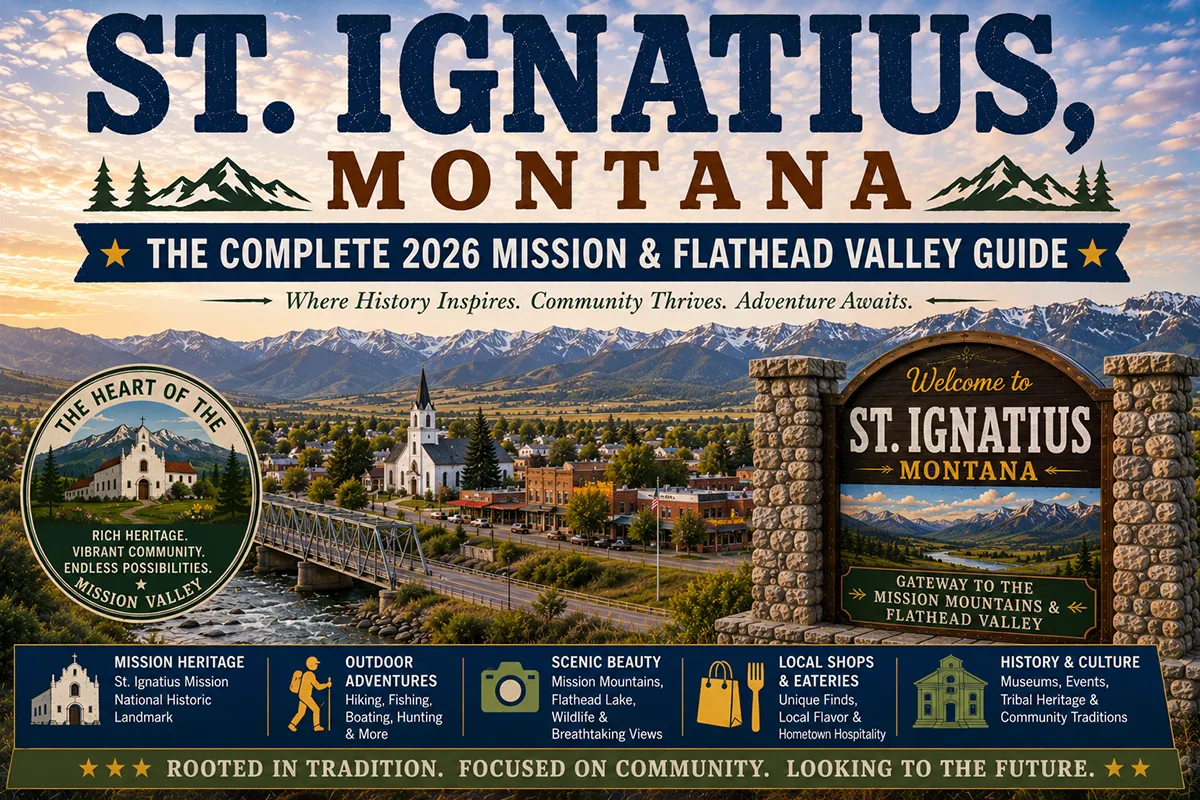
- St. Ignatius (~850) is a small Mission Valley community on the Flathead Indian Reservation, at the base of the Mission Mountains.
- The St. Ignatius Mission (1891, National Historic Landmark) has 58 hand-painted murals by self-taught artist Brother Joseph Carignano — including two unique paintings of Christ and Mary rendered in Native American Salish form.
- The National Bison Range in nearby Moiese protects one of America’s last free-roaming bison herds — now managed by the CSKT.
- The Mission Mountains provide a spectacular backdrop and accessible wilderness hiking with CSKT tribal permits.
- Best for: the mission murals (mandatory stop in the Mission Valley), National Bison Range, and CSKT cultural context.
Liked this article?
Add Roaming Montana as a preferred source so you see more of our articles and guides on Google.
St. Ignatius at a Glance
| Population (2020) | ~850 |
|---|---|
| County | Lake County |
| Reservation | Flathead Indian Reservation (CSKT) |
| Region | Northwest Montana (Mission Valley) |
| Distance to Polson | ~25 miles north (~30 min) |
| Distance to Missoula | ~65 miles south (~1.25 hours) |
| Distance to Ronan | ~15 miles north (~20 min) |
| Best for | St. Ignatius Mission murals, National Bison Range, Mission Mountains, CSKT cultural context |
What Makes St. Ignatius Different
The full story of the St. Ignatius Mission murals is richer than most travel content conveys. The mission was originally founded in 1845 by Father Pierre-Jean De Smet in present-day Idaho — the same Jesuit who established Montana’s first European settlement at Stevensville in 1841.
At the invitation of Chief Alexander (Chief Tmɫx̣ƛ̓cín) of the Upper Kalispel Tribe of the Salish nation, the mission relocated to the Mission Valley in 1854. The current Gothic Revival brick church was built in 1891, with bricks made from local clay by Indigenous workers and Jesuit missionaries together.
Brother Carignano’s murals were created under significant constraints — he worked with house paint mixed with oils, sometimes creating brushes from his own hair when proper tools weren’t available. He had never painted before. The 58 works he produced cover the entire interior of the church.
What no competitor adequately covers: two of the 58 murals depict Christ and the Virgin Mary in Native American Salish form — a remarkable integration of Indigenous identity into the mission’s religious iconography, placed at the rear of the church by the Salish community. These paintings are among the most culturally significant artworks in Montana.
The town itself sits at the base of the Mission Mountains — a dramatic 10,000-foot wall of rock rising immediately west of the valley floor. The visual impact from St. Ignatius looking west is one of the best mountain views in the Mission Valley.
For broader trip context, see my Montana cities and towns hub.
The Top 10 Things to Do In & Around St. Ignatius
1. St. Ignatius Mission & Murals
The mandatory stop. The brick church (1891) is a National Historic Site. Inside: 58 hand-painted murals by Brother Carignano covering ceiling and walls. Spend 45–60 minutes absorbing the artwork. A small museum and gift shop adjoin the church. Don’t miss: the two Salish-form images of Christ and Mary at the back of the church — the visual integration of Salish cultural identity into Catholic iconography is historically significant. Free, donations appreciated.
2. National Bison Range (Moiese, 20 miles south)
Year-round, the National Bison Range offers the opportunity to view 500 bison roaming on natural grassland, along with elk, bighorn sheep, antelope and deer on self-guided auto tours. The range was recently returned to CSKT management after decades of federal control — a significant restoration of tribal sovereignty over ancestral wildlife. The 19-mile auto tour and hiking trails are accessible. Admission charged.
3. Four Winds Indian Trading Post
Four Winds Indian Trading Post offers authentic Native American crafts, artwork, and cultural items in Saint Ignatius. Visitors can browse through traditional handcrafted goods including jewelry, pottery, and textiles created by local tribal artisans. One of the Mission Valley’s best sources for authentic CSKT artisan work.
4. Mission Mountains Wilderness Hiking (Tribal Permit Required)
The Mission Mountains Wilderness Area rises immediately behind St. Ignatius — 10,000-foot peaks with glacial lakes and significant grizzly bear habitat. CSKT tribal recreation permits are required for non-tribal members. Ashley Lakes Trailhead is one of the most popular entry points, offering views of the Mission Mountains from accessible terrain.
5. Blue Goose Aviation Scenic Flights
A local aviation company offering scenic flights over the Mission Valley and Flathead Lake from St. Ignatius — an extraordinary way to see the valley’s scale and the Mission Mountains’ full profile from above.
6. McDonald Lake
A picturesque alpine lake in the Mission Mountains accessible via tribal permit. Excellent fishing and hiking destination within the wilderness area.
7. St. Ignatius Mission Museum
The small museum adjacent to the church covers the mission’s history from the 1845 founding through the present — the Indigenous-Jesuit collaborative construction, the mission’s role in the CSKT community, and Brother Carignano’s story.
8. Mission Valley Scenic Drives
US-93 through St. Ignatius provides some of the Mission Valley’s most dramatic mountain views — the Mission Mountains are closest to the highway here. Evening light on the peaks is exceptional.
9. Day Trip to Pablo & Three Chiefs Culture Center (15 min north)
The CSKT’s own cultural institution presenting Salish, Kootenai, and Pend d’Oreille history. See Pablo guide.
10. Ronan & Ninepipe NWR (15 min north)
The Mission Mountain Golf Course and Ninepipe National Wildlife Refuge — both accessible from Ronan. See Ronan guide.
Where to Stay
| Hotel | Vibe | Price | Best For |
|---|---|---|---|
| Mission Mountain Motel | Local, clean | $90–140 | Most travelers |
| Ronan motels (15 min north) | More variety | $90–160 | Budget |
| Polson hotels (30 min north) | Full selection, lakeside | $130–250 | Lake access |
| Missoula hotels (1.25 hours south) | Full city | $140–260 | More variety |
Where to Eat
- St. Ignatius Steakhouse — local dinner option
- Glacier Gateway Truckstop Café — reliable diner food on US-93
- Ronan dining (15 min north) — more variety; see Ronan guide
Getting There
From Polson: 25 miles south on US-93, about 30 minutes.
From Missoula: 65 miles north on US-93, about 1.25 hours.
From Ronan: 15 miles south on US-93, about 20 minutes.
What St. Ignatius Unlocks
National Bison Range (20 min south at Moiese)
One of America’s last free-roaming bison herds, now under CSKT management.
Mission Valley Cultural Corridor
St. Ignatius → Ronan → Pablo → Polson — the full Mission Valley sequence from mission to tribal capital to lake.
Three Chiefs Culture Center (15 min north in Pablo)
Essential CSKT cultural context.
Mission Mountains Wilderness
Alpine hiking with tribal permit.
When to Visit
Year-round for the mission — the church is open year-round, though hours vary seasonally.
Summer (June–August): Best for Mission Mountains hiking (tribal permit required), National Bison Range auto tour, full valley exploration.
Spring (April–May): Bison calving season at the National Bison Range — the most dramatic wildlife period.
Fall (September–October): Fewer crowds, dramatic light on the Mission Mountains.
Personal Tips
Spend a full hour in the mission. Most visitors rush through in 20 minutes. Sit in the pews. Let your eyes adjust. Find all 58 murals. Look for the Salish Christ and Mary images at the back — they’re subtle and extraordinary.
The National Bison Range requires timing. Arrive early — bison are most active in morning. The 19-mile auto tour takes 1.5–2 hours.
Tribal permits before wilderness hiking. If you plan to access the Mission Mountains, get the CSKT recreational permit first.
Read the mission’s history before visiting. Understanding that this building was constructed collaboratively by Salish people and Jesuit missionaries — and that the murals were painted by a lay brother who had never painted before — fundamentally changes the experience.
St. Ignatius Quick Facts
| Mission founding | 1854 (relocated from Idaho at Salish invitation) | | Current church built | 1891 (Gothic Revival brick) | | Brother Carignano | Self-taught cook/handyman; painted all 58 murals in 14 months | | Salish Lord paintings | Two murals depicting Christ and Mary in Salish Native American form | | National Historic Site | Yes | | Average summer high | 82°F |
Conclusion
St. Ignatius Mission is one of Montana’s great undervisited cultural treasures. The murals are extraordinary — the story of their creation is even more so. Brother Carignano, a cook with no artistic training, painted a complete theological program across an entire church interior using house paint and homemade brushes.
And the Salish Lord paintings at the back of the church represent the kind of cultural integration that belongs in every conversation about Indigenous history in Montana. This is a mandatory stop in the Mission Valley.
Have a St. Ignatius question? Drop it in the comments — I read every one.
Frequently Asked Questions
Is St. Ignatius Montana worth visiting?
Yes — St. Ignatius is absolutely worth visiting, primarily for the St. Ignatius Mission (a National Historic Site with 58 extraordinary hand-painted murals) and the National Bison Range (20 miles south). The mission alone is one of the most remarkable cultural and artistic sites in Montana.
Who painted the St. Ignatius Mission murals?
The 58 murals were painted by Brother Joseph Carignano, an Italian Jesuit lay brother who served as the mission’s cook and handyman. He had no formal artistic training — he was entirely self-taught. Working over approximately 14 months in the 1890s, he painted all 58 works using house paint mixed with oils, sometimes making brushes from his own hair. The results cover every wall and the ceiling of the 1891 Gothic Revival church.
What are the Salish Lord paintings at St. Ignatius?
Two of the 58 murals at St. Ignatius Mission depict Jesus Christ and the Virgin Mary in Native American Salish cultural form — rendered with Indigenous features and dress. These paintings, placed at the rear of the church, represent a significant integration of Salish cultural identity into the mission’s religious iconography, created by and for the Salish community.
How far is St. Ignatius from Polson Montana?
St. Ignatius is approximately 25 miles south of Polson on US-93 — about a 30-minute drive through the Mission Valley. Both towns are on the Flathead Indian Reservation.
Is the National Bison Range near St. Ignatius?
The National Bison Range is approximately 20 miles south of St. Ignatius near the town of Moiese. Now managed by the Confederated Salish and Kootenai Tribes, the refuge protects approximately 500 free-roaming bison and offers a 19-mile self-guided auto tour.