I’ve driven through Laurel dozens of times on I-90 without stopping, and I suspect most Montana travelers have done the same. That changed when I pulled off to see the Stillwater River enter the Yellowstone — a confluence that’s been significant for thousands of years, that Lewis and Clark noted in their journals, and that most interstate travelers pass over a bridge without even registering.
Laurel is a working city that doesn’t ask for your attention. But it has things worth your attention if you offer it.
TL;DR
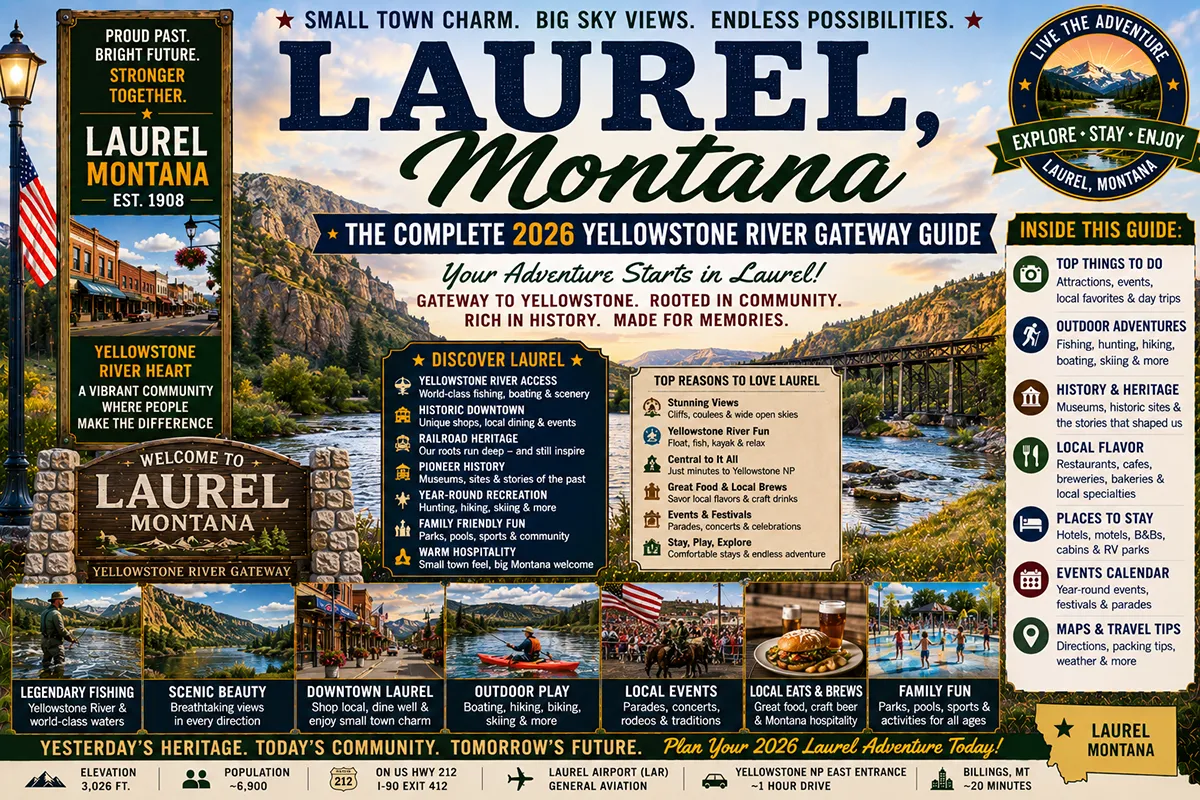
- Laurel (~7,300) is an I-90 industrial and agricultural city 8 miles west of Billings, at the confluence of the Stillwater and Yellowstone Rivers.
- Montana’s largest oil refinery (CHS Laurel) is located here — giving the city a working industrial character distinct from Billings’ commercial core.
- The most affordable lodging option in the Billings metro area — consistently $50–80 cheaper per night than equivalent Billings hotels.
- Best for: I-90 travelers needing an affordable overnight, anglers targeting the Yellowstone/Stillwater confluence, and travelers positioning for the Beartooth Highway (50 miles south via Red Lodge).
- Almost no quality travel content exists for Laurel — good ranking opportunity.
Liked this article?
Add Roaming Montana as a preferred source so you see more of our articles and guides on Google.
Laurel at a Glance
| Population (2020) | ~7,300 |
|---|---|
| County | Yellowstone County |
| Region | South-Central Montana |
| Elevation | 3,268 ft |
| I-90 exits | Exit 434, 437 |
| Distance to Billings | ~8 miles (~10 min) |
| Distance to Red Lodge | ~50 miles (~1 hour south via US-212) |
| Distance to Columbus | ~30 miles west (~35 min) |
| Best for | Budget Billings alternative, Yellowstone River access, Beartooth corridor base |
What Makes Laurel Different
Laurel grew as a Northern Pacific Railroad division point in 1882 and has remained a railroad and industrial city ever since.
The CHS Laurel Refinery — one of Montana’s largest employers and the state’s biggest oil refinery — is visible from the highway as a complex of stacks and processing towers.
This industrial character shapes Laurel’s personality: it’s a workers’ city, not a tourism hub, and that honesty is part of its appeal to travelers who prefer authentic over curated.
The Stillwater River confluence with the Yellowstone sits just south of town — a historically significant spot where the expedition journals noted “a handsome river” entering the Yellowstone. Today it’s a fishing access site and a place to watch the two rivers blend their colors.
The Stillwater runs clearer and colder from the Beartooth Mountains; the Yellowstone carries the sediment of its longer journey.
For broader context, see my Montana cities and towns hub.
The Top 10 Things to Do In & Around Laurel
1. Yellowstone and Stillwater River Confluence
The Lewis and Clark expedition noted this confluence on their return journey in 1806 — Clark called the Stillwater “a handsome river” and noted its clarity compared to the Yellowstone. A fishing access site near the confluence provides river access and a good view of where the two rivers merge. The confluence itself is visible from the US-212 bridge south of town.
2. Yellowstone River Fishing
The Yellowstone River around Laurel is excellent for walleye, sauger, channel catfish, and some trout. Multiple fishing access sites along the river within Laurel city limits and in the surrounding county. The section downstream of Laurel (toward Billings) is productive for catfish; upstream (toward Columbus) is better for trout.
3. City Park & Riverside Recreation
Laurel’s city park along the Yellowstone River has walking and biking trails, picnic areas, and family facilities — a pleasant riverside green space that locals use year-round.
4. Day Trip to Billings (10 minutes)
The Rimrocks, Yellowstone Art Museum, Western Heritage Center, Pictograph Cave State Park, and the Billings Brew Trail are all 10 minutes east. See Billings guide for the full Billings experience.
5. Day Trip to Red Lodge & Beartooth Highway (1 hour south)
US-212 south from Laurel through Joliet and Bridger reaches Red Lodge in about an hour — the launch point for the Beartooth Highway, one of America’s most spectacular drives. See Red Lodge guide.
6. Little Bighorn Battlefield Day Trip (45 minutes southeast)
The site of Custer’s Last Stand (1876) is 45 minutes southeast via I-90. See Hardin guide.
7. Laurel’s Historic Downtown
The historic commercial core has classic early 20th century storefronts — an unpretentious working-city downtown with local businesses rather than tourist shops.
8. CHS Refinery Viewing
The refinery complex is visible from multiple points around town — an industrial landscape that tells the story of Montana’s petroleum economy as clearly as anything in the state.
9. Fly Fish the Stillwater River (30 min south, Columbus area)
The Stillwater River upstream from Laurel is excellent trout water — cutthroat, rainbow, and brown trout in a mountain river with multiple access points. See Columbus guide for Stillwater details.
10. Sacrifice Cliff (Billings area, 15 min)
A sandstone cliff above the Yellowstone River near Billings — a significant Crow Nation historical site where, according to oral history, survivors of a smallpox epidemic rode their horses over the cliff. The cliffs are visible from below; access via Billings.
Where to Stay
| Hotel | Vibe | Price | Best For |
|---|---|---|---|
| Yellowstone River Inn | Riverside, local character | $100–160 | Most travelers |
| Super 8 Laurel | Budget chain, I-90 adjacent | $80–120 | Very budget |
| Western Motel Laurel | Basic, clean | $75–110 | Budget |
| Days Inn Laurel | Standard chain | $90–140 | Most road trippers |
| Billings hotels (8 min) | Full selection | $130–250 | Those wanting more options |
Laurel’s consistent price advantage over Billings: $50–80/night less for comparable quality.
Where to Eat
- Old Country Kitchen — a genuine Laurel institution; breakfast and lunch done right for decades
- The Pub — burgers and beer, working-city bar atmosphere
- Pizza Hut / standard chains — full fast-casual presence along the I-90 corridor
- Mexico Viejo — solid Mexican, casual
- Billings dining scene (10 min) — full variety including fine dining; see Billings guide
Getting There
From Billings: 8 miles west on I-90, about 10 minutes (Exit 434 or 437).
From Columbus: 30 miles east on I-90, about 35 minutes.
From Red Lodge: 50 miles north via US-212 through Joliet and Bridger, about 1 hour.
What Laurel Unlocks
Billings (10 min)
Montana’s largest city, Rimrocks, Yellowstone Art Museum, Billings Brew Trail. See Billings guide.
Red Lodge & Beartooth Highway (1 hour south)
One of America’s most spectacular drives. See Red Lodge guide.
Columbus & Stillwater River (35 min west)
Stillwater River fly fishing, Crazy Mountains access. See Columbus guide.
Little Bighorn Battlefield (45 min southeast)
Custer’s Last Stand site, Crow Nation cultural context. See Hardin guide.
When to Visit
Laurel is a year-round practical city rather than a seasonal destination:
Summer — Yellowstone River fishing, riverside park use, Beartooth day trips.
Fall — excellent catfish and walleye fishing; hunting season.
Winter — functional year-round; Billings proximity provides all services.
Spring — Yellowstone high water, good catfish season starting.
Personal Tips
Use Laurel for airport proximity saves. Billings Logan Airport is 15 minutes from Laurel. An overnight in Laurel before an early morning flight saves $60–80 versus a Billings hotel.
The Stillwater confluence is worth 30 minutes. Find the fishing access site at the confluence — it’s a historically significant and genuinely pretty spot that almost nobody stops at.
US-212 south to Red Lodge is the right Beartooth approach. Departing from Laurel means you can be in Red Lodge in an hour and starting the Beartooth ascent by 9 a.m. The drive is beautiful from the beginning.
Old Country Kitchen for breakfast. Before a long Beartooth day or a Billings museum morning, it’s the right call.
Laurel Quick Facts
| Founded | 1882 (Northern Pacific Railroad division point) |
|---|---|
| Named for | Laurel, Maryland (Northern Pacific executive connection) |
| Major industries | Oil refining (CHS Laurel Refinery), railroad, agriculture |
| Average summer high | 88°F |
| Average winter low | 11°F |
| I-90 exits | 434 and 437 |
Conclusion
Laurel rewards travelers who step off the interstate deliberately. The Yellowstone River confluence, the honest industrial character, the proximity to Billings and the Beartooth, and the consistent $60–80/night lodging savings make it worth knowing. It’s not Billings, and it doesn’t need to be.
Have a Laurel question? Drop it in the comments — I read every one.
Frequently Asked Questions
Is Laurel Montana worth visiting?
Worth stopping at — Laurel offers Yellowstone and Stillwater River fishing access, a historically significant river confluence, and 10-minute access to everything Billings provides at significantly lower hotel rates. As an I-90 overnight for travelers positioned for the Beartooth Highway south or Billings access east, it’s the smart logistical choice.
How far is Laurel from Billings?
Laurel is approximately 8 miles west of Billings on I-90 — about a 10-minute drive. Billings Logan International Airport (BIL) is approximately 15 minutes from Laurel.
Is Laurel cheaper than Billings for hotels?
Yes — Laurel hotels consistently run $50–80 less per night than equivalent Billings properties. The trade-off is slightly less dining variety and fewer entertainment options, but Billings is 10 minutes away for anything Laurel doesn’t have.
What fishing is available near Laurel Montana?
The Yellowstone River near Laurel provides excellent walleye, sauger, channel catfish, and some trout fishing at multiple public access sites. The Stillwater River (30 miles west near Columbus) adds cutthroat, rainbow, and brown trout fishing in mountain river conditions.
What is the CHS Laurel Refinery?
The CHS Laurel Refinery is Montana’s largest oil refinery, processing crude oil from the Williston Basin (Bakken Formation) and distributing refined petroleum products across the Northern Plains and Pacific Northwest. The facility is a major Yellowstone County employer and one of the defining features of Laurel’s industrial identity.