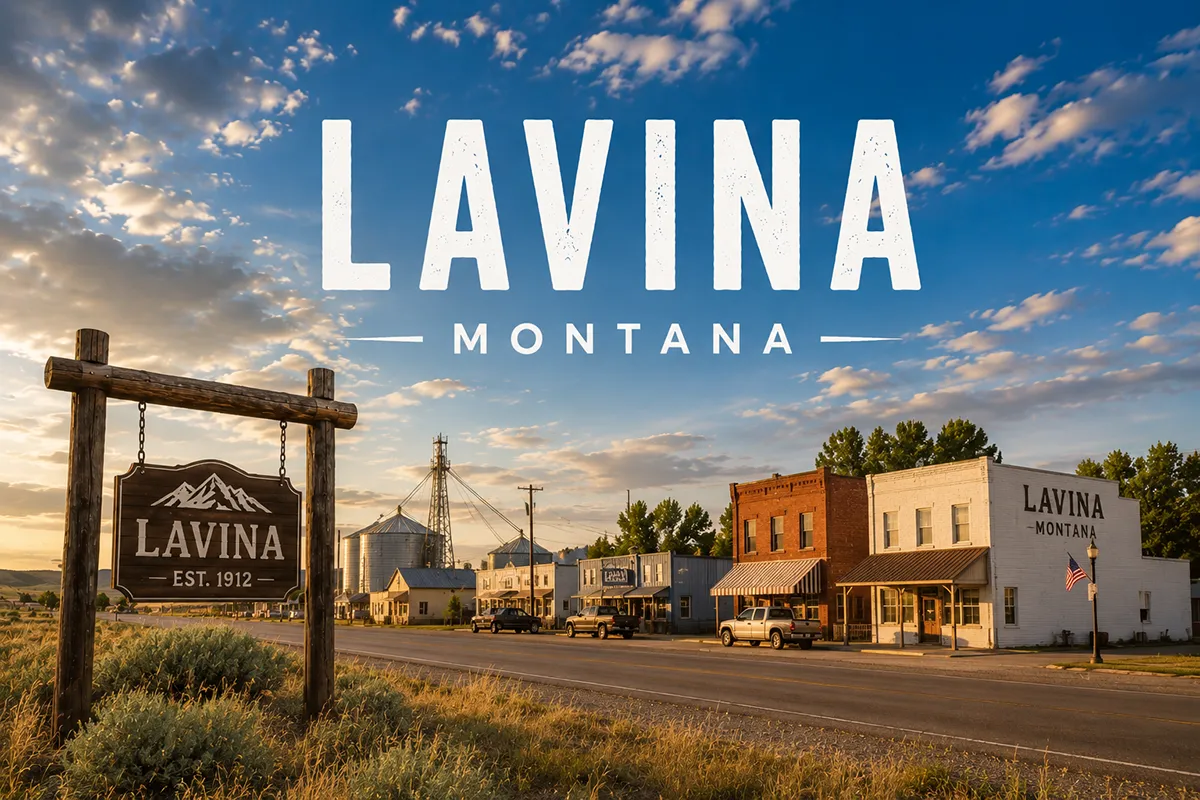
Three of the five National Register of Historic Places sites in Golden Valley County, Montana are in Lavina.
That’s an unusual concentration for a community of roughly 150 people.
The most visually striking is the Adams Hotel — a two-story Colonial Revival building completed in fall 1908 for $20,000. The architects were Link and Haire — the same Helena firm that designed the 1910 additions to the Montana State Capitol.
The hotel was named for John Q. Adams, vice president of the Chicago, Milwaukee, St. Paul and Pacific Railroad. It was built by Ludwig C. Lehfeldt, a German immigrant sheep rancher who had just sold 33,000 acres of his ranch land to the Milwaukee Road.
The 22 rooms had steam heat and gas lighting.
There was a ladies’ withdrawing room on the second floor.
Pure linen sheets and down comforters were promised in every room.
The hotel was built because Lehfeldt’s land sale had triggered something dramatic: the complete physical relocation of the town of Lavina about two miles east to a new site directly adjacent to the Milwaukee Road depot.
On February 16, 1908, the first passenger train pulled into what locals called New Lavina. Old Lavina — the original stage station built decades earlier by the Fort Benton trader Thomas C. Power — was abandoned.
The boom that followed was real but brief.
The drought-driven homestead collapse of the early 1920s, the closure of local banks, and the broader contraction of the Milwaukee Road’s western operations all hit Lavina hard. By the mid-1920s, the Adams Hotel had closed.
From the 1930s through the 1970s, the Lutheran Church used the hotel’s bar area as its chapel. The building changed hands multiple times. Restoration began in 2000. The hotel is now owned by Catherine Thayer, Ludwig Lehfeldt’s granddaughter, who has periodically opened the building for tours.
The other two NRHP sites in town are the Slayton Mercantile (still operating as a general store) and the Lavina State Bank building.
TL;DR
- Lavina (~150) is in Golden Valley County on US Highway 12 at the junction with Montana Highway 3, 45 miles northwest of Billings.
- The town was originally a stage station built by Fort Benton trader Thomas C. Power as a stop on Montana Territory’s first north-south mail route.
- First postmaster Walter Burke named the town for an old sweetheart named Lavina.
- The townsite was physically relocated about 2 miles east in 1907-08 when the Milwaukee Road arrived; the first train pulled into “New Lavina” on February 16, 1908.
- The Adams Hotel — completed fall 1908 for $20,000, designed by Link and Haire (Montana State Capitol architects), named for Milwaukee Road VP John Q. Adams — is the town’s signature historic structure.
- The Adams is one of three NRHP-listed sites in Lavina, along with the Slayton Mercantile and the Lavina State Bank building.
- Town incorporated 1920, the same year Golden Valley County was created.
- Lavina is the eastern of two incorporated towns in the county; Ryegate is the county seat 17 miles west.
- Best for: NRHP architecture travelers, Milwaukee Road heritage, US-12 corridor stops, Slayton Mercantile general-store experience.
Liked this article?
Add Roaming Montana as a preferred source so you see more of our articles and guides on Google.
Lavina at a Glance
| Population (estimated) | ~150 |
|---|---|
| County | Golden Valley County |
| County population (2020) | ~825 (one of MT’s least populous counties) |
| Region | Central Montana (Musselshell Valley) |
| Elevation | 3,425 ft |
| Distance to Ryegate (county seat) | ~17 miles west on US-12 |
| Distance to Roundup | ~30 miles east on US-12 |
| Distance to Billings | ~45 miles southeast via MT-3 |
| Distance to Harlowton | ~50 miles west on US-12 |
| Distance to Broadview | ~25 miles southeast |
| Distance to Judith Gap | ~75 miles northwest |
| Highway access | US-12, MT-3 (junction) |
| Founded | 1880s (original site); 1908 (relocated New Lavina) |
| Incorporated | 1920 |
| Best for | Adams Hotel, Slayton Mercantile, NRHP architecture, US-12 corridor |
What Makes Lavina Different
Lavina’s history runs in two distinct chapters: the stage-route era and the railroad era.
The Power Stage Station Era
When the Northern Pacific Railroad reached Billings in 1882, Thomas C. Power — a Fort Benton trader and entrepreneur — saw an opportunity.
Power wanted to run a stage line connecting Billings to Fort Benton. It would be the first north-south mail service in Montana Territory.
Forty miles north of Billings, the route ran into a natural obstacle — the Musselshell River. At the site of a good ford, Power and his partners built a stage station: stables, a bunk house, a saloon.
The first postmaster was Walter Burke. He named the small community Lavina — for an old sweetheart of the same name.
Original Lavina operated as a stage stop for roughly 25 years. River steamers had reached the area as early as 1860; the first railroads arrived in 1880.
The 1907-08 Relocation
The turning point came in 1907.
Ludwig C. Lehfeldt — a German-born sheep rancher whose family had emigrated from Germany to Iowa in 1870 and then to Montana with sons Ludwig and Herman in 1885 — sold 33,000 acres of his ranch land to the Milwaukee Road.
The railroad needed land for a new depot, switching yards, and right-of-way.
Surveyors chose a site approximately two miles east of original Lavina, in a wide bend of the Musselshell that had been a historic Indian campground. The decision wasn’t to expand Lavina — it was to abandon the original site and rebuild the town at the new railroad location.
On February 16, 1908, the first passenger train pulled into the new depot. Within weeks, the buildings of Old Lavina had been moved or rebuilt at New Lavina.
The Milwaukee Road’s electrified Pacific Coast Extension was the railroad’s signature project. Lavina was one of dozens of new towns established along the mainline.
The Adams Hotel Story
Ludwig Lehfeldt used proceeds from his Milwaukee Road land sale to build a hotel.
He recognized that the new railroad town would need substantial guest accommodations — for traveling businessmen, for homesteaders evaluating the area, for Milwaukee Road employees, for the constant traffic the railroad was bringing.
He hired Link and Haire as architects.
The Helena firm of Link and Haire was the most prominent architectural practice in Montana at the time. They had designed the additions to the Montana State Capitol completed in 1910. They knew how to build for permanence and impression.
The Adams Hotel was completed in fall 1908 for $20,000 — a substantial sum for a 150-person railroad town. Lehfeldt named the building for his friend John Q. Adams, vice president of the Milwaukee Road.
The 22-room Colonial Revival building was first-class for any era:
- Steam heat
- Gas lighting
- A bar stocked with the finest liquors and cigars
- An elegant dining room serving fine meals
- A ladies’ withdrawing room on the second floor
- Each guest room with carpeting, fine furnishings, and a matching china washbowl and pitcher set
The Adams hosted dances and social events in its dining room and lobby. It became the regional center of hospitality.
The Bust
The drought and bank closures of the early 1920s ended the boom.
The Adams Hotel declined steadily. Few guests stayed in its once-opulent rooms. By the mid-1920s, the hotel had closed entirely.
From the 1930s through the 1970s, the Lutheran Church used the hotel’s bar area as its chapel — an unusual but practical use of a beautiful building that the community had no resources to maintain in its original function.
The hotel changed hands multiple times. Restoration began in 2000 when Raymond Barry purchased the building and began work on the foundation, the second floor, and the exterior paint. He even lived in the first-floor master bedroom during the restoration.
Today the hotel is owned by Catherine Thayer, Ludwig Lehfeldt’s granddaughter. She has continued restoration work and periodically opens the building for tours.
The Adams Hotel was added to the National Register of Historic Places on December 6, 2005.
The Other NRHP Sites
The Slayton Mercantile — also NRHP-listed — still operates as the town’s general store. Historic preservation researchers visiting Lavina have made the Slayton one of the most frequent stops in central Montana.
The Lavina State Bank building is the third Lavina NRHP listing.
Both buildings reflect the early-20th-century Lehfeldt-era ambition that briefly transformed New Lavina into a substantial small community.
For broader trip context, see my Montana cities and towns hub.
The Top 6 Things to Do In & Around Lavina
1. Adams Hotel Exterior & Periodic Tours
The signature attraction.
Even when not open for interior tours, the exterior of the 1908 Colonial Revival hotel is genuinely photograph-worthy. Verify with the current owner (Catherine Thayer) about tour scheduling — typically Friday tours during summer months.
The building tells a substantive Montana story about the homestead boom, the Milwaukee Road expansion, and the broader patterns that defined small-town central Montana between 1900 and 1925.
2. Slayton Mercantile General Store
The NRHP-listed general store is still operating.
A genuine working historic commercial building. Visit during operating hours; pick up supplies; chat with the proprietors. One of the more substantive small-town mercantile experiences available in contemporary central Montana.
3. Lavina State Bank Building
The third NRHP-listed Lavina structure.
The bank building is visible on Main Street. Check with the current occupants about any interior access. Brief stop; primarily exterior architectural photography.
4. Old Lavina Site & Musselshell River
The original Power-era stage stop site is approximately two miles west of contemporary Lavina, near the Musselshell River ford.
Little remains visible today. The site is largely on private land. But for travelers interested in pre-railroad Montana history, the location has substantive historical weight.
5. US-12 Scenic Drive Through Musselshell Valley
US Highway 12 follows the Musselshell River across Golden Valley and Musselshell counties.
The route between Harlowton and Roundup — passing through Ryegate and Lavina — is one of the more genuinely scenic Musselshell Valley driving experiences available. Rolling pastureland, irrigated bottoms, scattered ranch headquarters.
6. Day Trip to Billings (45 miles southeast)
Montana’s largest city is accessible via Montana Highway 3 southeast from Lavina.
Full attractions including the Yellowstone Art Museum, Pictograph Cave State Park, the Western Heritage Center, and ZooMontana.
Where to Stay
Lavina has no dedicated lodging (the Adams Hotel is no longer operating as a hotel).
Most travelers base in Billings (45 minutes southeast) or Roundup (35 minutes east).
| Lodging | Vibe | Price | Best For |
|---|---|---|---|
| Billings hotels (45 min SE) | Full city selection | $130–280 | Most travelers |
| Roundup lodging (35 min E) | Small-town options | $100–180 | Musselshell Valley base |
| Harlowton hotels (1 hr W) | Wheatland County options | $100–180 | Central Montana base |
| Vacation rentals (Golden Valley County) | Limited; ranch stays | $130–250 | Hunters, photographers |
Where to Eat
- Local Lavina cafes — verify current operations
- Slayton Mercantile (Lavina) — supplies, snacks
- Roundup dining (35 min E) — broader options
- Billings restaurants (45 min SE) — extensive variety
Getting There & Around
From Billings: 45 miles northwest via MT-3, about 50 minutes.
From Roundup: 30 miles west on US-12, about 35 minutes.
From Ryegate: 17 miles east on US-12, about 20 minutes.
From Harlowton: 50 miles east on US-12, about 1 hour.
From Broadview: ~25 miles northwest, about 30 minutes.
Cell service: Generally available in Lavina and along US-12.
When to Visit
Summer (June-August): Best weather; longest daylight; Adams Hotel tour season; Musselshell Valley at peak visual character.
Fall (September-October): Outstanding central Montana light; cottonwood color along the Musselshell; harvest activity.
Winter (December-March): Severe Montana weather possible; many community services on reduced hours.
Spring (April-May): Quieter shoulder season; the prairie greens up.
Personal Tips
Visit on a Friday during summer. Catherine Thayer’s Adams Hotel tours typically happen Friday afternoons during summer months. Verify scheduling before traveling — these are limited-access events.
Stop at the Slayton Mercantile. Even if you don’t need anything, the working general store experience is substantive. Buy something small; chat with the proprietor; absorb the atmosphere.
Read the Lehfeldt family history. Ludwig Lehfeldt’s transition from German immigrant sheep rancher to substantial Milwaukee Road land developer is a substantively interesting Montana story. Understanding his role makes the Adams Hotel tour considerably more meaningful.
Plan a central Montana 2-day itinerary. A Billings-based trip including Lavina, Roundup, Ryegate, Harlowton, and Judith Gap makes a substantive central Montana road experience.
Note the Link and Haire connection. The architectural firm that designed the Adams Hotel also designed the Montana State Capitol additions. For travelers interested in early-20th-century Montana architecture, the connection is genuinely significant.
Don’t expect a tourism town. Lavina is a working agricultural community of about 150 people. The historic buildings are the substantive attraction; everything else is small-town authenticity.
Lavina Quick Facts
| Population (estimated) | ~150 | | Golden Valley County population (2020) | ~825 | | County established | October 4, 1920 | | Original Lavina founding | 1880s (Power stage station) | | Original Lavina founder | Thomas C. Power (Fort Benton trader) | | First postmaster / name origin | Walter Burke (named for sweetheart “Lavina”) | | Ludwig Lehfeldt sold 33,000 acres to Milwaukee Road | 1907 | | First passenger train into New Lavina | February 16, 1908 | | Adams Hotel built | Fall 1908 ($20,000) | | Adams Hotel architects | Link and Haire (Helena) | | Adams Hotel namesake | John Q. Adams (Milwaukee Road VP) | | Adams Hotel rooms | 22 | | Adams Hotel style | Colonial Revival | | Adams Hotel NRHP listing | December 6, 2005 | | Adams Hotel current owner | Catherine Thayer (Lehfeldt’s granddaughter) | | NRHP sites in Lavina | 3 (Adams Hotel, Slayton Mercantile, Lavina State Bank) | | Town incorporated | 1920 | | Average summer high | 84°F | | Average winter low | 6°F |
Conclusion
Lavina is a 150-person Golden Valley County town with substantively important architectural heritage.
The 1908 Adams Hotel, designed by the same architects who added to the Montana State Capitol, was once one of the finest hotels on the entire Milwaukee Road Pacific Coast Extension. The Slayton Mercantile still operates as a general store. The Lavina State Bank building still stands. The story of Ludwig Lehfeldt’s 33,000-acre land sale to the Milwaukee Road in 1907 and the resulting physical relocation of the entire town remains one of the more substantive small-community origin stories in central Montana.
Most travelers drive through Lavina without stopping. The next time you’re between Billings and Harlowton, take an hour.
Have a Lavina question? Drop it in the comments — I read every one.
Frequently Asked Questions
Is Lavina Montana worth visiting?
Lavina is worth a stop primarily for the 1908 Adams Hotel (NRHP-listed Colonial Revival building designed by Link and Haire, the same architects who added to the Montana State Capitol), the still-operating Slayton Mercantile general store (also NRHP-listed), the historic Lavina State Bank building (the third NRHP site in town), and the broader Milwaukee Road railroad heritage that defined the town from 1908 forward.
What is the Adams Hotel in Lavina Montana?
The Adams Hotel is a 22-room Colonial Revival hotel built in 1908 for $20,000 by Ludwig C. Lehfeldt, a German-born sheep rancher who had just sold 33,000 acres of his ranch land to the Milwaukee Road. The hotel was designed by Link and Haire, the prominent Helena architectural firm that also designed the 1910 additions to the Montana State Capitol. Lehfeldt named the building for his friend John Q. Adams, vice president of the Milwaukee Road. The hotel offered steam heat, gas lighting, fine dining, a bar with premium liquors, and a ladies’ withdrawing room on the second floor. The hotel declined during the 1920s drought and bank-closure era and was closed by the mid-1920s. From the 1930s through the 1970s, the Lutheran Church used the bar area as its chapel. Restoration began in 2000. The hotel was added to the National Register of Historic Places on December 6, 2005. Current owner Catherine Thayer (Lehfeldt’s granddaughter) periodically opens the building for tours.
When was Lavina Montana founded?
Lavina was originally founded in the 1880s as a stage station built by Fort Benton trader Thomas C. Power on his Billings-to-Fort Benton stage line — the first north-south mail service in Montana Territory. The original site sat at a Musselshell River ford. The community was named by first postmaster Walter Burke for an old sweetheart named Lavina. In 1907-08, the entire townsite was physically relocated approximately two miles east when rancher Ludwig C. Lehfeldt sold 33,000 acres to the Milwaukee Road for a new depot. The first passenger train pulled into “New Lavina” on February 16, 1908. The relocated town incorporated in 1920.
How big is Lavina Montana?
Lavina has approximately 150 year-round residents. The town covers a small area along US Highway 12 in Golden Valley County. Golden Valley County itself is one of Montana’s least populous counties, with approximately 825 residents in the 2020 census.
How far is Lavina from Billings Montana?
Who was Ludwig Lehfeldt?
Ludwig C. Lehfeldt was a German-born Montana sheep rancher whose family had emigrated from Germany to Iowa in 1870 and then to Montana with sons Ludwig and Herman in 1885. In 1907, Lehfeldt sold 33,000 acres of his Musselshell Valley ranch land to the Milwaukee Road, prompting the physical relocation of the Lavina townsite to a new location adjacent to the railroad’s new depot. With proceeds from the land sale, Lehfeldt built the Adams Hotel in 1908 — naming it for his friend John Q. Adams, vice president of the Milwaukee Road. The hotel is now owned by Lehfeldt’s granddaughter Catherine Thayer, who has continued restoration efforts and periodically opens the building for tours.
Where is Golden Valley County Montana?
Golden Valley County is in central Montana, established October 4, 1920 — one of the last counties created in the state. The county covers approximately 1,176 square miles, measuring roughly 30 miles wide by 50 miles tall. The Musselshell River flows west-to-east across the center of the county, parallel to US Highway 12 and the abandoned Milwaukee Road rail line. The county has only two incorporated communities: Ryegate (the county seat) and Lavina (17 miles east). Total county population was approximately 825 in the 2020 census, making it one of Montana’s least populous counties.