The first written record of Chico Hot Springs is a January 16, 1865 diary entry from a gold miner who wrote that he “went out to the hot springs and washed my dirty ‘duds.”
That single sentence, recorded sixty years before the community of Pray was officially founded, captures the heart of what this corner of Paradise Valley has always been about.
The natural geothermal mineral water bubbling out of the ground at the base of the Absaroka Range at 5,272 feet elevation flows at 37 gallons per minute and 113°F at the vent — generous enough to feed the two open-air pools that have been steaming continuously at this location for more than 125 years.
The hot springs were used by Indigenous peoples (Crow, Bannock, Sheepeater Shoshone, and Northern Plains tribes seasonally) for centuries before the gold miner washed his dirty duds in January 1865.
By the 1880s, an investor named Walter Matheson had built a bathhouse on the springs to capitalize on the Northern Pacific Railway’s new Park Branch, which connected Livingston to the Yellowstone north entrance at Gardiner in 1883 and was bringing the first wave of railroad tourists into Paradise Valley.
In 1900, Bill and Percie Knowles purchased the property and opened it as a boarding house — the boarding house grew into a resort, the resort grew into the institution that locals today simply call “Chico.”
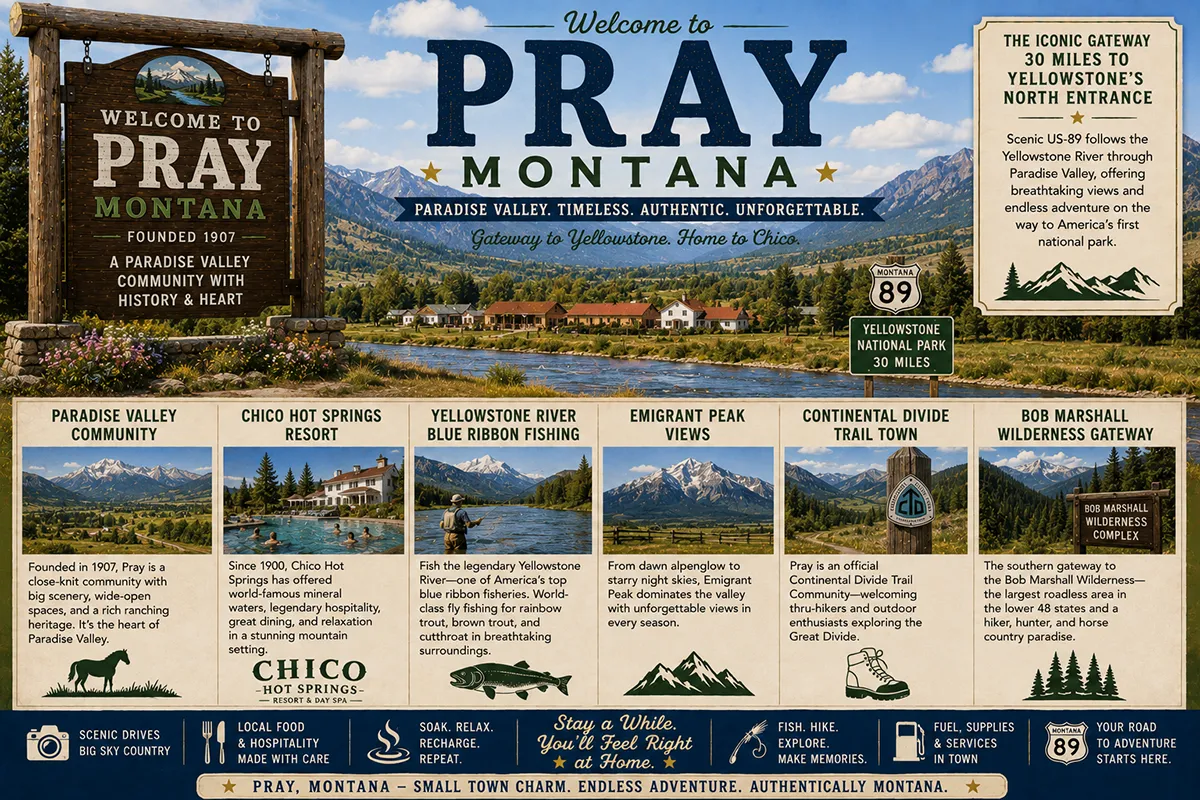
The community of Pray came along seven years after the Chico resort opened. In 1907, an entrepreneur named Valentine Eggar founded a settlement four miles east of the hot springs in the Paradise Valley bottomland and named it after Congressman Charles Nelson Pray.
The town has never been incorporated, but the post office and the community identity have persisted for 119 years, anchored by the Chico Hot Springs Resort and the surrounding ranches that occupy the rolling foothills between the Yellowstone River and the base of Emigrant Peak.
Today, “Pray, Montana” is more or less synonymous with Chico for most outside visitors — the resort’s address is in Pray; the resort defines the town’s contemporary identity; and the resort’s 700+ rolling acres effectively constitute the town’s largest landholding.
The Paradise Valley setting is the other half of the equation. The valley stretches roughly 50 miles from Livingston south to the Yellowstone north entrance at Gardiner, flanked dramatically on the east by the Absaroka Range and on the west by the Gallatin Range.
The Yellowstone River — North America’s longest free-flowing river — winds through the valley floor, generating Blue Ribbon fly fishing for cutthroat, rainbow, and brown trout.
Emigrant Peak rises a mile above the valley near Pray, dominating the eastern skyline. The Northern Yellowstone Elk Herd — one of the largest elk populations in North America — winters in the Paradise Valley grasslands after migrating out of Yellowstone National Park.
And spring creeks like DePuy and Nelson’s, fed by the constant cold flow of the Absaroka glacial drainage, support some of the most consistent year-round trout fishing in the United States.
TL;DR
- Pray (~700 area) is an unincorporated community in Park County in the heart of Paradise Valley — 30 miles south of Livingston and 30 miles north of Yellowstone National Park’s North Entrance at Gardiner.
- The town was founded in 1907 by Valentine Eggar and named after Congressman Charles Nelson Pray.
- Chico Hot Springs Resort (founded 1900 by Bill and Percie Knowles, now operated by the Art family) is the area’s anchor — two natural geothermal pools, historic resort lodging, world-class dining, NRHP listed.
- The Yellowstone River flows through the valley with Blue Ribbon trout fishing for cutthroat, rainbow, and brown.
- DePuy Spring Creek and Nelson’s Spring Creek offer some of America’s most consistent year-round trout fishing.
- Emigrant Peak (10,915 ft) rises more than a mile above the valley near Pray.
- The Northern Yellowstone Elk Herd winters in the surrounding Paradise Valley.
- Best for: Chico Hot Springs travelers, Yellowstone north entrance access, Yellowstone River fly fishers, Paradise Valley scenic drivers, and travelers seeking a quieter alternative to Gardiner.
Liked this article?
Add Roaming Montana as a preferred source so you see more of our articles and guides on Google.
Pray at a Glance
| Population (area) | ~700 |
|---|---|
| County | Park County |
| Status | Unincorporated community (CDP) |
| Region | South-Central Montana (Paradise Valley) |
| Elevation | 4,890 ft (Pray townsite); 5,272 ft (Chico Hot Springs) |
| Distance to Livingston | ~30 miles north (~40 min on US-89) |
| Distance to Gardiner / Yellowstone North Entrance | ~30 miles south (~40 min on US-89) |
| Distance to Bozeman | ~60 miles northwest (~1 hour) |
| Distance to Bozeman Yellowstone International Airport (BZN) | ~70 miles northwest (~1.25 hours) |
| Distance to Emigrant | ~5 miles south |
| Distance to Chico Hot Springs Resort | 4-mile detour east off US-89 |
| Founded | 1907 by Valentine Eggar |
| Named for | Congressman Charles Nelson Pray |
| Best for | Chico Hot Springs, Yellowstone River fishing, Paradise Valley, Yellowstone north entrance access |
What Makes Pray Different
Paradise Valley deserves more than a passing mention because it is genuinely one of the most striking landscapes in Montana.
The Yellowstone River — flowing north from Yellowstone National Park — cuts a wide, agricultural valley between two of the most dramatic mountain ranges in the contiguous United States.
The Absaroka Range to the east includes peaks above 10,000 feet and stretches deep into the Absaroka-Beartooth Wilderness. The Gallatin Range to the west connects to the Gallatin National Forest and the broader Yellowstone ecosystem.
The valley floor is fertile ranching country — many of the working ranches have been in the same families since the late 1800s. The Yellowstone River corridor supports one of America’s most studied wildlife migrations, with elk, mule deer, pronghorn, bison (during summer dispersal from Yellowstone), grizzly and black bears, and the occasional wolf moving through.
The Chico Hot Springs story spans more than a century and is genuinely worth understanding. Bill and Percie Knowles bought the property from Walter Matheson in 1900 and converted Matheson’s small 1880s bathhouse into a more substantial boarding house.
The boarding house added rooms, then cabins, then a restaurant. By the 1920s, Chico had become a regional destination — Yellowstone-bound tourists, Livingston-area ranchers and railroad families, and a steady stream of well-heeled travelers from Bozeman and Helena.
Through ownership changes across the 20th century, Chico added the Convention Center, expanded the spa, refined the dining room into what Montanans now consider one of the state’s best restaurants, and developed the surrounding ranch property into 700+ acres of accommodations, trails, and outbuildings.
The Art family acquired the resort in 1973 and has owned it for over 50 years. The two outdoor pools — the larger cooler pool at approximately 96°F and the smaller hotter pool at approximately 100°F (temperatures posted daily based on natural variation) — are the same pools that have welcomed soakers for generations. The resort is on the National Register of Historic Places.
The Chico dining room deserves a separate paragraph because it has become one of Montana’s signature restaurant experiences.
The kitchen turns out genuinely refined cuisine — fresh Montana ingredients, seasonal menus, careful technique — in a relaxed historic lodge setting.
The classic Chico Flaming Orange dessert (a hollowed orange filled with vanilla ice cream and Grand Marnier, set aflame tableside) has become a regional culinary landmark in its own right.
Reservations are essential; the dining room fills weeks ahead during summer and is busy year-round.
The 2022 Yellowstone River flooding context matters for current visitors. In June 2022, historic rainfall combined with rapid snowmelt produced devastating flooding that temporarily closed Yellowstone’s North Entrance and damaged sections of the US-89 corridor through Paradise Valley.
Pray and Chico Hot Springs were affected but recovered relatively quickly. The North Entrance has been fully restored and operational since 2023.
Visitors today see Paradise Valley back to its pre-flood character, though some segments of the riverside continue to show the geological reshaping the flood produced.
For broader trip context, see my Montana cities and towns hub.
The Top 10 Things to Do In & Around Pray
1. Chico Hot Springs Resort — Soaking
The two outdoor geothermal pools at Chico are the area’s foundational attraction. Day passes are available without an overnight stay; overnight guests get pool access throughout the resort hours (24-hour access for guests; day-pass hours more limited).
The water is genuine mineral water, with the characteristic mild sulfur smell that signals authentic geothermal source.
The setting — pools surrounded by historic resort buildings with the Absaroka Mountains as backdrop — is one of the most photographed soaking experiences in the American West.
2. Chico Dining Room
The restaurant alone justifies a Paradise Valley trip. Sophisticated menu with strong Montana ingredients, attentive service, a 19,000-bottle wine cellar, and the famous Flaming Orange dessert.
Reservations essential and should be made weeks in advance for summer and holiday dates. Smart-casual dress; the dining room takes itself seriously while remaining welcoming.
3. Yellowstone River Fly Fishing
Public access points along US-89 and East River Road provide wade and float fishing access to the Yellowstone — Blue Ribbon trout water for cutthroat, rainbow, and brown trout.
Multiple Livingston-area guides offer guided trips; many will pick up at Pray-area lodging. The Yellowstone is the longest free-flowing river in the contiguous United States and supports one of the country’s most-revered trout fisheries. Montana fishing license required.
4. DePuy Spring Creek & Nelson’s Spring Creek
Two of America’s most celebrated spring creeks flow into the Yellowstone in the Paradise Valley. Both are private but offer daily rod permits (paid access) for a limited number of anglers — book months in advance.
The constant 50°F-ish water temperatures produce some of the most consistent year-round trout fishing in the United States. Sophisticated dry-fly fishing in beautiful settings.
5. Emigrant Peak Hiking
Emigrant Peak (10,915 ft) rises a mile above the Paradise Valley floor and dominates the eastern skyline. The summit hike is challenging — approximately 5-6 miles round trip with 4,500+ feet of elevation gain — but the views from the top are spectacular.
The trail begins at the Emigrant Trailhead in the Gallatin National Forest east of Emigrant town. Carry plenty of water, expect afternoon thunderstorms in summer, and start early.
6. Yellowstone National Park (30 minutes south)
The North Entrance at Gardiner is the only entrance to Yellowstone National Park that is open to vehicles year-round.
From Pray, access to Mammoth Hot Springs, the Lamar Valley (via the northern park route to the Northeast Entrance), Old Faithful, and the broader park is straightforward.
Many Pray-area visitors use Chico as a base for multi-day Yellowstone exploration. See Gardiner guide and Cooke City guide for additional north-side context.
7. East River Road (MT-540) Scenic Drive
The county road on the east side of the Yellowstone River provides a slower, more scenic alternative to US-89 through Paradise Valley.
The road passes ranches, historic buildings, river access points, and the entrance to several spring creek operations.
Particularly beautiful in early morning and late afternoon light. A worthwhile detour for travelers willing to slow down.
8. Dailey Lake (~25 minutes east via MT-540)
A clear-water mountain lake with rocky beaches in the foothills of the Absarokas. Swimming, fishing for rainbow trout, picnicking, and camping. Less crowded than Yellowstone-area destinations. Open seasonally.
9. Day Trip to Livingston (30 minutes north)
The historic railroad town at the north end of Paradise Valley — Yellowstone National Park’s original tourist gateway via the Northern Pacific Railway.
Downtown shops, restaurants, the Yellowstone Gateway Museum, multiple breweries, and significant Montana literary and arts history (Tom McGuane, Russell Chatham, Jim Harrison all have Paradise Valley connections). See Livingston guide.
10. Horseback Riding & Outfitter Adventures
Multiple Pray-area outfitters offer guided horseback trips ranging from short scenic rides to multi-day pack trips into the Absaroka-Beartooth Wilderness.
Rockin’ HK Outfitters is among the longstanding local operations. Guided fly fishing, horseback wildlife viewing, and multi-activity ranch experiences all available.
Where to Stay
| Hotel | Vibe | Price | Best For |
|---|---|---|---|
| Chico Hot Springs Resort – Main Lodge | Historic 1900 lodge rooms | $200–400 | Authentic Chico experience |
| Chico Hot Springs – Cabins & Outbuildings | Resort cabins, varying sizes | $250–600+ | Families, groups |
| Chico Hot Springs Convention Center | Newer rooms | $200–350 | Modern comforts |
| Mountain Sky Guest Ranch (nearby) | Luxury guest ranch | $1,500+/day | All-inclusive luxury |
| Vacation rentals (Paradise Valley) | Ranch homes and cabins | $200–500+ | Families, longer stays |
| Emigrant lodging (5 min south) | Smaller properties | $150–300 | Alternative base |
| Gardiner lodging (30 min south) | Yellowstone gateway hotels | $180–400 | Park visitors |
| Livingston hotels (30 min north) | Best regional selection | $150–350 | Town comforts |
Reservations essential year-round at Chico; multi-month lead times recommended for summer and holiday dates.
Where to Eat
- Chico Hot Springs Dining Room — fine dining; reservations essential (the area’s signature meal)
- Chico Saloon — casual fare in the historic resort bar
- Old Saloon (Emigrant, 5 min south) — local Paradise Valley dive bar institution
- Emigrant Outpost (5 min south) — pizza and casual food on a sunny patio
- Livingston dining (30 min north) — significantly more variety
- Gardiner dining (30 min south) — Yellowstone gateway options
Getting There & Around
From Livingston: 30 miles south on US-89, about 40 minutes.
From Gardiner / Yellowstone North Entrance: 30 miles north on US-89, about 40 minutes.
From Bozeman: 60 miles southeast via I-90 to Livingston, then US-89 south, about 1 hour.
From Bozeman Yellowstone International Airport (BZN): 70 miles southeast, about 1.25 hours.
To Chico Hot Springs from US-89: Take the East River Road exit, then follow signs approximately 4 miles to the resort.
East River Road (MT-540) alternative: The county road on the east side of the Yellowstone River provides a scenic alternative to US-89 between Livingston and Pray. Slower but significantly more scenic.
Cell service: Generally available in Pray and along US-89; spotty on East River Road and Forest Service backroads.
What Pray Unlocks
Chico Hot Springs Resort (immediate)
The area’s defining attraction; one of Montana’s iconic hot springs destinations.
Yellowstone River & Paradise Valley
Blue Ribbon trout fishing; one of America’s classic mountain river valleys.
Yellowstone National Park (30 min south)
North Entrance at Gardiner; Mammoth Hot Springs, Lamar Valley, Old Faithful, all park attractions.
Emigrant Peak
10,915-foot summit with a strenuous trail.
Absaroka-Beartooth Wilderness (east)
One of America’s largest wilderness areas.
Livingston (30 min north)
Historic railroad town; original Yellowstone tourist gateway.
Bozeman (1 hour northwest)
Montana’s fastest-growing city; full services.
When to Visit
Year-round: Chico is open every day of the year. The pools operate continuously.
Summer (June–August): Peak Paradise Valley conditions; Yellowstone fully accessible; warm weather for hiking and fishing; book lodging months ahead.
Fall (September–October): Outstanding fall colors in the cottonwood corridor; elk rut in Yellowstone visible from the north entrance area; quieter than peak summer; cooler soaking weather is genuinely magical.
Winter (November–March): Yellowstone north entrance open year-round (the only park entrance that is); cross-country skiing in Paradise Valley; the pools are at their most dramatically beautiful with steam rising into freezing air; quieter resort character.
Spring (April–May): Quieter shoulder season; the valley greens up; high water on the Yellowstone affects fishing for several weeks; spring creeks remain at their best.
Personal Tips
Book Chico months in advance. This is not negotiable for summer or holiday weekends. The resort fills 6+ months ahead for prime dates. Even shoulder seasons require advance planning. Tuesday-Thursday windows are generally easier to book.
Pair the dining room with the pools. A Chico dinner followed by an evening soak under the stars is the signature Chico experience. The dining room takes 2-3 hours; allow at least 60-90 minutes for the after-dinner soak. Many guests return for breakfast at the dining room before checkout.
Combine Chico with Yellowstone for a multi-day base. Chico is 30 minutes from Gardiner, making it a viable lodging alternative for Yellowstone visitors who want resort amenities and dining quality that Gardiner can’t match. Day-trip to the park from Pray; soak away the dust at night.
Take East River Road in at least one direction. The drive between Livingston and Pray via East River Road (MT-540) is significantly more scenic than US-89. Allow extra time; the road is slower but rewards the patience.
Don’t underestimate the spring creek experience. DePuy and Nelson’s spring creek fishing is among the most genuinely sophisticated trout fishing available anywhere. Book daily rod permits months ahead. The water is technically demanding but the experience is unforgettable.
Manage soaking expectations on busy days. Chico’s pools can get crowded during peak summer weekends, particularly the smaller hotter pool. Early morning (just after opening) and late evening (just before close) are the quieter windows.
Allow real time for the dining room. The Chico kitchen takes its work seriously; meals are not rushed. Plan for 2-3 hours for dinner. The Flaming Orange dessert preparation alone is a small theater event.
Pray Quick Facts
| Pray founded | 1907 by Valentine Eggar | | Named for | Congressman Charles Nelson Pray | | Chico Hot Springs opened | 1900 (Bill and Percie Knowles, boarding house) | | First written record of springs | January 16, 1865 (gold miner’s diary) | | Walter Matheson’s first bathhouse | 1880s | | Northern Pacific Park Branch completed | 1883 (Livingston to Gardiner) | | Chico vent temperature | 113°F at 37 gallons/minute | | Chico pool temperatures | ~96°F (cooler larger pool); ~100°F (hotter smaller pool) | | Chico ownership (current) | Art family (since 1973) | | Chico acreage | 700+ | | Chico NRHP listing | Yes | | Emigrant Peak elevation | 10,915 ft | | Average summer high | 81°F | | Average winter low | 11°F |
Conclusion
Pray is one of the most genuinely meaningful small communities in Montana, and that meaning comes from a combination of geographic position and accumulated history. The Chico Hot Springs Resort has welcomed soakers for 125 years.
The Paradise Valley setting is among the most photographed mountain valleys in the American West. The Yellowstone River corridor is one of America’s most-revered trout fisheries.
The North Entrance to Yellowstone National Park is 30 minutes south, and the historic railroad town of Livingston is 30 minutes north.
For travelers building a serious Yellowstone-area itinerary or seeking a hot springs experience that ranks among the country’s most distinctive, Pray and Chico are exactly the kind of destination that justifies the long drive.
Have a Pray or Chico Hot Springs question? Drop it in the comments — I read every one.
Frequently Asked Questions
Is Pray Montana worth visiting?
Yes — Pray is worth visiting primarily for Chico Hot Springs Resort (the area’s anchor destination since 1900), the broader Paradise Valley experience (Yellowstone River Blue Ribbon fly fishing, Emigrant Peak, DePuy and Nelson’s Spring Creeks), and its strategic position 30 miles north of Yellowstone National Park’s North Entrance at Gardiner. The combination of historic resort character, world-class natural beauty, and Yellowstone access makes it one of Montana’s most substantive small-community destinations.
What is Chico Hot Springs?
Chico Hot Springs is a historic resort in Pray, Montana, in Paradise Valley. Opened as a boarding house in 1900 by Bill and Percie Knowles and acquired by the current Art family ownership in 1973, the resort features two natural geothermal mineral pools (approximately 96°F larger cooler pool and 100°F hotter pool, with the vent temperature reaching 113°F), historic lodge rooms and cabins, a celebrated dining room, a saloon, day spa, and 700+ acres of Montana property. The resort is listed on the National Register of Historic Places. The first written record of the natural hot springs dates to January 16, 1865, when a gold miner recorded in his diary “went out to the hot springs and washed my dirty ‘duds.”
Who is Pray Montana named for?
Pray was founded in 1907 by entrepreneur Valentine Eggar and named after Charles Nelson Pray, a Montana Congressman of the era. The community has never been formally incorporated but has maintained its identity as the central Paradise Valley community for nearly 120 years.
How far is Pray Montana from Yellowstone National Park?
Pray is approximately 30 miles north of the Yellowstone National Park North Entrance at Gardiner — about a 40-minute drive on US-89 south through Paradise Valley. The North Entrance is the only Yellowstone entrance that remains open to vehicle traffic year-round, making Pray a viable lodging base for year-round park visitors.
How far is Pray from Livingston Montana?
Pray is approximately 30 miles south of Livingston on US-89 — about a 40-minute drive. The route follows the Yellowstone River through Paradise Valley with the Absaroka Range on the east and the Gallatin Range on the west. The East River Road (MT-540) provides a slower, more scenic alternative on the east side of the river.
Do you have to be a guest at Chico Hot Springs to use the pools?
No — Chico Hot Springs offers day-use pool access for non-overnight guests. Day passes are sold at the front desk. Overnight resort guests have extended hours for pool access. Day-pass hours and current pricing should be verified with the resort directly before planning a visit. The two pools are open year-round.
What is Emigrant Peak?
Emigrant Peak is a 10,915-foot mountain in the Absaroka Range that rises dramatically above the Paradise Valley floor — more than a mile of elevation gain from the valley to the summit. The peak is the defining landmark of the Pray-Emigrant area and the most prominent mountain on Paradise Valley’s eastern skyline. The summit hike begins at the Emigrant Trailhead in the Gallatin National Forest and is approximately 5-6 miles round trip with 4,500+ feet of elevation gain — a challenging full-day hike that rewards experienced hikers with spectacular views of the Yellowstone River corridor and the surrounding wilderness.