The thing that makes Lincoln, Montana genuinely worth slowing down for is what happened on 26 acres of pine forest at the eastern edge of town in 2014.
Irish sculptor Kevin O’Dwyer and four other international artists — Steven Siegel from the United States, Jorn Ronnau from Denmark, Alan Counihan from Ireland, and Jaakko Pernu from Finland — converged on Lincoln to create site-specific sculptural works using natural and industrial materials drawn from the Blackfoot Valley itself. Burned timber from forest fires.
Logs from the local sawmill heritage. Newspaper. Steel from old mining infrastructure. A derelict tepee burner from a closed sawmill.
The five sculptors worked in residence for three weeks, and at the end of the residency they had created the founding installations of what is now Blackfoot Pathways: Sculpture in the Wild — one of the most unexpected and substantive contemporary sculpture parks in the American West.
Ten years later, the park has more than fourteen permanent installations by artists from multiple continents, hosts ongoing artist-in-residency programs, and welcomes visitors year-round, dawn to dusk, free of charge.
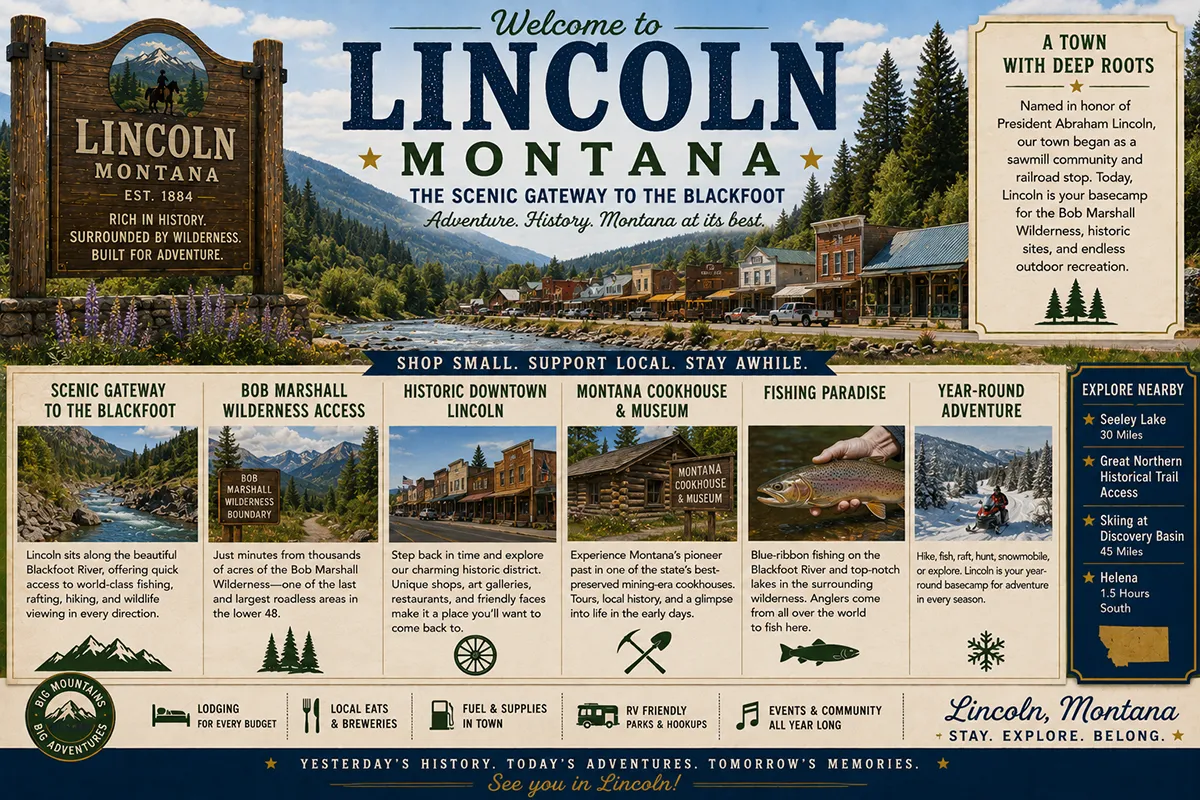
What makes Sculpture in the Wild particularly meaningful is its location. Lincoln sits in the upper Blackfoot Valley at about 4,500 feet elevation, surrounded by Continental Divide country and the southern reaches of the Bob Marshall Wilderness, with the Blackfoot River — Norman Maclean’s river, the actual setting of A River Runs Through It — flowing through the south end of town.
Lincoln’s broader history covers gold mining (the area saw a small rush in the 1860s), logging (which dominated the regional economy through much of the 20th century), and ranching.
The community lived through the international attention of 1996 when Theodore Kaczynski — who had occupied a remote cabin in the Stemple Pass area south of Lincoln since 1971 — was arrested as the Unabomber.
Lincoln has worked deliberately over the subsequent decades to define itself by what it actually is: a Continental Divide Trail community, a fly-fishing destination, a sculpture park, a wilderness gateway. The Sculpture in the Wild founding in 2014 was, in many ways, the cultural pivot.
The population is approximately 1,013, with services concentrated along Main Street (Montana Highway 200) — restaurants, the historic Hi-Country Trading Post, lodging, and the Lincoln Ranger Station of the Helena-Lewis & Clark National Forest.
For travelers driving between Great Falls and Missoula via MT-200, or making the Lewis & Clark County backcountry loop from Helena, Lincoln is the natural midway stop.
TL;DR
- Lincoln (~1,013) is a small community in Lewis & Clark County on Montana Highway 200, about 56 miles west of Helena and 80 miles east of Missoula via MT-200.
- Blackfoot Pathways: Sculpture in the Wild — a 26-acre sculpture park founded 2014 by Kevin O’Dwyer with 14+ permanent installations by international artists; free, open year-round dawn to dusk.
- An official Continental Divide Trail Community — CDT thru-hikers stop here for resupply.
- The Blackfoot River (Norman Maclean’s “A River Runs Through It” river) flows through the south side of town with excellent trout fishing.
- The Upper Blackfoot Valley Historical Society Museum covers local mining, logging, and ranching heritage.
- The Lincoln Ranger Station features a Grizzly Bear Exhibit and serves as the Forest Service information center for the surrounding Helena-Lewis & Clark National Forest.
- Bob Marshall Wilderness access from the north and east; Scapegoat Wilderness access from the north.
- Best for: contemporary sculpture park visitors, Continental Divide Trail travelers, Blackfoot River fly fishers, MT-200 corridor explorers, and Bob Marshall southern gateway access.
Liked this article?
Add Roaming Montana as a preferred source so you see more of our articles and guides on Google.
Lincoln at a Glance
| Population (2020) | ~1,013 |
|---|---|
| County | Lewis & Clark County |
| Region | Central-West Montana (Upper Blackfoot Valley) |
| Elevation | 4,560 ft |
| Distance to Helena | ~56 miles east on MT-200 (~1 hour) |
| Distance to Missoula | ~80 miles west on MT-200 (~1.5 hours) |
| Distance to Great Falls | ~110 miles northeast via MT-200 and I-15 (~2 hours) |
| Distance to Seeley Lake | ~40 miles west (~50 min) |
| Distance to Augusta (Rocky Mountain Front) | ~70 miles north (~1.5 hours via gravel) |
| Best for | Sculpture in the Wild, CDT travelers, Blackfoot River fishing, MT-200 corridor, Bob Marshall southern access |
What Makes Lincoln Different
The Lincoln community sits in an unusual geographic intersection. The Continental Divide passes just east of town — the dividing line between waters that flow to the Pacific and waters that flow to the Gulf of Mexico via the Mississippi.
The Bob Marshall Wilderness — at roughly 1.5 million acres, one of the largest wilderness areas in the contiguous United States — extends north and east of Lincoln. The Scapegoat Wilderness, which adjoins the Bob Marshall to the south, comes within a few miles of town.
The Blackfoot River drainage shapes the entire valley and flows west toward Bonner and Missoula, eventually joining the Clark Fork. Lincoln effectively sits in the middle of one of the most genuinely wild corners of the Lower 48, and the community has built its contemporary identity around that fact.
The Blackfoot River deserves its own mention. The river that Norman Maclean made famous in A River Runs Through It (1976) runs through Lincoln — not just a similarly named river or a tributary, but the actual headwaters river of Maclean’s family story.
The Blackfoot suffered serious water quality damage from upstream mining operations through much of the 20th century but has been the subject of one of the most successful river restoration efforts in the American West, led by The Nature Conservancy and a coalition of local landowners, fishing groups, and state and federal agencies.
Brown trout, rainbow trout, native westslope cutthroat, and bull trout (mandatory catch-and-release) are present in good numbers. Public access points along MT-200 east and west of Lincoln allow wade and float fishing.
The Sculpture in the Wild project deserves more context than it usually gets. Kevin O’Dwyer — an Irish-born metalsmith and sculptor based in County Tipperary — has a long history of organizing international sculpture symposia and residency projects.
The 2014 Lincoln residency was conceived as a way to celebrate the Blackfoot Valley’s environmental, industrial, and cultural heritage through contemporary sculpture practice.
The artists used materials that connected to the valley’s working history: timber from local sawmills, scrap steel from regional mining operations, recycled newspaper, even a derelict tepee-shaped sawmill burner that was repurposed as an installation centerpiece.
The first five sculptures were installed in 2014; the park has added approximately one new installation per year through subsequent artist residencies.
Artists have come from the United States, Ireland, Denmark, Finland, Germany, Australia, and other countries. The park is genuinely substantive — most contemporary art enthusiasts visiting Montana would consider it a meaningful destination.
The Continental Divide Trail context matters. The 3,100-mile CDT — the Continental Divide National Scenic Trail — passes within easy driving distance of Lincoln, and the community is an officially-designated CDT Trail Community.
Thru-hikers come into town for resupply, mail drops, laundry, beds, restaurant meals, and the kind of warm reception that the small handful of designated CDT Trail Communities provide.
For non-thru-hiking travelers, Lincoln is an accessible base for day-hiking portions of the CDT in the Helena-Lewis & Clark National Forest.
For broader trip context, see my Montana cities and towns hub.
The Top 10 Things to Do In & Around Lincoln
1. Blackfoot Pathways: Sculpture in the Wild
The 26-acre international sculpture park founded by Kevin O’Dwyer in 2014. More than 14 permanent site-specific installations by artists from multiple continents, set along walking paths through pine forest.
The works use natural and industrial materials drawn from the Blackfoot Valley — timber, steel, newspaper, mining and sawmill artifacts.
Entrance just east of town on MT-200. Free admission. Open year-round, dawn to dusk. Wheelchair accessible. Pet-friendly (leashed). Allow 1-2 hours minimum. One of the most genuinely substantive cultural attractions in central Montana.
2. Blackfoot River Fly Fishing
The Blackfoot River — the river of Norman Maclean’s A River Runs Through It — flows through the south side of Lincoln. Brown trout, rainbow trout, westslope cutthroat, and bull trout (mandatory catch-and-release) are all present.
Public access points along MT-200 provide wade and float fishing opportunities. The river has been the subject of one of the most successful watershed restoration projects in the American West.
Hire a local guide for first-time visitors; the river has subtle character that rewards local knowledge. Montana fishing license required.
3. Continental Divide Trail Section Hiking
Lincoln is an official Continental Divide Trail Community. Trailheads accessing the CDT are within easy driving distance — Rogers Pass (about 25 miles east) is one of the most popular access points and includes the National Weather Service marker for the coldest temperature ever recorded in the lower 48 (-70°F in 1954).
The CDT crosses dramatic high-country terrain through the Scapegoat Wilderness. Day hikes and longer backpacking trips both available. Bear safety essential — Bob Marshall ecosystem is grizzly habitat.
4. Upper Blackfoot Valley Historical Society Museum
The community museum covers the layered history of the Lincoln area — Indigenous use by the Salish, Pend d’Oreille, and Blackfeet peoples (this area sits in the contested borderlands between Salish-Pend d’Oreille territory to the west and Blackfeet territory to the east); the 1860s gold mining era; the 20th-century logging and ranching heritage; and the regional ecological story.
A worthwhile orientation stop for understanding what you’re looking at as you explore the valley.
5. Lincoln Ranger Station & Grizzly Bear Exhibit
The Helena-Lewis & Clark National Forest ranger station in Lincoln includes a permanent Grizzly Bear Exhibit covering bear ecology, current research on the Bob Marshall and Northern Continental Divide Ecosystem grizzly populations, and bear safety information for backcountry travelers.
Maps, trail conditions, and current bear activity reports are all available. An essential stop before any backcountry trip in the area.
6. Bob Marshall Wilderness Access (North & East)
Lincoln is a southern gateway to the Bob Marshall Wilderness — at roughly 1.5 million acres, one of the largest wilderness areas in the contiguous United States.
Multiple trailheads accessible from Lincoln via Forest Service roads lead into the wilderness boundary.
Day-hiking, backpacking, and horseback wilderness trips are all available; guided outfitters operate in the region. Bob Marshall trips require serious preparation, bear safety, and backcountry skills.
7. Scapegoat Wilderness (immediate north)
The smaller wilderness area immediately north of Lincoln — approximately 240,000 acres adjoining the Bob Marshall.
The Scapegoat is somewhat more accessible than the deeper Bob Marshall and offers excellent day hiking, fishing, and high-country exploration without the multi-day commitment that the Bob Marshall typically requires.
8. Rogers Pass Historical Site (25 miles east on MT-200)
The Continental Divide crossing on MT-200 between Lincoln and Augusta. A National Weather Service marker commemorates the -70°F temperature recorded here on January 20, 1954 — the coldest temperature ever officially recorded in the contiguous 48 states. Photo opportunity, brief stop, dramatic scenery.
9. Hooper Park (downtown Lincoln)
The community park along the Blackfoot River — concerts during summer, festivals, skateboard park, picnic areas, and evening strolling. The cultural heart of contemporary Lincoln.
10. Hi-Country Trading Post
The longstanding general store and trading post that has served Lincoln for generations. Local goods, outdoor gear, fishing supplies, hunting equipment, and the kind of small-town store that’s increasingly hard to find. Worth a stop for travelers and a necessity for thru-hikers.
Where to Stay
| Hotel | Vibe | Price | Best For |
|---|---|---|---|
| Three Bears Motel (Lincoln) | Basic local motel | $90–140 | Budget travelers |
| Sleepy Bear Inn (Lincoln) | Local lodging | $90–140 | Budget |
| Vacation rentals (Lincoln area) | Mix of cabins and homes | $130–280 | Families, longer stays |
| Lewis & Clark NF dispersed camping | Free dispersed sites | Free | Self-sufficient travelers |
| Helena hotels (1 hour east) | Best regional selection | $130–250 | Most comforts |
| Seeley Lake lodging (50 min west) | More options | $120–230 | Alternative base |
Where to Eat
- The Bushwhacker Saloon (Lincoln) — local bar and grill, community gathering point
- Lambkins Restaurant (Lincoln) — long-standing local cafe
- Local taverns and cafes along Main Street
- Helena dining (1 hour east) — Full city selection
- Missoula dining (1.5 hours west) — Wide variety
Lincoln has modest dining options; stock supplies if planning extensive backcountry exploration.
Getting There & Around
From Helena: 56 miles west on MT-200, about 1 hour through Lewis & Clark County backcountry.
From Missoula: 80 miles east on MT-200, about 1.5 hours through the lower Blackfoot Valley.
From Great Falls: ~110 miles southwest via I-15 south to Wolf Creek, then MT-200 west, about 2 hours.
From Bozeman: ~150 miles via I-90 west to Helena, then MT-200 west, about 2.75 hours.
Cell service: Generally available in Lincoln itself; reduced on Forest Service backroads and in the Bob Marshall/Scapegoat wilderness areas.
What Lincoln Unlocks
Sculpture in the Wild (immediate east)
One of the most substantive contemporary sculpture parks in the American West.
Blackfoot River (immediate south)
Norman Maclean’s river; one of America’s most successful trout-stream restorations.
Bob Marshall & Scapegoat Wilderness (north and east)
1.7+ million acres of contiguous wilderness; one of the largest in the contiguous US.
Continental Divide Trail
CDT trail town status; multiple access points within 30 minutes.
Rogers Pass (25 min east)
-70°F record temperature site on the Continental Divide.
Helena (1 hour east)
State capital with full attractions and services.
Seeley Lake (50 min west)
Mountain community with lake recreation. See Seeley Lake guide.
Missoula (1.5 hours west)
University town with full city services.
When to Visit
Summer (June–August): Sculpture in the Wild at peak (though it’s open year-round), Continental Divide Trail thru-hiker season, Bob Marshall accessibility, Blackfoot River fly fishing prime, MT-200 fully open. Longest daylight.
Fall (September–October): Outstanding fall colors in the Blackfoot Valley cottonwoods, hunting season for elk and deer (proper permits required), fewer crowds, ideal photography light.
Winter (November–March): Cross-country skiing and snowshoeing in the Helena-Lewis & Clark National Forest, snowy sculpture park photography, quieter community character, restaurants and lodging on reduced winter schedules.
Spring (April–May): Quieter shoulder season, the valley greens up, snowmelt brings high water in the Blackfoot, fishing transitions through several stages.
Personal Tips
Allow real time for Sculpture in the Wild. The 26-acre park rewards slow exploration — most visitors underestimate how much time they’ll want here. Plan a minimum of 90 minutes; many visitors stay 2-3 hours. Bring water and a snack; sit at one of the contemplative installations and absorb the work.
Time a visit for the artist-in-residency periods if possible. Sculpture in the Wild runs ongoing artist residencies, typically in summer and early fall. Witnessing a new installation being created is a substantively different experience than viewing the finished piece. Check the park’s current residency calendar before timing a visit.
The Blackfoot River requires a guide for first-time anglers. The river is more subtle than its famous reputation suggests. Hatches, holding water, and seasonal patterns reward local knowledge. Hiring a guide for at least the first day pays for itself in fishing success.
Use Lincoln as a CDT logistics base if you’re a thru-hiker. The town’s official CDT Trail Community status means motels, the Hi-Country Trading Post, and local restaurants are familiar with thru-hiker needs. Several lodging properties offer hiker rates.
Bob Marshall trips need real preparation. Day trips into the wilderness from Lincoln are accessible. Multi-day backcountry trips are serious undertakings — grizzly bear safety, water purification, navigation skills, and weather preparation are all non-negotiable. Lincoln Ranger Station staff can help with current conditions and recommendations.
Stop at Rogers Pass. The Continental Divide crossing 25 miles east of Lincoln includes the -70°F National Weather Service marker — a small but genuinely meaningful piece of American climate history. It’s a 10-minute stop with significant photo value.
Lincoln Quick Facts
| Sculpture in the Wild founded | 2014 by Kevin O’Dwyer | | Founding sculptors (2014) | Steven Siegel (USA), Jorn Ronnau (Denmark), Alan Counihan (Ireland), Jaakko Pernu (Finland), Kevin O’Dwyer (Ireland) | | Sculpture park size | 26 acres | | Permanent installations | 14+ | | Admission | Free | | Rogers Pass low temperature | -70°F (January 20, 1954) | | Continental Divide Trail Community | Yes (official designation) | | Blackfoot River literary connection | Norman Maclean’s “A River Runs Through It” (1976) | | Bob Marshall Wilderness size | ~1.5 million acres | | Average summer high | 78°F | | Average winter low | 10°F |
Conclusion
Lincoln is one of the genuinely substantive small-town stops in central Montana, and that substance comes from specific things: a 26-acre international sculpture park founded in 2014 that has accumulated more than fourteen permanent installations by artists from across multiple continents; the actual Blackfoot River of Norman Maclean’s literary classic, restored over four decades into one of America’s most successful native-trout watersheds; an official Continental Divide Trail community status that brings thru-hikers and their stories through town every summer; and the southern gateway position to one of the largest wilderness areas in the contiguous United States.
The MT-200 corridor between Helena and Missoula passes directly through Lincoln, and travelers who treat the town as a substantial waypoint rather than a quick stop find genuine rewards.
Have a Lincoln question? Drop it in the comments — I read every one.
Frequently Asked Questions
Is Lincoln Montana worth visiting?
Yes — Lincoln is worth visiting for Blackfoot Pathways: Sculpture in the Wild (a 26-acre international sculpture park with 14+ permanent installations, free year-round), Blackfoot River fly fishing (the river of Norman Maclean’s “A River Runs Through It”), Continental Divide Trail access (Lincoln is an official CDT Trail Community), the Bob Marshall Wilderness southern gateway, and as a substantive stop on the MT-200 corridor between Helena and Missoula.
What is Sculpture in the Wild?
Blackfoot Pathways: Sculpture in the Wild is a 26-acre international sculpture park near Lincoln, Montana, founded in 2014 by Irish sculptor Kevin O’Dwyer. The park features more than 14 permanent site-specific installations created by artists from the United States, Ireland, Denmark, Finland, Germany, Australia, and other countries. The works use natural and industrial materials drawn from the Blackfoot Valley’s heritage of mining, logging, and ranching. The park is located just east of Lincoln on Montana Highway 200, is open year-round dawn to dusk, has free admission, and is wheelchair accessible and pet-friendly (leashed dogs welcome).
Is the Blackfoot River the same river as “A River Runs Through It”?
Yes — the Blackfoot River that flows through Lincoln is the actual river of Norman Maclean’s A River Runs Through It (1976). The river suffered significant water quality damage from upstream mining operations through much of the 20th century but has been the subject of one of the most successful watershed restoration efforts in the American West, led by The Nature Conservancy and a coalition of state and federal agencies, fishing groups, and local landowners. The river now supports brown trout, rainbow trout, westslope cutthroat, and federally threatened bull trout (mandatory catch-and-release).
Is Lincoln a Continental Divide Trail town?
Yes — Lincoln is an officially-designated Continental Divide Trail (CDT) Community, one of a small number of towns along the 3,100-mile trail recognized for providing services and welcoming infrastructure for thru-hikers. CDT trailheads are within easy driving distance of Lincoln, with Rogers Pass (about 25 miles east on MT-200) one of the most popular access points.
What is at Rogers Pass Montana?
Rogers Pass is the Continental Divide crossing on Montana Highway 200, about 25 miles east of Lincoln. The site includes a National Weather Service marker commemorating the lowest temperature ever officially recorded in the contiguous 48 states: -70°F (-56.7°C) recorded on January 20, 1954. The pass is a dramatic mountain crossing and a popular access point to the Continental Divide Trail.
How far is Lincoln from Helena Montana?
Lincoln is 56 miles west of Helena on Montana Highway 200 — about a 1-hour drive through Lewis & Clark County backcountry. The route crosses some of the most scenic non-interstate driving in central Montana.
How far is Lincoln from Missoula Montana?
Lincoln is 80 miles east of Missoula on Montana Highway 200 — about a 1.5-hour drive through the lower and upper Blackfoot Valley.