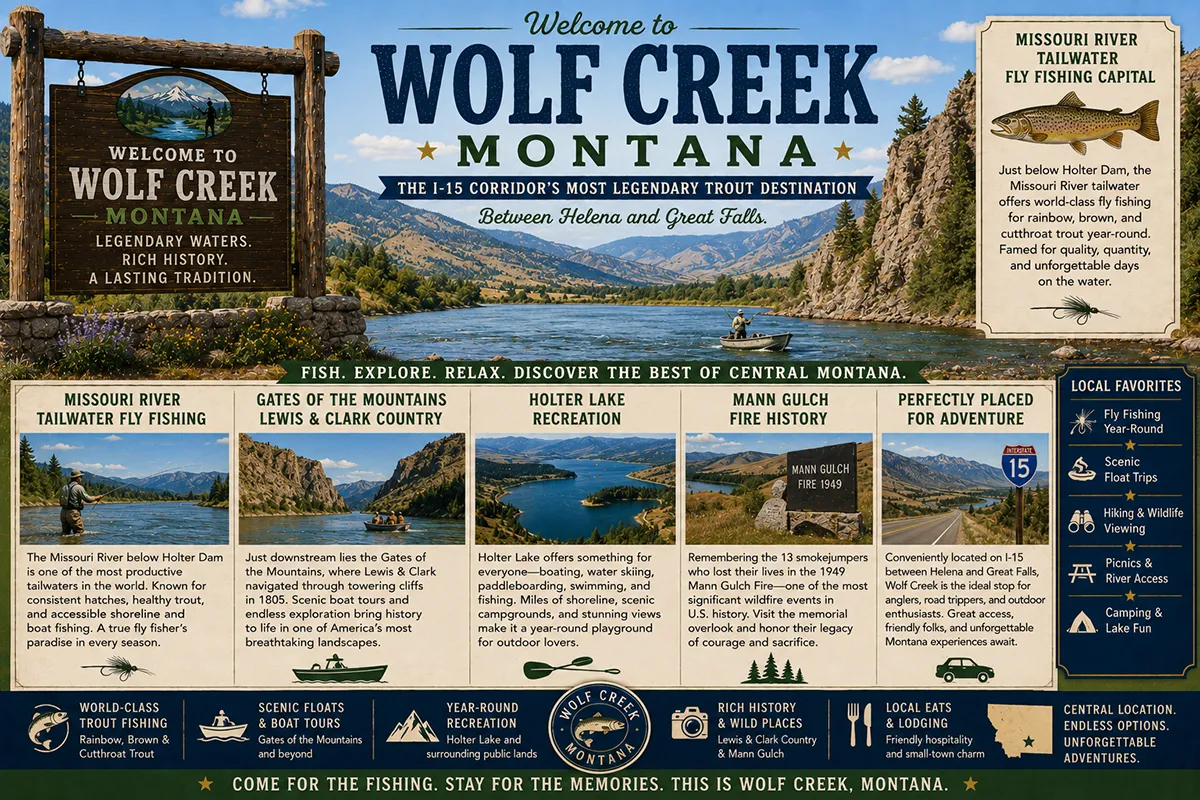
There are a few places in America where the conditions for trout fishing have been so optimized by geography and engineering that the river produces fish in volumes that border on the unbelievable. The Missouri River below Holter Dam is one of them.
When the Bureau of Reclamation completed Holter Dam in 1918, the impoundment that resulted — Holter Lake — became the third reservoir in a sequence of Missouri River dams (Hauser Dam 1907, Canyon Ferry 1953/1954, Holter 1918) that fundamentally transformed the upper Missouri River system.
Cold water released from the bottom of Holter Lake into the Missouri downstream created what fisheries biologists call a tailwater effect — consistent year-round cold water temperatures, stable flows, and the kind of bug life and food chain that supports trout populations measured in thousands of fish per mile.
The 35-mile stretch between Holter Dam and Cascade is now considered one of the finest tailwater trout fisheries in the world, with rainbow trout and brown trout in densities that anglers from across the United States travel here specifically to experience.
The small community of Wolf Creek sits at the heart of that fishery. The town is in Lewis & Clark County on Interstate 15 (Exit 226), 28 miles north of Helena and roughly 60 miles south of Great Falls.
The Missouri River flows north past town, just below Holter Dam, with the Wolf Creek Bridge serving as one of the most iconic boat launches in American fly fishing.
Wolf Creek itself is small — services include a fly shop, a couple of restaurants, lodging operations primarily geared toward visiting anglers, and the kind of working-river-town atmosphere that has built up over a century of fishing tradition.
The companion fishing town of Craig sits nine miles downstream along the frontage road. Cascade is another thirty-some miles north.
Between them, the Missouri offers more public access points, more guided trips, more drift-boat traffic, and more genuine angling history than almost any other stretch of trout water in the American West.
What’s more, the Wolf Creek area carries one of the most consequential pieces of American firefighting history. On August 5, 1949, fifteen U.S. Forest Service smokejumpers parachuted into a remote gulch east of the Missouri River in the Gates of the Mountains Wilderness to fight what appeared to be a routine wildfire.
Within hours, the fire had blown up beyond anything the crew could outrun. Thirteen of the fifteen smokejumpers died.
The Mann Gulch fire became the subject of Norman Maclean’s posthumously published Young Men and Fire (1992) and fundamentally transformed how the Forest Service trained and equipped wildland firefighters.
The gulch is still there, accessible only by boat from the Gates of the Mountains marina or by hiking from the canyon floor — and visiting it has become one of the most somber and meaningful pilgrimages available in American outdoor history.
TL;DR
- Wolf Creek (~330 area) is an unincorporated community in Lewis & Clark County on I-15 Exit 226, 28 miles north of Helena and 60 miles south of Great Falls.
- Position at the top of the Holter Dam-to-Cascade tailwater — one of the finest trout fisheries in the world, with thousands of trout per mile.
- Holter Dam (completed 1918) created Holter Lake (4,800+ surface acres) and the tailwater conditions that built the contemporary Missouri River trout fishery.
- The Wolf Creek Bridge boat launch is one of the most iconic fly-fishing access points in American angling.
- The Gates of the Mountains — named by Lewis and Clark on July 19, 1805 — open into a dramatic canyon at the south end of Holter Lake.
- The Mann Gulch fire of August 5, 1949 (13 of 15 smokejumpers killed) is one of the most consequential wildland firefighting events in American history; the gulch is accessible from the Gates of the Mountains marina.
- The companion fishing community of Craig is 9 miles downstream — a town of ~50 residents that exists almost entirely around fly fishing.
- Best for: serious Missouri River fly fishers, Lewis & Clark history travelers, Holter Lake boaters, Gates of the Mountains tourists, and Mann Gulch pilgrims.
Liked this article?
Add Roaming Montana as a preferred source so you see more of our articles and guides on Google.
Wolf Creek at a Glance
| Population (area) | ~330 |
|---|---|
| County | Lewis & Clark County |
| Status | Unincorporated community (CDP) |
| Region | Central-West Montana (Missouri River) |
| Elevation | 3,540 ft |
| Distance to Helena | ~28 miles south on I-15 (~30 min) |
| Distance to Great Falls | ~60 miles north on I-15 (~55 min) |
| Distance to Craig | ~9 miles north on frontage road |
| Distance to Cascade | ~35 miles north |
| Distance to Gates of the Mountains Marina | ~12 miles south (~20 min) |
| Distance to Helena Regional Airport (HLN) | ~30 miles south |
| Best for | Missouri River fly fishing, Holter Lake recreation, Gates of the Mountains, Mann Gulch history |
What Makes Wolf Creek Different
The Missouri River tailwater fishery is the foundational fact about Wolf Creek, and it’s worth understanding what makes it different from other famous Montana trout waters.
Most of Montana’s renowned trout rivers — the Madison, the Yellowstone, the Bitterroot — are freestone or limestone systems that depend on snowmelt and runoff for their water supply. Their character changes dramatically through the year as flows fluctuate.
The Missouri below Holter Dam is different: the dam releases consistent cold water from the bottom of Holter Lake throughout the year, producing remarkably stable conditions. Water temperatures rarely vary outside the 45-58°F range that trout thrive in.
Flows are managed and predictable. Bug life — mayflies, caddis, midges, and the famous summer trico hatch — develops at population densities that freestone rivers can’t match. The result is rainbow and brown trout in densities that experienced anglers describe as “thousands of fish per mile.”
The history of the Missouri River dams that produced this fishery deserves attention. Holter Dam was completed in 1918 by Montana Power Company as the third in a sequence of Missouri impoundments — Hauser Dam upstream had been completed in 1907 but failed catastrophically in 1908 (it was rebuilt in 1911).
Canyon Ferry Dam further upstream came later (the modern dam was completed in 1953-54, replacing an older 1898 structure).
Together, the three dams transformed the upper Missouri from a warm-water river with marginal trout habitat into one of America’s premier cold-water fisheries. The cold water releases from Holter Lake are the engineering choice that made the fishery possible.
The Gates of the Mountains is the other essential context. On July 19, 1805, Meriwether Lewis recorded in his journal his approach to a dramatic limestone canyon on the Missouri:
“this evening we entered much the most remarkable cliffs that we have yet seen… the river appears to have forced its way through this immence mountain… the rocks rise from the waters edge perpendicular to the height of about 1200 feet… from the singular appearance of this place I called it the gates of the rocky mountains.”
The canyon walls today still rise more than a thousand feet directly from the river. The Gates of the Mountains marina (at the south end of Holter Lake, about 12 miles south of Wolf Creek) operates tour boats that travel through the canyon several times daily during summer months.
The boat tours include interpretation of the Lewis and Clark history, the surrounding wildlife (mountain goats, bighorn sheep, golden eagles all visible from the boats), and the Mann Gulch fire site that branches off the canyon to the east.
The Mann Gulch story is one of the most consequential in American wildland firefighting history.
On August 5, 1949, fifteen smokejumpers from the Missoula base parachuted into a wildfire burning in Mann Gulch — a steep, narrow canyon on the east side of the Missouri River within the Gates of the Mountains Wilderness.
Within roughly two hours of landing, the fire had blown up into a moving wall of flame that overtook the crew as they tried to escape uphill.
Thirteen of the fifteen jumpers died. The two who survived — Walt Rumsey and Bob Sallee — followed the unusual decision of crew foreman Wagner Dodge, who set a small “escape fire” in the grass ahead of the main fire and laid down in the burned-over area.
Dodge’s escape fire technique was so unconventional at the time that some of the jumpers reportedly ran around him rather than joining him.
Norman Maclean spent fourteen years researching the fire and wrote Young Men and Fire, published posthumously in 1992 — one of the most important pieces of American non-fiction about the natural world.
Visiting Mann Gulch is genuinely meaningful for anyone interested in firefighting history, the Forest Service, or the broader American relationship with wildland fire.
For broader trip context, see my Montana cities and towns hub.
The Top 10 Things to Do In & Around Wolf Creek
1. Missouri River Fly Fishing (Holter Dam to Cascade)
The signature reason most travelers come to Wolf Creek. The 35-mile tailwater stretch below Holter Dam supports one of the most productive trout fisheries in the world — rainbow trout (the dominant species) and brown trout in densities measured in thousands of fish per mile.
Multiple boat launches (Holter Dam, Wolf Creek Bridge, Craig, Stickney, Spite Hill, Mid-Canon, Mountain Palace, Prewett Creek, Pelican) provide float fishing access; walk-and-wade fishing is available between launches and on the public-access stretches.
Guided trips through Wolf Creek Angler, Headhunters Fly Shop in Craig, and other area outfitters. Strong year-round fishery; legendary tricos in July-August. Montana fishing license required.
2. Gates of the Mountains Boat Tour
The dramatic limestone canyon on the Missouri River, named by Lewis and Clark on July 19, 1805. Tour boats depart multiple times daily during summer from the Gates of the Mountains marina (about 12 miles south of Wolf Creek).
The 2-hour tour includes interpretation of the Lewis and Clark expedition, the canyon’s geology, and the surrounding wildlife. Mountain goats, bighorn sheep, golden eagles, and ospreys are routinely visible from the boats. One of the most genuinely substantive boat tour experiences in the American West.
3. Mann Gulch Memorial Visit
Mann Gulch — the site of the August 5, 1949 fire that killed 13 smokejumpers — is accessible by boat from the Gates of the Mountains marina (some tour boats include a brief Mann Gulch stop) or by hiking from the canyon.
The site includes memorial markers for each of the fallen firefighters. For travelers familiar with Norman Maclean’s Young Men and Fire or interested in wildland firefighting history, the visit is genuinely meaningful. Approach the site with appropriate respect; it remains the gravesite of the men who died.
4. Holter Lake Recreation
The 4,800+ acre reservoir above Holter Dam offers boating, water skiing, swimming, fishing for walleye, kokanee salmon, perch, and rainbow trout (deep trolling methods recommended), and shoreline camping. Multiple boat ramps and campgrounds.
The lake extends north into Wolf Creek Canyon and includes the Gates of the Mountains section. Significantly less crowded than the Missouri River below the dam.
5. Wolf Creek Canyon Driving & Sightseeing
The dramatic canyon downstream of Holter Dam (where the Missouri River flows past Wolf Creek and toward Craig) is one of central Montana’s most underrated scenic drives.
I-15 traces the canyon’s eastern edge; the Recreation Road follows the river at water level on the west side.
Multiple turnouts allow stops for photography, walk-and-wade fishing, and canyon viewing. Bighorn sheep are routinely visible on the canyon walls.
6. Day Trip to Craig (9 miles north)
The companion fishing town of Craig — population approximately 50 — exists almost entirely around fly fishing. Headhunters Fly Shop (one of the most respected on the river), the Trout Shop, multiple river outfitters, and a handful of restaurants and lodging operations.
The town is what a true trout-fishing community looks like. Worth a visit even for non-anglers to absorb the river-rhythm character.
7. Lewis and Clark Expedition Interpretation
The Wolf Creek area is layered with Lewis and Clark expedition history. The Corps of Discovery passed through here in July 1805, traveling upstream on their journey to the Pacific.
Multiple historical markers along I-15 and the river corridor commemorate specific expedition events.
The Lewis and Clark National Historic Trail follows the corridor. Combine with the Gates of the Mountains boat tour for the full Lewis and Clark Missouri experience.
8. Holter Dam Visitor Information
The dam itself is accessible for viewing from the south side; the powerhouse and dam structure can be photographed from various angles. Holter Dam (completed 1918) was the engineering achievement that created the contemporary Missouri River trout fishery. Free; brief stop.
9. Day Trip to Helena (30 minutes south)
The state capital with full attractions — Montana State Capitol, the Cathedral of St. Helena, Last Chance Gulch, Montana Historical Society, Mount Helena hiking. See Helena guide.
10. Day Trip to Great Falls (~55 minutes north)
The C.M. Russell Museum (the definitive collection of Charlie Russell’s work), the Lewis & Clark Interpretive Center, the Great Falls of the Missouri (the falls the expedition had to portage around), and Giant Springs State Park (one of the largest freshwater springs in the United States).
See Great Falls guide.
Where to Stay
| Hotel | Vibe | Price | Best For |
|---|---|---|---|
| Wolf Creek Angler Lodge | Fly shop-adjacent lodging | $150–280 | Anglers |
| Frenchy’s Motel & Lounge (Wolf Creek) | Basic local motel | $90–140 | Budget |
| Vacation rentals (Wolf Creek-Craig area) | River cabins, ranch homes | $150–400 | Families, anglers |
| Holter Lake camping (BLM) | Lakeside developed and dispersed | $20–35 | Boaters, campers |
| Trout Shop / Headhunters cabins (Craig, 9 mi north) | Angler-focused | $130–280 | Serious fishermen |
| Helena hotels (30 min south) | Best regional selection | $130–250 | Most comforts |
| Cascade lodging (35 min north) | Riverside motels | $90–180 | Mid-corridor anglers |
Where to Eat
- The Oasis Bar & Casino (Wolf Creek) — local watering hole and food
- Frenchy’s Lounge (Wolf Creek) — casual food
- Izaak’s Restaurant (Craig, 9 mi north) — fly-fishing-town dining institution
- Helena dining (30 min south) — full city selection
- Great Falls dining (55 min north) — Bert & Ernie’s, Borries, multiple options
Wolf Creek itself has limited dining; many anglers eat at the bar/grills attached to local motels and fly shops, or drive to Craig, Helena, or Cascade.
Getting There & Around
From Helena: 28 miles north on I-15, about 30 minutes. Exit at I-15 Exit 226.
From Great Falls: 60 miles south on I-15, about 55 minutes.
From Bozeman: ~120 miles via I-90 west to Helena, then I-15 north, about 2.25 hours.
From Helena Regional Airport (HLN): 30 miles north via I-15, about 30 minutes.
To Gates of the Mountains Marina: 12 miles south of Wolf Creek; take I-15 south to Gates of the Mountains exit.
Cell service: Limited in Wolf Creek Canyon and on the river corridor downstream. Better service on I-15 and at higher elevations.
What Wolf Creek Unlocks
Missouri River Tailwater (Holter Dam to Cascade)
35 miles of one of the world’s premier trout fisheries.
Gates of the Mountains (12 min south)
Lewis & Clark’s named canyon; tour boats; Mann Gulch access.
Holter Lake (immediate)
4,800-acre reservoir; boating, fishing, camping.
Mann Gulch (via boat tour)
The 1949 smokejumper fire site; Norman Maclean’s “Young Men and Fire.”
Craig (9 min north)
The pure fishing town downstream.
Helena (30 min south)
State capital with full attractions.
Great Falls (55 min north)
C.M. Russell Museum and Lewis & Clark Interpretive Center.
When to Visit
Year-round fishing: The tailwater fishes year-round due to consistent cold water releases. Each season has distinct character.
March-April: Skwala stoneflies and BWO mayflies; smaller crowds.
May-June: Spring runoff doesn’t affect the tailwater the way it does other Montana rivers; great dry fly fishing.
July-August: The legendary trico hatch; significantly larger crowds; book guides months ahead.
September-October: Outstanding fall conditions; brown trout pre-spawn; quieter than summer.
November-February: Winter fishing (productive for prepared anglers); midges and tiny mayflies; very quiet conditions.
For non-anglers: Gates of the Mountains tour boats run primarily Memorial Day through Labor Day. Best visit timing is June-September.
Personal Tips
Hire a guide for your first day. The Missouri tailwater is famously productive but also famously subtle. The river fishes very differently than freestone rivers most anglers are familiar with. One guided day teaches enough to make subsequent independent days dramatically more successful.
Crowds aren’t a myth. The Holter Dam to Craig stretch in July-August can have 50+ drift boats in sight at once on weekend mornings. If solitude is part of what you want from a fishing trip, fish mid-week, in shoulder seasons, or in the more remote canyon sections below Craig.
Take the Gates of the Mountains boat tour. Even if you’re not a Lewis and Clark enthusiast, the canyon experience is genuinely spectacular. Allow 2-3 hours; some tours include the Mann Gulch stop.
Read Norman Maclean before visiting Mann Gulch. Young Men and Fire is not light reading but it’s one of the great pieces of American non-fiction. Visiting Mann Gulch without the context of Maclean’s research is significantly less meaningful.
Stay multiple nights. The drive from Helena or Great Falls is short, but the experience deepens with each day on the water. Three-day minimum is the right starting point for a serious Missouri River trip.
Watch for canyon weather. Wolf Creek Canyon can produce dramatic afternoon thunderstorms in summer. Drift-boat anglers should monitor conditions; wade anglers near the river should know where to retreat to in case of lightning.
Cell service requires planning. The canyon has spotty service. Set meeting times with guides in advance; don’t rely on real-time texting to coordinate the day.
Wolf Creek Quick Facts
| I-15 exit | 226 | | Distance to Helena | 28 miles south | | Distance to Great Falls | 60 miles north | | Holter Dam completed | 1918 (Montana Power Company) | | Holter Lake surface area | 4,800+ acres | | Tailwater fishery length | ~35 miles (Holter Dam to Cascade) | | Mann Gulch fire | August 5, 1949 (13 of 15 smokejumpers killed) | | Norman Maclean’s “Young Men and Fire” | Published posthumously 1992 | | Lewis & Clark named Gates of the Mountains | July 19, 1805 | | Gates of the Mountains canyon wall height | ~1,200 feet | | Average summer high | 82°F | | Average winter low | 11°F |
Conclusion
Wolf Creek is one of the most genuinely meaningful small communities in central Montana, and its meaning comes from the convergence of multiple consequential American stories — the engineering of the upper Missouri River dams that created one of the world’s premier trout fisheries, the Lewis and Clark expedition’s 1805 passage through the Gates of the Mountains, the 1949 Mann Gulch fire that fundamentally reshaped American wildland firefighting, and the contemporary fly-fishing culture that has built up around the Holter Dam tailwater over the past century. For serious anglers, Lewis and Clark history travelers, wildfire history pilgrims, and travelers willing to slow down and appreciate the layered significance of the upper Missouri River corridor, Wolf Creek rewards real time.
Have a Wolf Creek question? Drop it in the comments — I read every one.
Frequently Asked Questions
Is Wolf Creek Montana worth visiting?
Yes — Wolf Creek is worth visiting primarily for the Missouri River tailwater fly fishing (one of the world’s premier trout fisheries), the Gates of the Mountains boat tour and Lewis and Clark history, the Mann Gulch fire site and Norman Maclean’s “Young Men and Fire” pilgrimage, and Holter Lake recreation. Its strategic position on I-15 between Helena and Great Falls makes it an accessible base for substantial central Montana exploration.
What is the Missouri River tailwater?
The Missouri River tailwater refers to the 35-mile stretch of the river below Holter Dam (immediately downstream of Wolf Creek) to the town of Cascade. The tailwater is created by the dam’s release of consistent cold water from the bottom of Holter Lake throughout the year, producing stable temperatures (45-58°F range), predictable flows, and exceptional aquatic insect populations. The result is one of the most productive trout fisheries in the world, with rainbow trout and brown trout populations measured in thousands of fish per mile.
What was the Mann Gulch fire?
The Mann Gulch fire was a wildfire that burned on August 5, 1949, in Mann Gulch within the Gates of the Mountains Wilderness east of the Missouri River near Wolf Creek. Fifteen U.S. Forest Service smokejumpers parachuted into the fire to suppress it; within roughly two hours of landing, the fire blew up into a moving wall of flame that overtook the crew. Thirteen of the fifteen smokejumpers died. Crew foreman Wagner Dodge survived using his innovative “escape fire” technique — setting a small grass fire ahead of the main fire and laying down in the burned-over area. The Mann Gulch fire fundamentally transformed Forest Service wildland firefighter training and equipment. Norman Maclean spent fourteen years researching the fire and wrote Young Men and Fire, published posthumously in 1992.
Where are the Gates of the Mountains?
The Gates of the Mountains is a dramatic limestone canyon on the Missouri River at the south end of Holter Lake, about 12 miles south of Wolf Creek and 17 miles north of Helena. The canyon was named by Meriwether Lewis on July 19, 1805, who described the cliffs rising perpendicular from the water to about 1,200 feet. The Gates of the Mountains marina operates tour boats through the canyon during summer months (Memorial Day through Labor Day).
When was Holter Dam built?
Holter Dam was completed in 1918 by the Montana Power Company. The hydroelectric dam created Holter Lake (4,800+ acres) and produced the tailwater conditions downstream that created the contemporary Missouri River trout fishery. Holter is the lowest of three dams in the upper Missouri River sequence — preceded upstream by Hauser Dam (1907, rebuilt 1911) and Canyon Ferry Dam (modern structure completed 1953-54).
How far is Wolf Creek from Helena?
Wolf Creek is 28 miles north of Helena on Interstate 15 — about a 30-minute drive. Exit 226 from I-15 provides direct access to the Wolf Creek community and the Wolf Creek Bridge fishing access on the Missouri River.
What is the Wolf Creek Bridge?
The Wolf Creek Bridge is the most iconic boat launch and fishing access site on the Missouri River below Holter Dam. The bridge crosses the Missouri at the upstream edge of the famous tailwater fishery, providing concrete boat ramp access, parking for trucks and trailers, and walk-and-wade fishing access along the surrounding river corridor. The bridge serves as the starting line for many drift-boat trips downstream toward Craig.