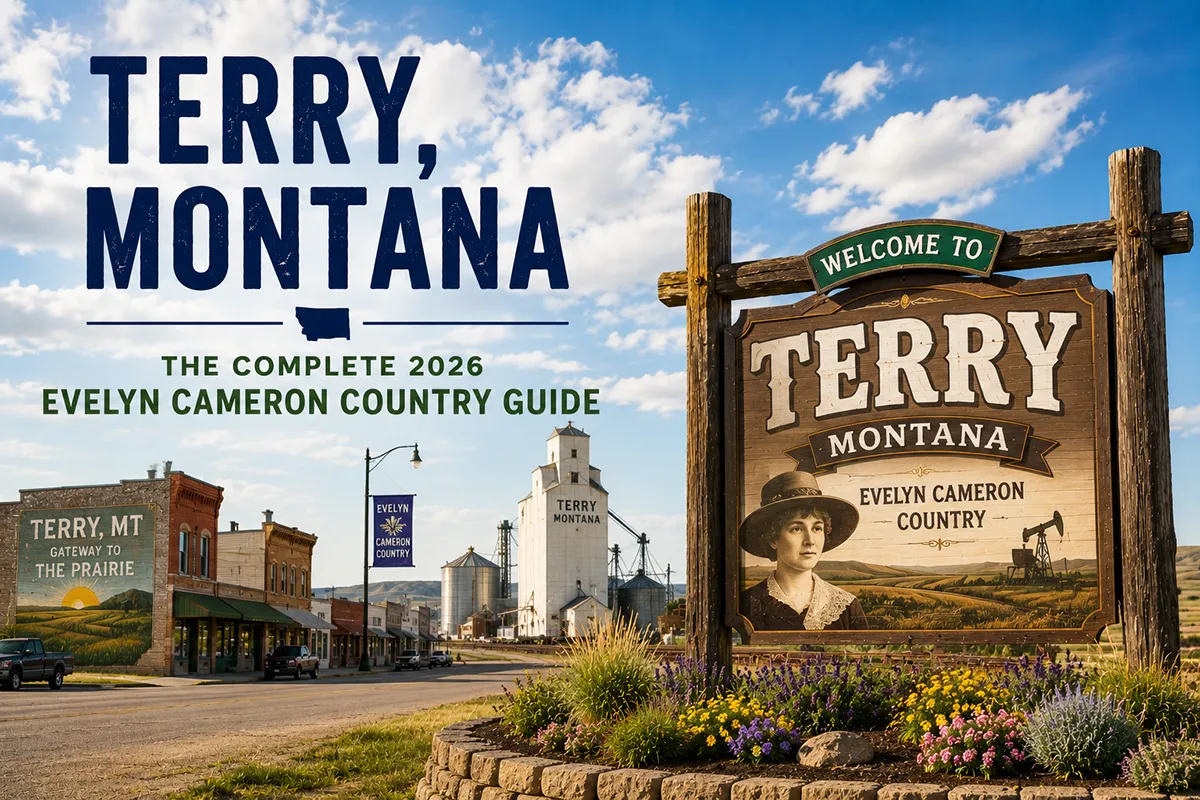
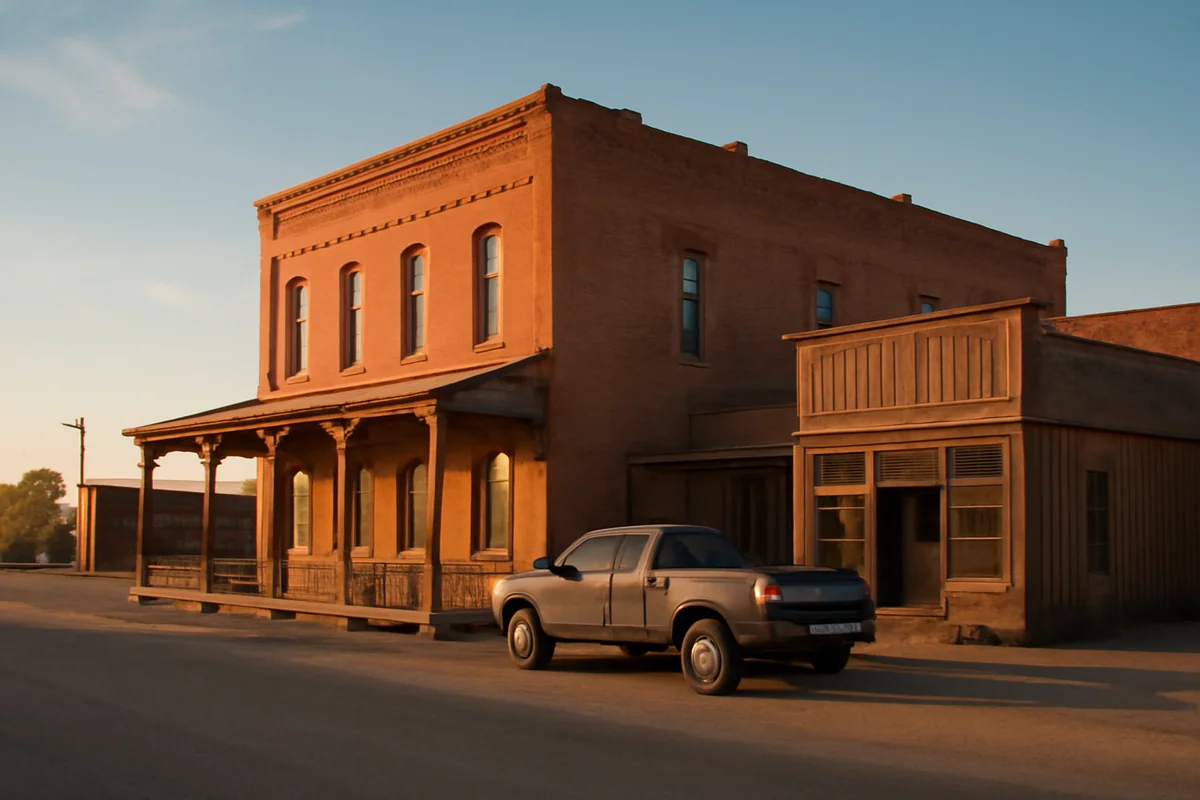
Terry is a town of about 560 people on the Yellowstone River where a British woman with a view camera spent the better part of four decades recording homestead life, and where a hotel opened in 1902 is still taking guests. It sits off I-94 between Miles City and Glendive, and most travelers pass it without knowing what they missed.
TL;DR
- Terry is the Prairie County seat in eastern Montana, just off I-94 on the Yellowstone River. The 2020 census counted 562 residents. It is part of Southeast Montana.
- The main draws are the Prairie County Museum and Evelyn Cameron Gallery, the Terry Badlands Wilderness Study Area, and the Kempton Hotel, which opened in 1902.
- The Terry Badlands are wild country with dirt roads, no designated parking and four-wheel drive recommended for the Calypso Trail; check with the BLM before driving in.
- Lodging is limited to a historic hotel, a motel and RV parks, and Miles City and Glendive are the nearest larger options.
- Older guides give the wrong age and arrival year for Evelyn Cameron, the wrong population and unverified lodging; this guide corrects them.
Liked this article?
Add Roaming Montana as a preferred source so you see more of our articles and guides on Google.
A Town on Two Railroads
Terry’s story begins with the Yellowstone River and a supply stop. The site was first called Joubert’s Landing, after a man who built a supply point for freighters traveling between Bismarck, Dakota Territory, and Miles City. When the Northern Pacific Railway arrived in 1881, the town was renamed for General Alfred Howe Terry, who led an 1876 expedition connected to George Armstrong Custer’s campaign. The township dates to 1884 and the town was incorporated in 1910.
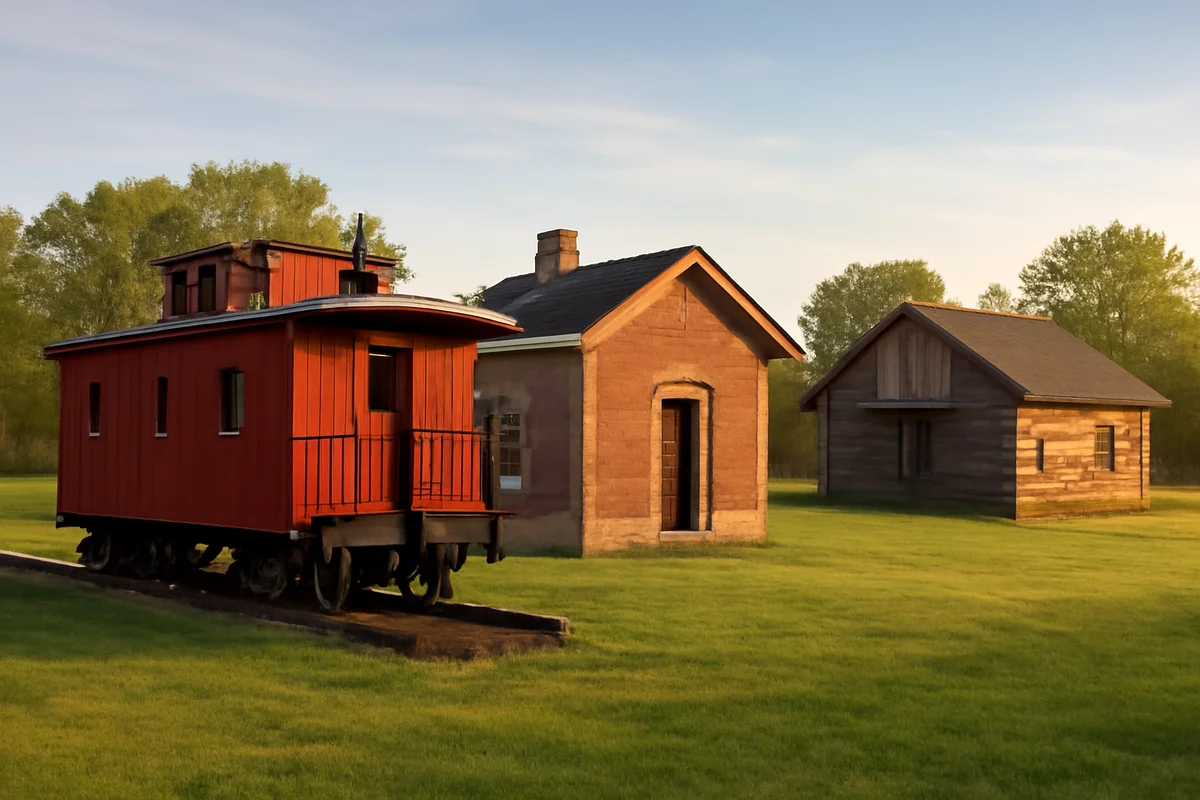
A second railroad followed. The Milwaukee Road built its Pacific Extension through the area in the early twentieth century, which made Terry a two-railroad town and explains the depot and caboose in the museum yard. For a wider look at how rail shaped eastern Montana, see the Montana railroads page.
The Numbers
Terry peaked at 1,191 residents in 1950, fell to 605 in 2010 and was 562 in 2020, according to Wikipedia. Older guides give “about 550,” which is close but not the census figure. Prairie County itself had 1,088 residents in 2020, making it one of the least populous counties in Montana, with every resident living in a rural area. Elevation is about 2,254 feet.
Why a Quiet Town Is Worth the Exit
Terry rewards people who like small places with deep layers. A few blocks of brick storefronts hold a museum in a former bank, a hotel that has outlasted the Milwaukee Road, and a cafe and tavern on Spring Street. Out of town, a badlands landscape runs north of the river for miles. This guide covers the history and sights in that order, then the practical details: lodging, food, events, weather and day trips. It is one of the profiles in the site’s collection of Montana cities and towns.
Evelyn Cameron: The Woman Behind the Camera
Evelyn Cameron is the reason many travelers know the name Terry. She was born August 26, 1868, at Furzedown Park, south of London, and died December 26, 1928, in Terry. Wikipedia says she and her husband, Ewen Somerled Cameron, a Scotsman from the Orkney Islands, migrated to Montana in September 1891, when she was 23. Older guides say she arrived in 1889 at age 22 and photographed “for the next 39 years,” which does not fit those dates.
The Photography Years
Ewen bought the couple’s first camera in July 1894, and Evelyn’s documented photography runs from then until her death in 1928. She photographed ranchers, homesteaders, cowboys and the daily life of the prairie, and she also kept a daily journal that records ordinary matters such as egg collecting and the difficulties of ranching. The photographs are valued for their accuracy and plain style.
The Rediscovery
Thousands of her prints and negatives were found in the late 1970s by Donna Lucey, whose book Photographing Montana, 1894-1928 was published in 1990. A later biography by Lorna Milne appeared in 2017, and a PBS documentary covers her life. The bulk of the original photographs are held by the Montana Historical Society in Helena, while a museum in Terry displays prints and artifacts. Older guides say the negatives were found in “a farmhouse attic” in 1978; sources confirm the late-1970s rediscovery but not that detail.
Prairie County Museum and Evelyn Cameron Gallery
The Prairie County Museum and Evelyn Cameron Gallery, at 101 South Logan, is the stop most visitors plan around. The phone is 406-635-4040 and the website is pcmuseum.org. Hours and admission are not posted on the tourism pages consulted. One regional listing says the museum is open in summer, with volunteers opening it in the off-season by appointment through a phone number on the door.
The Buildings and Exhibits
The museum is housed in the former State Bank of Terry, built in 1916, and the teller windows remain. Tourism listings describe a complex with the following:
- the 1916 and 1906 State Bank of Terry buildings
- a pioneer homestead and a Burlington Northern train depot
- a red wooden caboose
- the Larsen Memorial Building, with historical artifacts
- the Evelyn Cameron Gallery with prints and diary material
- a steam-heated outhouse, billed as the only one this side of the Mississippi
Among the artifacts are an edition of the New York Herald announcing Lincoln’s assassination and an original 1909 Enlarged Homestead Act map showing family names tied to 320-acre claims. Exhibits also cover open-range ranching, including the X-I-T brand, which ran cattle from Texas to southeastern Montana.
A separate organization, Evelyn Cameron Heritage, hosts events at a heritage center at 212 Laundre Avenue, including a gala marking 20 years of the organization in October 2025. For other small museums in the state, see the best museums in Montana.
The Kempton Hotel
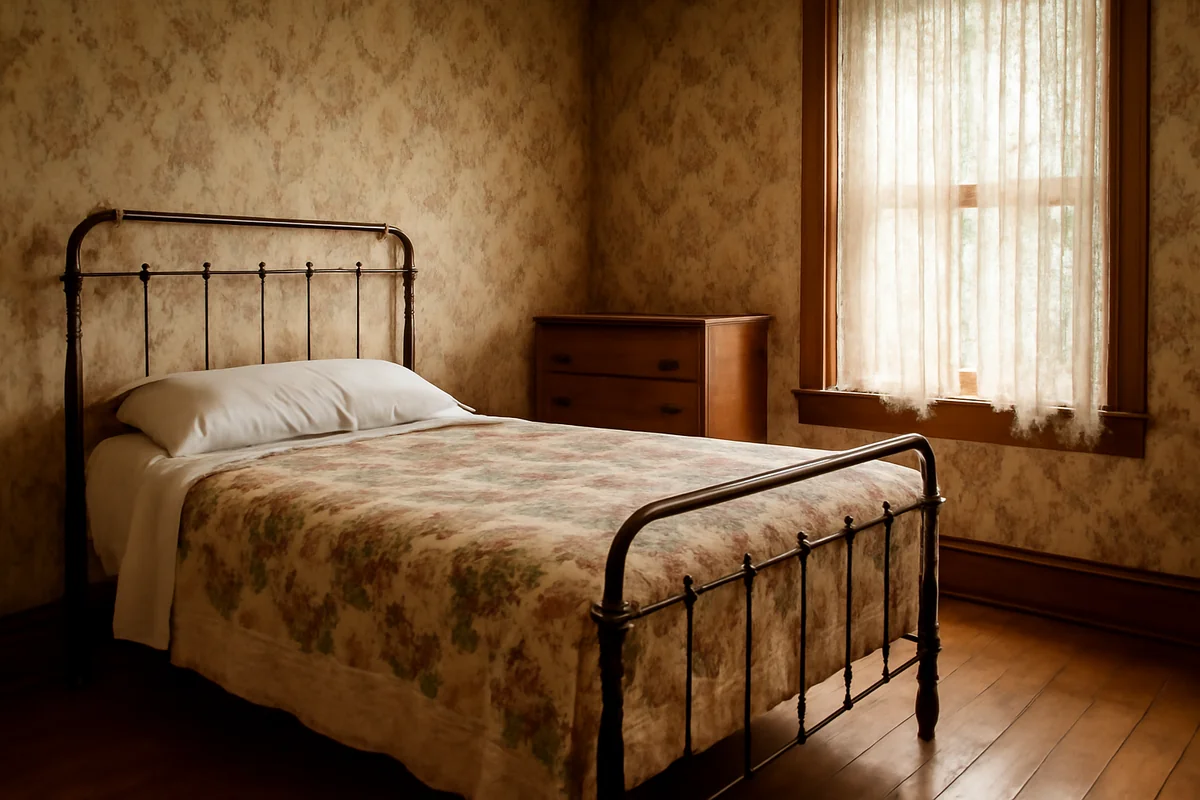
The Kempton Hotel, at 204 Spring Street, opened on June 15, 1902, and is described as the oldest continuously operated hotel in Montana. Wikipedia says homesteaders built it, that Russell and Linda Schwartz bought it in 1990 and that they kept the original decor. Tourism material says guests have included Theodore Roosevelt and Calamity Jane; treat that as local tradition.
The hotel has an attached antiques store and sits on Terry’s historic walking trail, with a map at the front desk according to the chamber site. A Wikipedia entry lists nine rooms, while the tourism listing gives no count. The phone is 406-635-5543. Because there are few rooms, booking ahead matters.
The Terry Badlands
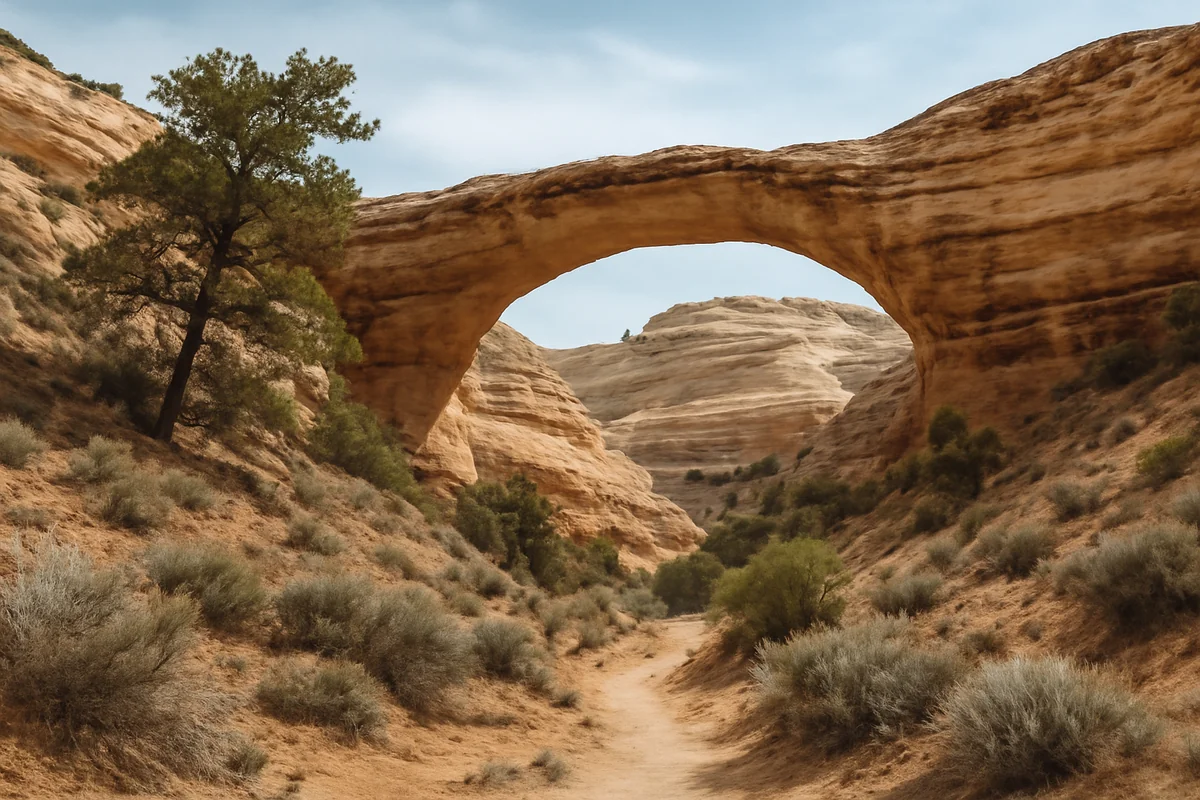
The Terry Badlands Wilderness Study Area is a Bureau of Land Management tract about 3 miles northwest of town, across the Yellowstone River. BLM describes colorful banded cliffs overlooking rolling prairie, with sandstone bridges, spires, table tops and buttes separated by deep gullies. Vegetation includes sage, yucca, greasewood and juniper, and the area holds one of the most easterly stands of limber pine. Wildlife includes mule and white-tailed deer, pronghorn, elk, badgers and many raptors.
How to Get There
Access is the part that catches people. BLM lists a Scenic View route: from I-94 at Terry, take Highway 253 across the Yellowstone River for about 2.5 miles to Scenic View Road, a dirt road, then turn left and drive about 6 miles to the Terry Scenic View overlook. A second route along the Milwaukee Road is currently unavailable because the Montana Department of Transportation closed the Milwaukee Bridge, whose deck had deteriorated.
BLM recommends four-wheel drive on the Calypso Trail, and notes that there are no designated parking areas, so visitors should pull over safely off the road. The agency’s message is plain: do not drive off road. Check with the BLM Miles City Field Office, 406-233-2800, before heading out.
Natural Bridges Trail
The Natural Bridges Trail is a little over a mile to the natural bridges, rated relatively easy to moderate and suitable for a day hike. There is no fee, and the stay limit is 16 days. Wheeled traffic is limited to the Calypso Trail, because both sides are inside the study area. Other writers describe a 5.5-mile Calypso Trail Drive, a photo spot called Chimney Rock and six miles of scenic drive road.
Cautions
Gumbo clay turns slick and impassable after rain, and cell coverage can be spotty. Bring water, tell someone the plan and watch for rattlesnakes; see Montana rattlesnakes. Visitors can also hunt rocks and fossils, and petrified logs may be found. The Army graffiti from the 1800s on Sheridan Butte is part of the area’s cultural record, so look but do not add to it.
Rivers, Agates and Other Outdoor Stops
The Yellowstone River runs just north of town, and the chamber site lists fishing, hunting, camping, hiking, wildlife viewing and agate hunting among local activities. Agate hunters search the river banks, starting from fishing access points; see Montana agates and Montana rockhounding sites for rules and tips.
Southeast Montana tourism lists a Badlands to Badlands trail on its Terry community page, tying the Terry Badlands to the badlands of North Dakota. A viewpoint called Powder River Historic Point is described along Old Highway 10 with a lookout and an information board on Custer’s march toward the Little Bighorn. Older guides describe “Powder River access” and a “Powder River Historical Drive” on US-12; those could not be matched to current listings.
The 1938 Custer Creek Train Wreck
The most somber chapter nearby is the Custer Creek disaster. At 12:35 a.m. on June 19, 1938, the Milwaukee Road’s westbound Olympian, with 155 passengers on board, crashed through a bridge near Saugus, southwest of Terry, after a cloudburst sent a flash flood down Custer Creek. The locomotive and several cars fell into the creek. The official death toll is given as 47, an estimate because some bodies were swept into the Yellowstone River, and 75 people were injured.
The wreck is often called the worst rail disaster in Montana history. It is not a tourist stop and the creek crossing is not marked in the sources consulted, but it is part of how local families remember the Milwaukee Road era.
Where to Eat
Terry’s dining list is short, and hours change, so a phone call is smart.
- Dizzy Diner (316 East Spring Street): a local diner, 406-635-4666.
- Roy Rogers Tavern (205 West Spring): a bar, 406-635-9913.
- Hardware Hank’s (200 Logan): hardware and supplies, 406-635-5440.
- Prairie Unique (114 South Logan): a hobby shop and boutique, 406-635-5598.
Older guides name a “Terry Bar,” which does not appear in current listings; Roy Rogers Tavern does. Pick up groceries and fuel in Miles City or Glendive if staying at an RV park.
Where to Stay
| Option | Type | Notes |
|---|---|---|
| Kempton Hotel | Historic hotel | 204 Spring St, 406-635-5543; opened 1902 |
| Diamond Motel & Campground | Motel and camping | 118 E Spring, 406-635-5407 |
| Small Towne RV Campground | RV | 803 S Towne Ave, 406-635-4501 |
| Terry RV Oasis | RV | 510 Yellowstone St, 406-635-5520 |
| BLM Terry Badlands | Dispersed camping | 16-day stay limit; no designated sites |
| Miles City | Hotels, KOA | About 40 to 45 miles west; see Miles City |
| Glendive | Hotels | About 40 to 55 miles east; see Glendive |
Older guides list the Kempton Hotel at $80 to $120 and “budget motels” at $75 to $110. Those prices could not be confirmed. The fair and hunting season fill the small number of rooms. For statewide options, see the best RV parks in Montana.
Events on the Prairie County Calendar
The Prairie County Fair, called “the biggest little fair in all of eastern Montana,” is held at the Prairie County Fairgrounds, 31 Fairgrounds Road, in August. Wikipedia also lists Terry Yippie and the Evelyn Cameron Gala as annual events. The fairgrounds host year-round events including rodeos, demolition derbies, gun shows and concerts, and the contact number is 406-635-2121. For the statewide picture, see Montana in August.
Weather and Seasons
Terry has a semi-arid continental climate. Wikipedia lists a record high of 113 degrees F and a record low of minus 47, with about 13.36 inches of precipitation a year; the same article gives conflicting snowfall numbers. Older guides give a summer high of 90 and a winter low of 4 degrees, which could not be sourced.
| Season | What to expect | Best for |
|---|---|---|
| Spring | Muddy dirt roads, wind | Quiet drives, bird watching |
| Summer | Hot, thunderstorms; museum open | Museum, hotel, fair |
| Early fall | Mild days, cool nights | Badlands photography, hunting |
| Winter | Cold, wind, icy I-94 | Short stops only |
See the Montana weather guide, the winter driving guide and Montana bug season before a trip, and the Montana night sky guide for stargazing away from town lights.
Getting There and Day Trips
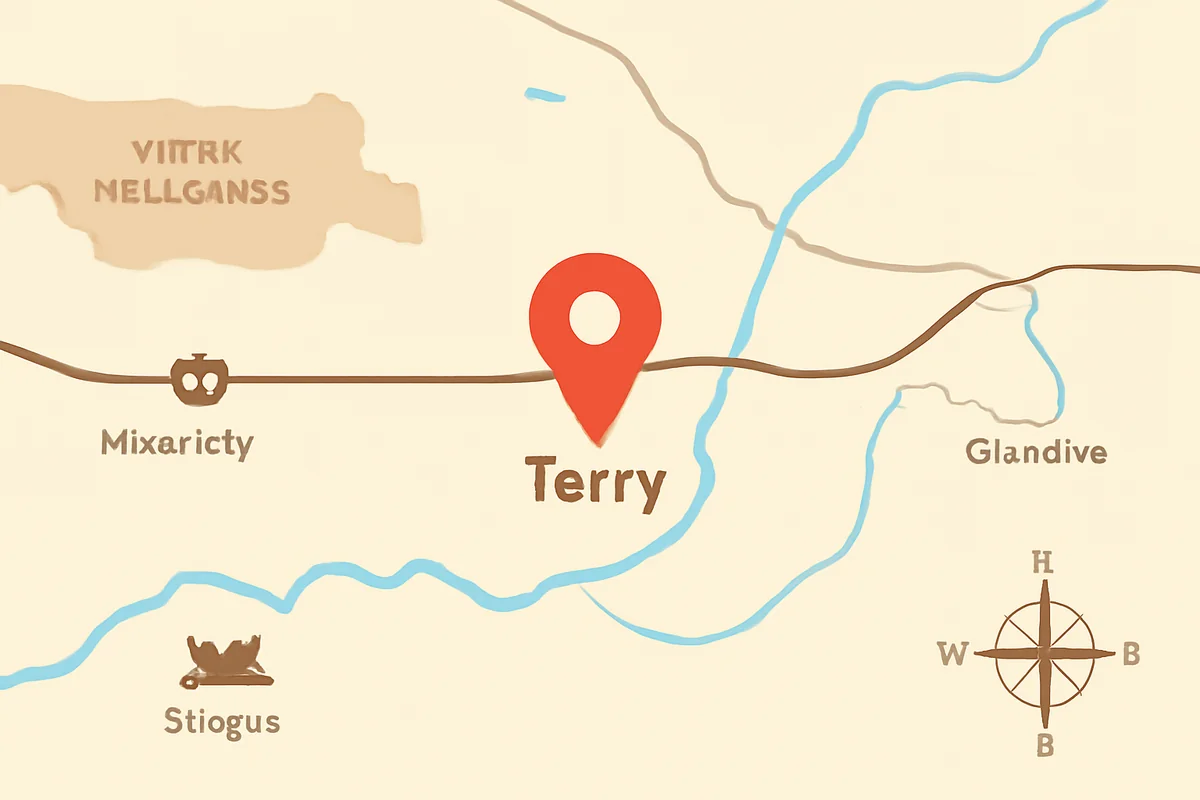
Terry sits just north of I-94. The Kempton Hotel’s listing places the town at Exit 176, while a travel blog gives Exit 169 with a drive of about 8 miles on Old Highway 10; the exit numbers should be confirmed before relying on them. Distances below are approximate.
| Destination | Approx. distance | Why go |
|---|---|---|
| Miles City | about 40 to 45 miles west | Range Riders Museum, Bucking Horse Sale |
| Glendive | about 40 to 55 miles east | Makoshika State Park, airport |
| Wibaux | roughly 65 miles east | Pierre Wibaux Museum, Gem Theatre |
| Forsyth | roughly 75 miles west | Rosebud County seat |
| Saugus (Custer Creek) | southwest of town | Site of the 1938 wreck |
| Terry Badlands | about 3 miles northwest | Hiking, scenic views |
Older guides give Miles City as about 40 miles and Glendive as about 55; with Terry near Exit 176 and the two cities near Exits 138 and 213 on I-94, both are probably closer to 40 miles. The larger regional picture is on the Southeast Montana page.
Local Knowledge: What the Brochures Skip
Call the museum first. Hours are seasonal, and off-season visits run by appointment through a posted number.
Know which badlands road is open. The Milwaukee Road bridge route is closed, so the Scenic View route is the one to use.
Bring a spare tire and water. Dirt roads in the badlands are rough, and there is no designated parking.
Skip the badlands after rain. Clay roads become slippery and can strand even four-wheel-drive vehicles.
Book the Kempton early. The historic hotel has few rooms, and summer weekends fill.
Ask about the walking trail. The chamber lists a historic walking trail with a map at the Kempton front desk.
Respect the graffiti and the rocks. The Army inscriptions on Sheridan Butte are historic; look without touching.
Fuel up in Miles City or Glendive. Terry’s services are limited.
Practical Info
| Item | Details |
|---|---|
| Best time to visit | Late May to September for the museum; fall for photography |
| Location | Prairie County seat, eastern Montana, on the Yellowstone River near I-94 |
| Population | 562 (2020 census) |
| Elevation | About 2,254 feet |
| Museum | 101 South Logan, 406-635-4040 |
| Badlands contact | BLM Miles City Field Office, 406-233-2800 |
| Nearest airport | Terry Airport is small; Glendive and Billings have more service (see Montana airports) |
| Bring | Water, spare tire, offline map, layers |
| Difficulty | Easy in town; rough roads outside it |
Frequently Asked Questions
What is Terry, Montana known for?
Evelyn Cameron’s photography, the Terry Badlands, the Kempton Hotel and the Prairie County Museum.
How many people live in Terry?
562 at the 2020 census.
When did Evelyn Cameron arrive in Montana?
Wikipedia gives September 1891, at age 23.
How far is Terry from Miles City?
About 40 to 45 miles west.
Is the Terry Badlands trail hard?
The Natural Bridges Trail is rated easy to moderate, but the roads in need a four-wheel-drive vehicle.
Is the Kempton Hotel the oldest in Montana?
It is described as the oldest continuously operated hotel in the state.
Final Thoughts
Terry offers a tidy combination: a camera pioneer’s archive in a former bank, an unusual badlands landscape just across the river and a hotel that has been open for more than a century. It is a good stop for travelers who like to leave the interstate and read the landscape.
Pin this guide for the next I-94 drive, and check the details marked for verification before leaving. Corrections from locals are welcome in the comments. The wider set of Montana cities and towns has more places for the route, and the Southeast Montana page connects them.
Sources and further reading
- Wikipedia: Terry, Montana
- Wikipedia: Prairie County, Montana
- Wikipedia: Evelyn Cameron
- Wikipedia: The Kempton Hotel
- Wikipedia: Custer Creek train wreck
- Visit Terry, Montana
- Visit Southeast Montana: Terry
- Visit Southeast Montana: Prairie County Museum and Evelyn Cameron Gallery
- VisitMT: Prairie County Museum and Evelyn Cameron Gallery
- Visit Southeast Montana: Prairie County Fair
- BLM: Terry Badlands
- BLM: Natural Bridges Trail
- Travel Montana Now: Terry