The first time I drove through Malta I stopped at the Phillips County Museum because the building had a fiberglass dinosaur out front and I had an hour to kill. I ended up staying for three hours.
The museum has a Brachylophosaurus skeleton — “Elvis” — found nearby, and a paleontologist on staff, and exhibits that make you understand why the Hi-Line prairie is one of the most important fossil-bearing landscapes in North America.
Most travelers drive past Malta without stopping. This is the guide to change that.
TL;DR
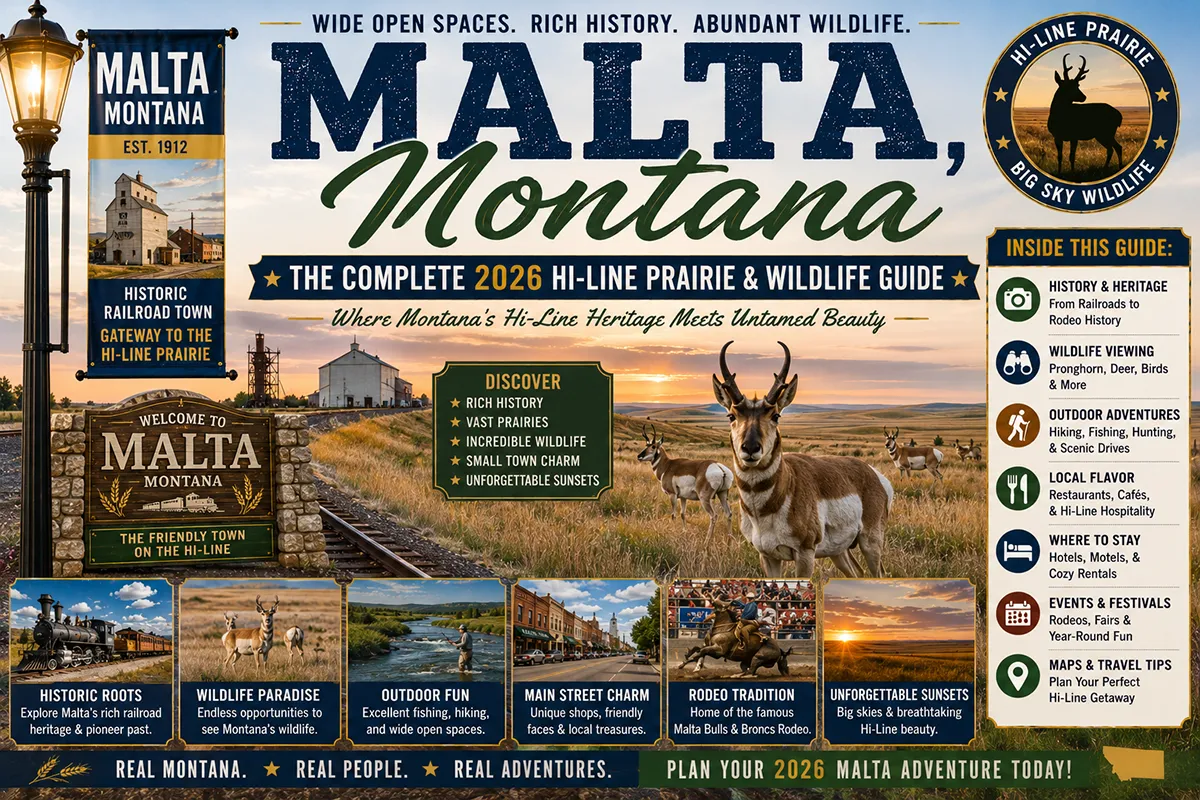
- Malta (~1,900) is a Hi-Line ranching town in north-central Montana, sitting on US-2 between Havre and Glasgow.
- Home to the Phillips County Museum with “Elvis” the dinosaur and a world-class paleontology program, and gateway to Bowdoin National Wildlife Refuge (one of the best migratory bird refuges in the northern plains).
- The Charles M. Russell National Wildlife Refuge — 1.1 million acres of Missouri River Breaks country — starts near Malta.
- Best for: paleontology enthusiasts, birders, remote prairie road trippers, off-the-beaten-path Montana.
- Almost no SERP competition.
Liked this article?
Add Roaming Montana as a preferred source so you see more of our articles and guides on Google.
Malta at a Glance
| Population (2020) | ~1,900 |
|---|---|
| County | Phillips County (county seat) |
| Region | North-Central Montana (Hi-Line) |
| Elevation | 2,254 ft |
| Distance to Havre | ~68 miles (~1 hour) |
| Distance to Glasgow | ~52 miles (~50 min) |
| Distance to Lewistown | ~90 miles (~1.5 hours) |
| Best for | Dinosaur fossils, birding, Missouri Breaks wildlife, remote prairie travel |
What Makes Malta Different
Phillips County — Malta’s county — has been called one of the most important fossil-bearing landscapes in North America.
The same Cretaceous-era sedimentary geology that built Makoshika State Park near Glendive runs through here, and discoveries have been extraordinary: Brachylophosaurus canadensis (“Elvis”) was found nearby and is one of the best-preserved hadrosaur specimens ever found, with fossilized skin impressions.
The surrounding landscape is dominated by two massive wildlife refuges. Bowdoin National Wildlife Refuge, just north of town, is a critical breeding and migratory stopover for waterfowl, shorebirds, and prairie species — American white pelicans nest in large colonies here.
The Charles M. Russell National Wildlife Refuge to the south encompasses 1.1 million acres of Missouri River Breaks country — one of the most remote and intact wildlife habitats in the lower 48.
For broader trip context, see my Montana cities and towns hub.
The Top 10 Things to Do in Malta & Surroundings
1. Phillips County Museum
The single most important reason to stop in Malta. Full dinosaur skeletons including “Elvis” (Brachylophosaurus), an active paleontology program, and exhibits on the Indigenous history and ranching heritage of Phillips County. Budget 2–3 hours. One of the best rural Montana museums in the state.
2. Bowdoin National Wildlife Refuge
A 15,551-acre wetland refuge 7 miles east of Malta, with a 15-mile auto tour loop. American white pelicans, Franklin’s gulls, and breeding ducks in massive numbers. Piping plovers, endangered in the lower 48, nest here. Spring migration (April–May) and fall migration (September–October) are peak times. Free.
3. Dinosaur Field Station Tours
The Malta Dinosaur Field Station offers summer tours to active dinosaur fossil excavation sites in Phillips County. A genuinely rare opportunity to see paleontology fieldwork happening and to walk through fossil-bearing badlands with a guide.
4. Charles M. Russell National Wildlife Refuge
1.1 million acres of Missouri River Breaks badlands, grassland, and reservoir habitat stretching east and south of Malta. Elk, deer, antelope, golden eagles, ferruginous hawks, and prairie dog towns. The CMR encompasses wild, remote country accessible by dirt roads. A 4WD vehicle and good navigation are recommended.
5. Sleeping Buffalo Hot Springs (20 miles east)
A geothermal hot spring resort near Saco — basic pools but authentic Montana experience. Popular with locals.
6. Zortman and Landusky (50 miles south)
Two tiny towns in the Little Rocky Mountains with a gold-mining history. Scenic drive; ghost-town atmosphere.
7. Milk River Fishing
The Milk River flows through Malta and offers walleye, pike, and catfish fishing — prairie river species different from the mountain trout streams of western Montana.
8. Glasgow-Malta Hi-Line Drive (US-2)
The stretch of US-2 between Malta and Glasgow passes through one of the most remote sections of the Hi-Line — wheat fields, coulees, prairie, and the occasional small-town grain elevator. Slow down and absorb it.
9. Rock Art Viewing
Phillips County has documented rock art sites in the badlands country along the Missouri Breaks. Contact the Malta BLM Field Office for current accessible site information.
10. Phillips County Fair (August)
The county fair in Malta — rodeo, livestock shows, and community events. An authentic northern plains rural fair experience.
Where to Stay
| Hotel | Vibe | Price | Best For |
|---|---|---|---|
| Maltana Motel | Classic roadside motel | $80–120 | Budget travelers |
| Great Northern Hotel | Small downtown hotel | $90–130 | Most travelers |
| Sleeping Buffalo Hot Springs (20 mi east) | Basic hot spring resort | $100–160 | Hot spring experience |
| Malta KOA | RV/tent camping | $30–60 | Campers |
Malta is among Montana’s most affordable overnight options.
Where to Eat
- GN Bar & Steakhouse — the main dining option in Malta
- Tin Cup Bar & Grill — locals’ bar and grill
- Pizza Palace — casual
- Westside Restaurant — diner basics
Options are limited — Malta is a remote Hi-Line town. Stock up on provisions in Havre or Glasgow if you’re camping.
Getting There
Malta sits directly on US-2 (the Hi-Line).
From Havre: 68 miles east, about 1 hour.
From Glasgow: 52 miles west, about 50 minutes.
By plane: No commercial service to Malta. Havre (HVR) or Glasgow (GGW) have limited service.
When to Visit
Spring (April–May) is peak birding at Bowdoin — migration peaks.
Summer (June–August) is warmest and driest; field station dinosaur tours operate.
Fall (September–October) is excellent — second migration wave at Bowdoin, hunting season.
Winter is very cold and very quiet. Most refuges have limited access.
Personal Tips
Call the Phillips County Museum before visiting. Hours change seasonally and the field station tours require advance reservation.
Bowdoin in spring is extraordinary. The pelican colony alone is worth the stop. Bring binoculars.
CMR is serious backcountry. The Charles M. Russell Refuge requires a good map, a spare tire, and enough fuel. Don’t drive the refuge roads in a standard sedan after rain.
Malta is a genuine overnight. Don’t try to do Malta as a side trip from Havre in an afternoon. The museum and Bowdoin together justify staying a night.
Malta Quick Facts
| Founded | 1890 (Great Northern Railroad) |
|---|---|
| Named for | Malta, an island in the Mediterranean |
| Famous fossil find | “Elvis” the Brachylophosaurus |
| Average summer high | 86°F |
| Average winter low | 0°F |
Conclusion
Malta is where paleontologists go for good reason: the fossil beds are world-class, the museum is exceptional, and the surrounding Missouri Breaks country is wild in a way that’s increasingly rare. For travelers driving the Hi-Line, Malta deserves more than a gas stop.
Have a Malta question? Drop it in the comments — I read every one.
Frequently Asked Questions
Is Malta Montana worth visiting?
Yes — Malta is worth visiting, particularly for the Phillips County Museum (with “Elvis” the Brachylophosaurus and active paleontology programs), Bowdoin National Wildlife Refuge (one of the northern plains’ best birding sites), and as a gateway to the massive Charles M. Russell National Wildlife Refuge. For Hi-Line road trippers, it’s the best full-stop between Havre and Glasgow.
What is the Phillips County Museum in Malta?
The Phillips County Museum is a regional natural history and cultural museum in Malta featuring full dinosaur skeletons including “Elvis” (Brachylophosaurus canadensis), one of the most complete and best-preserved hadrosaur specimens ever found. The museum has an active paleontology program and offers summer field tours to active dig sites.
What is Bowdoin National Wildlife Refuge near Malta?
Bowdoin National Wildlife Refuge is a 15,551-acre wetland refuge 7 miles east of Malta, managed by the U.S. Fish and Wildlife Service. It’s a critical breeding and stopover site for migratory waterfowl, with a colony of American white pelicans as its most dramatic feature. A 15-mile auto tour loop provides access. Free admission.
How far is Malta from Havre?
Malta is approximately 68 miles east of Havre on US-2 — about a 1-hour drive along the Hi-Line.