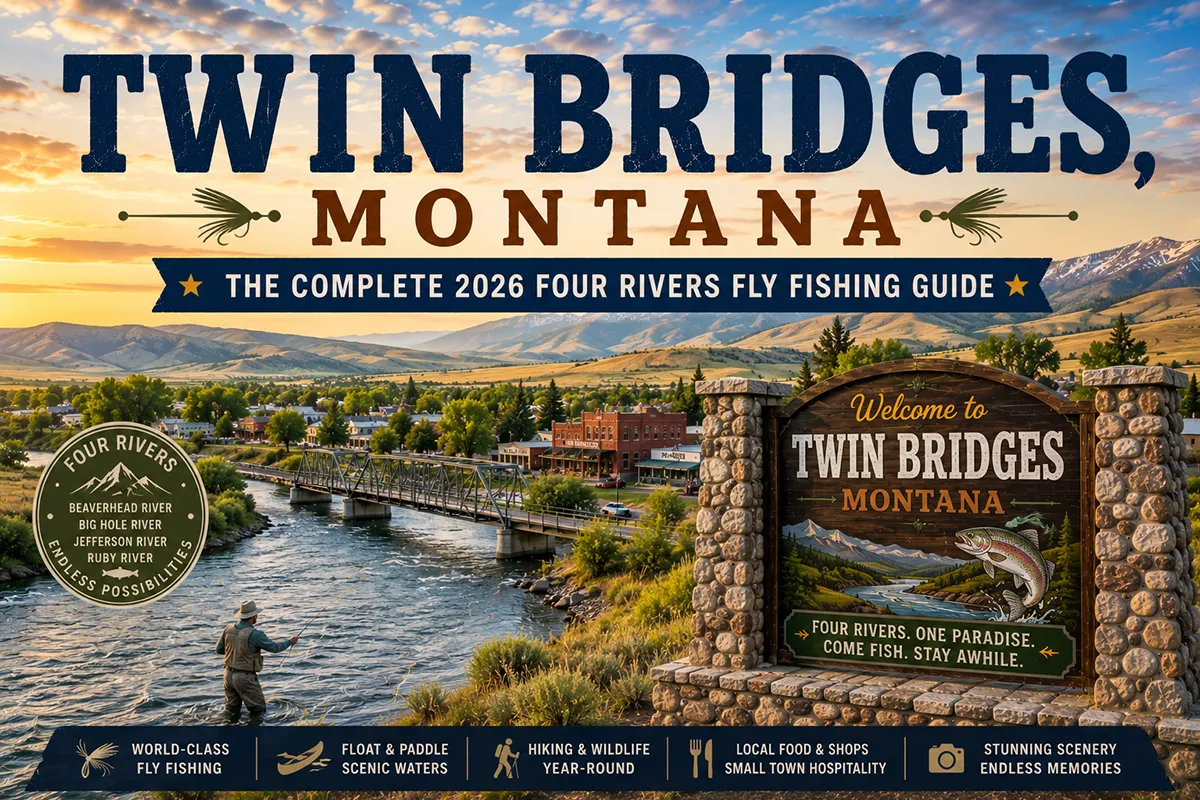
Lewis and Clark called the three rivers that formed the Jefferson by the names of their president’s cardinal virtues — Philosophy, Philanthropy, and Wisdom.
Those names didn’t stick. Later settlers renamed them the Big Hole, the Ruby, and the Beaverhead. Together with the Jefferson they form, at Twin Bridges, the most concentrated Blue Ribbon trout fishing confluence in Montana.
A town of 380 people sits in the middle of it, home to one of the most respected fly rod manufacturers in the world. The fishing is not a tourism pitch. It’s the actual reason the town exists.
TL;DR
- Twin Bridges (~380) sits where the Big Hole, Beaverhead, and Ruby Rivers converge to form the Jefferson River — four Blue Ribbon trout streams in one small valley.
- Home to R.L. Winston Rod Company, world-famous makers of premium fly rods since 1929 — free factory tours weekdays at 11 a.m.
- Montana Mad Hatters makes handcrafted custom cowboy hats used by presidents and country music stars.
- Beaverhead Rock State Park (nearby) is where Sacajawea recognized her homeland in 1805.
- The Doncaster Round Barn — the birthplace area of Spokane, 1889 Kentucky Derby winner — is a compelling obscure Montana story.
- Best for: serious fly fishers, cycling tourists, Lewis & Clark trail travelers, and anyone who wants the fly fishing epicenter without Ennis prices.
Liked this article?
Add Roaming Montana as a preferred source so you see more of our articles and guides on Google.
Twin Bridges at a Glance
| Population (2020) | ~380 |
|---|---|
| County | Madison County |
| Region | Southwest Montana |
| Elevation | 4,626 ft |
| Distance to Dillon | ~26 miles south (~30 min) |
| Distance to Virginia City | ~20 miles east (~25 min) |
| Distance to Bozeman | ~85 miles via US-287 (~1.5 hours) |
| Distance to Yellowstone West Entrance | ~90 miles (~1.75 hours) |
| Best for | Fly fishing, R.L. Winston factory tour, cycling, Lewis & Clark history |
What Makes Twin Bridges Different
When Meriwether Lewis stood at this confluence in July 1805 and named the three rivers feeding the Jefferson, he was trying to honor the intellectual virtues of the president who’d funded the expedition.
The settlers who came later were more practical — they named them for geography. But the rivers themselves haven’t changed: four Blue Ribbon trout streams in a single compact valley, each with its own character.
The Beaverhead, Big Hole, Ruby, and Jefferson rivers meet at Twin Bridges, making it a mecca for fly fishers, and it’s home to the world-famous R.L. Winston Rod Company.
The R.L. Winston fly rod factory offers tours beginning at 11 a.m., Monday through Friday — an extraordinary opportunity to watch premium fly rods being assembled by hand in a working factory setting. This is the single most distinctive experience in Twin Bridges for travelers.
The deeper story most SERP competitors miss: The Doncaster Round Barn. In 1889, a horse named Spokane won the Kentucky Derby. Spokane was bred in Madison County near Twin Bridges at the Doncaster Stock Farm.
A round barn — built in 1880 to house the stock farm’s horses — still stands near Twin Bridges and is listed on the National Register of Historic Places. Montana producing a Kentucky Derby winner in 1889 is the kind of story that deserves more than a footnote.
For broader trip context, see my Montana cities and towns hub.
The Top 10 Things to Do In & Around Twin Bridges
1. R.L. Winston Rod Company Factory Tour
The R.L. Winston fly rod factory offers tours beginning at 11 a.m., Monday through Friday. Founded in 1929 and based in Twin Bridges since 1976, Winston is one of the most respected fly rod makers in the world — their graphite, fiberglass, and bamboo rods are fished everywhere from the Madison to New Zealand. The tour shows the complete hand-assembly process. Free. Plan 45 minutes.
2. Fly Fish the Four Rivers
Four distinct fishing experiences within a few miles of each other:
- Beaverhead River: Technical spring-creek character, large wild browns, pressure from serious anglers
- Big Hole River: Classic freestone river, legendary salmonfly hatch (late May–early June), wild browns and rainbows
- Ruby River: Smaller, more intimate, excellent cutthroat
- Jefferson River: Wide, slower, good for floaters
Four Rivers Fishing Company on Main Street is the local outfitter for guide trips on all four.
3. Montana Mad Hatters
Sheila Kirkpatrick has made hats for the likes of George H.W. Bush and Hank Williams, Jr. Each hat is handmade and customized to meet the wearer’s needs. Custom cowboy hats made on-site — a genuine American craft tradition. Even if you don’t order a hat, watching the process is worth the visit.
4. Beaverhead Rock State Park
About 14 miles south of Twin Bridges on US-41. Its history dates back to 1805, when Lewis and Clark’s main expedition camped on the Beaverhead River at Beaverhead Rock, now a state park. The rock — a prominent sandstone formation — is where Sacajawea recognized her homeland and told Lewis they were near her Shoshone people’s territory. Day use only. Free.
5. The Doncaster Round Barn
A National Register–listed round barn from 1880, built at the Doncaster Stock Farm that bred Spokane — the 1889 Kentucky Derby winner. The only Kentucky Derby winner ever bred in Montana. The barn is viewable from the road.
6. Twin Bridges Historical Association Museum
The Twin Bridges Historical Museum has interesting history on the town’s mining, early exploration, military, and geological exhibits. Small but well-organized local museum covering Madison County’s ranching and mining heritage.
7. Bill White Bike Camp (Free Cyclists’ Campground)
Cyclists are thrilled to discover the free Bill White bike camp along the river. Twin Bridges is a significant waypoint on the Transamerica Bicycle Trail — a free dedicated campground with amenities for touring cyclists. One of the most cyclist-friendly communities in Montana.
8. Tobacco Root Mountains Hiking
The Tobacco Root Mountains rise to the east of Twin Bridges — generally less-visited than the Big Hole or Madison ranges, with excellent alpine lakes and trails. Mill Creek drainage above Sheridan is the most accessible.
9. “Floating Flotillas Fish Fantasy” River Parade
The Floating Flotillas Fish Fantasy river parade is sponsored by the Greater Ruby Valley Chamber of Commerce. An annual summer event in which decorated river floats parade down the river — one of Twin Bridges’ most distinctive community celebrations.
10. Day Trip to Virginia City / Nevada City (20 minutes)
Montana’s gold-rush ghost towns are just 20 minutes east — a natural pairing with any Twin Bridges visit. See Virginia City guide.
Where to Stay
| Hotel | Vibe | Price | Best For |
|---|---|---|---|
| Stardust Lodge | Local motel, clean | $90–140 | Most travelers |
| Fishing lodges (Ruby Valley) | Angler-focused | $200–450 | Dedicated fly fishers |
| Ruby River Reservoir area cabins | Remote, scenic | $150–300 | Couples, self-sufficient |
| Dillon hotels (26 min south) | Chain options | $120–180 | More variety |
| Bill White Bike Camp | Free cyclists’ campground | Free | Touring cyclists |
Where to Eat
- Twin Bridges Bar & Grill — the local gathering spot; reliable Montana bar food
- Old Hotel Restaurant — the town’s best sit-down meal
- Sheridan Bakery (Sheridan, 20 min) — worth the short drive for pastries
- Virginia City options (20 min east) — seasonal but worthwhile
Getting There
From Dillon: 26 miles north on US-41/MT-41, about 30 minutes.
From Bozeman: 85 miles via US-191 and US-287, about 1.5 hours.
From Butte: 55 miles via I-15 and US-41, about 1 hour.
When to Visit
Late May – early June: Big Hole River salmonfly hatch — the most dramatic dry fly event in Montana. Float the Big Hole during salmonfly for an unforgettable fishing experience.
June–August: Full summer season — all rivers fishing well, R.L. Winston tours running.
September: Brown trout fall run; excellent fishing with reduced pressure.
Year-round: R.L. Winston tours run weekdays year-round.
Personal Tips
Book the R.L. Winston tour ahead. Tours start at 11 a.m. weekdays — call or email ahead to confirm. Don’t miss it; this is the reason to stop in Twin Bridges even if you don’t fish.
The salmonfly hatch on the Big Hole is worth planning a trip around. Late May to early June — the largest stonefly in Montana hatches en masse on the Big Hole River near Twin Bridges. Trout feed recklessly on the surface. It’s one of North America’s great fly fishing events.
Montana Mad Hatters is the shop even non-hat-people love. Give it 30 minutes.
Cycling tourists: this is your town. Free campground, flat river valley, friendly community.
Combine with Virginia City and Dillon. The MT-41 corridor — Twin Bridges, Virginia City, Dillon, Bannack — is one of Montana’s best full-day history-plus-fishing routes.
Twin Bridges Quick Facts
| Founded | 1867 (Lott brothers’ bridges) |
|---|---|
| Named for | Two bridges built across the Beaverhead and Big Hole rivers |
| R.L. Winston | Making fly rods since 1929; Twin Bridges since 1976 |
| Kentucky Derby connection | Spokane (1889 winner) bred at Doncaster Stock Farm nearby |
| Average summer high | 82°F |
| Average winter low | 12°F |
Conclusion
Twin Bridges is the most concentrated Blue Ribbon trout fishing geography in Montana — four rivers within walking distance of each other, a world-class rod manufacturer who’ll show you how their product is built, and a custom hat maker who’s dressed presidents and country stars. For fly fishers it’s a pilgrimage; for everyone else it’s a compelling 3-hour stop that most Montana travelers drive right past.
Have a Twin Bridges question? Drop it in the comments — I read every one.
Frequently Asked Questions
Is Twin Bridges Montana worth visiting?
Yes — Twin Bridges is worth visiting both for fly fishers (the confluence of four Blue Ribbon trout streams makes it arguably Montana’s fly fishing epicenter) and for general travelers (the R.L. Winston Rod Company factory tour, Montana Mad Hatters, and the Doncaster Round Barn make it genuinely distinctive). The free R.L. Winston tour alone is worth the detour.
What is R.L. Winston Rod Company?
R.L. Winston Rod Company is one of the world’s most respected manufacturers of premium fly fishing rods, founded in 1929 and based in Twin Bridges since 1976. The company makes graphite, fiberglass, and bamboo rods entirely by hand. Free factory tours showing the complete rod-building process run weekdays at 11 a.m.
What rivers meet at Twin Bridges?
The Big Hole River, Beaverhead River, and Ruby River all converge near Twin Bridges to form the Jefferson River — four Blue Ribbon trout streams in a single compact valley. This concentration of high-quality wild trout water makes Twin Bridges one of the most significant fly fishing communities in the American West.
What is the Big Hole salmonfly hatch near Twin Bridges?
The salmonfly hatch on the Big Hole River (late May to early June) is one of the most celebrated fly fishing events in North America. Giant stoneflies (salmonflies) hatch in massive numbers, and large trout feed aggressively on the surface for 1–2 weeks. Guides are booked months in advance for this window.
Did Twin Bridges produce a Kentucky Derby winner?
Yes — Spokane, the 1889 Kentucky Derby winner, was bred at the Doncaster Stock Farm near Twin Bridges. The farm’s round barn (built 1880) is still standing and listed on the National Register of Historic Places. Spokane is the only Kentucky Derby winner ever bred in Montana.