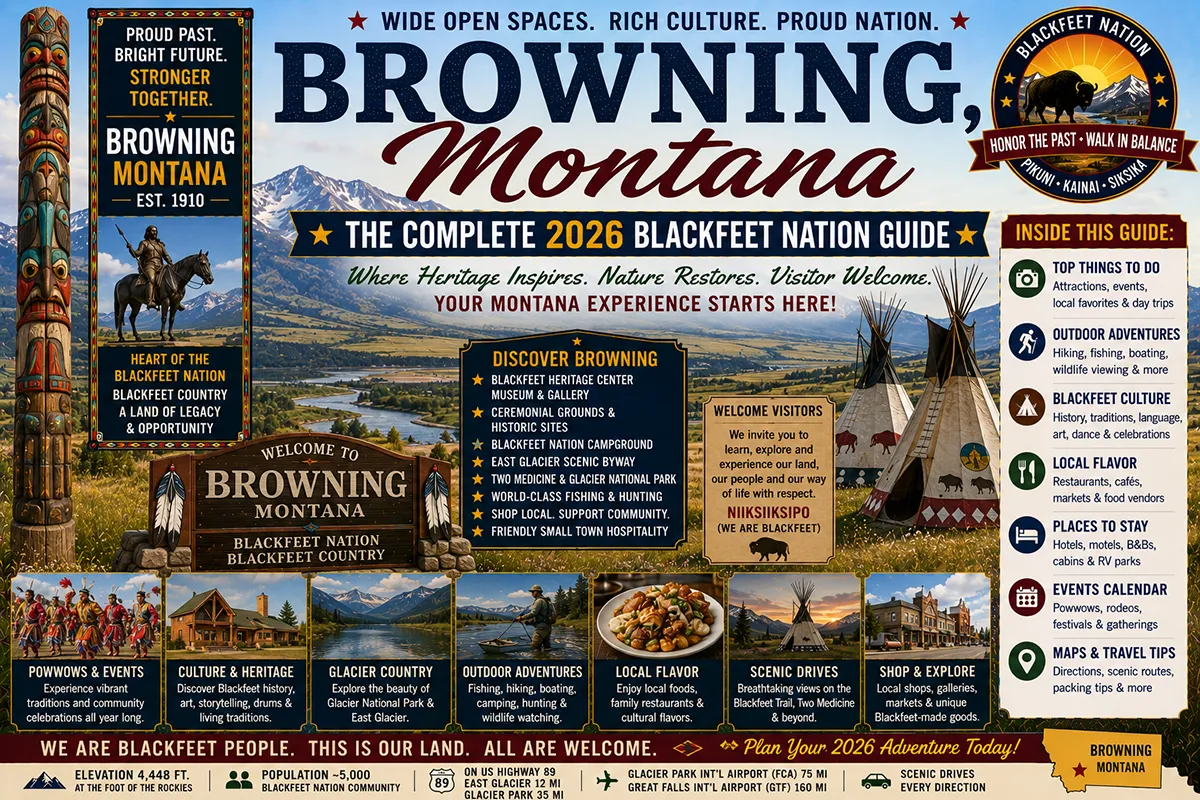
Browning sits on the eastern edge of the Rocky Mountain Front, in the center of the Blackfeet Reservation — and the view west from town is one of the most dramatic in Montana.
The mountains don’t rise gradually here; they erupt from the plains in a wall of limestone, sometimes visible from 60 miles east.
The Blackfeet call this region the “Backbone of the World.” For thousands of years before Glacier National Park was created, this was simply where they lived.
TL;DR
- Browning (~8,600) is the capital of the Blackfeet Nation — one of the largest Native American reservations in the U.S. — and the largest community near Glacier National Park’s East Entrance.
- Museum of the Plains Indian is the finest Plains Indian art and culture museum in Montana — genuinely world-class collection.
- North American Indian Days (second week of July) is one of the most significant Native American cultural gatherings in North America — four days of traditional dance, drumming, and Blackfeet celebration.
- Glacier National Park’s East Entrance (St. Mary and Many Glacier) is accessible from Browning.
- Two Medicine area of Glacier is the closest and least-crowded of the park’s major valleys.
- Visitor protocol: Browning is a sovereign Blackfeet Nation community. Approach with genuine respect.
Liked this article?
Add Roaming Montana as a preferred source so you see more of our articles and guides on Google.
Browning at a Glance
| Population (2020) | ~8,600 |
|---|---|
| Tribe | Blackfeet Nation (Niitsitapi) |
| County | Glacier County |
| Region | Northwest Montana |
| Distance to Glacier East Entrance (St. Mary) | ~30 miles (~35 min) |
| Distance to Many Glacier | ~45 miles (~55 min) |
| Distance to Great Falls | ~115 miles (~2 hours) |
| Best for | Blackfeet Nation culture, Museum of the Plains Indian, Glacier East side, North American Indian Days |
What Makes Browning Different
The Blackfeet Nation (Niitsitapi, meaning “the real people”) has lived on the eastern Rocky Mountain Front for centuries. The Blackfeet controlled the Northern Plains in the 18th and 19th centuries — one of the most powerful and militarily formidable nations on the continent.
The reservation established in 1888 represents a fraction of their traditional territory, but the relationship to the land — particularly to the mountains to the west — remains deep and ongoing.
Browning is a working reservation community. It experiences significant poverty, which shapes the visitor experience in ways that differ from Montana’s resort towns.
The cultural institutions here — the Museum of the Plains Indian, the tribal college, the annual powwow — are all expressions of cultural persistence that deserve respect.
The east side of Glacier National Park — including St. Mary, Many Glacier, Two Medicine, and the spectacular Going-to-the-Sun Road from the east — is accessible from Browning and is substantially less crowded than the west side.
For broader trip context, see my Montana cities and towns hub and the Going-to-the-Sun Road guide for Glacier strategy.
The Top 10 Things to Do In & Around Browning
1. Museum of the Plains Indian
The finest Plains Indian art and culture museum in Montana — operated by the U.S. government in cooperation with the Blackfeet Tribe. The permanent collection includes historic Blackfeet dress, weapons, tools, and ceremonial objects alongside rotating contemporary Native American art. One of the most important Native American museums in the Mountain West. Free in winter; modest admission in summer.
2. North American Indian Days (Second Week of July)
Four days of traditional Blackfeet celebration — intertribal dance competitions (traditional, fancy, grass, jingle dress), drumming, giveaways, stick games, and community events. One of the most significant Native American gatherings in North America, drawing participants from tribes across the continent. Open to respectful public visitors. Photography protocol: ask before photographing dancers or ceremonies.
3. Glacier National Park — East Entrance & St. Mary
30 miles west of Browning, St. Mary is the eastern end of Going-to-the-Sun Road. The east side has a distinctly different character from the west — drier, windier, with broader glaciated valleys and a prairie-to-mountain transition that’s equally spectacular. See the Going-to-the-Sun Road guide.
4. Many Glacier Valley
45 miles northwest of Browning, Many Glacier is widely considered the most scenically dramatic valley in Glacier National Park — Swiftcurrent Lake backed by multiple glacier-carved peaks. The Swiftcurrent Nature Trail (2.5 miles) and hike to Grinnell Glacier are accessible from the Many Glacier Hotel area.
5. Two Medicine Valley (Glacier, 25 miles south)
The closest Glacier valley to Browning and the least-crowded major valley in the park. Two Medicine Lake, Running Eagle Falls (a cave falls visible only at certain water levels), and the surrounding backcountry are exceptional and dramatically underutilized.
6. Blackfeet Community College
The tribal college in Browning — a center of Blackfeet cultural education and language preservation. The Blackfeet language program is among the most active Indigenous language revitalization efforts in Montana.
7. Blackfeet Cultural Tours
Browning-based cultural tour operators offer guided experiences of Blackfeet history, landscape, and traditional knowledge on reservation lands. These tours provide access and context unavailable at any museum. Inquire at the tribe’s tourism office.
8. Drive the Going-to-the-Sun Road from the East
Begin at St. Mary and drive west toward Logan Pass. The east-side perspective — rising from the plains into the mountains — is a genuinely different experience from the west-side drive and arguably more dramatic in its initial ascent.
9. Rocky Mountain Front Scenic Drive (US-89 South)
US-89 south from Browning to Choteau follows the Rocky Mountain Front — 60 miles of dramatic mountain-meets-plains scenery through the Blackfeet and agricultural communities of Glacier County.
10. Heart Butte (South on Reservation)
A small community deep in the Blackfeet Reservation, Heart Butte offers a different view of the Front Range and a quieter, more traditional community character than Browning.
Where to Stay
| Hotel | Vibe | Price | Best For |
|---|---|---|---|
| War Bonnet Inn | Basic motel, reliable | $100–160 | Most travelers |
| Glacier Peaks Hotel | Functional, central | $95–150 | Budget travelers |
| Many Glacier Hotel (inside Glacier NP) | Historic park lodge | $250–450 | Glacier-focused splurge |
| St. Mary / East Glacier (lodges) | Park adjacent | $150–300 | East Glacier access |
| Cut Bank (25 min east) | Basic motels | $80–130 | Budget |
Where to Eat
- Junction Café — best reliable option in Browning
- TakeBack Sandwich — local lunch
- Various reservation businesses — limited options; stock up in Cut Bank or Wheatland before extended stays
Getting There
From Great Falls: 115 miles northwest on US-89, about 2 hours — through the Blackfeet Reservation’s eastern prairie.
From Cut Bank: 25 miles west on US-2, about 25 minutes.
From Glacier West Entrance: Drive over Going-to-the-Sun Road to St. Mary, then east to Browning — about 1.5 hours.
From Shelby: 45 miles south on US-89.
Visitor Protocol
The Blackfeet Reservation is sovereign Blackfeet Nation territory. Visitors should:
- Ask before photographing any community members, ceremony, or cultural event
- Follow powwow etiquette — no photography without permission; treat dances as ceremony, not performance
- Respect posted access restrictions on reservation lands
- Purchase from Blackfeet-owned businesses when possible
- Approach cultural programs with genuine curiosity, not tourism-checklist mentality
What Browning Unlocks
Glacier National Park East Side (30 min)
St. Mary, Many Glacier, Two Medicine, Going-to-the-Sun Road east approach.
Choteau & Rocky Mountain Front (1 hour south)
Egg Mountain, Freezout Lake, Bob Marshall Wilderness access. See Choteau guide.
Havre (2 hours east)
Hi-Line’s largest city. See Havre guide.
Great Falls (2 hours south)
C.M. Russell Museum, Lewis & Clark Interpretive Center. See Great Falls guide.
When to Visit
Second Week of July — North American Indian Days. The primary cultural reason to visit.
Summer (June–August) — Glacier National Park east side full access, Museum of the Plains Indian open with full hours.
Fall (September–October) — Glacier dramatic fall colors; fewer crowds on the east side.
Winter — Museum open (free in winter); cold and quiet on the reservation.
Personal Tips
North American Indian Days is extraordinary. Plan your trip around it if possible. The dance competitions and drumming are world-class cultural events rarely witnessed by non-Indigenous visitors.
Museum of the Plains Indian is undervisited. More people should know about this collection. The quality exceeds what visitors expect from a small-city museum.
East Glacier access is the real value. Many Glacier and Two Medicine are dramatically less crowded than the west side and equally beautiful. Use Browning as an eastern Glacier base.
The drive from Great Falls on US-89 is spectacular. The approach to the Front from the south — watching the mountains grow from a hint on the horizon to a wall above you — is one of Montana’s great drives.
Browning Quick Facts
| Founded | 1895 (as a trading center) | | Reservation established | 1888 | | Blackfeet Nation | One of the largest reservations in the U.S. (~1.5 million acres) | | North American Indian Days | Since 1952 | | Average summer high | 76°F | | Average winter low | 4°F |
Conclusion
Browning rewards visitors who come with genuine respect and curiosity. The Museum of the Plains Indian is one of Montana’s finest cultural institutions. North American Indian Days is one of the most significant Indigenous cultural events in North America. And the access it provides to Glacier’s spectacular, less-visited east side makes it a more complete Glacier gateway than most travelers realize.
Frequently Asked Questions
Is Browning Montana worth visiting?
Yes — Browning is worth visiting for the Museum of the Plains Indian (one of the finest Plains Indian culture museums in the Mountain West), North American Indian Days (second week of July, one of the most significant Native American gatherings in North America), and as the most practical gateway to Glacier National Park’s east side (St. Mary, Many Glacier, Two Medicine). Approach with respect for Blackfeet Nation sovereignty.
What is the Museum of the Plains Indian in Browning?
The Museum of the Plains Indian is operated by the U.S. government in cooperation with the Blackfeet Tribe in Browning. The permanent collection includes historic Blackfeet dress, weapons, tools, and ceremonial objects, alongside rotating contemporary Native American art exhibitions. It’s one of the most important Plains Indian cultural museums in the Mountain West. Free in winter; modest admission May through September.
What is North American Indian Days?
North American Indian Days is a four-day intertribal celebration held in Browning every second week of July, organized by the Blackfeet Nation. It includes traditional dance competitions (drawing participants from tribes across North America), drumming, stick games, giveaways, and community events. It’s one of the most significant Native American cultural gatherings in the United States, open to respectful public visitors.
How far is Browning from Glacier National Park?
Browning is approximately 30 miles from Glacier National Park’s East Entrance at St. Mary — about a 35-minute drive west on US-89. Many Glacier is an additional 15 miles (45 min total); Two Medicine is about 25 miles south of Browning.