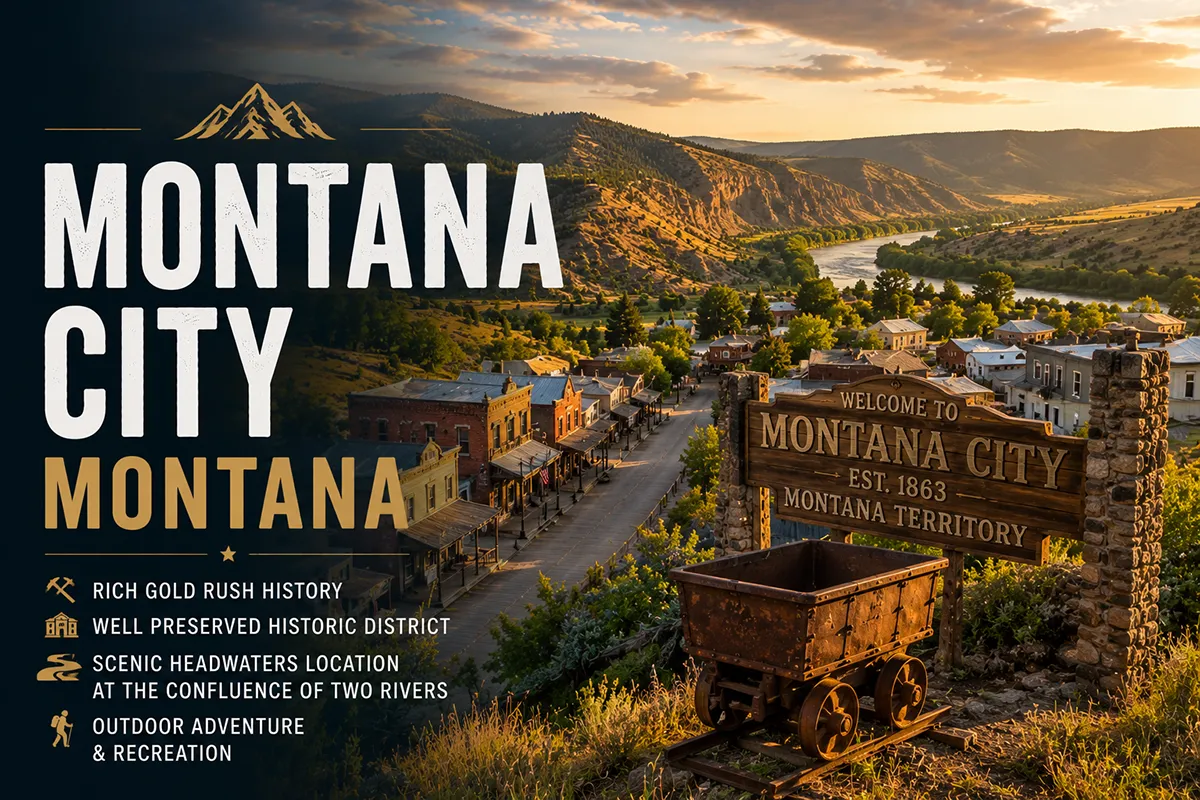
When the Montana Town Company formally laid out the new community in October 1864, they faced a substantial question: what to name it?
The decision was substantively obvious.
Just five months earlier — on May 26, 1864 — the U.S. Congress had created Montana Territory. The new territory was the substantial political response to the booming gold rush settlements that had developed at Bannack (1862), Virginia City (1863), and Last Chance Gulch (also 1864 — the future site of Helena). The substantial new territory needed a substantial new town to anchor its identity.
The Montana Town Company decided to name their new town Montana City.
The substantial naming honor placed Montana City in the substantively unique position of being the Montana community named directly for the territory itself — and, after November 8, 1889, for the state itself. The naming was substantial.
Today, Montana City is an unincorporated community with approximately 2,800 residents sitting 6 miles south of Helena — the state capital. The community is located in the very northern tip of Jefferson County, immediately across the Helena-Jefferson County line.
Interstate 15 runs through the community. The substantial Jefferson Valley surrounding Montana City is flanked by the Tobacco Root Mountains and Highland Mountains to the south and west.
Substantively unusually for a contemporary Helena suburb, Montana City sits atop one of the oldest prehistoric paleoindian archaeological sites in the state of Montana — substantial evidence that the area was occupied by Indigenous peoples thousands of years before European-American contact.
TL;DR
- Montana City (~2,800) is an unincorporated CDP in the northern tip of Jefferson County, 6 miles south of Helena along Interstate 15.
- The community was founded in October 1864 by the Montana Town Company and named directly for the newly designated Montana Territory itself.
- Montana City sits atop one of the oldest prehistoric paleoindian archaeological sites in Montana — substantial pre-contact Indigenous heritage.
- First gold prospectors arrived in summer 1862; the Lower Prickly Pear Mining District was established to govern the area in 1864.
- By 1868, placer mines were proving less profitable — Chinese miners moved in to substantially rework the claims.
- A substantial railroad arrival in 1887 — the Helena and Wickes Railroad and a Great Northern Railway branch line — produced a brief revival.
- In the late 1940s, industrialist Henry J. Kaiser built a substantial cement plant for Permanente Cement Company east of the original town, leveraging proximity to an Anaconda Company lime quarry.
- A new Montana City began to grow in the 1960s, with the community substantially developing into a flourishing bedroom suburb for Helena.
- Elevation 4,053 ft, in the Jefferson Valley beneath the Tobacco Root and Highland Mountains.
- Best for: Helena area travelers, I-15 corridor stops, mining heritage exploration, Helena gold-rush-era history.
Liked this article?
Add Roaming Montana as a preferred source so you see more of our articles and guides on Google.
Montana City at a Glance
| Population (estimated) | ~2,800 |
|---|---|
| County | Jefferson County (northern tip) |
| Status | Unincorporated CDP |
| Region | Southwest Montana (Jefferson Valley) |
| Elevation | 4,053 ft |
| Distance to Helena (state capital) | ~6 miles north |
| Distance to Clancy | ~3 miles south |
| Distance to Jefferson City | ~8-10 miles south |
| Distance to Boulder (Jefferson County seat) | ~20 miles south |
| Distance to East Helena | ~5 miles northeast |
| Distance to Butte | ~60 miles south |
| Highway access | I-15 |
| Surrounding mountains | Tobacco Root Mountains, Highland Mountains |
| Founded | October 1864 (Montana Town Company) |
| Best for | Helena suburbs, I-15 mining heritage, paleoindian heritage |
What Makes Montana City Different
Three distinct stories define Montana City’s character: the paleoindian heritage, the territorial-era founding, and the Henry Kaiser cement-plant era.
The Paleoindian Heritage
The location that became Montana City has been substantially significant for thousands of years.
The community sits atop one of the oldest prehistoric paleoindian archaeological sites in the state of Montana — substantial evidence that Indigenous peoples occupied the area as far back as the Paleoindian period (roughly 13,000-7,500 BCE).
The Jefferson Valley provided substantial resources for early hunters and gatherers: substantial game animals, reliable water from Prickly Pear Creek, and accessible mountain passes leading to the broader Missouri River drainage to the north and the Madison-Gallatin-Jefferson river system to the south.
Subsequent Indigenous occupation — by ancestors of the contemporary Salish, Pend d’Oreille, Shoshone, Crow, and Blackfeet peoples — continued for thousands of years before European-American contact.
The substantial paleoindian heritage of Montana City is not generally recognized by casual visitors. Most who drive through on I-15 see only the contemporary suburban-commercial character. The substantially deep human history under the surface remains largely invisible.
The 1862 Gold Rush
The first European-American activity in the Montana City area dates to summer 1862 — when the first gold prospectors arrived in the broader Prickly Pear Creek drainage.
Gold had been discovered at Bannack (south-central Montana, then part of Idaho Territory) in July 1862. The strike triggered substantial migration of prospectors throughout the broader region.
By the substantial summer of 1862, prospectors had spread north into what would become Jefferson County, searching for substantial new gold deposits along Prickly Pear Creek and its tributaries.
In 1864, two substantial events shaped the area:
- May 26, 1864: U.S. Congress created Montana Territory, separating the substantial gold-rush region from the previous Idaho Territory.
- July 14, 1864: Four substantial prospectors — John Cowan, John Crab, D. J. Miller, and Reginald Stanley — struck gold at Last Chance Gulch (the future Helena), substantially triggering the Helena-area gold rush.
The substantial new gold activity required substantial new town infrastructure. The Montana Town Company — one of multiple competing land-development companies operating in the territory in 1864 — laid out Montana City in October 1864.
The Lower Prickly Pear Mining District
Substantial governance of the area required substantial new legal infrastructure.
The Lower Prickly Pear Mining District was established in 1864 to substantially govern the area. The substantial district produced placer gold for several years, with substantial activity along Prickly Pear Creek and its substantial tributaries.
By 1868, the placer mines were proving substantially less profitable. Most of the substantial easily-accessible gold had been recovered. Many of the original European-American prospectors moved on to other camps.
Chinese Miners
A substantial subsequent chapter of Montana City history involves Chinese miners who moved into the area starting in the late 1860s and 1870s.
The Chinese miners substantially reworked claims that European-American miners had abandoned — using substantial labor-intensive techniques that could extract residual gold from substantially low-grade tailings.
The Chinese community at Montana City and the broader Lower Prickly Pear Mining District was substantial.
The substantial Chinese presence in Montana mining communities of this era is a substantially under-documented chapter of broader American history.
Substantial racial discrimination — including the 1882 Chinese Exclusion Act and substantial local legal restrictions — substantially constrained Chinese miners’ rights.
Despite these substantial barriers, Chinese miners produced substantial gold from substantially reworked claims throughout the broader Helena area.
The 1887 Railroad Revival
In 1887, Montana City experienced a substantial brief revival.
The Helena and Wickes Railroad — a substantial narrow-gauge line connecting Helena to the substantial silver-mining camp at Wickes (approximately 25 miles south of present-day Montana City) — was completed in 1887. A Great Northern Railway branch line also reached the area. The Montana City post office was established the same year.
The substantial railroad-era revival was brief. Most of the substantial mining activity had moved further south to substantial larger camps. By the 1890s, Montana City had substantially contracted again.
The 1940s Henry Kaiser Cement Plant
The most substantively important 20th-century chapter of Montana City’s history began in the late 1940s.
Henry J. Kaiser — the substantial American industrialist who had built Liberty Ships during World War II, founded Kaiser Permanente Health, and established Kaiser Aluminum — built a substantial cement plant for the Permanente Cement Company just east of what remained of Montana City.
The substantial location was chosen because of its proximity to an Anaconda Company lime quarry that provided substantial limestone — the primary raw material for cement production.
The substantial Kaiser cement plant operated for decades, providing substantial industrial employment for the broader Helena area. The plant’s substantial presence substantially shaped the contemporary character of Montana City and surrounding country.
The 1960s Suburban Revival
A substantial new Montana City began to grow in the 1960s.
The substantial Montana state capital at Helena — combined with substantial post-war suburban development trends across the United States — drove substantial residential growth in the Jefferson Valley immediately south of Helena.
Montana City emerged as a substantial bedroom suburb of Helena, with substantial new residential development substantially extending into the broader Jefferson Valley.
The contemporary Montana City reflects this substantial 1960s-and-later residential growth. The substantial historic character of the original 1864 mining-era town is substantially less visible than the contemporary suburban-residential character.
For broader trip context, see my Montana cities and towns hub, Montana gold rush overview, and key historical events in Montana.
The Top 6 Things to Do In & Around Montana City
1. Day Trip to Helena (6 miles north)
The Montana state capital and the natural urban anchor for any Montana City visit.
Attractions include the substantial Montana State Capitol Building, the Cathedral of St. Helena, the Helena Brewery district, Last Chance Gulch historic district (where the substantial 1864 gold strike occurred — the same year Montana City was founded), and the substantial Montana Historical Society Museum. See best things to do in Helena and breweries in Helena for detailed planning.
2. I-15 Mining Heritage Corridor
The substantial drive south from Montana City through Clancy, Jefferson City, and Boulder crosses substantively important Montana mining heritage country.
Multiple substantial ghost towns and historic mining sites along the corridor — including Wickes (former end of the substantial Helena and Wickes Railroad), Comet, Elkhorn (one of the most substantively well-preserved Montana mining ghost towns), and the broader Lower Prickly Pear Mining District heritage.
3. Day Trip to Butte (60 miles south)
The substantial historic mining metropolis on I-15.
Attractions include the substantial Berkeley Pit (the substantial open-pit copper mine), the World Museum of Mining, the Mai Wah Museum (substantially documenting Chinese-American heritage in Montana, including the Lower Prickly Pear context), and substantial restaurants. See things to do in Butte for detailed planning.
4. Boulder Hot Springs Day Trip (20 miles south)
The substantial Boulder Hot Springs Inn (NRHP-listed Spanish Revival) in Boulder provides substantial hot springs recreation.
See best natural hot springs in Montana and Montana hot springs for broader context.
5. Tobacco Root Mountains & Highland Mountains
The substantial mountains immediately south and west of Montana City provide substantial outdoor recreation including hiking, fishing, hunting, and dispersed camping.
The Tobacco Root Mountains are particularly substantial — featuring substantial granite peaks, alpine lakes, and substantial mining-era heritage scattered throughout the range.
6. East Helena & Helena Industrial Heritage
The substantial East Helena community (~5 miles northeast of Montana City) features substantial industrial heritage including the substantial 1888 East Helena Smelter site (operated until 2001) and broader industrial-era history.
Where to Stay
Montana City has limited dedicated lodging.
Most travelers base in Helena (6 miles north) or in nearby Clancy or Jefferson City (just south).
| Lodging | Vibe | Price | Best For |
|---|---|---|---|
| Helena hotels (10 min N) | State capital | $130–280 | Most travelers |
| Boulder lodging (25 min S) | Boulder Hot Springs Inn | $130–280 | Hot springs visitors |
| Butte options (1 hr S) | Historic mining metropolis | $110–220 | Extended I-15 travel |
| Vacation rentals (Montana City) | Helena-suburb character | $130–280 | Families, longer stays |
Where to Eat
- Local Montana City options — small selection along I-15; verify current operations
- Helena dining (10 min N) — extensive variety; see breweries in Helena
- Clancy options (5 min S) — small-town selection
- Boulder restaurants (20 min S) — Jefferson County seat
Getting There & Around
From Helena: ~6 miles south on I-15, about 10 minutes.
From Clancy: ~3 miles north on I-15, about 5 minutes.
From Jefferson City: ~8-10 miles north on I-15, about 12 minutes.
From Boulder: ~20 miles north on I-15, about 25 minutes.
From Butte: ~60 miles north on I-15, about 1 hour.
Cell service: Excellent throughout Montana City and along I-15.
When to Visit
Summer (June-August): Best weather; substantial Tobacco Root and Highland Mountains access; warmest temperatures.
Fall (September-October): Outstanding southwestern Montana fall color; cooler temperatures; quieter; substantial accessibility for the broader mining ghost town exploration.
Winter (December-March): Severe Montana weather; some access limited; Boulder Hot Springs particularly substantive in winter.
Spring (April-May): Snowmelt; the country greens up; quieter shoulder season.
Personal Tips
Read about the October 1864 founding. Understanding that Montana City was substantially named for the newly designated Montana Territory itself — and was founded just five months after the May 26, 1864 Congressional act that created the territory — adds substantial historical depth to a visit. Few Montana communities have substantially closer naming ties to the territorial-state identity.
Note the paleoindian heritage. Montana City sits atop substantially one of the oldest prehistoric paleoindian archaeological sites in the state. While the substantial deep heritage isn’t visible to casual visitors, recognizing it substantially deepens any visit.
Read about Henry J. Kaiser. Understanding that the substantial late-1940s Permanente Cement Company plant was a substantial Henry J. Kaiser enterprise — the same substantial American industrialist who built Liberty Ships during WWII, founded Kaiser Permanente Health, and established Kaiser Aluminum — adds substantial 20th-century industrial history depth.
Combine with the broader I-15 mining heritage. A morning in Helena, an afternoon at the Wickes/Comet/Elkhorn ghost towns, and an evening dinner in Boulder — with Montana City as the operational base — makes a substantively meaningful southwestern Montana mining heritage day.
Don’t expect a substantial historic downtown. Montana City is substantially more visible as a contemporary suburban-residential community than as a historic mining-era town. The substantial historical heritage is largely subsurface; the substantial visual character is contemporary suburban.
Use Montana City as an I-15 base. The community’s position immediately south of Helena on I-15 makes it substantively practical as a quiet base for travelers exploring the broader Helena–Butte mining corridor.
Montana City Quick Facts
- Population (estimated) | ~2,800
- County | Jefferson County (northern tip)
- Elevation | 4,053 ft | | Founded | October 1864
- Founded by | Montana Town Company
- Named after | Montana Territory (created May 26, 1864)
- First gold prospectors arrived | Summer 1862
- Lower Prickly Pear Mining District established | 1864
- Placer mines decline | 1868
- Chinese miners’ arrival | Late 1860s-1870s
- Helena and Wickes Railroad | Reached area 1887
- Great Northern branch line | 1887
- Post office established | 1887
- Henry Kaiser cement plant built | Late 1940s
- Cement plant company | Permanente Cement Company
- Adjacent industrial | Anaconda Company lime quarry
- Suburban revival began | 1960s
- Distance to Helena | 6 miles
- Distance to Butte | 60 miles
- Surrounding mountains | Tobacco Root + Highland
- Adjacent Jefferson County communities | Clancy, Jefferson City, Boulder
- Average summer high | 81°F
- Average winter low | 13°F
Conclusion
Montana City is a 2,800-resident unincorporated community with substantially unique territorial-era heritage and a substantial contemporary role as a Helena suburb.
The substantial October 1864 founding by the Montana Town Company. The substantial direct naming for Montana Territory itself. The substantial paleoindian heritage extending back thousands of years. The substantial Lower Prickly Pear Mining District era.
The substantial Chinese miners chapter starting in the late 1860s. The substantial 1887 Helena and Wickes Railroad brief revival. The substantial late-1940s Henry Kaiser Permanente Cement plant. The substantial 1960s-and-later suburban revival that has produced the contemporary community.
The next time you’re driving I-15 between Helena and Butte, look for the Montana City exit. The community you’ll find is substantially modest — but it carries the substantial name of the entire state, and the substantial layers of Indigenous, mining, railroad, industrial, and suburban heritage that have substantially shaped Montana itself.
Have a Montana City question? Drop it in the comments — I read every one.
Frequently Asked Questions
Is Montana City Montana worth visiting?
Montana City is worth a stop primarily for the substantial territorial-era heritage (founded October 1864 and named directly for the newly designated Montana Territory), the substantial Lower Prickly Pear Mining District history, the substantial late-1940s Henry Kaiser Permanente Cement industrial heritage, and as a substantively practical base for exploring the broader Helena area and the I-15 mining heritage corridor between Helena and Butte. The community itself is substantially modest in size and character — but the historical layers are substantively interesting.
Why is Montana City named that?
Montana City was named directly for the Montana Territory itself. The Montana Town Company laid out the community in October 1864 — just five months after the U.S. Congress had created Montana Territory by Act of Congress on May 26, 1864. The substantial naming honor placed Montana City in the substantively unique position of being the Montana community named directly for the territory (and, after November 8, 1889 statehood, for the state) itself. Few Montana communities have substantially closer naming ties to the territorial-state identity.
Where is Montana City Montana located?
Montana City is located in the very northern tip of Jefferson County in southwest Montana — 6 miles south of Helena (the state capital) along Interstate 15. The community sits in the Jefferson Valley at 4,053 feet elevation, flanked by the Tobacco Root Mountains and Highland Mountains to the south and west. It is approximately 60 miles north of Butte on I-15.
How big is Montana City Montana?
Montana City has approximately 2,800 residents in the unincorporated CDP. The community has been growing substantially as a Helena suburb since the 1960s, with substantial new residential development continuing through the 2010s and 2020s. Montana City is one of the larger unincorporated communities in Jefferson County, substantially larger than nearby Clancy and Jefferson City.
What is the paleoindian heritage of Montana City?
Montana City sits atop one of the oldest prehistoric paleoindian archaeological sites in the state of Montana — substantial evidence that Indigenous peoples occupied the area as far back as the Paleoindian period (roughly 13,000-7,500 BCE). The substantial Jefferson Valley provided substantial resources for early hunters and gatherers: substantial game animals, reliable water from Prickly Pear Creek, and accessible mountain passes leading to the broader Missouri River drainage to the north and the Madison-Gallatin-Jefferson river system to the south. Subsequent Indigenous occupation continued for thousands of years before European-American contact. The substantial paleoindian heritage isn’t generally recognized by casual visitors but adds substantial depth to any understanding of the community.
Who was Henry Kaiser and why did he build a cement plant at Montana City?
Henry J. Kaiser (1882-1967) was one of the substantial American industrialists of the 20th century. He built Liberty Ships during World War II (more than 1,400 of them, substantially supporting the Allied war effort), founded Kaiser Permanente Health (now one of the substantial healthcare systems in the United States), established Kaiser Aluminum, and built substantial dams and infrastructure projects across the American West. In the late 1940s, Kaiser built a substantial cement plant for his Permanente Cement Company just east of Montana City. The substantial location was chosen because of its proximity to an Anaconda Company lime quarry that provided the substantial limestone raw material for cement production. The plant operated for decades, providing substantial industrial employment for the broader Helena area.
How far is Montana City from Helena Montana?
Montana City is approximately 6 miles south of Helena via Interstate 15 — about a 10-minute drive. Helena serves as the natural urban anchor for any Montana City visit, with full state-capital infrastructure including the Montana State Capitol Building, the Cathedral of St. Helena, the Last Chance Gulch historic district, substantial breweries in Helena, things to do in Helena, and broader services. The position immediately south of Helena makes Montana City substantively practical as a quiet base for travelers exploring the broader Helena area without staying in the larger city itself.