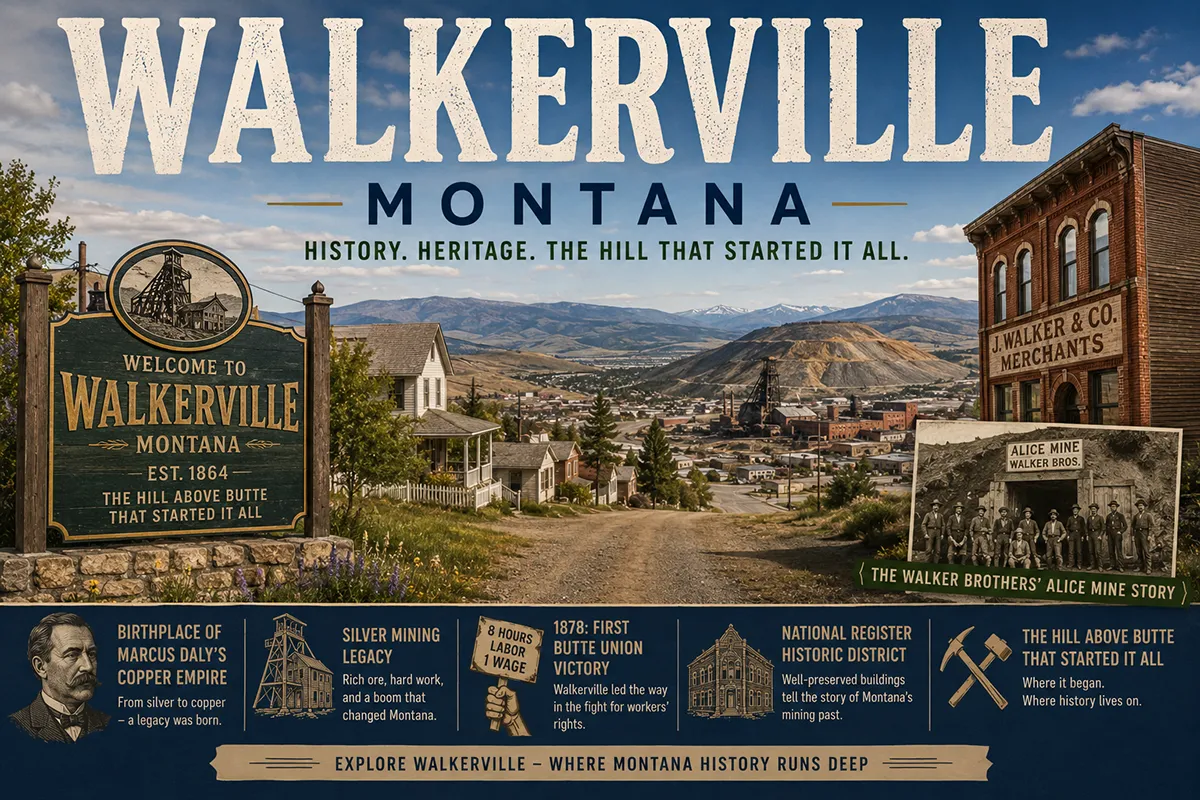
Stand on the corner of Daly Street and Main Street in Walkerville and you’re standing on the foundation of three of Montana’s largest fortunes. The Alice Mine, the Lexington, and the Moulton — three of the richest silver mines on the Butte Hill — were all here.
The men who owned and worked them included names that anyone who’s spent ten minutes reading Montana history will recognize: Marcus Daly, William A. Clark, A.J. Davis.
Daly didn’t just learn mining in Walkerville — he was Walker Brothers’ on-site agent who came up from Utah in 1876, looked at the Alice Claim that prospector Rollo Butcher had located the year before, recommended his employers buy it for $25,000, and proceeded to manage it as he built the technical expertise and capital that would let him purchase the Anaconda Mine four years later and become the most powerful of the three Copper Kings.
This is the actual birthplace of the Butte mining empire. Not Butte proper, three blocks downhill. Walkerville. The town that almost wasn’t called Walkerville at all — for a brief period in 1876, the area was known as Rainbow, because the Alice vein branched off from the older Rainbow lode that Professor John E. Clayton had identified earlier that year.
Had the naming gone slightly differently, Marcus Daly might have been the manager of a mine in Rainbeau, Montana, and one of the world’s great mining cities might have grown around it.
Today Walkerville is small — about 639 residents in roughly half a square mile clinging to the upper slope of the Butte Hill, surrounded on three sides by the modern Butte-Silver Bow consolidated city-county government but maintaining its own independent municipal status.
The town is part of the Butte-Anaconda National Historic Landmark District. Many of the buildings on Main Street date to the 1870s and 1880s. The Old Lexington Stamp Mill — site of Butte’s first smelter — is still here.
So is the kind of stubborn independent spirit that drove the community’s first union victory in 1878, when the Alice Mine and Mill Band paraded alongside 150 members of the newly formed Butte Workingmen’s Union to protest a wage cut from $3.50 to $3.00 a day. The Walkers backed down. Butte unionism started here.
TL;DR
- Walkerville (~639) sits on the north slope of the Butte Hill, an independent incorporated town within the boundaries of Butte-Silver Bow consolidated city-county.
- Named for the Walker Brothers — Joseph, Samuel Sharp, Matthew, and David — Salt Lake City bankers excommunicated from the Mormon Church who purchased the Alice silver mine from prospector Rollo Butcher in 1876 for $25,000.
- Marcus Daly worked here as the Walkers’ agent before launching his Anaconda copper empire in 1880 — Walkerville is the literal birthplace of Butte’s mining fortunes.
- Three of Butte’s richest silver mines — the Alice, Lexington, and Moulton — were all in Walkerville, seeding the fortunes of Daly, A.J. Davis, and William A. Clark.
- The 1878 Butte Workingmen’s Union victory at the Alice — restoring the wage cut from $3.00 back to $3.50 a day — was the first union victory in Butte’s storied labor history.
- Part of the Butte-Anaconda National Historic Landmark District; many Main Street buildings date to the 1870s-1880s.
- Best for: Butte mining-history travelers, historic streetscape photography, Copper King heritage seekers, and Butte-Anaconda NHL District completers.
Liked this article?
Add Roaming Montana as a preferred source so you see more of our articles and guides on Google.
Walkerville at a Glance
| Population (2020) | ~639 |
|---|---|
| County | Silver Bow County (Butte-Silver Bow consolidated) |
| Status | Incorporated town inside the consolidated city-county |
| Region | Southwest Montana |
| Elevation | ~6,180 ft (one of the highest incorporated towns in Montana) |
| Distance to downtown Butte | ~1 mile south (~5 min) |
| Distance to Anaconda | ~25 miles west (~30 min) |
| Distance to Helena | ~65 miles northeast (~1.25 hours) |
| Distance to Missoula | ~120 miles northwest (~2 hours) |
| Best for | Mining history, Butte-Anaconda NHL District, Copper King heritage |
What Makes Walkerville Different
The first thing to understand about Walkerville is its place in Butte’s geological story. Butte’s mineralization happened in distinct zones — silver dominated the early surface deposits on the north and west sides of the Hill, while the rich copper deposits were buried deeper and toward the south and east.
Walkerville sits squarely in the silver zone. The Alice Vein, the Rainbow lode, the Lexington, the Moulton, and the rich claims of the 1870s and early 1880s were all in or near Walkerville.
As the surface silver played out and the deep copper boom took over in the 1890s and 1900s, the center of Butte mining gravity shifted south and east, leaving Walkerville as the elder statesman neighborhood — the place where it all started, still occupied by miners’ descendants, still independent.
The Walker Brothers themselves deserve more attention than they usually get in travel content.
Joseph, Samuel Sharp, Matthew, and David Walker were prosperous Salt Lake City bankers who had been excommunicated from the LDS Church for various theological and political disagreements.
They had built their initial fortune at the Emma Mine in Alta, Utah, under the management of a young Irish-American foreman named Marcus Daly.
When Rollo Butcher’s discovery of the Alice silver vein on the Butte Hill filtered back to Salt Lake City in late 1875, the Walkers sent Daly north to investigate.
Daly recommended the purchase. The Walkers paid Butcher $25,000 in 1876 — money that would seem trivial when measured against the fortunes the Alice would generate.
Daly’s career trajectory from there is one of the most consequential in American mining history. He served as manager and eventually part-owner of the Alice.
He installed a 20-stamp mill, then expanded it to a 60-stamp mill that was reportedly the world’s largest dry crushing and chloridizing operation at the time.
By 1880, with his expertise and capital established, he sold his Alice interests and acquired the Anaconda Mine — the operation that would make him one of the three Copper Kings and a national political figure.
Daly Street in Walkerville is named for him. Walkerville’s main thoroughfare is still called Daly Street even though Daly himself departed for the south side of the Hill nearly 150 years ago.
The 1878 union victory at the Alice belongs in any serious Butte history. When the Walkers cut wages from $3.50 to $3.00 a day, the newly formed Butte Workingmen’s Union responded with a 150-member march on the Alice.
The Alice Mine and Mill Band — a company-sponsored ensemble — actually played in the protest, an extraordinary moment of company workers turning company resources against the company. The Walkers restored the $3.50 wage.
This was the first union victory in what would become one of America’s most consequential mining union movements; the Western Federation of Miners and later the Industrial Workers of the World would draw on this Butte tradition for decades. Walkerville earned its labor history before Butte proper had one.
The town was officially incorporated in 1890. The first mayor was William Hall, the Alice Mine’s superintendent, who proceeded to name several Walkerville streets after his children: William, Rose, Pearl, and Sibyl.
Some of those streets no longer exist; the 1955 expansion of the Alice into an open-pit operation (the Alice Pit) blasted away portions of Sibyl, Rose, and Pearl streets, making them unusable.
The Anaconda Company offered residents fair prices for properties in the blast zone, then sold the homes back for one dollar with the requirement that the buyers move them off-site. Many Walkerville houses on neighboring streets today started life on the demolished blocks above the Alice Pit.
For broader trip context, see my Montana cities and towns hub.
The Top 10 Things to Do In & Around Walkerville
1. Walkerville Historic District Walking Tour
The community’s National Register district preserves dozens of buildings dating from the 1870s through the early 1900s. Daly Street is the spine; Main Street holds many of the oldest structures.
The Caplice & McCune building (still standing, dating to the 1880s) is one of the most photographed early Butte commercial buildings.
Densely clustered miners’ houses, several still occupied, line the steep side streets. A free self-guided walking tour can be assembled with materials from the Butte-Silver Bow Public Archives.
2. Old Lexington Stamp Mill & Gardens
The site of Butte’s first smelter — the Lexington Stamp Mill — has been preserved as a historical site and community garden space.
Markers cover the early silver-processing history and the mill’s role in establishing Butte as a mining center. The gardens are a quiet contrast to the industrial-history weight of the site.
3. Alice Mine Headframe & Pit View
The Alice’s headframe is still standing as one of the visible mining-era landmarks on the north Butte Hill. The Alice Pit (formed by 1955 open-pit expansion) is also viewable from accessible Walkerville streets.
For mining-history photographers, the combination of headframe and pit is one of the more dramatic compositions on the Butte Hill.
4. Butte-Anaconda National Historic Landmark District
Walkerville is one of the constituent neighborhoods of the larger Butte-Anaconda NHL District, which protects more than 6,000 historic structures across Butte, Walkerville, and Anaconda.
The Walking Tour from Walkerville south into Uptown Butte covers the full transition from silver to copper, from independent Walkerville to consolidated Butte. Plan a full day for the comprehensive experience.
5. World Museum of Mining (Butte, 10 minutes south)
On the Orphan Girl Mine site west of downtown Butte. Genuine mining headframes, restored mine yard buildings, underground tours to the 100-foot level, and exhibits covering Butte’s complete mining history from silver to copper to contemporary operations.
One of America’s most substantive mining museums. Allow 3-4 hours.
6. Mineral Museum (Montana Tech, Butte, 10 minutes south)
The Montana Tech Mineral Museum has one of the finest gem and mineral collections in the United States — Yogo sapphires, Butte copper specimens, gold from across the West, fluorescent mineral collection. Free admission. A natural pairing with a Walkerville mining-history visit.
7. Daly Street Architecture Walking Tour
The street named for Marcus Daly retains many of its original buildings. Walk Daly from Main Street south through Walkerville to the Butte boundary for the full historical-architecture experience. Several buildings carry plaques covering specific historic significance.
8. Day Trip to Anaconda (~30 minutes west)
The smelter town that Marcus Daly built to process his Anaconda Mine ore. The Washoe Smelter Stack (585 feet) is one of the tallest freestanding masonry structures in the world; Daly’s mansion (Hearst Free Library), the Old Works Golf Course (built on remediated smelter slag), and the historic Main Street together make Anaconda the natural sequel to a Walkerville visit. See Anaconda guide.
9. Berkeley Pit (10 minutes south in Butte)
The 1.6-mile-long, 1,800-foot-deep open-pit copper mine that defined late-stage Butte mining. The viewing platform is open to visitors (modest admission fee); the pit’s filling acid-water reservoir is one of the most environmentally significant Superfund sites in the United States. Stark, somber, and necessary context for understanding Butte’s complete mining story.
10. Continental Divide Trail & Highland Mountains
The Continental Divide passes within a few miles south of Walkerville; the Highland Mountains rise dramatically to the south of the Butte Hill. Day hiking, fishing, and backcountry exploration are all within 30 minutes of Walkerville. The Pintler Wilderness and Beaverhead-Deerlodge National Forest provide extensive options.
Where to Stay
Walkerville has limited lodging. Butte (a mile south) provides the practical accommodation options.
| Hotel | Vibe | Price | Best For |
|---|---|---|---|
| Copper King Mansion B&B (Butte, 5 min south) | William A. Clark’s historic mansion | $180–280 | History travelers |
| Finlen Hotel (Butte, 5 min south) | Historic 1924 hotel | $130–220 | Classic Butte stay |
| Butte hotel chains | Standard motels and hotels | $100–180 | Budget travelers |
| Vacation rentals (Butte-Walkerville) | Historic homes | $150–300 | Families, longer stays |
See Butte guide for comprehensive lodging coverage.
Where to Eat
Walkerville has limited dining; head to Butte (a mile south) for the full range.
- Pork Chop John’s (Butte, 5 min south) — Butte institution; the famous pork chop sandwiches
- Sparky’s Garage (Butte) — barbecue
- Pekin Noodle Parlor (Butte) — opened 1911, one of America’s oldest continuously operating Chinese restaurants
- Uptown Café (Butte) — fine dining in the historic district
- Gamer’s Café (Butte) — historic café in the M&M Cigar Store building
Getting There & Around
From Butte: ~1 mile north on Main Street/Daly Street, about 5 minutes. Walkerville is essentially a continuation of Uptown Butte up the north slope of the Hill.
From Helena: 65 miles southwest via I-15, about 1.25 hours.
From Missoula: 120 miles southeast via I-90, about 2 hours.
From Bozeman: 85 miles west via I-90, about 1.5 hours.
From Bert Mooney Airport (BTM): 8 miles southwest, about 15 minutes.
What Walkerville Unlocks
Butte Uptown Historic District (5 min south)
The Copper King Mansion, the Berkeley Pit, World Museum of Mining, Mineral Museum, Mai Wah Society Chinese mining history, the historic M&M Cigar Store. See Butte guide.
Anaconda & Washoe Smelter (~30 min west)
Marcus Daly’s smelter town with the 585-ft Washoe Smelter Stack and the Old Works Golf Course. See Anaconda guide.
Continental Divide & Highland Mountains
Hiking, fishing, backcountry access within 30 minutes.
Philipsburg (~1 hour west)
Historic mining town with the Granite Ghost Town and Sweet Palace. See Philipsburg guide.
Helena (~1.25 hours northeast)
State capital with full attractions. See Helena guide.
When to Visit
Summer (June–August): Best weather for walking the historic district; full World Museum of Mining and Mineral Museum operations.
Fall (September–October): Beautiful golden light on the historic district buildings; cooler temperatures for the steep Butte Hill walking.
Winter (November–March): Cold and snowy at 6,180 feet elevation; the historic streetscape is dramatically beautiful but walking conditions can be challenging.
Spring (April–May): Quieter shoulder season; melt-off can muddy the side streets but the longer daylight is welcome.
Personal Tips
Walkerville is best experienced with Butte. Don’t drive up the hill from Butte, look around for 20 minutes, and drive back down. Walkerville and Uptown Butte together tell the complete arc of the mining story. Allow at least a half day for the full walking-tour experience covering both communities.
Bring good walking shoes. Walkerville sits at 6,180 feet on the steep north slope of the Butte Hill. The streets are real hills. Walking the historic district is genuinely uphill-and-downhill work.
Photographic light is best mid-morning and late afternoon. The east-facing aspect of the Butte Hill catches morning light beautifully; the late afternoon golden hour illuminates the building facades. Midday light tends to be flat for the historic streetscape.
Read the union history before you visit. Walkerville’s role in launching Butte unionism (the 1878 Alice victory) is meaningful context that travel content rarely covers. A short read on the Western Federation of Miners and the IWW’s Butte history will substantially enrich a Walkerville walking tour.
Daly Street is the spine. If you only have an hour, walk the full length of Daly Street through Walkerville. Most of the historically significant buildings, plaques, and views are on or adjacent to it.
Walkerville Quick Facts
| Silver discovery north of Missoula Gulch | 1872 | | Alice Mine located by Rollo Butcher | 1875 | | Walker Brothers purchased Alice | 1876 ($25,000) | | Marcus Daly sold Alice interests, bought Anaconda | 1880 | | Butte Workingmen’s Union victory at Alice | 1878 | | Walkerville incorporated | 1890 | | Cable car connection to Butte | 1889 | | Alice Pit open-pit conversion | 1955 | | Elevation | ~6,180 ft | | Average summer high | 79°F | | Average winter low | 6°F |
Conclusion
Walkerville is one of the most historically substantive small towns in the American West, and it earns that significance through specifics — the Alice silver vein, the Walker Brothers’ $25,000 purchase from Rollo Butcher in 1876, Marcus Daly’s apprenticeship before he launched the Anaconda empire in 1880, the 1878 union victory that birthed Butte labor history, and the 1955 open-pit blast that destroyed three Walkerville streets named for the first mayor’s children.
A square mile and a half of steep ground above the Butte Hill, 639 people, and the foundation of three Montana fortunes.
For travelers interested in how the American West actually got built — the money, the labor, the families — Walkerville is essential reading.
Have a Walkerville question? Drop it in the comments — I read every one.
Frequently Asked Questions
Is Walkerville Montana worth visiting?
Yes — Walkerville is worth visiting for Butte-Anaconda National Historic Landmark District completers, mining-history travelers, and anyone interested in the actual origin point of Marcus Daly’s copper empire. The community preserves dozens of 1870s-1880s buildings, the Old Lexington Stamp Mill site, the Alice Mine headframe, and the streetscape that hosted Butte’s first union victory in 1878. Combined with Butte’s broader attractions (a mile south), it’s one of America’s most substantive mining-heritage destinations.
Why is Walkerville Montana named Walkerville?
Walkerville is named for the four Walker brothers — Joseph, Samuel Sharp, Matthew, and David — Salt Lake City bankers who had been excommunicated from the LDS Church and built their initial fortune at the Emma Mine in Alta, Utah. In 1876, the Walkers purchased the Alice silver claim on the Butte Hill from prospector Rollo Butcher for $25,000, sending Marcus Daly as their on-site agent to manage the operation. The mining camp that grew up around the Alice took the Walker name when it was officially incorporated as a town in 1890.
What was the Alice Mine?
The Alice Mine was one of Butte’s richest early silver mines, located on the Butte Hill in what became Walkerville. Discovered by prospector Rollo Butcher in 1875, purchased by the Walker Brothers of Salt Lake City in 1876 for $25,000, and managed by Marcus Daly until 1880, the Alice produced significant amounts of silver in its early decades and provided the capital and expertise that allowed Daly to purchase the Anaconda Mine and launch his copper empire. The Alice was later expanded into the Alice Pit (1955), an open-pit operation that became part of the Anaconda Company’s broader Butte mining infrastructure.
What is the Butte-Anaconda National Historic Landmark District?
The Butte-Anaconda NHL District is one of America’s largest National Historic Landmark Districts, protecting more than 6,000 historic structures across the communities of Butte, Walkerville, and Anaconda. It encompasses the complete arc of Montana’s mining history — from the silver discoveries of the 1870s through the copper boom that made Butte one of the wealthiest cities in America in the late 19th and early 20th centuries, and the smelter operations at Anaconda that processed Butte’s ore. Walkerville is one of the district’s constituent neighborhoods.
How is Walkerville related to Butte Montana?
Walkerville is an independent incorporated town that sits inside the geographical boundaries of Butte-Silver Bow consolidated city-county. The two communities are physically continuous — Walkerville is essentially the upper portion of the Butte Hill, separated from Uptown Butte by the historical accident of separate incorporation. Walkerville maintains its own town government and identity while sharing schools, utilities, and most services with Butte-Silver Bow. The town is approximately 1 mile north of downtown Butte.
What was the 1878 union victory at the Alice Mine?
In 1878, the Walker Brothers cut miners’ wages at the Alice from $3.50 to $3.00 per day. The newly formed Butte Workingmen’s Union responded by organizing a 150-member protest march at the mine, accompanied by the Alice Mine and Mill Band (a company-sponsored ensemble whose members joined the union action). Faced with the unified opposition, the Walkers restored the $3.50 wage. This was the first union victory in what would become one of America’s most significant mining-labor movements, with the Western Federation of Miners and the Industrial Workers of the World both drawing on Butte’s union tradition for decades. Walkerville’s role in launching Butte unionism predates the larger Butte labor history by more than a decade.