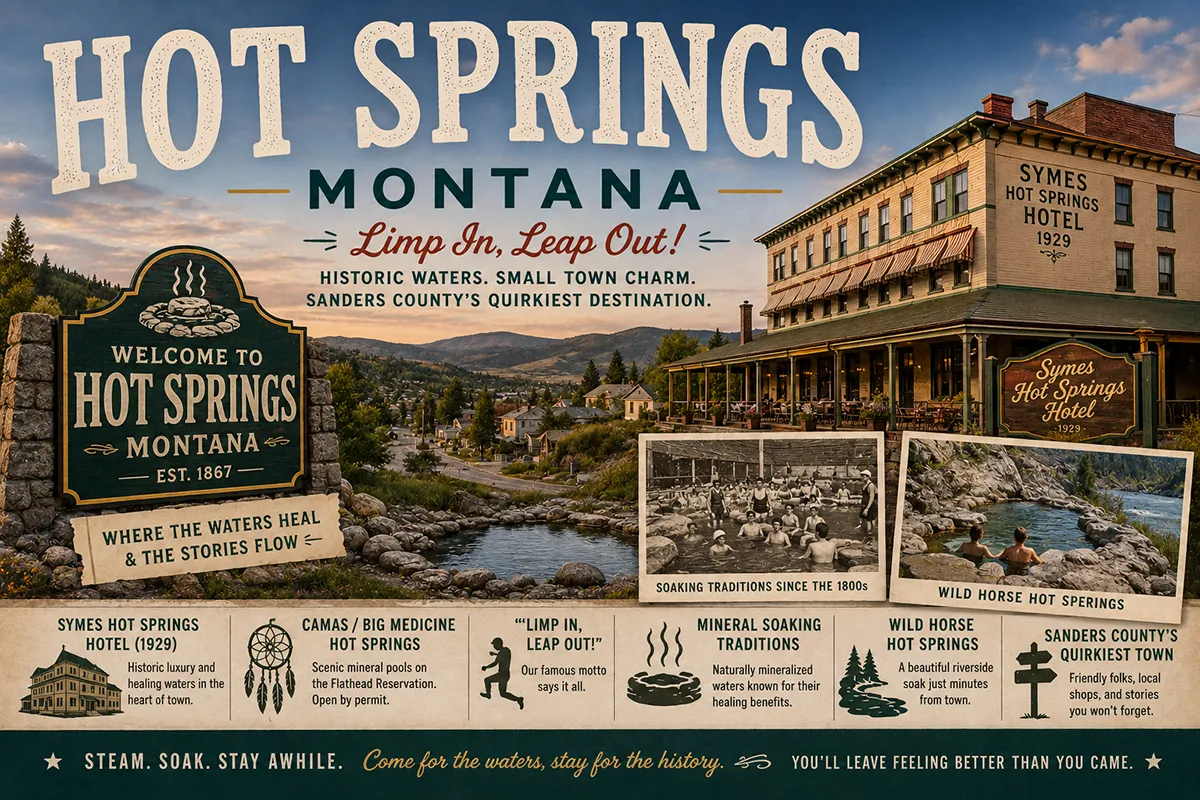
The sign that greets you on the way into town reads “Limp In, Leap Out.” It’s been the unofficial motto of Hot Springs, Montana for more than a century — originally rendered as “Limp In, Hop Out,” updated at some point in the modern era to “Leap Out” — and it summarizes the entire appeal of the town in five words.
The mineral waters bubbling out of the ground here have been claimed for over 150 years as therapeutic for everything from arthritis to polio.
Whether the medical claims hold up under contemporary scrutiny matters less than the fact that the soaking experience is genuine.
The water comes out of the ground at 113°F. It smells distinctly of sulfur. And there is something about lying in 108-degree mineral water with the sky open above you that does, in fact, make you feel different walking out than you did walking in.
The town sits on the Flathead Indian Reservation in Sanders County’s Little Bitterroot River Valley — the homeland of the Kootenai, Flathead, Pend d’Oreille, and Kalispell peoples, who used the springs they called Big Medicine for healing and ceremony for centuries before any of the Euro-American hotels appeared.
The name “Hot Springs” is descriptive, obviously, but the town’s secondary name comes from the camas plant (Camassia) that grows in the surrounding camas prairie — a culturally significant Indigenous food plant. The Salish-Kootenai cultural presence is part of the experience here and worth understanding as you visit.
The Symes Hot Springs Hotel is the town’s anchor. Fred Symes purchased a three-acre parcel containing the free-flowing Lemeroux Springs in 1929, announced plans to build a Mission Style resort hotel and bathhouse, and opened the doors in spring 1930.
Ninety-six years later, the Symes is still operating — National Register-listed, owned by Leslee and Dan Smith (who bought it almost by accident during a 1990s hunting trip), and largely unchanged. The red neon signs from the 1930s still glow at night.
The pools — an outdoor pool at 101°F and an octagonal indoor pool at 108°F — still drain and refill with mineral water that comes straight from the ground. The 31 rooms plus 15 surrounding cabins range from charmingly antique to functionally weathered. The Symes is, as Leslee Smith puts it, “the biggest antique I’ve ever bought.”
TL;DR
- Hot Springs (~557) is a small Sanders County town on the Flathead Indian Reservation (CSKT lands), in the Little Bitterroot River Valley about 17 miles north of Plains via MT-28.
- The Symes Hot Springs Hotel (1929/30) is the town’s National Register-listed anchor — Mission Style architecture, indoor 108°F octagonal pool, outdoor 101°F pool, 31 rooms and 15 cabins, and the original neon signs from the 1930s.
- Camas Hot Springs (also called Big Medicine Hot Springs) emerges at 113°F. The original public bathhouse closed in the 1980s, but the springs remain culturally significant to the CSKT.
- Town motto: “Limp In, Leap Out” (originally “Limp In, Hop Out”).
- Multiple additional soaking options including Alameda’s (vintage 1930s spa with lithium private baths), Wild Horse Hot Springs (clothing-optional), and Sophia Springs (newer property with “The Plunge”).
- Best for: hot springs aficionados, healing-waters tradition seekers, quiet off-the-beaten-path Western Montana travelers, and CSKT cultural heritage context.
Liked this article?
Add Roaming Montana as a preferred source so you see more of our articles and guides on Google.
Hot Springs at a Glance
| Population (2020) | ~557 |
|---|---|
| County | Sanders County |
| Region | Western Montana (Little Bitterroot River Valley) |
| Elevation | 2,841 ft |
| Reservation | Flathead Indian Reservation (CSKT) |
| Distance to Plains | ~17 miles south (~25 min via MT-28) |
| Distance to Polson | ~38 miles northeast (~55 min) |
| Distance to Missoula | ~95 miles southeast (~1.75 hours) |
| Distance to Kalispell | ~110 miles northeast (~2 hours) |
| Distance to Quinn’s Hot Springs | ~25 miles south (~35 min) |
| Best for | Hot springs soaking, Symes Hotel stay, quiet off-grid character, CSKT cultural context |
What Makes Hot Springs Different
Hot Springs is genuinely unusual among Montana destinations because of how slowly time has moved through it. The town’s contemporary identity is built almost entirely on its early 20th-century hot springs resort era.
The first well was drilled in 1911; stronger flows were discovered in 1913; by 1915 forty wells had been drilled across the area.
Hotels sprouted up — the Headquarters, the Florence, Hotel DeMers, the original Camas Bathhouse on Spring Street — and Hot Springs became one of Montana’s premier therapeutic destinations during the 1920s, ’30s, and ’40s, when soaking in mineral waters was a doctor-prescribed treatment for ailments from arthritis to polio.
What’s striking is how much of that era is still here. The Camas Bathhouse on Spring Street closed in the 1980s, but its building remains.
The Symes is still in operation under owners who deliberately preserve its 1930s character rather than modernizing it. Alameda’s nearby is a “vintage 1930s spa motel” offering private baths with lithium-containing mineral water.
Sophia Springs, a newer property, includes “The Plunge” — a continuously flowing outdoor soak in a privacy-fenced enclosure.
Multiple older buildings dot the small downtown. The whole town feels suspended in a particular American mid-century moment, and there is no realistic chance of that changing soon.
The cellular service story has become a small piece of Hot Springs lore. In 2012 the town was featured in Time magazine because of its unusually limited cell phone service — at that time, just one tower serving the area, with Wi-Fi spotty in town.
Coverage has improved since then but remains less reliable than in larger Western Montana communities. For some visitors that’s a deal-breaker; for many it’s exactly the appeal. The town has the kind of disconnection from contemporary noise that’s getting genuinely rare.
The CSKT context is essential. Hot Springs sits inside the Flathead Indian Reservation, which is governed by the Confederated Salish and Kootenai Tribes.
Camas Hot Springs — also known to the CSKT as Big Medicine — held ceremonial and healing significance for centuries before the first Euro-American hot springs hotel opened. Visitors should approach the springs with that history in mind.
The CSKT also operate a number of important cultural sites and museums on the reservation, and the National Bison Range (now restored to CSKT management under its Indigenous name) is accessible from the broader region.
The Symes Hotel deserves a paragraph of its own. Fred Symes was a businessman who saw an opportunity in the boom of Hot Springs resort tourism in the 1920s.
The three-acre Lemeroux Springs property he purchased in 1929 already had the mineral water; he added the Mission Style hotel and bathhouse, opened it in spring 1930, and then continued building through the 1930s and ’40s.
The current owners, Leslee and Dan Smith, found the hotel for sale in the mid-1990s during a hunting-trip detour that took them through Lolo Hot Springs and Quinn’s Hot Springs before they noticed the for-sale sign in the Symes window.
They bought it two weeks later and have been running it ever since — expanded to 31 hotel rooms plus 15 surrounding cabins, with the dining room (often featuring live music on weekends), the iconic indoor 108°F octagonal pool, and the outdoor pool maintaining the Symes’ specific 1930s-resort character. It is genuinely one of the most distinctive lodging experiences in Montana.
For broader trip context, see my Montana cities and towns hub.
The Top 10 Things to Do In & Around Hot Springs
1. Soak at the Symes Hot Springs Hotel
The town’s primary attraction. The Symes offers an outdoor mineral pool at approximately 101°F and an indoor octagonal pool at 108°F (sometimes hotter).
Day-use passes are available without booking a room; overnight guests have full pool access. The water has a noticeable sulfur smell — this is normal, expected, and part of the mineral content that gives the soaking its therapeutic reputation. Bring quick-dry clothing; the pools drain and refill regularly.
2. Stay at the Symes
Beyond day-use, an overnight stay at the Symes is its own substantial experience. The rooms are antique-furnished, the walls are thin, the cell service is spotty, and the dining room often has live music on weekends.
The cabins behind the main hotel offer slightly more privacy. The full Symes experience requires at least one overnight; many visitors stay longer. Reservations are essential during summer and holiday weekends; the hotel fills up far in advance.
3. Camas Hot Springs / Big Medicine Hot Springs
The geological hot springs that gave the town its name. The original Camas Bathhouse closed in the 1980s, but the springs themselves remain on the landscape and are culturally significant to the CSKT.
The site is on the Flathead Indian Reservation; visitors should respect the cultural significance and read CSKT interpretive material before visiting. The springs emerge at approximately 113°F.
4. Alameda’s Hot Springs Retreat
A vintage 1930s spa motel offering private mineral baths — including some that contain lithium, valued historically for its mood-stabilizing properties.
The motel is small, the baths are private, and the experience is significantly different from the more social Symes pools. Reservations recommended.
5. Sophia Springs “The Plunge”
A newer Hot Springs property offering “The Plunge” — a continuously flowing outdoor soak in a privacy-fenced enclosure near the corner of Wall and North Streets. Open year-round to lodging guests. A more modern soaking experience than the historic Symes alternatives.
6. Wild Horse Hot Springs
Located outside Hot Springs town (about 5 miles southeast on a county road), Wild Horse is the area’s clothing-optional hot springs option. Private soaking rooms with mineral water, distinct from the public-pool experiences in town. Adults-oriented; reservations required.
7. Hot Springs Artists Society & Local Galleries
The town has a small but active arts community. Several galleries and studios operate in the downtown — check current openings during your visit. The combination of mineral-bath culture, retirees, and creative residents has produced an unusual small-town arts scene worth a slow afternoon.
8. Sanders County Antique & “Junk Store” Browsing
Hot Springs has multiple antique and vintage stores along its small downtown — the kind of casual treasure-hunting experience that pairs naturally with hot-springs soaking. Several stores have been operating for decades and reflect the area’s mid-century resort heritage.
9. Day Trip to Plains (25 minutes south)
The Sanders County corridor includes Plains’ Clark Fork River, Koo-Koo-Sint Bighorn Sheep Viewing Site (between Plains and Thompson Falls), and Quinn’s Hot Springs Resort at Paradise. See Plains guide.
10. Day Trip to the National Bison Range (45 minutes northeast)
The bison range — managed by the CSKT under its Indigenous name — preserves one of the most significant bison herds in the United States on Flathead Indian Reservation land.
Wildlife loop drives, bison viewing, and CSKT-led interpretation make it one of Montana’s most substantive Indigenous-stewardship sites. Open seasonally; check current schedule.
Where to Stay
| Hotel | Vibe | Price | Best For |
|---|---|---|---|
| Symes Hot Springs Hotel | Iconic 1929 Mission Style, antique-furnished, pool access | $130–250 | The signature Hot Springs experience |
| Symes Cabins (behind hotel) | Same property, more privacy | $150–280 | Couples, slightly upgraded |
| Alameda’s Hot Springs Retreat | Vintage 1930s spa motel, private baths | $140–220 | Private soaking, quieter atmosphere |
| Sophia Springs Lodging | Newer property, “The Plunge” soak | $140–220 | Newer accommodation, less historic |
| Wild Horse Hot Springs (5 miles SE) | Clothing-optional retreat | $120–220 | Adult travelers, private soaking |
| Vacation rentals (Hot Springs area) | Mix of properties | $150–300 | Families, longer stays |
Where to Eat
- Symes Hotel Dining Room — basic but reliable; live music on weekends
- Local Hot Springs cafés — small downtown options
- Plains (25 min south) — more variety; The Lantern bar and grill
- Quinn’s Hot Springs Resort (35 min south) — upscale dining in historic setting
Hot Springs has limited dining; bring snacks or supplies, especially if cell service prevents food-delivery options.
Getting There & Around
From Plains: 17 miles north on MT-28, about 25 minutes through the Little Bitterroot River Valley.
From Polson: 38 miles southwest via MT-28 south through Flathead Reservation country, about 55 minutes.
From Missoula: 95 miles northwest via I-90, MT-135, and MT-200/MT-28, about 1.75 hours.
From Kalispell: 110 miles southwest via US-93 south to Polson, then MT-28, about 2 hours.
Cell service: Limited — improved since the 2012 Time magazine feature but still less reliable than larger Western Montana communities. Download offline maps before arrival.
What Hot Springs Unlocks
Plains & Sanders County Corridor (25 min south)
The Clark Fork River, Koo-Koo-Sint Bighorn Sheep Viewing Site, Sanders County Fair. See Plains guide.
Quinn’s Hot Springs Resort (35 min south)
A different historic hot springs experience — pools at varying temperatures, restaurant, lodge. The MT-200 corridor option.
National Bison Range & CSKT Lands (45 min NE)
CSKT-managed bison preserve and broader Flathead Indian Reservation cultural sites.
Polson & Flathead Lake (55 min NE)
The southern end of Flathead Lake. See Polson guide.
Wild Horse Hot Springs (5 miles SE)
Clothing-optional alternative for adult travelers.
When to Visit
Year-round: The hot springs are open in every season. Winter soaking — when the air is below freezing and the steam rises off the pools — is one of the most distinctive sensory experiences in Montana.
Summer (June–August): Busy season; book accommodations weeks ahead. Long daylight, comfortable temperatures.
Fall (September–October): Beautiful golden light, fewer crowds, ideal soaking weather.
Spring (April–May): Quieter shoulder season; some snow melt-off can affect surrounding roads.
Winter (November–March): Genuinely magical for soaking — steam, cold air, dramatic contrast. Cell service even more limited; some businesses operate on reduced winter hours.
Personal Tips
Book the Symes far ahead. During summer and holiday weekends, the Symes fills up months in advance. Tuesday-Thursday windows are easier to book; weekend stays often require 2-3 month lead times.
Manage expectations about the Symes. The hotel is genuinely historic and deliberately preserved — not luxurious. The rooms are antique-furnished, the walls are thin, the maintenance is functional rather than refined. The character is the entire point. Travelers expecting boutique luxury will be disappointed; travelers expecting a 1930s mineral-bath resort experience will be delighted.
The sulfur smell is normal. The mineral content that makes the waters therapeutic includes sulfur compounds that have a distinct (and to some, unpleasant) smell. Your skin and hair will absorb some of it. This is expected. Bring quick-dry clothing that you don’t mind smelling slightly like sulfur.
Pair with Quinn’s for the full Sanders County hot springs experience. Many travelers do Quinn’s (more upscale, MT-200 corridor) and the Symes (historic, character-driven) on consecutive nights. The two are completely different soaking experiences and complementary rather than competitive.
Respect CSKT cultural sites. Camas Hot Springs and the surrounding land have deep Indigenous significance. Read CSKT interpretive materials before visiting cultural sites; don’t photograph ceremonial areas; ask permission when uncertain.
Stock up before arrival. Hot Springs has limited grocery and restaurant options. Bring food, snacks, and any specific drinks you’ll want during your stay.
Hot Springs Quick Facts
| Named for | Mineral hot springs and the camas plant (Camassia) | | First well drilled | 1911 | | Symes Hotel built | 1929-1930 (Fred Symes; Mission Style) | | Symes current owners | Leslee and Dan Smith (mid-1990s purchase) | | Symes pool temps | 101°F outdoor; 108°F octagonal indoor | | Camas Hot Springs vent temp | 113°F | | Time magazine feature | 2012 (one cell phone tower) | | Reservation | Flathead Indian Reservation (CSKT) | | Average summer high | 84°F | | Average winter low | 18°F |
Conclusion
Hot Springs is one of Montana’s most genuinely distinctive small-town destinations. The combination of the 1929 Symes Hotel, the 113-degree Camas mineral water, the CSKT cultural context, the deliberate disconnection from contemporary noise, and the unmistakable sense of a town suspended in mid-century resort time creates an experience that nothing else in Montana quite replicates.
For travelers who appreciate antique character, mineral soaking, quiet days, and a slower rhythm, Hot Springs is genuinely worth the long detour off the interstate. Limp in, leap out.
Have a Hot Springs question? Drop it in the comments — I read every one.
Frequently Asked Questions
Is Hot Springs Montana worth visiting?
Yes — Hot Springs is worth visiting for the historic Symes Hot Springs Hotel (1929 Mission Style, National Register-listed, with indoor 108°F and outdoor 101°F mineral pools), the broader hot springs soaking culture (Alameda’s, Sophia Springs, Wild Horse Hot Springs), the CSKT Flathead Reservation cultural context, and the deliberately preserved 1930s small-town character. It’s one of Montana’s most distinctive lodging and soaking destinations.
What is the Symes Hot Springs Hotel?
The Symes Hot Springs Hotel is a historic Mission Style hotel and mineral bath complex built by Fred Symes in 1929-1930 on the site of the natural Lemeroux Springs. Listed on the National Register of Historic Places, it features 31 hotel rooms, 15 surrounding cabins, an outdoor mineral pool at approximately 101°F, an indoor octagonal mineral pool at 108°F, and a dining room often featuring live music on weekends. Current owners Leslee and Dan Smith have maintained the hotel’s deliberately preserved 1930s character since their mid-1990s purchase.
What is “Limp In, Leap Out”?
“Limp In, Leap Out” is the official motto of Hot Springs, Montana, referring to the perceived therapeutic value of the town’s mineral hot springs. Doctors historically prescribed thermal-springs soaking as treatment for ailments ranging from arthritis to polio, and the town built its 20th-century resort identity around the healing-waters tradition. The original version of the motto was “Limp In, Hop Out,” updated at some point to the contemporary “Leap Out.”
What is Camas Hot Springs?
Camas Hot Springs (also known as Big Medicine Hot Springs) is the natural geothermal feature that gives Hot Springs, Montana its name. The springs emerge at approximately 113°F and have held ceremonial and healing significance for the Kootenai, Flathead, Pend d’Oreille, and Kalispell peoples for centuries. The town and springs are located on the Flathead Indian Reservation, governed by the Confederated Salish and Kootenai Tribes (CSKT). The original Camas Bathhouse on Spring Street closed in the 1980s, but the springs themselves remain on the landscape.
How far is Hot Springs Montana from Plains?
Hot Springs is approximately 17 miles north of Plains via MT-28 — about a 25-minute drive through the Little Bitterroot River Valley.
Is Hot Springs Montana on the Flathead Indian Reservation?
Yes — Hot Springs sits inside the Flathead Indian Reservation in Sanders County. The reservation is the homeland of and governed by the Confederated Salish and Kootenai Tribes (CSKT). The hot springs themselves held cultural and ceremonial significance for the Kootenai, Flathead, Pend d’Oreille, and Kalispell peoples for centuries before Euro-American settlement and development of the contemporary resort era.