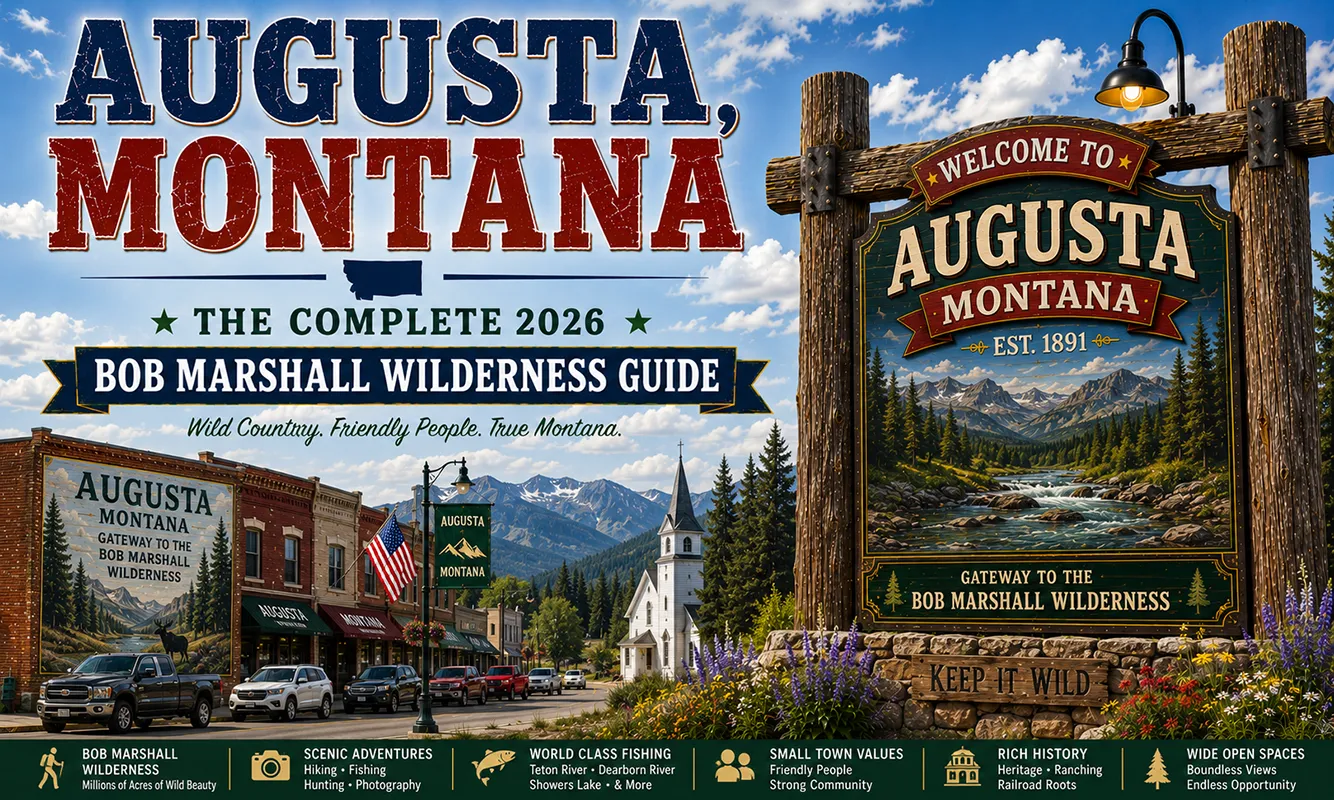
The Bob Marshall Wilderness begins where Augusta’s roads end. At the Benchmark Trailhead — 33 miles west of Augusta up the South Fork of the Sun River — the pavement stops and 1.5 million acres of designated wilderness begins.
Backpackers, hikers, and horseback riders assemble in Augusta every summer to explore one of the most completely preserved mountain ecosystems in the world.
The town itself has about 315 residents, an 1886-established American Legion Rodeo, and the kind of Western character that hasn’t been manufactured for tourism — it’s simply what happens when a ranching community lives in the shadow of one of the great American wilderness areas for a century.
TL;DR
- Augusta (~315) is on US-287 at the Rocky Mountain Front, 60 miles northwest of Great Falls.
- The premier gateway to the Bob Marshall Wilderness Complex — the Benchmark Trailhead (33 miles west) is the most-used entry to “The Bob.”
- The American Legion Rodeo (Fourth of July weekend) is one of the oldest continuously running rodeos in Montana.
- The Sun River elk herd — one of the largest migratory elk herds in the Rocky Mountain Front — winters in the Sun River Game Preserve and passes through the Augusta area.
- Best for: Bob Marshall Wilderness pack trips, Rocky Mountain Front exploration, authentic Western community character.
Liked this article?
Add Roaming Montana as a preferred source so you see more of our articles and guides on Google.
Augusta at a Glance
| Population (2020) | ~315 |
|---|---|
| County | Lewis and Clark County |
| Region | North-Central Montana (Rocky Mountain Front) |
| Elevation | 4,062 ft |
| Distance to Great Falls | ~60 miles southeast (~1.25 hours) |
| Distance to Choteau | ~30 miles north (~35 min) |
| Distance to Benchmark Trailhead | ~33 miles west (~50 min gravel) |
| Best for | Bob Marshall Wilderness access, Sun River elk herd, American Legion Rodeo, Rocky Mountain Front |
What Makes Augusta Different
Augusta serves as the Trailhead to the Bob Marshall Wilderness Complex and a great place for outdoor recreation — the gateway to the “Crown Jewel” of the wilderness system.
The Bob is one of the most completely preserved mountain ecosystems in the world: 1.5 million acres of rugged peaks, alpine lakes, cascading waterfalls, shimmering crystal clear streams, and large remote river valleys.
What makes Augusta’s gateway status distinctive is the Benchmark Trailhead — reached via a 33-mile drive up the South Fork of the Sun River Road.
This trailhead provides direct access into the Bob Marshall’s interior and is the most commonly used entry point for guided horse pack trips into the wilderness.
Allens’ Manix Trading Post, built in 1902, has served locals and visitors for over a century — it’s the place where pack trip outfitters and wilderness-bound hikers stock up on provisions before disappearing into the mountains for a week.
The Sun River Game Preserve — established in 1913 to protect the Sun River elk herd — borders the wilderness immediately west of Augusta.
The herd, one of the largest elk concentrations on the Rocky Mountain Front, winters on the preserve and migrates into the high country of the Bob Marshall each spring.
Watching the elk move through the Sun River corridor in April and October is one of the finest wildlife spectacles in central Montana.
For broader trip context, see my Montana cities and towns hub.
The Top 10 Things to Do In & Around Augusta
1. Book a Bob Marshall Wilderness Pack Trip
The primary reason most people make the deliberate drive to Augusta. Multiple outfitters run guided horse pack trips from the Benchmark Trailhead into the Bob Marshall Wilderness — multi-day journeys to the Chinese Wall (a 1,000-foot limestone escarpment running 22 miles), alpine lakes, and remote river valleys. Mills Wilderness Adventures, Sun River Outfitters, and others operate from Augusta. Book months ahead for summer.
2. Drive the Sun River Canyon (South Fork Road)
Even without a wilderness pack trip, the drive up the South Fork of the Sun River Road toward the Benchmark Trailhead is extraordinary — the canyon narrows, the Rocky Mountain Front closes overhead, and the geology becomes increasingly dramatic. The road is gravel beyond Gibson Reservoir; high-clearance recommended.
3. Gibson Reservoir & Sun Canyon Lodge
About 25 miles west of Augusta via Sun River Road — a reservoir impounded from the North Fork of the Sun River, with dramatic Rocky Mountain Front scenery rising directly from the water. The Sun Canyon Lodge has operated in this setting for decades. Fishing, boating, and camping.
4. Sun River Elk Herd Viewing (Spring and Fall)
The Sun River elk herd migrates between the Rocky Mountain Front and the high wilderness country. Spring (April–May) and fall (October–November) migrations through the Augusta area are the best viewing opportunities. Dawn and dusk drives along Sun River Road and the game preserve boundary are productive.
5. American Legion Rodeo (Fourth of July Weekend)
Augusta’s American Legion Rodeo, established in 1886, is one of the oldest continuously running rodeos in the United States. Fourth of July weekend. Professional rodeo competition plus community parade and celebration. One of the most genuine western rodeo events in central Montana.
6. Walk Historic Downtown Augusta
Many of the buildings in downtown Augusta are from the early 1900s — Allens’ Manix Trading Post (built 1902), the F.M. Mack Building, and an old blacksmith building. Three blocks of authentic frontier commercial architecture. Browse the trading post, have breakfast at Mel’s Diner, and absorb a Western streetscape that hasn’t been renovated for tourism.
7. Augusta Historical Museum
Local history museum covering the Rocky Mountain Front’s ranching heritage, the development of the wilderness protection movement, and the history of the Sun River Game Preserve.
8. Rocky Mountain Front Scenic Drive (US-287/US-89 Corridor)
The drive between Augusta and Choteau along the base of the Rocky Mountain Front is one of the finest in Montana — mountain wall on the west, open plains on the east, the contrast stark and beautiful. See Choteau guide.
9. Hike in the Lewis and Clark National Forest
Multiple trailheads along the Sun River Road access the Lewis and Clark National Forest before the wilderness boundary — shorter day hikes into the Front’s terrain without committing to the full wilderness experience.
10. Willow Creek Reservoir
A small reservoir near Augusta with fishing and a quieter recreation option than Gibson Reservoir.
Where to Stay
| Hotel | Vibe | Price | Best For |
|---|---|---|---|
| Augusta Bunkhouse | Western character | $80–130 | Wilderness travelers |
| Lazy B Motel | Basic, local | $85–130 | Most travelers |
| Sun Canyon Lodge (25 min west) | Remote, riverside | $130–250 | Wilderness/fishing focus |
| Pack trip lodges | Full expedition service | $400–800/day | Guided wilderness trips |
| Great Falls hotels (1.25 hours) | Full selection | $130–250 | More variety |
Where to Eat
- Mel’s Diner — the breakfast institution; fuel before a wilderness day
- Buckhorn Bar — lunch, dinner, and the social center of Augusta
- Western Bar — another local gathering spot
- Allens’ Manix Trading Post — provisions and local goods
Getting There
From Great Falls: 60 miles northwest on US-89 and US-287, about 1.25 hours.
From Choteau: 30 miles south on US-287, about 35 minutes.
What Augusta Unlocks
Bob Marshall Wilderness (33 miles west at Benchmark Trailhead)
The most direct access to America’s third-largest wilderness area.
Choteau & Egg Mountain (30 min north)
Dinosaur paleontology, Freezout Lake migration. See Choteau guide.
Great Falls (1.25 hours southeast)
C.M. Russell Museum, Lewis & Clark Interpretive Center. See Great Falls guide.
Rocky Mountain Front Scenic Corridor
US-287 between Augusta and Choteau is one of Montana’s most dramatic highway drives.
When to Visit
Summer (June–August): Prime Bob Marshall pack trip season; Sun River Road fully accessible; American Legion Rodeo in July.
Spring (April–May): Sun River elk herd migration; Freezout Lake snow goose migration (near Choteau); dramatic Front Range scenery.
Fall (September–October): Elk rut in the Front, fall hunting season, spectacular mountain light.
Year-round: Allens’ Trading Post and the bar/restaurant scene are open in all seasons.
Personal Tips
Book Bob Marshall pack trips 3–6 months ahead. The best outfitters fill their summer schedule by February. Contact Augusta outfitters directly — most have websites and take inquiries year-round.
Drive the Sun River Canyon even without a pack trip. The 25-mile drive to Gibson Reservoir is an extraordinary afternoon activity — the Rocky Mountain Front’s geology is spectacular from the road.
The American Legion Rodeo is the right Fourth of July. It’s been running since 1886. That’s genuine.
Sunrise on the Rocky Mountain Front from Augusta. The eastern face of the mountains catches first light dramatically — the limestone reefs turn orange before the plains below warm. Worth a 5 a.m. drive west.
Mel’s Diner for breakfast, Buckhorn Bar for everything else. The social rhythm of Augusta is uncomplicated and authentic.
Augusta Quick Facts
| Founded | 1880s (ranching community) | | Bob Marshall Wilderness | 1.5 million acres; third-largest wilderness in lower 48 | | American Legion Rodeo | Running since 1886 — one of America’s oldest | | Sun River Elk Herd | One of Rocky Mountain Front’s largest migratory herds | | Average summer high | 80°F | | Average winter low | 9°F |
Conclusion
Augusta is for travelers who want the Bob Marshall Wilderness without the guesswork of finding it themselves. The town has been organizing people’s entry into one of America’s greatest wilderness areas for over a century — the outfitters, the trading post, the rodeo, the bar, and the 1902 buildings on Main Street all tell that story. For wilderness-bound travelers, this is the right preparation room.
Have an Augusta question? Drop it in the comments — I read every one.
Frequently Asked Questions
Is Augusta Montana worth visiting?
Yes — Augusta is the premier gateway to the Bob Marshall Wilderness, with multiple outfitters running guided horse pack trips from the Benchmark Trailhead (33 miles west). The American Legion Rodeo (one of America’s oldest, running since 1886) and the authentic Western character of historic downtown Augusta make it worth visiting even without a wilderness trip. The Sun River Canyon drive to Gibson Reservoir is outstanding.
What is the Bob Marshall Wilderness near Augusta?
The Bob Marshall Wilderness Complex, known as “The Bob,” is one of the most completely preserved mountain ecosystems in the world — 1.5 million acres of rugged peaks, alpine lakes, cascading waterfalls, and large remote river valleys. The Benchmark Trailhead, 33 miles west of Augusta via the South Fork Sun River Road, is the most-used entry point.
How far is the Bob Marshall Wilderness from Augusta?
The Benchmark Trailhead — the primary entry point to the Bob Marshall Wilderness from Augusta — is approximately 33 miles west of Augusta via the South Fork of the Sun River Road. About 50 minutes driving, mostly gravel road. High-clearance vehicle recommended.
What is the American Legion Rodeo in Augusta?
The Augusta American Legion Rodeo is one of the oldest continuously running rodeos in the United States, established in 1886. Held every Fourth of July weekend, it features PRCA professional rodeo competition alongside community parade and celebration.
What is the Sun River elk herd?
The Sun River elk herd is one of the Rocky Mountain Front’s largest migratory elk populations, wintering in the Sun River Game Preserve (established 1913) west of Augusta and migrating into the Bob Marshall Wilderness high country in spring. Spring (April–May) and fall (October–November) migrations through the Augusta area offer excellent viewing opportunities.