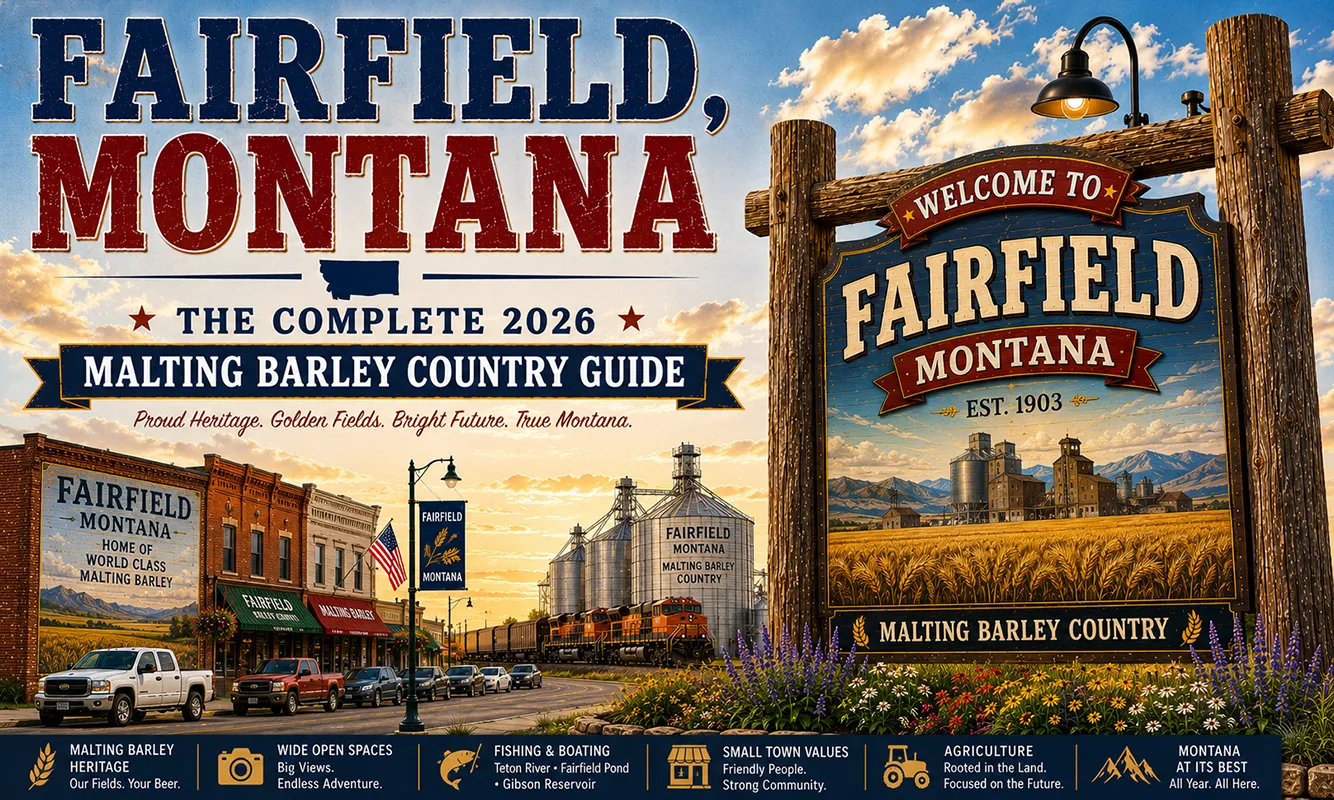
Every major American brewery — Anheuser-Busch, Coors, Miller — has bought barley from the Fairfield Bench. The rolling wheat and barley country west of Great Falls, known as the Fairfield Bench, produces more malting barley per acre than almost anywhere else in the United States.
The soil chemistry, elevation, and growing season create ideal conditions for the high-protein barley that brewers require.
Fairfield has worn the self-proclaimed title “Malting Barley Capital of the World” since the 1960s, and the title isn’t entirely hyperbolic — the Bench’s barley is genuinely world-class, and the local elevator complex that grades and ships it is one of the most important grain infrastructure pieces in Montana.
TL;DR
- Fairfield (~700) is the county seat of Teton County on US-89, 35 miles northwest of Great Falls.
- The “Malting Barley Capital of the World” — the Fairfield Bench produces premium malting barley purchased by major American breweries.
- Freezout Lake Wildlife Management Area (10 miles south near Choteau) hosts one of the world’s most spectacular snow goose migrations — up to 300,000 birds in March.
- Best for: agricultural heritage enthusiasts, snow goose migration watchers, and Rocky Mountain Front travelers.
Liked this article?
Add Roaming Montana as a preferred source so you see more of our articles and guides on Google.
Fairfield at a Glance
| Population (2020) | ~700 |
|---|---|
| County | Teton County (county seat) |
| Region | North-Central Montana (Rocky Mountain Front) |
| Elevation | 3,963 ft |
| Distance to Great Falls | ~35 miles southeast (~40 min) |
| Distance to Choteau | ~25 miles north (~30 min) |
| Distance to Freezout Lake | ~10 miles south (~15 min) |
| Best for | Malting barley heritage, Freezout Lake snow goose migration, Rocky Mountain Front |
What Makes Fairfield Different
The Fairfield Bench — the elevated plateau between the Rocky Mountain Front and Great Falls — is one of the finest agricultural landscapes in Montana, and malting barley is its signature crop.
The barley grown here has a protein content and kernel size that makes it ideal for brewing. The major American breweries have long-term purchasing relationships with Fairfield Bench farmers, and the local Glacier Grain elevator processes and grades barley for export to breweries across the country.
This is agricultural heritage worth knowing. Most travelers associate Montana with ranching, mining, or outdoor recreation.
The malting barley story is genuinely distinctive — it connects Fairfield’s fields directly to the beer on the table in Chicago, Denver, and St. Louis. For travelers interested in where food and beverage products actually come from, Fairfield is a fascinating stop.
Freezout Lake WMA is the other major draw. Located about 10 miles south of Fairfield (closer to Choteau), it’s one of the most spectacular wildlife events in the American West — up to 300,000 snow geese and 10,000 tundra swans stopping during spring migration in late February and March.
The sight and sound of hundreds of thousands of geese launching from the lake simultaneously is one of Montana’s most extraordinary natural experiences. It is, objectively, one of the world’s great bird migrations.
For broader trip context, see my Montana cities and towns hub.
The Top 10 Things to Do In & Around Fairfield
1. Freezout Lake Wildlife Management Area (10 miles south)
The snow goose migration at Freezout Lake is the primary reason to plan a visit to the Fairfield area. In late February and March, up to 300,000 snow geese and 10,000 tundra swans use the lake as a stopover on their northward migration to Arctic breeding grounds.
The birds arrive in waves, often launching en masse at dawn — the sound of hundreds of thousands of wings and calls is extraordinary. Peak timing varies by year; contact Montana FWP or the Choteau Chamber for current migration reports.
Outside snow goose season, Freezout Lake hosts significant waterfowl populations year-round — nesting ducks and geese in summer, fall migration in September through November.
2. Fairfield Bench Agricultural Heritage Drive
Drive the county roads of the Fairfield Bench to understand what “Malting Barley Capital” means in practice. The bench’s rolling topography, the grain elevator infrastructure, and the scale of the barley operations are visible from the roads. Peak visual time is August — golden barley fields stretching to the mountain wall to the west.
3. Fairfield Grain Elevators
The elevator complex that processes and ships the Bench’s barley harvest is a working agricultural landmark — the physical infrastructure of the malting barley economy. Visible from the highway through town.
4. Rocky Mountain Front Views (West of Fairfield)
US-89 west and north from Fairfield follows the Rocky Mountain Front — the mountain wall rising abruptly from the plains. The drive toward Choteau on US-89 is particularly striking.
5. Day Trip to Choteau (25 miles north)
Egg Mountain paleontology, Two Medicine Dinosaur Center, Choteau’s authentic Western character. See Choteau guide.
6. Waterfowl Hunting (Fall)
The Teton County plains around Fairfield and the Freezout Lake WMA are productive for duck and goose hunting in fall. Public land hunting access; check current Montana FWP regulations.
7. Teton River Fishing
The Teton River drains the Rocky Mountain Front and flows through Teton County near Fairfield — brown and cutthroat trout accessible from fishing access sites.
8. Sun River Access (South of Fairfield)
The Sun River flows east from the Bob Marshall Wilderness through the Fairfield Bench area — walleye and catfish in the lower river; trout in the upper reaches.
9. Day Trip to Augusta (40 miles south)
Bob Marshall Wilderness gateway, American Legion Rodeo. See Augusta guide.
10. Day Trip to Great Falls (40 minutes southeast)
C.M. Russell Museum, Lewis & Clark Interpretive Center. See Great Falls guide.
Where to Stay
| Hotel | Vibe | Price | Best For |
|---|---|---|---|
| Fairfield area motels | Local, basic | $85–130 | Most travelers |
| Choteau lodging (25 min north) | Small town character | $90–150 | More variety |
| Great Falls hotels (40 min southeast) | Full selection | $130–250 | Most amenities |
Where to Eat
- Fairfield Bar & Café — local gathering place; reliable meals
- Trackside Bar — community institution
- Choteau dining (25 min north) — more variety; see Choteau guide
- Great Falls (40 min southeast) — full restaurant variety
Getting There & Around
From Great Falls: 35 miles northwest on US-89, about 40 minutes.
From Choteau: 25 miles south on US-89, about 30 minutes.
From Conrad: ~40 miles west, about 45 minutes.
What Fairfield Unlocks
Freezout Lake WMA (10 min south)
March snow goose migration — up to 300,000 birds.
Choteau & Egg Mountain (25 min north)
Dinosaur paleontology, authentic Western character.
Augusta & Bob Marshall (40 min south)
Premier Bob Marshall Wilderness gateway.
Great Falls (40 min southeast)
Full city, C.M. Russell Museum, Lewis & Clark.
When to Visit
Late February – March: Freezout Lake snow goose migration peak — one of the world’s great wildlife spectacles. This is the reason to prioritize Fairfield in your Montana itinerary.
Summer (June–August): Barley growing season; Rocky Mountain Front hiking; full Teton River fishing.
Fall (September–October): Harvest season (barley combines visible); fall waterfowl migration at Freezout Lake.
Year-round: The agricultural character of the Fairfield Bench is visible in every season.
Personal Tips
Time your visit for the snow goose migration. Late February to late March — contact Montana FWP (fwp.mt.gov) or the Choteau Chamber for current migration reports. The exact peak varies 2–3 weeks depending on winter conditions. This is a bucket-list level wildlife experience that most Montana travelers don’t know about.
Dawn at Freezout Lake. The geese launch at first light in massive flocks — the sound alone is extraordinary. Arrive before sunrise with binoculars and a warm jacket.
Combine with Choteau. Egg Mountain and the Two Medicine Dinosaur Center are 25 miles north. A single day can cover snow goose migration in the morning and dinosaur paleontology in the afternoon.
August for the barley fields. The visual peak of the Fairfield Bench agricultural landscape is August when the barley is golden and the combines are working. The grain elevator loading activity during harvest is worth watching.
Fairfield Quick Facts
| Founded | 1900s (homestead era) | | Malting barley | World-class quality; purchased by major American breweries | | Freezout Lake | Snow goose migration: up to 300,000 birds; tundra swans: ~10,000 | | Teton County | County seat | | Average summer high | 82°F | | Average winter low | 5°F |
Conclusion
Fairfield is an agricultural town with two excellent reasons to visit: the Malting Barley Capital identity (an agricultural story that connects Montana’s fields to America’s breweries) and the Freezout Lake snow goose migration (one of the world’s most spectacular waterfowl events, 10 miles south). Combined with Choteau 25 miles north, the Fairfield area makes a complete and rewarding Rocky Mountain Front day.
FAQ
Is Fairfield Montana worth visiting?
Yes — primarily for the Freezout Lake snow goose migration (up to 300,000 snow geese and 10,000 tundra swans in late February–March) 10 miles south, the Malting Barley Capital agricultural heritage, and the Rocky Mountain Front access. Combined with Choteau (25 miles north), it’s one of the strongest day itineraries on the Rocky Mountain Front.
What is the Freezout Lake snow goose migration near Fairfield?
Freezout Lake Wildlife Management Area, about 10 miles south of Fairfield, hosts one of the largest snow goose migrations in the world during late February through March. Up to 300,000 snow geese and 10,000 tundra swans stop at the lake during their northward migration to Arctic breeding grounds. Montana FWP provides current migration reports.
Why is Fairfield called the Malting Barley Capital?
The Fairfield Bench’s combination of soil chemistry, elevation, and growing conditions produces premium malting barley with the protein content and kernel quality that major American breweries require. Anheuser-Busch, Coors, Miller, and others have purchased barley from Fairfield Bench farmers for decades.