On February 27, 1943, at 9:26 in the morning, a methane explosion tore through the Smith Mine’s No. 3 tunnel west of Bearcreek. Seventy-four men were working underground.
Three escaped. Seventy-one died — the worst coal mining disaster in Montana’s history. The victims were Serbians, Montenegrins, Scots, Italians, Germans, Americans — a microcosm of the immigrant labor force that had built Bearcreek into a coal town of 2,000 people at its peak.
The mine shaft where they died still stands west of town, a silent structure in the hillside above a community that never recovered.
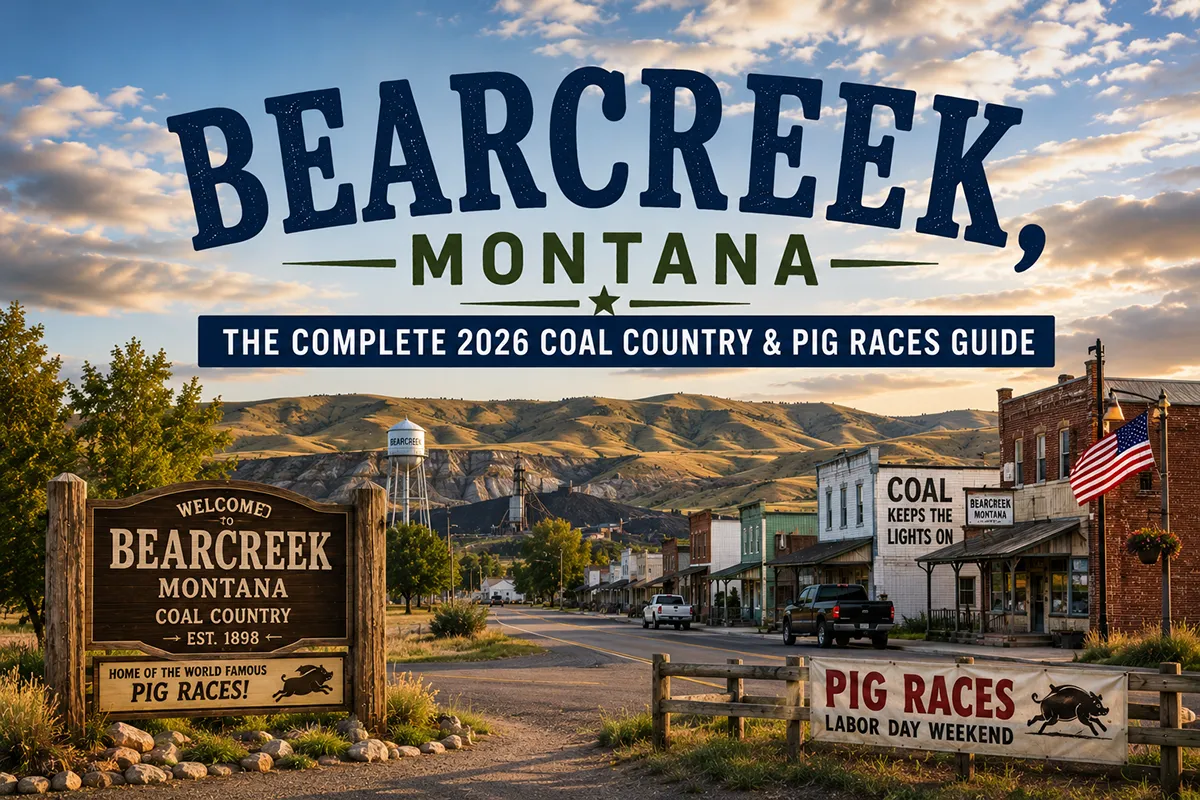
Today, Bearcreek has about 85 people and one of the most famous bars in Montana. The Bear Creek Saloon’s pig races — held Thursday through Sunday from Memorial Day through Labor Day, featuring named pigs in kerchiefs running a mini oval track behind the building — began in 1988 when the Yellowstone wildfires killed the region’s tourist traffic and owners Pits and Lynn DeArmond needed a way to bring people back to their struggling bar.
They invented the pig races. They saved the business. The proceeds now go to Carbon County student scholarships.
TL;DR
- Bearcreek (~85) is a Carbon County former coal town 7 miles southeast of Red Lodge.
- The Bear Creek Saloon & Steakhouse hosts the famous Bear Creek Downs Pig Races — named pigs in kerchiefs running a track behind the saloon, Thursday–Sunday Memorial Day through Labor Day. Born from the 1988 Yellowstone wildfire crisis.
- The Smith Mine Disaster Memorial marks Montana’s worst mining tragedy — 74 men underground, 71 killed on February 27, 1943.
- The Bearcreek Bank (National Register) survives from the coal boom as one of the few original structures.
- Bullet holes in the saloon ceiling from the mining era remain visible.
- Best for: the pig races experience, Smith Mine Disaster history, Carbon County loop drive travelers.
Liked this article?
Add Roaming Montana as a preferred source so you see more of our articles and guides on Google.
Bearcreek at a Glance
| Population (2020) | ~85 |
|---|---|
| County | Carbon County |
| Region | South-Central Montana |
| Distance to Red Lodge | ~7 miles west (~10 min) |
| Distance to Billings | ~65 miles north (~1.25 hours) |
| Distance to Belfry | ~5 miles east (~7 min) |
| Best for | Pig races, Smith Mine Disaster history, Carbon County loop |
What Makes Bearcreek Different
Bearcreek carries two distinct identities that exist in unresolved tension: a community defined by one of the most devastating industrial disasters in Montana history, and the home of one of the most entertainingly eccentric traditions in the American West.
The coal mining history is the substrate. Bearcreek was founded around 1905–1906 when coal deposits of exceptional quality were discovered in the surrounding hills.
By the 1920s and early 1930s, Bearcreek and the surrounding communities had a combined population approaching 3,000 — served by seven mercantiles, a bank, two hotels, two billiard halls, a brickyard, numerous saloons, and, allegedly, not a single church.
The community was predominantly immigrant: Serbians, Montenegrins, Italians, Scots, and Eastern Europeans who came to Montana specifically for the mining work and who brought their cultural traditions into a compressed mining camp environment.
The 1943 Smith Mine disaster ended that world. Methane gas had been a concern in the mine’s deeper workings; management was aware of the hazard but operations continued.
When the explosion occurred at 9:26 a.m. on a Saturday in February, 74 men were underground. Three men near the mine entrance survived.
The 71 who died were buried in graves across several Carbon County cemeteries — the disaster effectively ended the coal mining era in Bearcreek, and the community declined through the late 1940s and 1950s as demand for coal fell and the railroad connecting Bridger to Bearcreek finally closed in 1953.
The pig races are a separate story — genuinely cheerful, genuinely useful (the proceeds fund scholarships), and genuinely strange in the best way.
Pits and Lynn DeArmond developed the pig race concept in 1988 when business declined due to the Yellowstone wildfires. They built a small oval track behind the saloon, obtained pigs, and held races with wagering proceeds going to local scholarships. The concept worked so well that it became the defining identity of the saloon — and of Bearcreek itself.
For broader trip context, see my Montana cities and towns hub.
The Top 10 Things to Do
1. Bear Creek Downs Pig Races
The primary reason most people visit Bearcreek today. During the summer season (Memorial Day through Labor Day), pig races are held Thursday, Friday, Saturday and Sunday at 7:00 p.m.
There are 12 nightly races on a 15-minute schedule featuring such stars as Makin’ Bacon, Knuckles, and Nota Hot Dog. The pigs wear colored kerchiefs; spectators bet on races from a balcony above the track.
The winning pig pays out one-half of each $50 race pot. The other half goes toward scholarships for Carbon County high school students.
Practical details: No cover charge to watch. Cash helpful for wagering. Arrive early for dinner at the steakhouse — the charbroiled steaks are the best in the area, and the saloon fills up before race time.
2. Smith Mine Disaster Memorial
A historical plaque outside the mine shaft west of Bearcreek marks the site of Montana’s worst coal mining disaster. On an unfortunate Saturday in February 1943, Bearcreek became the scene of Montana’s worst recorded mining disaster.
It devastated and changed the town forever, influencing its rapid demise after the methane explosion which killed over 75 miners. The mine shaft is still standing — a sobering structure in the hillside that requires no embellishment.
This is genuinely moving historical territory. The memorial is not elaborate, which is appropriate. Stand there and look at the shaft and understand that 71 families across Carbon County received the worst news imaginable that February morning.
3. Dine at the Bear Creek Saloon & Steakhouse
The saloon serves what many locals consider the finest charbroiled steaks in Carbon County. The establishment has been operating continuously since the coal mining era — its walls carry the weight of that history, including the famous bullet holes in the ceiling from the mining era when miners spent their paychecks on whiskey and got rowdy.
The Bearcreek Saloon is also known for the bullet holes in its ceiling, dating back to the days when town miners would spend their pay checks on spirits and get a little rowdy.
4. Bearcreek Bank (National Register of Historic Places)
The Bearcreek Bank — now on the National Register of Historic Places — stands as a symbol of the town’s storied history. One of the few surviving original structures from Bearcreek’s coal boom era — the bank represents the scale of the community’s ambition at its peak.
5. Coal Camp Road Historic Drive
The roads around Bearcreek pass through the remnants of the broader coal mining district — the sites of former communities like Bear Creek proper, Washoe, and the mining camp infrastructure. Most structures are long gone, but the landscape itself tells the story.
6. Red Lodge Day Trip (7 minutes west)
Bearcreek is 7 miles from Red Lodge — close enough that most visitors combine the two. Red Lodge’s historic downtown, skiing at Red Lodge Mountain, and the Beartooth Highway are all accessible from the same base. See Red Lodge guide.
7. Beartooth Highway via Red Lodge (15 minutes west then south)
One of America’s most spectacular mountain drives. See Red Lodge guide.
8. Carbon County Scenic Loop
The full Carbon County loop from Red Lodge east through Bearcreek, north through Belfry, Joliet, Bridger, Edgar, and back toward Billings gives the full arc of Carbon County’s agricultural and mining heritage.
9. Wildlife Viewing Near Bear Creek
The creek drainage and surrounding foothills provide good wildlife viewing — white-tailed deer, mule deer, wild turkeys, and occasional elk in the Coal Camp Road area.
10. History Research at Carbon County Historical Society (Red Lodge)
For deep dives into the Smith Mine Disaster, the immigrant community history, and Carbon County’s coal era, the Carbon County Historical Society in Red Lodge has the primary documents and photographs.
Where to Stay
| Hotel | Vibe | Price | Best For |
|---|---|---|---|
| Red Lodge hotels (7 min west) | Mountain town range | $120–280 | Most travelers |
| Bearcreek area vacation rentals | Rural cabins | $150–280 | Longer stays |
| Billings (1.25 hours north) | Full city | $130–250 | Airport proximity |
Where to Eat
- Bear Creek Saloon & Steakhouse — the only real option in Bearcreek, and genuinely excellent; arrive before 7 p.m. for dinner before the races
- Red Lodge restaurants (7 min west) — Carbon County Steakhouse, Piccola Cucina, and more
Getting There & Around
From Red Lodge: 7 miles east on MT-308, about 10 minutes.
From Billings: ~65 miles south via US-212 and MT-308, about 1.25 hours.
From Belfry: 5 miles west on MT-308, about 7 minutes.
When to Visit
Memorial Day through Labor Day (Thursday–Sunday): Pig races at 7 p.m. — the only time this experience is available.
Year-round: Smith Mine Memorial is accessible year-round. Bear Creek Saloon operates outside race season for the steakhouse.
Personal Tips
Arrive at 5–6 p.m. for dinner before races. The saloon fills up significantly before the 7 p.m. race start. Showing up at 6:45 p.m. means waiting for a table.
The steak is serious. Don’t focus only on the pig races — the Bear Creek Saloon’s charbroiled steaks are among the best in Carbon County. Order one.
The Smith Mine visit is separate from the pig race visit. The mine site west of town deserves its own quiet time — not a quick stop before racing. Come in the morning before the saloon opens.
Bring cash for wagering. The pig race betting is cash-only; the $2 per spot wagers go toward scholarships. Have enough small bills for a full card.
Quick Facts
| Founded | 1905–1906 (coal mining) | | Peak population | ~3,000 (1920s–1930s combined communities) | | Smith Mine Disaster | February 27, 1943; 71 killed | | Pig races founded | 1988 (Yellowstone wildfire year) | | Scholarship proceeds | All pig race wager proceeds to Carbon County students | | Average summer high | 80°F |
Conclusion
Bearcreek is a town that has reinvented itself through honesty and humor. The Smith Mine Disaster is the defining historical event — brutal, real, and properly commemorated. The pig races are the defining contemporary event — absurd, fun, and genuinely charitable. Both coexist in a community of 85 people seven miles from Red Lodge, and both are worth your time.
Have a Bearcreek question? Drop it in the comments — I read every one.
Frequently Asked Questions
Is Bearcreek Montana worth visiting?
Yes — Bearcreek is worth visiting for the Bear Creek Saloon pig races (one of Montana’s most distinctive and entertaining traditions, held Thursday–Sunday Memorial Day through Labor Day) and the Smith Mine Disaster Memorial (the worst mining disaster in Montana history). The saloon’s charbroiled steaks are also among Carbon County’s best.
What are the Bearcreek pig races?
The Bear Creek Downs pig races are held at the Bear Creek Saloon & Steakhouse in Bearcreek, Thursday through Sunday from Memorial Day through Labor Day, starting at 7 p.m. Named pigs wearing colored kerchiefs run a mini oval track behind the saloon while spectators bet on races. Proceeds fund Carbon County student scholarships. The tradition started in 1988 when owners Pits and Lynn DeArmond invented the races to attract visitors during the Yellowstone wildfire crisis.
What was the Smith Mine Disaster?
The Smith Mine Disaster occurred on February 27, 1943, when a methane explosion in the Smith Mine No. 3 tunnel west of Bearcreek killed 71 of the 74 miners working underground — the worst mining disaster in Montana history. The victims included Serbian, Montenegrin, Italian, Scottish, and American miners. The disaster, combined with declining coal demand, effectively ended Bearcreek’s role as a major mining community.