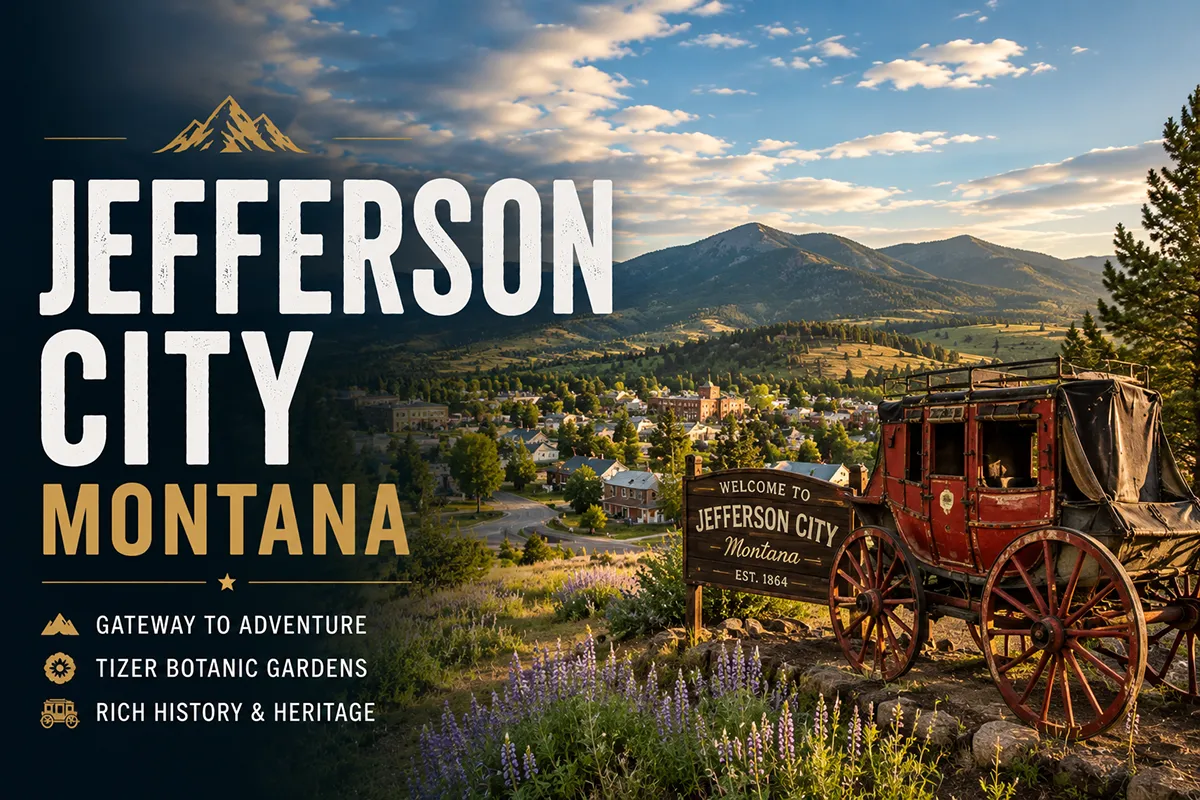
When Jefferson County was created on January 16, 1864 — by the first territorial assembly of Idaho Territory (which then included most of present-day Montana) — it became one of the nine original counties of what would soon be reorganized as Montana Territory on May 26, 1864.
The first county seat was named Jefferson City.
Most travelers driving the I-15 corridor between Helena and Boulder don’t realize they’re passing through a community with one of the most substantively important early-territorial historical pedigrees in Montana.
Jefferson City was the county seat from 1864 to 1869 — the first such designation in what is now a county that has been continuously organized for 161 years. The seat moved to Radersburg in 1869, then to Boulder in 1886, where it has remained ever since.
The town was named — like the county — after Thomas Jefferson, third President of the United States, who was responsible for the Louisiana Purchase that included most of the territory in which Montana was situated. The official county naming happened February 2, 1865.
Jefferson City itself developed as a substantial stop on the Virginia City-Fort Benton stagecoach route — the primary 1860s freight and passenger corridor connecting the booming southwestern Montana gold camps (Virginia City and Bannack) to the steamboat terminus on the Missouri River at Fort Benton.
The location was practical: 14 miles south of present-day Helena, 13 miles north of present-day Boulder, and immediately adjacent to substantial gold and silver mining operations developing in the surrounding Jefferson County hills.
Today, Jefferson City has approximately 275 residents — a substantially smaller community than its territorial-era peak. The town’s contemporary character reflects its position as a substantially residential community along the I-15 corridor between Helena and Boulder, with the historic mining heritage continuing to define the broader landscape.
TL;DR
- Jefferson City (~275) is an unincorporated CDP in Jefferson County, on Interstate 15 between Helena (14 miles north) and Boulder (13 miles south, the current county seat).
- Jefferson City was the first county seat of Jefferson County (1864-1869) — one of Montana Territory’s nine original counties.
- The county was named for Thomas Jefferson (third President of the United States) on February 2, 1865.
- The town developed as a substantial stop on the Virginia City-Fort Benton stagecoach route in the 1860s.
- Lode mining in Jefferson County began in 1864 with the discovery of the Gregory lode near nearby Wickes.
- The Wickes mining district produced approximately 264,000 ounces of gold through 1959 — chiefly as a byproduct of rich silver-lead ores.
- The Montana Tunnels Project — a large open-pit gold mine — has been active near Jefferson City since the late 1990s.
- The Tizer Botanic Gardens near town features approximately 100 varieties of roses and 150 varieties of clematis — a substantially unusual horticultural attraction.
- The remote Tizer Lakes southeast of town provide substantial outdoor recreation opportunities.
- Best for: Montana territorial history travelers, mining heritage exploration, Helena-Boulder I-15 corridor stops, Tizer Gardens visitors.
Liked this article?
Add Roaming Montana as a preferred source so you see more of our articles and guides on Google.
Jefferson City at a Glance
| Population (estimated) | ~275 |
|---|---|
| County | Jefferson County |
| Status | Unincorporated CDP |
| Region | Southwest Montana (I-15 corridor) |
| Elevation | 4,560 ft |
| Distance to Helena (state capital) | ~14 miles north |
| Distance to Boulder (current county seat) | ~13 miles south |
| Distance to Clancy | ~5 miles north |
| Distance to Wickes (mining ghost town) | ~8 miles southwest |
| Distance to Comet (mining ghost town) | ~15 miles southwest |
| Distance to Elkhorn (mining ghost town) | ~25 miles south |
| Distance to Butte | ~50 miles south |
| Distance to Townsend | ~50 miles east |
| Distance to Whitehall | ~45 miles south |
| Highway access | I-15 |
| Founded | 1864 (territorial era) |
| First county seat | 1864-1869 |
| Best for | Territorial history, mining heritage, Tizer Gardens, I-15 corridor |
What Makes Jefferson City Different
Three distinct stories define the community: the territorial founding, the mining heritage, and the contemporary recreational identity.
The Territorial Founding
In the early 1860s, the discovery of gold at Bannack (1862) and Virginia City (1863) triggered the substantial Montana gold rush. Tens of thousands of prospectors, freighters, merchants, and settlers poured into what was then the eastern portion of Washington Territory (and briefly, Idaho Territory after March 1863).
On January 16, 1864, the first Idaho Territorial Assembly organized Jefferson County as one of nine original counties of the territory — covering a substantial portion of what would soon become Montana Territory.
The county was named for Thomas Jefferson in recognition of the Louisiana Purchase that had brought this region under U.S. sovereignty. The county naming was formalized on February 2, 1865 when Montana Territory’s first legislative assembly confirmed the county boundaries.
The first county seat was named Jefferson City.
The community had developed organically as a stop on the Virginia City-Fort Benton stagecoach route — the substantial freight and passenger corridor connecting the southwestern Montana gold camps to the steamboat terminus on the upper Missouri River at Fort Benton.
The Jefferson City location was practical: substantial flat land, water access, a position roughly halfway between the major settlements then developing at Last Chance Gulch (which would become Helena) and at the nearby gold-and-silver mining camps in the Boulder Valley.
The county seat designation lasted five years.
In 1869, the seat was moved to Radersburg — a more substantial mining-era community that had grown rapidly during the 1860s gold rush. Radersburg was eventually overtaken by Boulder, which became the county seat in 1886 and has remained so ever since.
The Mining Heritage
Jefferson County has been substantially defined by mining since the 1860s.
Lode mining began in 1864 with the discovery of the Gregory lode near Wickes — approximately 8 miles southwest of Jefferson City. The Gregory was followed by the Alta, Comet, and Minah mines — collectively responsible for nearly all the metals produced in the broader Wickes (Colorado) district over the next 95 years.
The most active mining period was 1880-1893 — when the Wickes district produced substantial gold (chiefly as a byproduct of rich silver-lead ores).
Gold production from 1864 to 1928 was estimated at approximately $4,325,000 (about 210,000 ounces) from lodes and approximately $25,000 (about 1,200 ounces) from placers. Total production through 1959 reached approximately 264,000 ounces from lodes and 2,200 ounces from placers.
Beyond Wickes, the Clancy district (just north of Jefferson City, around present-day Clancy and Prickly Pear Creek) was the most productive placer-gold area in Jefferson County. The Basin and Boulder district, Elkhorn district, and Whitehall district all produced substantial lode gold.
The Mining Ghost Towns
Several substantial mining-era communities developed during this period that today survive only as ghost towns:
- Wickes: Substantial 1880s town that supported the Gregory, Alta, Comet, and Minah mines. Charcoal kilns built 1881 are still extant. Coke ovens also remain.
- Comet: Substantial 1880s mining camp, today largely abandoned.
- Elkhorn: Substantial 1880s mining town. A few residents still live there today, but most of what remains is essentially a ghost town with old miner cabins, stables, and Fraternity Hall (the substantial community meeting place). One of Montana’s most substantively important mining-era ghost towns.
- Alhambra: Substantial 1880s community. Coke ovens still extant.
- Corbin, Gregory: Smaller historic mining communities.
The Modern Open-Pit
The contemporary mining era in Jefferson County is anchored by the Montana Tunnels Project — a substantial open-pit gold-and-zinc-and-lead mine that has been active near Jefferson City since the late 1990s. The mine extracts ore from a large open pit and processes it on-site, producing substantial gold, zinc, and lead concentrates.
Tizer Botanic Gardens
The Tizer Botanic Gardens — a substantially unusual horticultural attraction located near Jefferson City — features thousands of blooming flowers including approximately 100 varieties of roses and 150 varieties of clematis.
The gardens are open seasonally (typically May through October). At nearly 5,000 feet of elevation, the gardens represent one of the higher-altitude commercial botanical operations in the American West. Verify current scheduling and admission before visiting.
Tizer Lakes
The remote Tizer Lakes — located in the Elkhorn Mountains southeast of Jefferson City — provide substantial outdoor recreation opportunities including hiking, fishing, and dispersed camping. Access is via Forest Service roads from the Jefferson Valley.
For broader trip context, see my Montana cities and towns hub, Montana gold rush overview, and key historical events in Montana.
The Top 6 Things to Do In & Around Jefferson City
1. Tizer Botanic Gardens
The signature contemporary attraction.
Thousands of blooming flowers including 100 varieties of roses and 150 varieties of clematis. Open seasonally (typically May through October). One of the more substantively unusual horticultural attractions in southwestern Montana.
2. Wickes & Comet Ghost Towns
The signature mining heritage attractions.
Wickes — approximately 8 miles southwest of Jefferson City — features the 1881 charcoal kilns and coke ovens from the substantial 1880s mining era. Comet approximately 15 miles southwest features additional substantial mining infrastructure remnants.
Approach respectfully — some of the ghost towns are on private property. Verify access before exploring.
3. Elkhorn Ghost Town
The most substantively important of the Jefferson County mining ghost towns.
Located approximately 25 miles south of Jefferson City via Forest Service roads from Boulder, Elkhorn features substantial surviving infrastructure including Fraternity Hall (the substantial community meeting hall), old miner cabins, stables, and broader village ruins.
A few residents still live in the area. The Elkhorn ghost town is one of the most substantively well-preserved 19th-century mining communities in Montana.
4. Tizer Lakes
The remote alpine lakes southeast of Jefferson City in the Elkhorn Mountains.
Access via Forest Service roads. Hiking, fishing, dispersed camping. Substantial outdoor recreation in genuinely uncrowded territory.
5. Day Trip to Helena (14 miles north)
The Montana state capital and the natural urban anchor for any Jefferson City visit.
Attractions include the Montana State Capitol Building, the Cathedral of St. Helena, the Helena Brewery district, Last Chance Gulch historic district, and substantial restaurant and shopping options. See best things to do in Helena and breweries in Helena for detailed planning.
6. Day Trip to Boulder (13 miles south)
The current Jefferson County seat.
Attractions include the substantial Boulder Hot Springs Inn (1880s Spanish Revival hot springs hotel, NRHP-listed), the Free Enterprise Radon Health Mine and Sunshine Health Mine (unusual radon-therapy operations), the Merry Widow Health Mine, and the 1889 Jefferson County Courthouse.
See best natural hot springs in Montana and Montana hot springs for broader context.
Where to Stay
Jefferson City has limited dedicated lodging.
Most travelers base in Helena (14 miles north) or Boulder (13 miles south).
| Lodging | Vibe | Price | Best For |
|---|---|---|---|
| Helena hotels (20 min N) | State capital | $130–280 | Most travelers |
| Boulder lodging (15 min S) | Boulder Hot Springs Inn | $130–280 | Hot springs visitors |
| Boulder Hot Springs Inn, Spa, Retreat Center | Historic NRHP-listed | $130–280 | Spa-focused |
| Butte options (1 hr S) | Larger city | $110–220 | Extended I-15 travel |
| Vacation rentals (Jefferson Valley) | Limited; rural character | $130–250 | Quieter base |
Where to Eat
- Local Jefferson City options — small selection; verify current operations
- Helena dining (20 min N) — extensive variety; see breweries in Helena
- Boulder restaurants (15 min S) — small-town selection
- Butte options (1 hr S) — see things to do in Butte for additional context
Getting There & Around
From Helena: ~14 miles south on I-15, about 20 minutes.
From Boulder: ~13 miles north on I-15, about 15 minutes.
From Clancy: ~5 miles south on I-15 frontage roads or US-15, about 10 minutes.
From Butte: ~50 miles north on I-15, about 1 hour.
From Townsend: ~50 miles west via US-12 and I-15, about 1 hour.
From Whitehall: ~45 miles north via I-15 and county roads, about 1 hour.
Cell service: Generally available throughout Jefferson City and along I-15.
When to Visit
Summer (June-August): Best weather; Tizer Botanic Gardens at peak bloom; Tizer Lakes access; ghost town exploration; warmest temperatures.
Fall (September-October): Outstanding southwestern Montana fall color; cooler temperatures; quieter; substantial accessibility for the broader mining ghost town exploration.
Winter (December-March): Severe Montana weather; some access limited; Boulder Hot Springs particularly substantive in winter.
Spring (April-May): Snowmelt; the country greens up; quieter shoulder season.
Personal Tips
Read the territorial-era history. Understanding that Jefferson City was the first county seat of one of Montana Territory’s nine original counties — and was eventually displaced by Radersburg (1869) and ultimately Boulder (1886) — adds substantial historical depth to a visit. Most contemporary visitors never realize the community’s substantial early-territorial significance.
Combine with the Clancy and Wickes mining heritage. A morning at the Tizer Botanic Gardens, an afternoon exploring the Wickes ghost town and charcoal kilns, and an evening dinner in Helena — with Jefferson City as the operational base — makes a substantively meaningful southwestern Montana mining heritage day.
Visit Elkhorn ghost town deliberately. The substantial preservation of Elkhorn (~25 miles south via Boulder) makes it one of the most substantively important mining-era ghost towns in Montana. Plan a half-day for proper exploration. Access via Forest Service roads from Boulder.
Plan around the Tizer Gardens bloom calendar. The roses and clematis peak at different times. Verify current bloom conditions with the gardens before visiting if specific flowers are your goal.
Drive the I-15 corridor deliberately. The route between Helena and Butte crosses substantively important mining heritage country. Multiple substantial stops along the way — Jefferson City, Clancy, Boulder, Elkhorn, Basin — make for a substantive day-trip itinerary.
Don’t expect tourism amenities. Jefferson City itself is a substantively quiet residential community. The interesting things are the territorial-era history, the surrounding mining heritage landscape, the Tizer Gardens, and the broader Jefferson County context.
Jefferson City Quick Facts
- Population (estimated) | ~275
- County | Jefferson County
- Elevation | 4,560 ft
- Founded | 1864 (territorial era)
- First county seat | 1864-1869
- County created | January 16, 1864 (Idaho Territorial Assembly)
- County name confirmed | February 2, 1865 (Montana Territorial Assembly)
- County named after | Thomas Jefferson (3rd US President)
- Original Montana Territory counties | 9 (Jefferson among them)
- Subsequent county seats | Radersburg (1869-1886), Boulder (1886-present)
- Original economic role | Virginia City-Fort Benton stagecoach stop
- Lode mining began | 1864 (Gregory lode near Wickes)
- Wickes district peak | 1880-1893
- Wickes total gold production | ~264,000 oz (through 1959)
- Wickes charcoal kilns built | 1881
- Wickes coke ovens | Extant
- Montana Tunnels Project active | Late 1990s-present
- Tizer Botanic Gardens varieties | 100 roses, 150 clematis
- Tizer Lakes location | Elkhorn Mountains southeast
- Average summer high | 80°F
- Average winter low | 12°F
Conclusion
Jefferson City is a 275-person Jefferson County community with substantially significant early-territorial heritage.
The first county seat designation (1864-1869) of one of Montana Territory’s nine original counties. The substantial Virginia City-Fort Benton stagecoach route position. The 1864 founding of the broader mining heritage that defined Jefferson County for over 150 years.
The Wickes (Colorado) mining district with its 264,000 ounces of gold and substantial silver-lead production. The substantial 1881 Wickes charcoal kilns. The Elkhorn ghost town preserved 25 miles south. The contemporary Tizer Botanic Gardens with its 100 varieties of roses and 150 varieties of clematis. The contemporary Montana Tunnels Project open-pit mine.
The next time you’re driving I-15 between Helena and Butte, look for the Jefferson City exit. The community you’ll find isn’t large or visually impressive — but it sits at the substantively significant historical crossroads of Montana territorial heritage.
Have a Jefferson City question? Drop it in the comments — I read every one.
Frequently Asked Questions
Is Jefferson City Montana worth visiting?
Jefferson City is worth a stop primarily for the substantially important Montana territorial-era history (Jefferson City was the first county seat of Jefferson County from 1864 to 1869 — one of Montana Territory’s nine original counties), the surrounding mining heritage landscape (including the Wickes, Comet, and Elkhorn ghost towns), the unusual Tizer Botanic Gardens with 100 varieties of roses and 150 varieties of clematis, and the remote Tizer Lakes in the Elkhorn Mountains southeast of town. Best combined with a broader I-15 corridor exploration between Helena and Boulder.
Was Jefferson City the first county seat of Jefferson County Montana?
Yes — Jefferson City was the first county seat of Jefferson County, Montana from 1864 to 1869. The county was created on January 16, 1864 by the first Idaho Territorial Assembly and was one of the nine original counties of Montana Territory when it was formed on May 26, 1864. The county was officially named for Thomas Jefferson (third President of the United States) on February 2, 1865 by the Montana Territorial Assembly. The county seat was moved to Radersburg in 1869 and then to Boulder in 1886, where it has remained ever since.
What is the Virginia City-Fort Benton stagecoach route?
The Virginia City-Fort Benton stagecoach route was the substantial 1860s freight and passenger corridor connecting the southwestern Montana gold camps at Virginia City and Bannack to the steamboat terminus on the upper Missouri River at Fort Benton. The route ran approximately north-south through what would later become Helena (then Last Chance Gulch), Jefferson City, and the Boulder Valley. The substantial flow of freight, passengers, and gold made the route one of the most economically important pre-railroad corridors in Montana Territory. Jefferson City developed organically as a stop along this route in the early 1860s before being designated the first county seat of Jefferson County in 1864.
How big is Jefferson City Montana?
Jefferson City has approximately 275 year-round residents. The community covers a small area in central Jefferson County at an elevation of 4,560 feet, along Interstate 15 between Helena (14 miles north) and Boulder (13 miles south). The community has substantially contracted from its territorial-era peak when it served as the first county seat.
What are the Tizer Botanic Gardens?
The Tizer Botanic Gardens are a substantially unusual horticultural attraction located near Jefferson City, Montana, featuring thousands of blooming flowers including approximately 100 varieties of roses and 150 varieties of clematis. At nearly 5,000 feet of elevation, the gardens represent one of the higher-altitude commercial botanical operations in the American West. The gardens are open seasonally — typically May through October. Verify current scheduling and admission before visiting.
What is the Wickes mining district?
The Wickes (also called Colorado) mining district is located in north Jefferson County approximately 20 miles south of Helena and 8 miles southwest of Jefferson City. Lode mining began in 1864 with the discovery of the Gregory lode. Four mines — the Gregory, Alta, Comet, and Minah — produced nearly all the metals from the district. The most active period was 1880-1893, with substantial production continuing through 1959. Total gold production through 1959 reached approximately 264,000 ounces from lodes and 2,200 ounces from placers — chiefly as a byproduct of rich silver-lead ores. The substantial 1881 charcoal kilns and coke ovens at Wickes are still extant today.
How far is Jefferson City from Helena Montana?
Jefferson City is approximately 14 miles south of Helena (the Montana state capital) via Interstate 15 — about a 20-minute drive. From Boulder (the current Jefferson County seat to the south), Jefferson City is approximately 13 miles north on I-15, about a 15-minute drive. The position makes Jefferson City substantively practical as a quiet rural-residential base for travelers who want easy access to Helena’s substantial state-capital attractions without staying in the larger city itself.