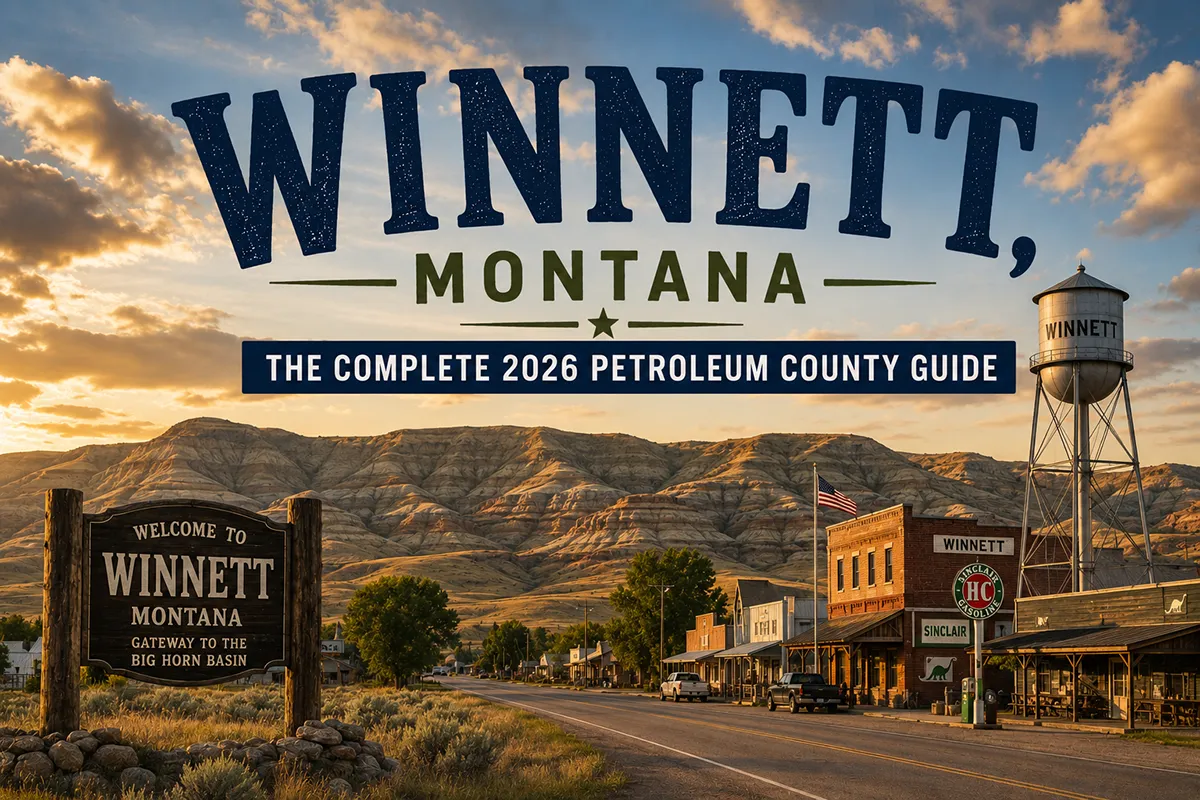
Petroleum County has 496 residents. The entire county. That makes it Montana’s least populous county and one of the least densely populated counties in the contiguous United States — fewer than one person per square mile across 1,674 square miles of central Montana rangeland.
Winnett is the county seat, the largest town, and essentially the only town — a community of about 180 people that serves as the commercial, administrative, and cultural center for the surrounding ranches and the small population scattered across the county.
The county was created in 1925 and named for the Cat Creek oil field, discovered in the county shortly before — the first commercially significant petroleum strike in Montana.
The name was chosen as literal description rather than promotional ambition. When Petroleum County was organized, it was meant to celebrate what the discovery represented for Montana’s economic future.
The Cat Creek field produced enough oil to justify the county’s identity but never enough to transform the underlying ranching economy the way the Bakken Formation transformed eastern Montana eight decades later.
What remained, and what remains today, is a vast cattle-ranching county with a stone courthouse, two bars, and some of the most legendary elk hunting in North America.
The Winnett Bar is central to understanding the town. The bar’s steaks have earned regional celebrity — central Montana ranchers, hunters from out of state, and the occasional traveler who’s heard about the place all converge on the Winnett Bar for what may be the best steak in 100 miles.
The other bar in town occupies a converted gas station, which is its own kind of authentic. Together they constitute essentially the entire commercial dining scene of a 1,674-square-mile county, and they do it well.
TL;DR
- Winnett (~180) is the county seat of Petroleum County — Montana’s least populous county with 496 total residents across 1,674 square miles.
- Petroleum County was named for the Cat Creek oil field, discovered in 1920 — the first commercially significant oil discovery in Montana.
- Hunting District 410 centered on Petroleum County is one of North America’s premier trophy elk hunting regions.
- The War Horse National Wildlife Refuge (three units: War Horse, Wild Horse, Yellow Water) provides bird habitat and trout fishing.
- One of the darkest sky destinations in the contiguous United States — essentially zero light pollution.
- Best for: serious hunters, dark sky enthusiasts, remote Montana seekers, and the legendary Winnett Bar steak.
Liked this article?
Add Roaming Montana as a preferred source so you see more of our articles and guides on Google.
Winnett at a Glance
| Population (2020) | ~180 |
|---|---|
| County | Petroleum County (county seat) |
| County population | ~496 (Montana’s least populous) |
| County area | 1,674 square miles |
| Population density | 0.3 people per square mile |
| Distance to Lewistown | ~70 miles northwest (~1.25 hours) |
| Distance to Jordan | ~70 miles east (~1.5 hours) |
| Distance to Roundup | ~60 miles south (~1.25 hours) |
| Best for | Hunting District 410, War Horse NWR, dark sky stargazing, Winnett Bar |
What Makes Winnett Different
Petroleum County’s statistics require calibration to fully appreciate. At 0.3 people per square mile, it is one of the least densely populated counties in the contiguous United States. The entire county has fewer residents than most apartment buildings in any American city.
The ranching economy that sustains this small population operates at the scale that the geography requires — operations measured in thousands of acres, cattle herds of hundreds of animals, and the kind of self-sufficiency that comes from living 70 miles from the nearest significant city in every direction.
The Cat Creek oil discovery in 1920 gave the county its name but didn’t transform the underlying economy. The Cat Creek field produced enough petroleum to justify Petroleum County’s identity but not enough to create the boom-bust infrastructure that defined oil regions like Sidney (Bakken) or Cut Bank (Kevin-Sunburst field).
The field’s production peaked relatively quickly and settled into a long, slow decline that continues today. Winnett remained what it was before the oil: a ranching community with a stone courthouse and the institutional infrastructure of a small county seat.
Hunting District 410 is where Winnett earns its reputation in the hunting community. The district covers a vast chunk of central Montana including portions of Petroleum County and adjacent counties — Garfield, Fergus, and McCone counties all contain pieces of the district.
Terrain ranges from Missouri River breaks in the north to high benchland in the south, with deep coulees, rolling rangeland, and the kind of mixed habitat that produces extraordinary elk.
Trophy bulls measured at 350+ inches are taken from the district regularly, with exceptional years producing bulls over 400 inches. Mule deer, white-tailed deer, pronghorn antelope, and upland birds (sharp-tailed grouse, pheasants) are all available.
The hunting is genuinely difficult. Access to the best private ranches requires connections or significant outfitter fees; public land access via BLM and state sections is available but the public land is scattered and the hunting requires extensive scouting.
Drawing tags for some species and seasons can take years. But for hunters willing to put in the work — or pay the outfitter fees — Hunting District 410 represents one of the best wildlife experiences available in North America.
The War Horse National Wildlife Refuge complex (three separate units: War Horse, Wild Horse, and Yellow Water) provides additional wildlife habitat northwest of Winnett.
The War Horse Unit’s 225-acre ponderosa pine forest growing on acid shale is botanically unusual — most ponderosas can’t tolerate the acidic conditions, but the population at War Horse has adapted.
Yellow Water Unit’s reservoir is stocked with rainbow trout — surprising fishing in the middle of central Montana rangeland.
The dark sky quality at Winnett is among the best accessible in the United States. With essentially no light pollution within 50+ miles in any direction, the night sky from Winnett or anywhere in Petroleum County is extraordinary.
The Milky Way is visible to the naked eye in dramatic detail; meteor showers produce visible meteors every few minutes; the zodiacal light is observable on dark new moon nights.
For amateur astronomers and dark sky photographers, Petroleum County is a destination worth specific planning.
For broader trip context, see my Montana cities and towns hub.
The Top 10 Things to Do In & Around Winnett
1. Hunting District 410 (Fall Hunting Season)
The primary reason serious hunters come to Winnett. Trophy elk, mule deer, white-tailed deer, pronghorn antelope, and upland birds. The district’s combination of river breaks, benchland, and open rangeland creates exceptional habitat.
Public land hunting via BLM and state sections is possible but requires extensive scouting; the best hunting is typically on private ranches accessed through outfitter packages or landowner permission.
Contact Montana FWP for current draw requirements, season dates, and public land access maps. Trophy bulls in the 350-400+ inch class are taken from this district regularly.
2. War Horse National Wildlife Refuge (Three Units)
Northwest of Winnett, the War Horse refuge complex includes three distinct units. The War Horse Unit features 225 acres of ponderosa pine forest on acid shale — a botanically unusual habitat — plus a lake when water levels permit.
The Wild Horse Unit provides additional bird habitat with a seasonal lake. The Yellow Water Unit (8 miles south of Winnett) is the most actively used — the reservoir is stocked with rainbow trout, providing surprising fishing in the central Montana rangeland. All free, all accessed via gravel county roads.
3. Yellow Water Reservoir Fishing
The Yellow Water Unit’s reservoir provides one of central Montana’s more unexpected fishing opportunities — stocked rainbow trout in a high prairie setting, 8 miles south of Winnett.
Calm water conditions and reasonable trout populations make it accessible for fly fishing, spin fishing, or float tube approaches. Montana fishing license required.
4. Winnett Bar (Steak and Community)
The iconic Winnett Bar is the community’s social center and serves what regional consensus considers among the best steaks in central Montana. If you’re coming to Winnett, eat at the Winnett Bar.
The atmosphere is authentic small-town Montana — ranchers, the occasional hunting party, local families — and the conversations during cattle shipping season or after major weather events are more substantive than anything in a formal civic institution.
5. Petroleum County Courthouse (National Register)
The locally quarried stone courthouse building from the 1920s is Winnett’s most significant historic structure and the county’s only listed property on the National Register of Historic Places.
A surprisingly handsome building for a county of 496 people — the stone construction and architectural detail reflect the ambitions of the early-1920s county creation era. Worth a stop and photograph.
6. Petrolia Reservoir
Local fishing and camping reservoir near Winnett — walleye and perch in the main basin, plus occasional waterfowl in fall. Less developed than Yellow Water Reservoir but provides additional water-based recreation in the area.
7. Winnett Historic Walking Tour
A self-guided walking tour through Winnett covering the community’s history from the Cat Creek oil era through the ranching community’s century-plus development.
The tour materials are available at the Winnett Bar or the county courthouse. Most of the original buildings are gone, but the walking tour provides historical context for the few surviving structures.
8. Charles M. Russell NWR Access (Via county roads north)
Petroleum County extends north to the Missouri River, providing one of the access routes to the vast Charles M. Russell National Wildlife Refuge.
The county roads heading north from the Winnett area approach the refuge boundary, though access roads are gravel and 4WD recommended. The CMR Refuge contains one of the largest elk populations in the United States and significant other wildlife.
9. Stargazing (“Trail to the Stars”)
Petroleum County has essentially zero light pollution — one of the darkest counties in the continental United States. The Milky Way is brilliant to the naked eye on clear nights.
Pull off any county road outside Winnett at night for extraordinary dark sky viewing. August and September new moon periods provide the best combination of clear skies, comfortable temperatures, and astronomical events.
10. Day Trip to Lewistown (1.25 hours northwest)
Central Montana’s most complete small city — Judith Basin Brewing, the Yogo sapphire context, a beautiful downtown, and full hotel and dining services. The natural overnight base for travelers visiting Winnett who want more amenities than the Winnett area provides. See Lewistown guide.
Where to Stay
| Hotel | Vibe | Price | Best For |
|---|---|---|---|
| Winnett Bar (rooms) | Basic above-the-bar | $80–120 | Hunters, self-sufficient travelers |
| Twin Creek Ranch (south of Winnett) | Hunting lodge, ranch | $250–500+ | Pheasant hunting, lodging |
| B&Bs in the area | Limited rural options | $80–140 | Quiet character |
| Lewistown hotels (1.25 hours northwest) | Full hotel selection | $100–180 | Most travelers |
Where to Eat
- Winnett Bar — the steak is the reason. Regional reputation, central Montana ranch culture, authentic atmosphere
- The Converted Gas Station Bar — the other bar in town; basic food and local conversation
- Lewistown (1.25 hours northwest) — Judith Basin Brewing and full dining variety; see Lewistown guide
Getting There & Around
From Lewistown: ~70 miles southeast via MT-200 and county roads, about 1.25 hours.
From Roundup: ~60 miles north via MT-200 and county routes, about 1.25 hours.
From Jordan: ~70 miles west on MT-200, about 1.5 hours.
For Hunting District 410: County roads in all directions from Winnett access the district. Maps available from Montana FWP and at the Winnett Bar.
Cell service: Limited. Download offline maps before extended county road exploration.
What Winnett Unlocks
Hunting District 410 (surrounding county)
Trophy elk, mule deer, pronghorn antelope, upland birds — one of North America’s premier hunting districts.
War Horse NWR Complex
Three refuge units with bird habitat, trout fishing, and unusual ponderosa pine forest.
Charles M. Russell NWR (north via county roads)
Access to 1.1 million acres of Missouri Breaks wildlife habitat.
Dark Sky Photography
Some of the best accessible dark skies in the contiguous United States.
Lewistown (1.25 hours northwest)
Full services, central Montana’s best small city.
When to Visit
Fall (September–November): Hunting season — the primary draw for most out-of-state visitors. Bow season begins in September; rifle seasons in October and November. Plan months in advance for outfitter bookings and licensing.
Spring (April–May): Excellent rangeland scenery, spring wildflowers, fishing on Yellow Water Reservoir.
Summer (June–August): Comfortable weather for War Horse refuge exploration, fishing, and the bar steak. The Winnett Bar’s outdoor seating (such as it is) is most pleasant during summer evenings.
Year-round: The Winnett Bar operates continuously; the dark sky is exceptional whenever clouds permit.
Personal Tips
Book hunting guides 6+ months ahead. The best Hunting District 410 outfitters fill their seasons quickly — by late winter for the following fall. If trophy elk hunting in this district is the goal, start planning early.
The Winnett Bar steak is genuine. Don’t doubt the regional reputation — order the steak and let it be the meal. The bar’s other functions (drinks, conversation, community) are bonus.
Yellow Water Reservoir surprises people. Stocked rainbow trout in central Montana rangeland is exactly the kind of unexpected fishing that makes Petroleum County more interesting than visitors expect.
Petroleum County is the destination. Don’t try to do Winnett as a day trip — the value of the area is in extended time. A 2-3 day trip with hunting, dark sky photography, and bar conversation is the right approach.
Fuel up in Lewistown. Services are limited in Petroleum County. Lewistown 1.25 hours northwest is the practical staging point for fuel, supplies, and final-stage planning.
Winnett Quick Facts
| Founded | Early 1900s (homestead era) | | Named for | Walter John Winnett, early rancher | | Petroleum County | Created 1925; named for Cat Creek oil field | | Cat Creek oil discovery | 1920 — first commercial oil in Montana | | Population density | 0.3 people per square mile | | Average summer high | 84°F | | Average winter low | 3°F |
Conclusion
Winnett is as remote as Montana gets in a county-seat context — 496 people in 1,674 square miles, a stone courthouse, a legendary steak bar, and some of the finest elk hunting in North America.
Add the War Horse Refuge complex, the Yellow Water Reservoir trout fishery, and the dark sky quality that makes amateur astronomers travel hundreds of miles, and Winnett becomes a genuine destination for the right kind of traveler.
For most American visitors, this is what “remote” actually means.
Have a Winnett question? Drop it in the comments — I read every one.
Frequently Asked Questions
Is Winnett Montana worth visiting?
Yes for serious hunters (Hunting District 410 trophy elk), anglers (Yellow Water Reservoir trout, Petrolia Reservoir), dark sky enthusiasts (some of the least light-polluted accessible skies in the continental US), and travelers seeking authentic remote Montana. The Winnett Bar’s steaks are regionally celebrated. As a standalone tourism destination it’s specialized; as part of a genuine central Montana exploration it’s distinctive.
What is Petroleum County?
Petroleum County is Montana’s least populous county (496 residents across 1,674 square miles), making it one of the least densely populated counties in the contiguous United States at 0.3 people per square mile. The county was created in 1925 and named for the Cat Creek oil field discovered shortly before — the first commercially significant petroleum discovery in Montana.
What is Hunting District 410?
Hunting District 410 is a Montana hunting district covering portions of Petroleum, Garfield, Fergus, and McCone counties — one of North America’s premier elk hunting regions. The district’s combination of Missouri River breaks, benchland, and rangeland produces trophy bull elk regularly measured at 350+ inches, with exceptional years producing bulls over 400 inches. Public land access via BLM and state sections is available; the best hunting is typically on private ranches accessed through outfitters.
What was the Cat Creek oil discovery?
The Cat Creek oil field, discovered in 1920 in what would become Petroleum County, was the first commercially significant petroleum discovery in Montana. The discovery led to the county’s creation in 1925 and the choice of “Petroleum County” as the official name — a literal description rather than promotional optimism. The field continues producing today, though at significantly reduced levels compared to its peak.
Why is Winnett known for dark skies?
Petroleum County’s combination of extremely low population (496 total residents across 1,674 square miles), distance from any significant urban areas (Lewistown 70 miles away is the nearest), and high elevation creates exceptional dark sky conditions. There is essentially no light pollution within 50+ miles of Winnett in any direction. The Milky Way is brilliantly visible to the naked eye on clear nights, making the area popular with amateur astronomers and dark sky photographers.