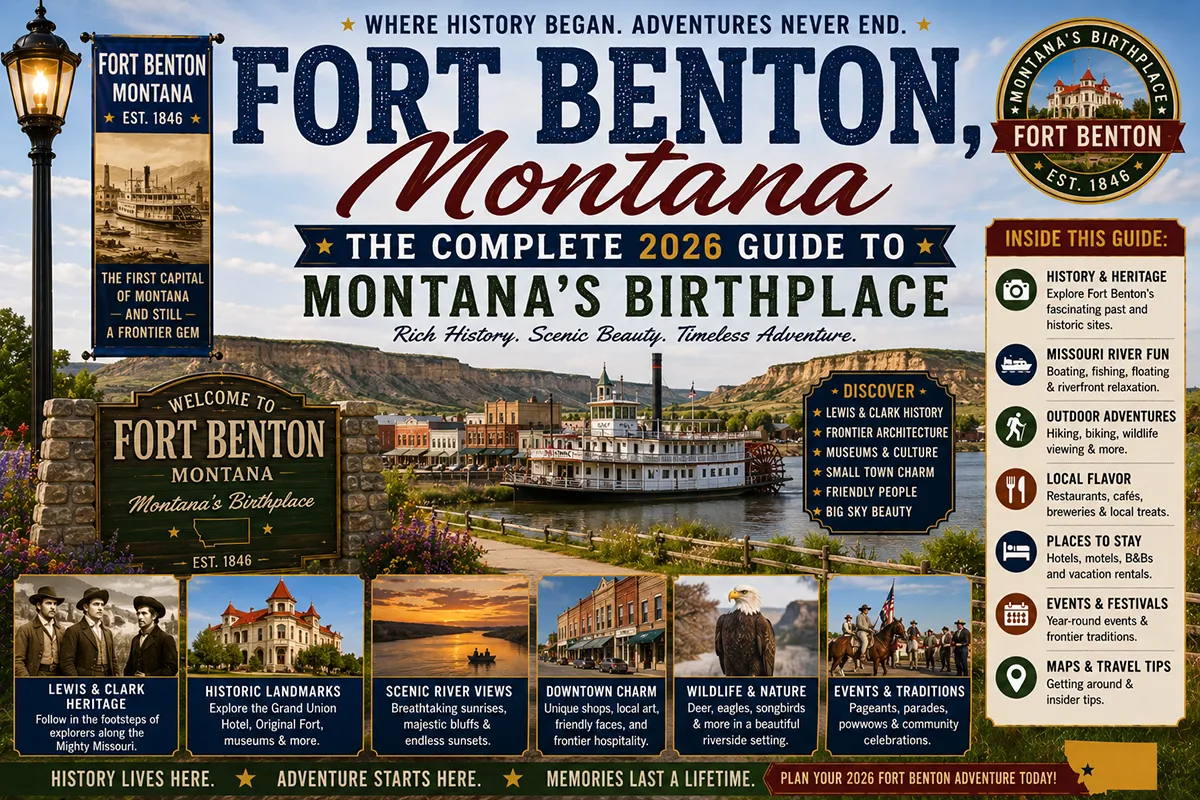
In 1860, the steamboat Chippewa reached Fort Benton — 3,000 miles upstream from New Orleans, 2,285 miles from St. Louis. It was the farthest inland any steamboat had ever traveled on the Missouri River.
Fort Benton was, briefly, the most important trade city between St. Louis and the Pacific Coast. They called Front Street “the bloodiest block in the West” because twelve of its thirteen businesses were saloons, brothels, or dance halls.
Today Front Street is a quiet park along the Missouri. A bronze sheepdog sits at the levee. The Grand Union Hotel still stands.
TL;DR
- Fort Benton (~1,500) is the “Birthplace of Montana” — established as a fur trading post in 1846, it became the world’s most inland seaport and the commercial and political launching pad for the Montana Territory.
- The Grand Union Hotel (1882) is one of Montana’s most historically significant hotels, still operating.
- The story of Shep — a loyal sheepdog who waited at the train station for his dead owner for 5.5 years — is one of Montana’s most beloved tales.
- The Museum of the Upper Missouri and Old Fort Benton reconstruction are exceptional.
- The Wild and Scenic Upper Missouri River offers outstanding canoe and float trips below town.
- Best for: history travelers, Lewis & Clark enthusiasts, Missouri River canoeists, day-trippers from Great Falls (40 miles south).
Liked this article?
Add Roaming Montana as a preferred source so you see more of our articles and guides on Google.
Fort Benton at a Glance
| Population (2020) | ~1,500 |
|---|---|
| County | Chouteau County (county seat) |
| Region | North-Central Montana |
| Elevation | 2,600 ft |
| Historical significance | World’s most inland seaport (steamboat era) |
| Distance to Great Falls | ~40 miles (~45 min) |
| Distance to Havre | ~100 miles (~1.5 hours) |
| Best for | History, Lewis & Clark, Missouri River, day trip from Great Falls |
What Makes Fort Benton Different
Fort Benton’s claim is specific and verifiable: it was the farthest point upstream on the Missouri River that steamboats could reach, making it the commercial hub for the fur trade and gold rush commerce of the entire Northern Rockies from the 1860s through the 1880s. Goods from New Orleans arrived here. Gold dust from Virginia City left here. Merchants, miners, and missionaries all passed through.
Lewis and Clark camped near here in 1805. The Old Fort (reconstructed on the original footprint) preserves that history. Four museums in the Heritage Complex together tell the story more completely than almost any small-town museum cluster in Montana.
Then there’s Shep. In 1936, a sheep herder from Fort Benton fell ill and died. His body was shipped east by train from Fort Benton. His dog watched the casket loaded onto the train and then — for 5.5 years — met every train at the Fort Benton station, waiting for his owner to return. Station workers fed Shep and eventually named him.
He died in 1942 after slipping on an icy rail. The bronze statue at the levee is one of the most visited sites in Fort Benton.
For broader trip context, see my Montana cities and towns hub.
The Top 10 Things to Do in Fort Benton
1. The Heritage Complex (Four Museums)
The Fort Benton Heritage Complex includes four distinct museums under one admission: Old Fort Benton (reconstructed fur trading fort), Museum of the Upper Missouri (steamboat era and Native American history), Museum of the Northern Great Plains (agriculture), and the agricultural history center. Plan a full morning — 3+ hours — to do it justice.
2. Visit Shep’s Memorial
The bronze statue of Shep at the riverfront levee is Fort Benton’s most emotionally resonant site. The story is displayed on interpretive panels nearby. Bring tissues.
3. Walk Front Street
Montana’s most historically significant commercial streetscape — the original steamboat-era buildings along the Missouri River. The Grand Union Hotel anchors the east end. Walk the full length of the levee park.
4. Stay or Dine at the Grand Union Hotel
Built in 1882 and called the “Waldorf of the West,” the Grand Union is Montana’s oldest continuously operating hotel. The dining room is excellent. Even if you don’t stay the night, the lobby and dining room are worth visiting.
5. Canoe or Float the Wild and Scenic Upper Missouri River
The 149-mile stretch of the Missouri below Fort Benton is designated Wild and Scenic — one of the few sections of the Missouri that looks essentially as Lewis and Clark saw it in 1805. Multi-day canoe and kayak trips (3–7 days) through the White Cliffs area are one of Montana’s greatest river experiences. Several outfitters in Fort Benton offer guided and self-guided trips.
6. Day Float on the Missouri
Even a 4–6 hour float from Fort Benton toward Coal Banks Landing gives an extraordinary introduction to the White Cliffs landscape and Lewis & Clark history.
7. Lewis & Clark National Historic Trail
Fort Benton is a major waypoint on the Lewis & Clark Trail — the expedition passed within sight in 1805 (upstream) and 1806 (downstream). Interpretive panels throughout town cover the expedition’s route.
8. Montana Agricultural Center
Part of the Heritage Complex — covers the transformation of Montana’s prairie into wheat-farming country, with original equipment, photographs, and oral histories.
9. Drive to the White Cliffs Overlook
Take the road northeast of Fort Benton to overlooks above the Missouri River canyon. The white sandstone formations that Lewis & Clark described in their journals are visible from these overlooks.
10. Fort Benton Bridge Walk
The historic highway bridge over the Missouri at Fort Benton is now a pedestrian span. Walk it for river views and to understand the town’s geography.
Where to Stay
| Hotel | Vibe | Price | Best For |
|---|---|---|---|
| Grand Union Hotel | Historic 1882, fully restored | $180–280 | Splurge, history lovers |
| Pioneer Lodge | Basic, functional | $90–140 | Budget |
| Great Falls hotels (40 min) | Full selection | $130–250 | Budget travelers |
Fort Benton’s limited lodging is best supplemented by Great Falls for those wanting more options.
Where to Eat
- Grand Union Hotel Restaurant — best dining in Fort Benton; locally sourced menu
- Union Grille — casual, solid lunch
- Bob’s Riverfront Restaurant — burgers and basics on the levee
- Great Falls (40 min) has a full dining scene; see Great Falls guide
Getting There
From Great Falls: 40 miles north on US-87, about 45 minutes. Fort Benton is an easy half-day or full-day trip from Great Falls.
From Havre: ~100 miles east on US-87, about 1.5 hours.
What Fort Benton Unlocks
Wild & Scenic Missouri River Float (from Fort Benton)
Multi-day canoe trips through the White Cliffs — the most Lewis & Clark-authentic river experience in Montana.
Great Falls (40 min)
C.M. Russell Museum, Lewis & Clark Interpretive Center. See Great Falls guide.
Havre & Bear Paw Battlefield (1.5 hours)
Hi-Line gateway and Chief Joseph surrender site. See Havre guide.
When to Visit
Summer (June–August) is the Missouri River float season and the full museum season.
May and September are good shoulder months — less crowd, pleasant temperatures.
The Heritage Complex is open most of the year with reduced winter hours.
Personal Tips
Book a Missouri River canoe trip. The White Cliffs stretch is one of Montana’s transformative experiences. Multi-day trips are booked through Fort Benton outfitters; plan 3–5 days for the Coal Banks Landing to Judith Landing section.
Stay at the Grand Union if you can. The history of the building, the dining room food quality, and the riverside location make it genuinely worthwhile.
Time Shep’s memorial for a quiet moment. In summer, the levee gets busy. Early morning or evening, when the light is on the Missouri and few visitors are about, is when the emotional weight of Shep’s story fully lands.
Combine with Great Falls in a day trip. 40 minutes away, with the C.M. Russell Museum and Lewis & Clark Interpretive Center — together they make a compelling central Montana history day.
Fort Benton Quick Facts
| Founded | 1846 (American Fur Company trading post) |
|---|---|
| Peak era | 1860–1888 (steamboat commerce) |
| Famous distinction | World’s most inland seaport |
| Average summer high | 84°F |
| Average winter low | 10°F |
Conclusion
Fort Benton is small, quiet, and extraordinarily important to Montana’s story. The steamboat levee, the Heritage Complex, the Grand Union Hotel, and Shep’s memorial together give you more genuine Montana history per hour than almost anywhere else in the state. The Wild and Scenic Missouri below town adds one of the great river adventures in the American West. For history travelers and canoeists, this is essential.
Have a Fort Benton question? Drop it in the comments — I read every one.
Frequently Asked Questions
Is Fort Benton Montana worth visiting?
Yes — Fort Benton is one of Montana’s most historically significant small towns, worth a half-day or full-day visit from Great Falls. The Heritage Complex (four museums), the Grand Union Hotel, the story of Shep the loyal dog, the riverfront levee walk, and access to Wild and Scenic Missouri River canoe trips make it an extraordinary stop for history travelers.
Why is Fort Benton called the Birthplace of Montana?
Fort Benton was established in 1846 as a fur trading post and became the world’s most inland seaport — the farthest point upstream that Missouri River steamboats could reach. It served as the commercial and logistical hub for Montana Territory’s gold rush era and early settlement, earning it the “Birthplace of Montana” designation.
What is the story of Shep in Fort Benton?
In 1936, a sheep herder from the Fort Benton area died and his body was shipped east by train. His dog — later named Shep by station workers — watched the casket loaded and then met every arriving train at the Fort Benton station for 5.5 years, waiting for his owner to return. Shep died in 1942 after slipping on an icy rail. A bronze statue at the Missouri River levee commemorates him.
What is the Grand Union Hotel in Fort Benton?
The Grand Union Hotel is an 1882 Victorian hotel on Fort Benton’s riverfront, called the “Waldorf of the West” at its opening. It’s Montana’s oldest continuously operating hotel. After a period of decline it was fully restored and now offers lodging and dining in a building that preserves significant Montana steamboat-era history.
Can you canoe the Missouri River from Fort Benton?
Yes — the 149-mile stretch of the Missouri River below Fort Benton is designated Wild and Scenic, and several Fort Benton outfitters offer guided multi-day canoe and kayak trips through the White Cliffs area. This section of the river looks essentially as Lewis and Clark saw it in 1805. Multi-day trips (3–7 days) are the full experience; shorter day floats are also available.
How far is Fort Benton from Great Falls?
Fort Benton is approximately 40 miles north of Great Falls — about a 45-minute drive on US-87. This proximity makes Fort Benton an excellent half-day or full-day day trip from Great Falls.