Bear Paw Battlefield is 16 miles south of Havre. On October 5, 1877, after a 1,170-mile flight from the U.S. Army beginning in the Wallowa Valley of Oregon, Nez Perce Chief Joseph surrendered here with the words: “From where the sun now stands, I will fight no more forever.”
He was 37 miles from the Canadian border — freedom — when exhaustion and cold stopped him. The battlefield is a national monument now, managed by the Nez Perce National Historical Park. It’s one of the most sobering sites in American history.
Most people drive past Havre on US-2 without stopping. That’s a mistake.
TL;DR
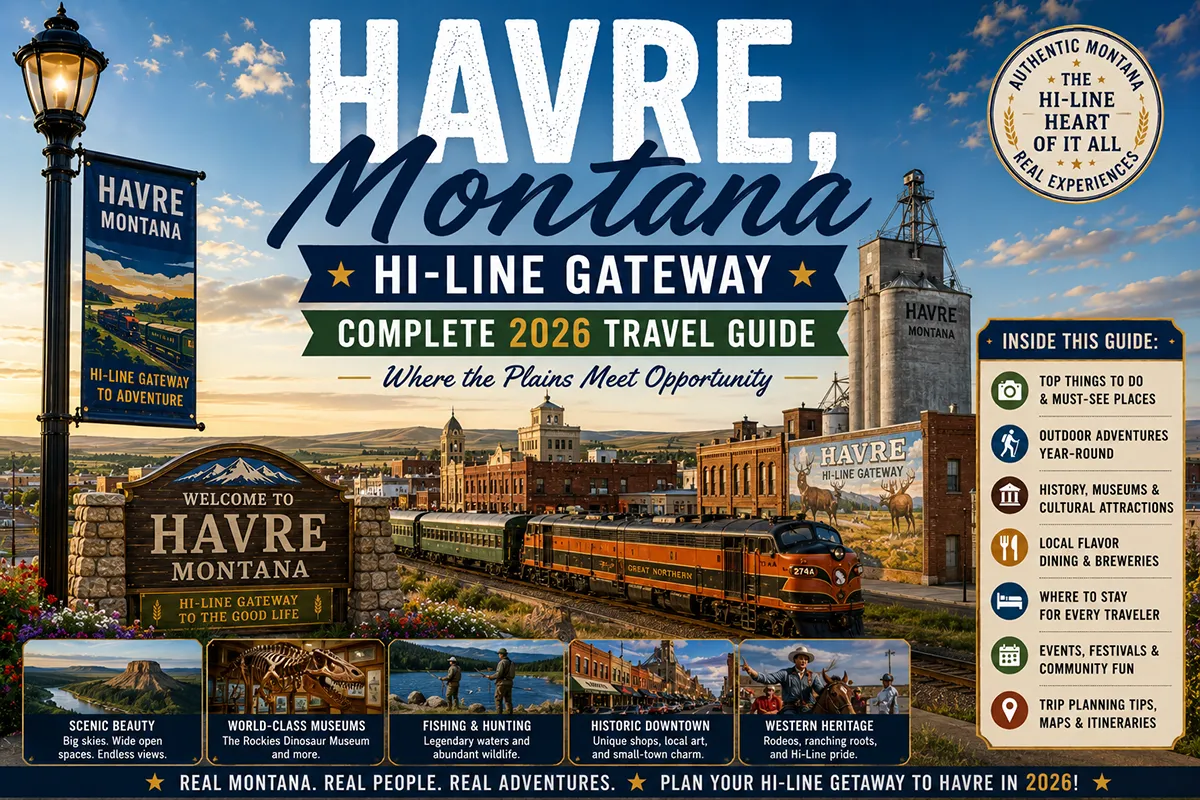
- Havre (~9,700) is the largest city on Montana’s Hi-Line — the 500-mile US Highway 2 corridor running east-west along the old Great Northern Railway.
- Home of Havre Beneath the Streets, an extraordinary underground tour of Havre’s original subterranean commercial district from the 1900s.
- Gateway to Bear Paw Battlefield — where Chief Joseph surrendered — 16 miles south.
- Fort Assinniboine nearby — one of the largest frontier forts in the American West.
- Best for: Hi-Line road trippers, history travelers, off-the-beaten-path Montana exploration.
Liked this article?
Add Roaming Montana as a preferred source so you see more of our articles and guides on Google.
Havre at a Glance
| Population (2020) | ~9,700 |
|---|---|
| County | Hill County (county seat) |
| Region | North-Central Montana (Hi-Line) |
| Elevation | 2,493 ft |
| University | Montana State University-Northern |
| Distance to Great Falls | ~115 miles (~2 hours) |
| Distance to Glacier NP East Entrance | ~130 miles (~2.5 hours) |
| Best for | Hi-Line road trips, Havre Beneath the Streets, Bear Paw Battlefield, frontier history |
What Makes Havre Different
The Hi-Line is not Montana’s most visited corridor — that honor goes to the I-90/Yellowstone circuit and the Glacier-Whitefish axis. But US Highway 2 along the Hi-Line is one of the most historically significant roads in Montana, following the route of James J. Hill’s Great Northern Railway and passing through the heart of the Northern Plains tribes’ traditional territory.
Havre is the Hi-Line’s main population center. It exists because of the railroad — the Great Northern needed a division point, and in 1879 the town of Havre appeared. The railroad shaped everything: the underground commercial district (businesses moved underground to avoid the harsh winters and unregulated street life above), the immigrant communities, the cattle culture.
The area’s history is significant: Fort Assinniboine to the southwest was one of the most formidable frontier forts in North America. Bear Paw Battlefield 16 miles south is where one of American history’s most poignant stories ended.
For broader trip context, see my Montana cities and towns hub.
The Top 10 Things to Do in Havre
1. Havre Beneath the Streets
The most distinctive attraction in northern Montana. A 1-hour guided underground tour of the original subterranean commercial district that operated beneath Havre from approximately 1904 to the 1930s. When the above-ground buildings burned or the streets became too rough, entrepreneurs moved businesses underground — an opium den, a brothel, a bakery, a butcher shop, a Chinese laundry. The original spaces survive remarkably intact.
This is one of the most unique historical tours in Montana. Reserve in advance.
2. Bear Paw Battlefield National Monument (16 miles south)
The site where Chief Joseph and approximately 400 Nez Perce people were surrounded on October 1–5, 1877, after a 1,170-mile flight across four states. The fighting lasted 5 days in cold autumn weather before Joseph surrendered. A self-guided driving and walking tour covers the battle positions. Managed by the Nez Perce National Historical Park. Free. Profoundly moving.
3. Fort Assinniboine
One of the largest frontier military posts in the American West, built in 1879 to prevent Sitting Bull and his followers from returning from Canada. The fort was decommissioned in 1911. Several original buildings survive and are accessible via guided tours arranged through MSU-Northern.
4. H. Earl Clack Museum
The Havre area regional history museum covering the Hi-Line’s Native American history, frontier settlement, railroad development, and the local ecology. Free.
5. Rocky Boy’s Indian Reservation (Chippewa-Cree)
The Rocky Boy’s Reservation borders Havre and is home to the Chippewa-Cree people. Cultural events and the Bear Paw Ski Bowl are on or near the reservation.
6. Bear Paw Ski Bowl (Rocky Boy’s Reservation)
A small ski area on Bear Paw Mountain at the edge of the reservation. Basic, affordable, excellent for families and local culture. Usually open December through March.
7. Beaver Creek County Park (Day Trip, 30 min south)
One of the largest county parks in the U.S. at 10,000+ acres — forests, reservoirs, and camping in the Bear Paw Mountains.
8. Wahkpa Chu’gn Buffalo Jump
A prehistoric buffalo jump (bison driven off a cliff for hunting) adjacent to the Havre Holiday Village Mall. Archaeological site with 2,000+ years of use. Tours available.
9. Chinook (30 minutes east)
The small town near Bear Paw Battlefield. The Blaine County Museum there has excellent Chief Joseph and Nez Perce context for the battlefield visit.
10. Hi-Line Road Trip Architecture
Driving US-2 through small towns like Chinook, Malta, and Glasgow — the grain elevators, 1910s-era storefronts, and railroad infrastructure represent an intact landscape of early Great Plains settlement that’s disappearing everywhere else.
Where to Stay
| Hotel | Vibe | Price | Best For |
|---|---|---|---|
| Havre Inn & Suites | Full-service, reliable | $110–180 | Most travelers |
| Best Western Havre | Chain standard | $110–170 | Most travelers |
| El Toro Inn | Budget motel | $80–130 | Very budget |
| Budget Host Hi-Line Motel | Basic budget | $75–110 | Very budget |
| Travelodge Havre | Budget chain | $80–130 | Interstate travelers |
Havre is one of Montana’s most affordable overnight stops.
Where to Eat
- Duck Inn — steaks and prime rib, Havre’s best dinner
- 15th Street Station — casual American
- Athenian Restaurant — Greek-American, a regional institution
- Pizza Hut/chain options — limited but available
- Bullhook Community Club — bar and grill
Getting There
From Great Falls: ~115 miles northeast on US-87, about 2 hours.
From Glacier East Entrance: ~130 miles east on US-2, about 2.5 hours.
By train: Havre is a stop on the Amtrak Empire Builder (Chicago–Seattle) — one of the few Montana cities accessible by train year-round.
By plane: Havre City-County Airport (HVR) offers limited service to Billings and Great Falls.
What Havre Unlocks
Bear Paw Battlefield (16 min)
The Chief Joseph surrender site.
Chinook & Blaine County Museum (30 min)
Chief Joseph context, Hi-Line history.
Glacier National Park East Entrance (2.5 hours)
Drive US-2 west through Cut Bank and into the park at St. Mary.
Great Falls (2 hours south)
C.M. Russell Museum, Lewis & Clark Interpretive Center. See Great Falls guide.
Malta, Glasgow, Fort Peck Dam (1–3 hours east)
Continue the Hi-Line road trip east.
When to Visit
Summer (June–August) is the most comfortable. Havre Beneath the Streets tours run daily, Bear Paw Battlefield is fully accessible, Fort Assinniboine tours available.
Fall (September–October) is quieter, excellent weather.
Winter is cold — US-2 can become treacherous in blizzards; be prepared.
Late April–May can be excellent — spring wildflowers on the plains.
Personal Tips
Reserve Havre Beneath the Streets. Tours fill, especially in summer. Book at least a day ahead.
Bear Paw Battlefield requires a full hour. Don’t rush the self-guided tour. The interpretive stops are thoughtfully placed to help you understand the battle positions.
The Hi-Line road trip is a full day, not just Havre. Plan to also stop in Chinook (Bear Paw Museum), Malta (dinosaur country), and Glasgow (Fort Peck).
Take the Empire Builder train if you can. The Havre Amtrak station still serves the Empire Builder, and the approach to Havre through the Hi-Line plains is beautiful at sunrise.
Havre Quick Facts
| Founded | 1879 (Great Northern Railroad) |
|---|---|
| Named for | Le Havre, France (by a French railroad financier) |
| Major industries | Agriculture, railroad, MSU-Northern, healthcare |
| Average summer high | 83°F |
| Average winter low | 4°F |
| Amtrak | Yes (Empire Builder) |
Conclusion
Havre is the Hi-Line’s essential stop. Havre Beneath the Streets is one of the most unique historical tours in Montana; Bear Paw Battlefield is one of the most important historical sites in the American West. Together they make a day in Havre genuinely worth planning. Add the Fort Assinniboine tour and Beaver Creek Park, and you have a full 48 hours of content that most Montana travelers will completely miss.
Have a Havre question? Drop it in the comments — I read every one.
Frequently Asked Questions
Is Havre, Montana worth visiting?
Yes — Havre offers two of the most distinctive and historically significant experiences in Montana: Havre Beneath the Streets (an underground tour of an original 1900s subterranean commercial district) and Bear Paw Battlefield (where Chief Joseph and the Nez Perce surrendered after a 1,170-mile flight, 37 miles from the Canadian border). Together these two sites make Havre one of the most rewarding off-the-beaten-path stops in the state.
What is Havre Beneath the Streets?
Havre Beneath the Streets is a guided tour of the original underground commercial district built beneath Havre starting around 1904. When fires and difficult winter conditions made above-ground life challenging, entrepreneurs moved their businesses underground — creating a subterranean city that included a bakery, butcher shop, Chinese laundry, brothel, and opium den. The underground spaces survive remarkably intact and are accessible only via guided tour. Approximately one hour.
What is Bear Paw Battlefield near Havre?
Bear Paw Battlefield is a National Monument (managed as part of the Nez Perce National Historical Park) marking the site of the final battle of the Nez Perce War of 1877. On October 5, 1877, Chief Joseph surrendered here after a 1,170-mile flight from the Wallowa Valley of Oregon, 37 miles short of the Canadian border. It’s one of the most historically significant and emotionally resonant battlefield sites in the American West. Free admission; self-guided tour.
Can you take a train to Havre Montana?
Yes — Havre is a stop on the Amtrak Empire Builder route (Chicago to Portland/Seattle), one of the few Montana cities accessible by direct passenger train year-round. The station is active and the approach to Havre through the Hi-Line plains is one of the most dramatic sections of the Empire Builder route.
How far is Havre from Glacier National Park?
Havre is approximately 130 miles west of Glacier National Park’s East Entrance at St. Mary — about a 2.5-hour drive via US-2 west. Havre can serve as an eastern base for visiting Glacier, though Kalispell or Whitefish are much closer and more practical.
What is the Hi-Line in Montana?
The Hi-Line is the informal name for the corridor along US Highway 2 in northern Montana, following the route of James J. Hill’s Great Northern Railway (1893). The name refers to the route’s high northern latitude. The Hi-Line passes through Havre, Chinook, Malta, Glasgow, Plentywood, and dozens of small agricultural towns across 500 miles of northern Montana.
Is Havre good for a road trip stop?
Yes — Havre is one of the best road trip stops on the Hi-Line. It’s the corridor’s largest city, has the best accommodation selection, features Havre Beneath the Streets as a compelling afternoon activity, and sits 16 miles from Bear Paw Battlefield. For travelers driving US-2 across northern Montana, Havre is the natural overnight stop.