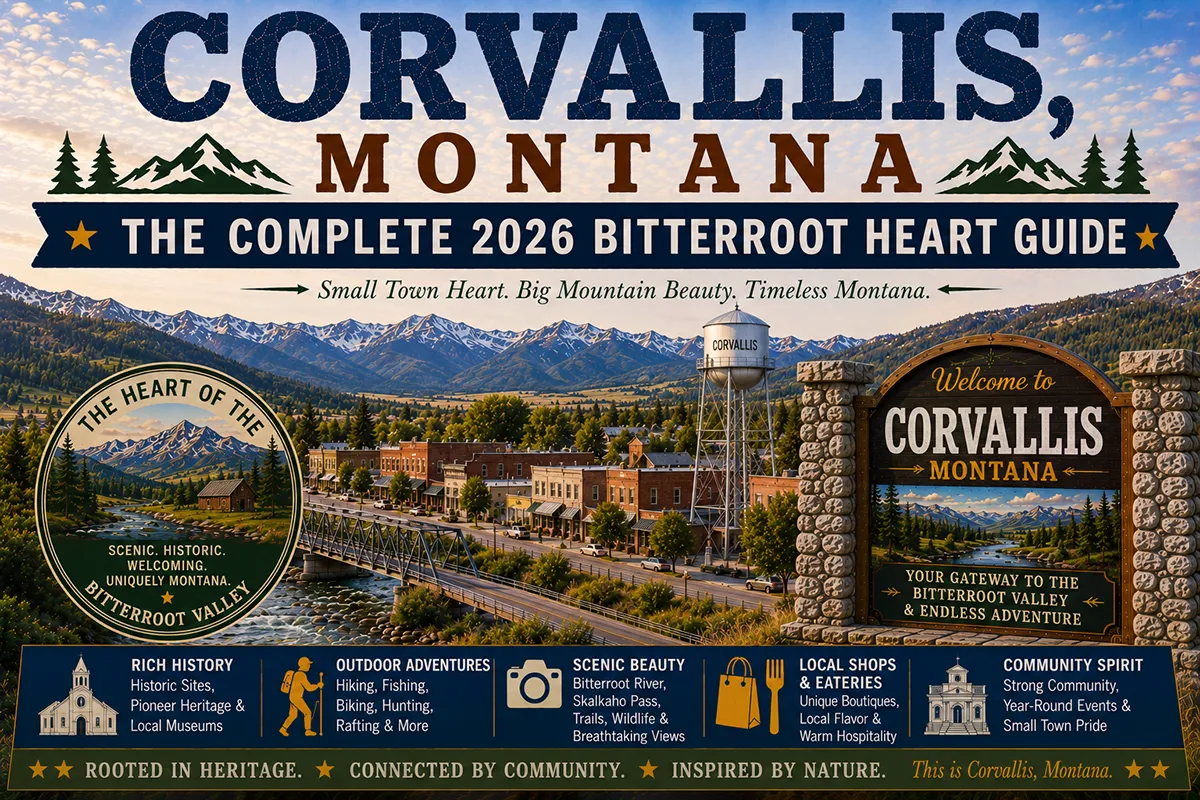
The name comes from the Latin cor vallis — “heart of the valley” — and the early settlers from Corvallis, Oregon who founded this community in the 1860s chose it for exactly that reason. Corvallis sits in the geographic and agricultural center of the Bitterroot Valley, and it was one of the first permanent non-mission settlements in the entire valley.
The Teller Wildlife Refuge, which sprawls across 1,300 acres of Bitterroot River frontage just west of town, is one of the finest conservation properties in western Montana — and almost no one outside the region knows about it.
TL;DR
- Corvallis (~1,200) is in the mid-Bitterroot Valley on US-93, 5 miles north of Hamilton.
- The Teller Wildlife Refuge — 1,300 acres of Bitterroot River frontage, managed by the Teller Wildlife Trust — is open to the public for hiking, fishing, birding, and wildlife photography.
- One of the oldest non-mission settlements in the Bitterroot Valley, dating to the 1860s.
- The mid-valley apple orchard heritage supports a growing cidery culture.
- Best for: wildlife refuge visitors, Bitterroot River fishing, valley history, and cidery stops.
Liked this article?
Add Roaming Montana as a preferred source so you see more of our articles and guides on Google.
Corvallis at a Glance
| Population (2020) | ~1,200 |
|---|---|
| County | Ravalli County |
| Region | Western Montana (Bitterroot Valley) |
| Distance to Hamilton | ~5 miles south (~8 min) |
| Distance to Victor | ~7 miles north (~10 min) |
| Named for | Corvallis, Oregon (by Oregon settler founders) |
| Meaning | Cor vallis (Latin: heart of the valley) |
What Makes Corvallis Different
The Teller Wildlife Refuge is the central SERP gap for Corvallis. This 1,300-acre conservation property managed by the Teller Wildlife Trust holds some of the most productive Bitterroot River riparian habitat in the valley — cottonwood forest, wetlands, side channels, and river access — all open to the public for non-motorized recreation.
Birders find it exceptional: more than 180 bird species have been documented, including nesting great horned owls, ospreys, bald eagles, and Swainson’s hawks.
The property’s conservation model is also significant. Rather than government acquisition, the Teller family donated the land to a private conservation trust that manages it specifically for wildlife. That model has influenced conservation work across the Bitterroot Valley.
The orchard heritage is real: the Bitterroot Valley grows more than 70 apple varieties, and cideries have emerged in recent years using that agricultural tradition. The Corvallis area is part of the valley’s cidery cluster — worth a stop for apple-based local products.
The Top Things to Do
1. Teller Wildlife Refuge
The most important reason to stop in Corvallis. Walk the trail system through 1,300 acres of riparian forest and wetland along the Bitterroot River. Birding, wildlife photography, and hiking are all excellent. Free public access.
2. Bitterroot River Fishing
Multiple public access sites near Corvallis for brown and rainbow trout fishing in the Bitterroot River.
3. Bitterroot Valley Cideries
The Corvallis area is near the heart of the valley’s cider industry. Local cideries use traditional Bitterroot apple varieties — worth a tasting stop.
4. Historic Bitterroot Valley Farmsteads
Corvallis has some of the oldest surviving ranch and farmstead buildings in the Bitterroot Valley — structures dating to the 1860s and 1870s visible from county roads.
5. Bitterroot Trail Cycling
The 50-mile paved trail passes through Corvallis — access points for rides toward Hamilton or Victor.
6. Hamilton Day Trip (8 min south)
Daly Mansion, Blodgett Canyon, Bitterroot Brewing. See Hamilton guide.
7. Victor Day Trip (10 min north)
Victor Heritage Museum, Victor Steakhouse, Bitterroot River access. See Victor guide.
8. Corvallis Farmers Market
Seasonal Saturday market with Bitterroot Valley produce, local artisans, and agricultural community character.
Where to Stay
Hamilton (5 miles south) is the practical lodging base with full hotel selection.
Where to Eat
- Corvallis-area dining — limited; Hamilton (5 min) has the full Bitterroot dining scene
- Cidery tastings — check local business hours seasonally
Getting There
From Hamilton: 5 miles north on US-93, about 8 minutes.
From Victor: 7 miles south on US-93, about 10 minutes.
Personal Tips
Teller Wildlife Refuge is the call. Download the trail map from the Teller Wildlife Trust website before visiting. The osprey viewing in summer is outstanding.
Combine with Hamilton. Hamilton is 5 minutes south and provides the full mid-valley experience. A Corvallis-Hamilton day covers the refuge, Daly Mansion, and Blodgett Canyon.
Quick Facts
Founded | 1860s
Teller Wildlife Refuge | 1,300 acres; 180+ documented bird species
Apple varieties in Bitterroot | 70+
Average summer high | 83°F |
Conclusion
Corvallis is the Bitterroot Valley’s quiet heart — literally (its name says so) and practically. The Teller Wildlife Refuge is a remarkable conservation property open to the public; the orchard and cidery heritage gives the mid-valley a distinctive agricultural identity. Worth a full morning for birders and a stop for anyone doing the Bitterroot Valley properly.
Frequently Asked Questions
Is Corvallis Montana worth visiting?
Worth a stop primarily for the Teller Wildlife Refuge — 1,300 acres of Bitterroot River riparian habitat managed for wildlife and open to public hiking, fishing, and birding. Combined with Hamilton (5 miles south), Corvallis is an excellent mid-valley stop.
What is the Teller Wildlife Refuge near Corvallis?
The Teller Wildlife Refuge is a 1,300-acre conservation property on the Bitterroot River near Corvallis, managed by the Teller Wildlife Trust. It preserves some of the most productive riparian habitat in the Bitterroot Valley — cottonwood forest, wetlands, and river frontage. More than 180 bird species have been documented. Public access is free for non-motorized recreation.
How far is Corvallis from Hamilton Montana?
Corvallis is approximately 5 miles north of Hamilton on US-93 — about an 8-minute drive.