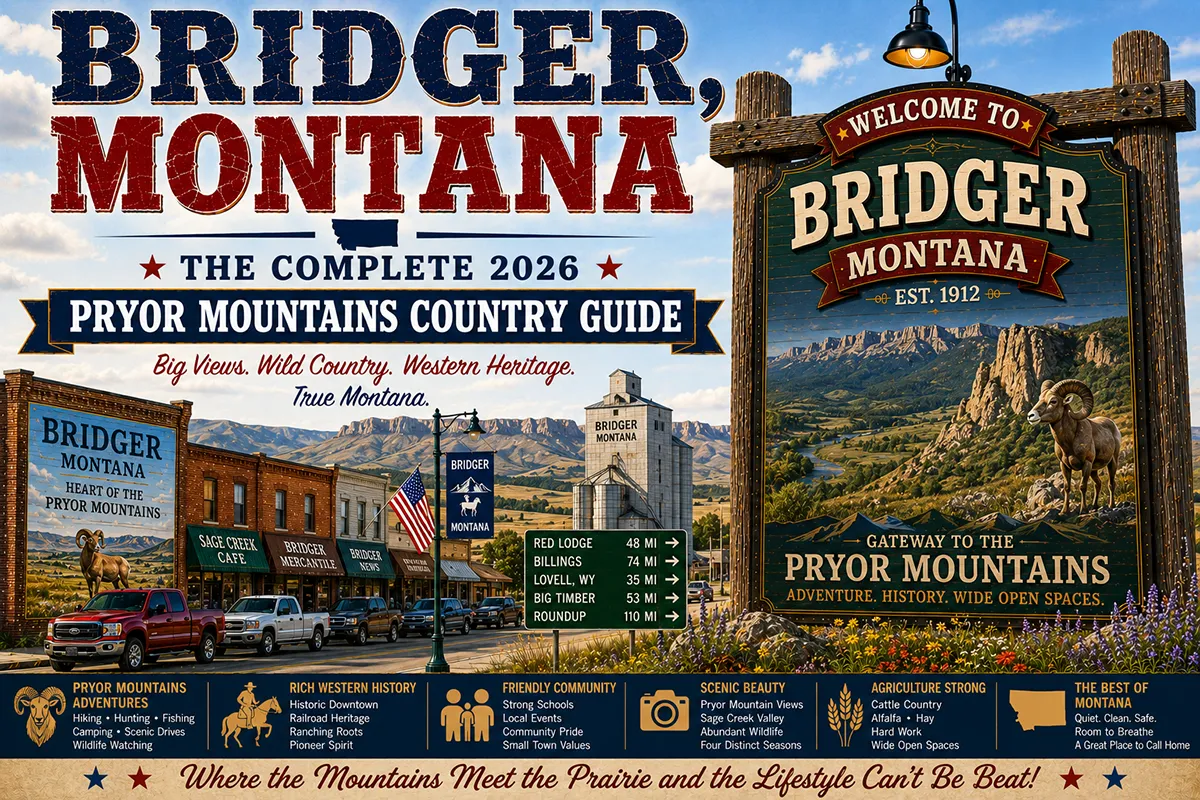
Jim Bridger was the American West’s most celebrated mountain man — fur trapper, guide, storyteller, and wilderness survivor whose knowledge of the Rocky Mountain and Great Plains terrain from the 1820s to the 1870s was unmatched. He trapped beaver in the Rockies, guided emigrant wagon trains, served as an Army scout, and knew Yellowstone’s geysers decades before the official expeditions “discovered” them.
He told stories about them that nobody believed. The Montana town named for him sits at the base of the Carbon County landscape that he traversed repeatedly, at a junction where the Clarks Fork of the Yellowstone emerges from its canyon and enters the open valley.
The Pryor Mountains, rising to the southeast of Bridger, are the terrain that makes this area genuinely distinctive for modern travelers.
The BLM’s Pryor Mountains Wild Horse Range is one of the few places in the American West where you can reliably see free-roaming wild horses in dramatic mountain terrain — Spanish Colonial mustangs whose lineage traces back centuries, running free on a 38,000-acre range that the federal government has managed for them since 1968.
TL;DR
- Bridger (~800) is a Carbon County town on US-310, between Billings (60 miles north) and Belfry (18 miles south), at the junction of the Clarks Fork Valley.
- The Pryor Mountains Wild Horse Range — 38,000 BLM acres with free-roaming Spanish Colonial mustangs — is accessed from roads near Bridger.
- The Clarks Fork of the Yellowstone provides excellent fishing through the Carbon County valley.
- Named for mountain man Jim Bridger — the iconic fur trapper and wilderness guide.
- US-310 through Bridger connects to the Beartooth Highway at Red Lodge (via Belfry) and provides access to Chief Joseph Scenic Byway.
- Best for: wild horse enthusiasts, fly fishers, Carbon County scenic drives, and Beartooth approach travelers.
Liked this article?
Add Roaming Montana as a preferred source so you see more of our articles and guides on Google.
Bridger at a Glance
| Population (2020) | ~800 |
|---|---|
| County | Carbon County |
| Region | South-Central Montana |
| Elevation | 3,665 ft |
| Distance to Billings | ~60 miles north (~1 hour on US-310) |
| Distance to Red Lodge | ~40 miles south (~50 min via Belfry) |
| Distance to Belfry | ~18 miles south (~20 min) |
| Distance to Laurel | ~40 miles north (~45 min) |
| Best for | Pryor Mountains Wild Horse Range, Clarks Fork fishing, Carbon County drives, Beartooth access |
What Makes Bridger Different
The Pryor Mountains are a small, isolated range southeast of Bridger with a quality of wildness that belies their modest elevation (highest point about 8,800 feet).
The range straddles the Montana-Wyoming border and contains one of the most significant wild horse populations in the American West.
The horses on the BLM’s Pryor Mountain Wild Horse Range are Spanish Colonial mustangs — descendants of horses brought to North America by Spanish conquistadors in the 16th century, with DNA evidence linking them to Iberian breeds rather than the more common American mustang stock found elsewhere.
These aren’t recent escapees from ranches. The Pryor Mountain horses have likely been wild in this terrain for centuries, and genetic studies in the 1990s and 2000s confirmed their distinctive Spanish Colonial heritage.
The BLM established the 38,000-acre range in 1968 — the first wild horse range in the United States — specifically to protect this population. Today roughly 100–150 horses roam the range in family bands, observable from roads and trails in the Crooked Creek area.
The Clarks Fork of the Yellowstone is the other major attraction. The river emerges from its dramatic upper canyon (carved through the Beartooth Plateau south of Bridger) into the broader Carbon County valley, where it’s accessible for excellent trout fishing.
The Clarks Fork is a Blue Ribbon fishery in its lower sections — brown trout and some rainbow trout in a river with good public access.
The Jim Bridger connection gives the town an appropriate identity. Bridger’s trading post and knowledge of the West were so comprehensive that he became the prototype of the American frontier scout — indispensable to anyone trying to move through terrain that he knew and others didn’t.
For broader trip context, see my Montana cities and towns hub.
The Top 10 Things to Do In & Around Bridger
1. Pryor Mountains Wild Horse Range
The definitive Bridger-area experience for wildlife enthusiasts. Access the range via the Crooked Creek Road east of Bridger (gravel; high-clearance recommended).
The horses are most reliably seen in the Crooked Creek and Dryhead areas of the range. Morning and evening are the best times.
The horses are genuinely wild — they won’t approach, but patient waiting at water sources or observation points often produces sightings. The BLM Billings Field Office (406-896-5000) can provide current horse location information.
The Dryhead area — where the range meets the Wyoming border — has some of the most dramatic Pryor Mountain scenery. The landscape of rocky ridges, juniper and ponderosa pine, and sweeping views into Wyoming is extraordinary.
2. Fly Fish the Clarks Fork of the Yellowstone
The Clarks Fork below its canyon provides excellent brown trout fishing. The Bridger Bend Fishing Access Site near Laurel and the Weymiller Fishing Access Site near Belfry give boat launch and wade fishing access. The lower Clarks Fork is best fished from a drift boat in the longer runs between access sites.
The river fishes best after spring runoff — typically June through October. Brown trout dominate the lower sections; some cutthroat and rainbow trout mix in from upper tributaries.
3. Historic Downtown Bridger
Bridger has several historic structures on the National Register of Historic Places — the town developed as a railroad supply center and coal mining support community in the late 1800s. Walking the downtown block reveals early 20th-century commercial architecture that reflects the Carbon County coal era.
4. Drive US-310 to Belfry and Red Lodge
The US-310 corridor from Bridger south to Belfry and Red Lodge is one of the approach routes to the Beartooth Highway — less famous than driving directly from Billings, but passing through distinctive Carbon County ranch and farming country along the lower Clarks Fork.
5. Chief Joseph Scenic Byway Access (via Red Lodge/Belfry)
From Bridger, continue south to Red Lodge and then pick up the Beartooth Highway or the Chief Joseph Scenic Byway through Wyoming’s Sunlight Basin. Both are extraordinary drives in their own right. The Chief Joseph Byway (Wyoming Highway 296) is the less-famous but equally spectacular alternative to the Beartooth.
6. Carbon County Scenic Loop Drive
A scenic loop from Red Lodge east through Bearcreek, north through Bridger, and northeast toward Edgar gives a full Carbon County circuit. The loop passes through historic coal mining communities, Clarks Fork Valley ranchland, and the base of the Beartooth Mountains.
7. BoJa Farm (near Bridger)
A farm and orchard operation near Bridger that offers farm-fresh, chemical-free produce and occasional farm or orchard tours. Worth a stop for travelers interested in the agricultural side of Carbon County.
8. Garage Steakhouse and Buckeye Bar Casino
Bridger’s most distinctive community establishment — the Garage Steakhouse serves what locals call the best beef in Carbon County, with a bar and casino operation attached. The kind of honest Montana steakhouse that doesn’t need a website to fill its tables.
9. Yellowstone River Day Trip (via Laurel or Billings)
The full Yellowstone River system — from the Clarks Fork confluence near Laurel upstream — connects Bridger to the broader Yellowstone country. See Billings guide and Laurel guide.
10. Bighorn Canyon National Recreation Area (via Lovell, WY, 1.5 hours south)
The Bighorn Canyon — a spectacular 70-mile reservoir with sheer canyon walls — straddles the Montana-Wyoming border south of the Pryor Mountains. Additional wild horse viewing along the Bighorn Canyon shoreline roads.
Where to Stay
| Hotel | Vibe | Price | Best For |
|---|---|---|---|
| Bridger Motel | Local, basic | $85–130 | Most travelers |
| Red Lodge hotels (40 min south) | Mountain town character | $120–280 | Beartooth focus |
| Billings hotels (1 hour north) | Full city selection | $130–250 | More amenities |
| BLM dispersed camping (Pryor Mtns) | Primitive, free | Free | Wild horse seekers |
Where to Eat
- Garage Steakhouse and Buckeye Bar Casino — Bridger’s institution; steak done right
- BoJa Farm (seasonal) — farm-fresh produce
- Belfry area options (18 min south) — limited
- Red Lodge (40 min south) — full restaurant variety
Getting There & Around
From Billings: 60 miles south on US-310, about 1 hour.
From Red Lodge: 40 miles north on US-310 via Belfry, about 50 minutes.
For Pryor Mountains: East from Bridger via Pryor Road to Crooked Creek Road — high-clearance vehicle recommended for the final miles to the range.
What Bridger Unlocks
Pryor Mountains Wild Horse Range (east of Bridger)
Free-roaming Spanish Colonial mustangs on 38,000 BLM acres.
Red Lodge & Beartooth Highway (40 min south)
One of America’s most spectacular drives.
Billings (1 hour north)
Montana’s largest city.
Bighorn Canyon (1.5 hours south via Lovell, WY)
Spectacular canyon country with additional wild horse viewing.
Fromberg (8 miles north)
Clarks Fork Valley Museum and nearby Clarks Fork fishing.
When to Visit
Summer (June–August): Best for wild horse viewing (horses move to higher elevations with spring green-up), Clarks Fork fishing, all roads open.
Fall (September–October): Wild horses move to lower elevations — often easier viewing. Clarks Fork brown trout season peaks.
Spring (April–May): Foals born in late spring — possibly the most photogenic season for wild horse viewing.
Winter: Pryor Mountain roads may be impassable. Clarks Fork ice fishing. Bridger itself operational year-round.
Personal Tips
Contact BLM Billings before your Pryor Mountain visit. The horses move around the 38,000-acre range; the BLM field office can give current location information to significantly improve your chances of finding them. The Crooked Creek area is typically the most reliable zone.
Morning is the best time for wild horse viewing. The horses are most active in early morning — moving from overnight rest areas to water and grazing. Arrive at the Crooked Creek viewpoints by 7 a.m. if possible.
The Garage Steakhouse is the right dinner. Bridger isn’t a culinary destination, but the Garage Steakhouse is the kind of honest, quality Montana steakhouse that’s worth finding. Don’t judge it by its exterior.
Allow a full day for the Pryor Mountains. The drive from Bridger, the hiking or driving within the range, and the wait time for horse viewing are best allocated a full day. Don’t plan it as a quick detour.
Bridger Quick Facts
| Founded | 1900 (railroad era) | | Named for | Jim Bridger, mountain man, fur trapper, and wilderness guide | | Pryor Mountains Wild Horse Range | Est. 1968; first wild horse range in U.S.; ~100–150 horses | | Spanish Colonial mustangs | DNA-confirmed Iberian lineage | | Clarks Fork | Blue Ribbon trout water; brown trout dominant | | Average summer high | 87°F | | Average winter low | 10°F |
Conclusion
Bridger carries the right name for this country — wild, practical, and indispensable to travelers who know what it connects. The Pryor Mountains Wild Horse Range is one of the American West’s genuine wildlife treasures, accessible from roads near town. The Clarks Fork fishing is excellent. And the US-310 corridor through Bridger connects Billings to the Beartooth and to the Chief Joseph Byway through one of Carbon County’s most authentic stretches of road.
Have a Bridger question? Drop it in the comments — I read every one.
Frequently Asked Questions
Is Bridger Montana worth visiting?
Yes — primarily for the Pryor Mountains Wild Horse Range (free-roaming Spanish Colonial mustangs on 38,000 BLM acres, accessible via Crooked Creek Road east of Bridger) and Clarks Fork of the Yellowstone fly fishing. As a US-310 corridor community connecting Billings to the Beartooth Highway, it also serves as a stop on one of Carbon County’s scenic Carbon County Loop drives.
What is the Pryor Mountains Wild Horse Range?
The Pryor Mountains Wild Horse Range is a 38,000-acre BLM-managed wild horse range in the Pryor Mountains southeast of Bridger — the first wild horse range established in the United States (1968). The range protects approximately 100–150 Spanish Colonial mustangs whose DNA lineage traces to Iberian breeds brought to North America by Spanish explorers. The horses are genuine wild horses, not escapees from ranches.
Are the Pryor Mountain horses really Spanish Colonial mustangs?
Yes — genetic studies confirmed that the Pryor Mountain horses have DNA consistent with Spanish Colonial (Iberian) breeds, distinguishing them from most American mustang populations whose genetics reflect a mix of more recent escapees and released domestic horses. The Pryor Mountain population is one of the most genetically distinct and historically significant wild horse groups in North America.
Who was Jim Bridger?
Jim Bridger (1804–1881) was one of the most celebrated American mountain men — a fur trapper who worked the Rockies and Great Plains from the 1820s to the 1870s. He was among the first non-Indigenous Americans to observe Yellowstone’s geysers and hot springs (which he described to widespread disbelief), guided numerous emigrant wagon trains and military expeditions, and served as an Army scout. His comprehensive wilderness knowledge made him the prototype of the American frontier guide.
Is the Clarks Fork good for fishing near Bridger?
Yes — the Clarks Fork of the Yellowstone is a Blue Ribbon trout fishery in its lower sections near Bridger and Belfry. Brown trout are the primary species. Best fishing is June through October after spring runoff; a drift boat significantly improves access to the longer runs between fishing access sites.