Bannack is 25 miles west of Dillon on a dirt road, and it’s the best ghost town in Montana. Not the most famous — that’s Virginia City — but the most pristine. Nobody lives there.
Nobody has for decades. The buildings are original construction from the 1860s, slowly deteriorating in the high desert air. A two-hour walk through Bannack is one of the most evocative historical experiences in the state.
TL;DR
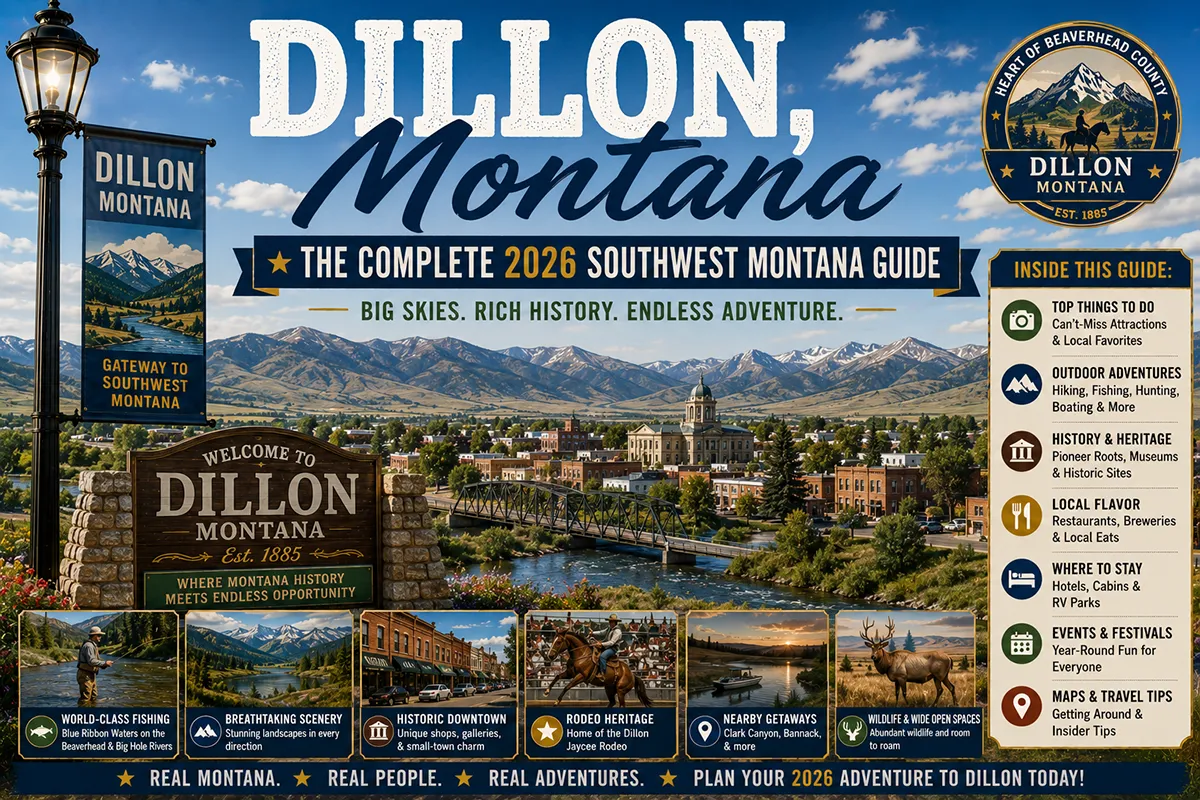
- Dillon (~4,100) is the county seat of Beaverhead County — the largest county in Montana — and the practical hub of the broad southwest Montana ranching country.
- Gateway to Bannack State Park (Montana’s most authentic ghost town), the Big Hole National Battlefield, and the Beaverhead River (one of Montana’s top Blue Ribbon trout streams).
- Home to the University of Montana Western.
- Best for: off-the-beaten-path travelers, history and ghost town enthusiasts, fly fishers, and anyone driving I-15 between Salt Lake City and Butte.
- Very low SERP competition — strong ranking opportunity.
Liked this article?
Add Roaming Montana as a preferred source so you see more of our articles and guides on Google.
Dillon at a Glance
| Population (2020) | ~4,100 |
|---|---|
| County | Beaverhead County (county seat, largest county in MT) |
| Region | Southwest Montana |
| Elevation | 5,096 ft |
| University | University of Montana Western |
| Distance to Butte | ~65 miles (~1 hour) |
| Distance to Salt Lake City | ~375 miles (~5.5 hours via I-15) |
| Best for | Bannack ghost town, Big Hole Battlefield, Beaverhead fly fishing, southwest Montana base |
What Makes Dillon Different
Beaverhead County is the largest county in Montana — larger than some states — and Dillon is its only real town. The county is one of the most sparsely populated places in the contiguous U.S.: vast ranching valleys, big mountain ranges, and very few people.
Dillon itself is a classic Montana ranch town: a university (UMW, about 1,500 students), the railroad, agricultural supply businesses, and a genuine working-cattle community. It’s not a tourist town — but what surrounds it is extraordinary.
Bannack, 25 miles west on gravel road, was Montana’s first territorial capital (briefly, before Virginia City). It’s now a state park and one of the most completely preserved ghost towns in the American West.
Unlike Virginia City, which has living residents and commercial businesses, Bannack is empty. That emptiness is the point.
Big Hole National Battlefield, 60 miles northwest, marks the site of the August 9–10, 1877, battle between the U.S. Army and the Nez Perce — one of the most significant and tragic events in the story of the American West.
For broader trip context, see my Montana cities and towns hub.
The Top 10 Things to Do in Dillon & Surroundings
1. Bannack State Park
Montana’s first territorial capital (1864–1865), now an extraordinary ghost town with 60+ original buildings. Walk the main street, peer into the abandoned hotel, post office, and Masonic lodge. No residents; minimal signage; the buildings are allowed to age naturally. Bannack Days (third weekend of July) brings living history reenactors. One of the most important historical sites in Montana.
2. Big Hole National Battlefield (60 miles northwest)
On August 9, 1877, Colonel John Gibbon’s troops attacked a sleeping Nez Perce village of 800 men, women, and children at dawn. The Nez Perce fought back, retreated, and eventually continued their flight — which ended at Bear Paw Battlefield near Havre. The site is a National Park Service monument with an excellent visitor center and self-guided walking tour. Sobering and essential.
3. Fly Fish the Beaverhead River
Blue Ribbon trout water flowing through the Beaverhead Valley south of Dillon. Large wild brown trout in technical, spring-influenced water. Similar character to the Madison but less crowded and less well-known nationally. Multiple public access points.
4. Clark Canyon Reservoir (20 miles south)
Montana’s most productive trophy trout lake — enormous brown and rainbow trout. Also good walleye. Day use and camping available.
5. Pioneer Mountains National Scenic Byway
A 45-mile paved loop through the Pioneer Mountains south of Dillon, passing Maverick Mountain Ski Area and ending at Polaris. One of the least-driven scenic byways in Montana.
6. Maverick Mountain Ski Area
Small, affordable ski area in the Pioneer Mountains south of Dillon — locals’ mountain with minimal crowds and reasonable lift tickets.
7. University of Montana Western Museum
The university’s natural history and geology collections — small but worthwhile if you’re already in town.
8. Beaverhead County Museum
Regional history museum covering the gold rush era, ranching culture, and Lewis & Clark’s journey through Beaverhead County (they passed through here in 1805).
9. Sacajawea Memorial Area
Lewis & Clark crossed the Continental Divide near Lemhi Pass, about 60 miles west of Dillon. A historic marker near the divide commemorates Sacajawea, who recognized her homeland and her Shoshone people here in 1805.
10. Ruby River Valley Drive
Highway 287 north of Dillon through the Ruby River Valley is a quiet, beautiful drive through ranch country with views of the Tobacco Root and Ruby mountain ranges.
Where to Stay
| Hotel | Vibe | Price | Best For |
|---|---|---|---|
| Best Western Paradise Inn | Reliable chain, full service | $130–200 | Most travelers |
| Comfort Inn Dillon | Standard chain | $120–180 | Budget travelers |
| Sundowner Motel | Budget motel, clean | $90–130 | Very budget |
| Bannack State Park Campground | Camping in the ghost town | $15–25 | Campers, history lovers |
| Pioneer Mountain Cabins | Remote cabins | $150–250 | Couples, solitude |
Where to Eat
- Lion’s Den Restaurant — best dinner in town, steaks and comfort food
- Papa T’s — breakfast and lunch standard
- Sparky’s Garage — burgers and pub food
- Sweetwater Coffee — local café, breakfast
- Blacktail Station — bar and grill
Getting There
From Butte: 65 miles south on I-15, about 1 hour.
From Missoula: ~130 miles via I-90 and I-15, about 2 hours.
From Salt Lake City: ~375 miles north on I-15, about 5.5 hours.
Dillon sits directly on I-15, making it one of the most accessible southwest Montana towns for travelers arriving from Utah and Idaho.
What Dillon Unlocks
Bannack State Park (25 min, gravel road)
Montana’s best ghost town.
Big Hole National Battlefield (1 hour northwest)
Critical Nez Perce history site.
Virginia City (1.5 hours)
The more famous (and inhabited) gold rush town. See Virginia City guide.
Ennis & Madison River (1.5 hours)
Blue Ribbon fly fishing country. See Ennis guide.
Butte (1 hour north)
See Butte guide.
When to Visit
Summer (June–August) is the main season — Bannack is accessible, Big Hole is fully staffed, Clark Canyon is swimmable.
Bannack Days (third weekend of July) is the best single event — living history interpreters bring the ghost town to life for a weekend.
Fall (September–October) is excellent — cooler temperatures, elk season, superb fly fishing.
Winter is cold; Maverick Mountain Ski Area is the draw.
Personal Tips
Allow a half day for Bannack. Walk every building, read every marker, and if you can — stay for Bannack Days.
Big Hole Battlefield requires a full morning. The visitor center film and self-guided walk together take 2–3 hours. Don’t rush the personal nature of the site.
Clark Canyon Reservoir is underrated for trophy trout. Bigger fish than most tourists know about.
The Pioneer Mountains Scenic Byway is one of Montana’s secrets. Drive it slowly.
Dillon Quick Facts
| Founded | 1880 (Union Pacific Railroad) |
|---|---|
| Named for | Sidney Dillon, Union Pacific president |
| County | Beaverhead County — largest county in Montana |
| Average summer high | 82°F |
| Average winter low | 10°F |
Conclusion
Dillon’s appeal is almost entirely in what surrounds it — Bannack, Big Hole, the Beaverhead River, Clark Canyon. The town itself is a practical ranch hub. But those surroundings are extraordinary, and Dillon’s position on I-15 makes it a natural stop for travelers coming from the south.
One night in Dillon, half a day in Bannack, a morning at Big Hole — that’s a genuine Montana experience most visitors never find.
Have a Dillon question? Drop it in the comments — I read every one.
Frequently Asked Questions
Is Dillon Montana worth visiting?
Yes — Dillon is worth visiting primarily for Bannack State Park (Montana’s most pristine ghost town, 25 miles west) and Big Hole National Battlefield (60 miles northwest), two of the most historically significant sites in the state. Beaverhead River fly fishing and Clark Canyon Reservoir add outdoor recreation value. As an I-15 overnight stop between Salt Lake City and Butte, Dillon is the smartest option in southwest Montana.
What is Bannack State Park near Dillon?
Bannack was Montana’s first territorial capital (1864–1865), founded after a gold discovery in 1862. Now a state park, it’s one of the most completely preserved ghost towns in the American West — 60+ original buildings standing on the townsite, uninhabited, slowly aging. Unlike Virginia City, which still has residents, Bannack is fully empty. The third weekend of July brings Bannack Days, with living history interpreters bringing the town to life.
What is Big Hole National Battlefield?
Big Hole National Battlefield commemorates the August 9–10, 1877 battle between U.S. Army forces and the Nez Perce people. Colonel Gibbon’s troops attacked a sleeping village of 800 Nez Perce, who fought back and escaped to continue their 1,170-mile flight — which ultimately ended at Bear Paw Battlefield near Havre. The NPS site has an excellent visitor center and self-guided walking tour of the battle positions.
How far is Dillon from Bannack State Park?
Dillon is approximately 25 miles from Bannack State Park — about a 35-minute drive west on Montana Highway 278, which becomes gravel road for the final few miles to the park. High-clearance vehicles are recommended after wet weather.
Is the Beaverhead River good for fly fishing?
Yes — the Beaverhead River is Montana Blue Ribbon trout water with large wild brown trout in technical, spring-influenced conditions. It’s less crowded than the Madison and less well-known nationally, making it an excellent option for serious fly fishers who want quality fishing without the Madison’s pressure. Multiple public access points are available.