In 1900, a man named William A. Clark was worth more than most countries. He’d made his fortune from copper — specifically from the hill under Butte, Montana, which at the time was producing a quarter of the world’s copper supply.
Clark’s mansion is still standing in Uptown Butte, open for tours. Down the hill, the Berkeley Pit is a mile-wide open-pit mine filled with toxic water that’s rising by a foot every year. Both are worth visiting for reasons that couldn’t be more different.
TL;DR
- Butte (~34,000) is the most historically significant mining city in Montana — the “Richest Hill on Earth” that produced over 20 billion pounds of copper.
- The Uptown Historic District is one of the largest National Historic Landmark Districts in the U.S., with 6,000+ historic buildings — more Victorian architecture than virtually any comparable western city.
- Home to a genuine Irish-immigrant culture (brought by Copper King Marcus Daly’s deliberate recruitment from Ireland) expressed in pubs, St. Patrick’s Day celebrations, and the annual An Ri Ra Irish festival.
- Best for: history travelers, industrial heritage, authentic working-class Montana culture, and anyone who wants a Montana city that hasn’t been polished for tourists.
- For the deep-dive activity guide, see our detailed Butte things-to-do post.
Liked this article?
Add Roaming Montana as a preferred source so you see more of our articles and guides on Google.
Butte at a Glance
| Population (2020) | ~34,000 |
|---|---|
| County | Silver Bow County (city-county consolidated) |
| Region | Southwest Montana |
| Elevation | 5,538 ft |
| Nickname | “The Richest Hill on Earth,” “Butte America” |
| Distance to Helena | ~65 miles (1 hour) |
| Distance to Missoula | ~120 miles (2 hours) |
| Distance to Bozeman | ~80 miles (1.5 hours) |
| Best for | Industrial history, Irish heritage, Victorian architecture, authentic working Montana |
What Makes Butte Different
Butte doesn’t apologize for itself. It’s not a resort town, not a college town, not a particularly pretty town by Montana mountain standards.
It’s a copper-mining city built on top of a mountain that produced extraordinary wealth for a few people and hard, dangerous work for tens of thousands more — mostly Irish, Welsh, Cornish, Italian, and Chinese immigrants who came to work the mines.
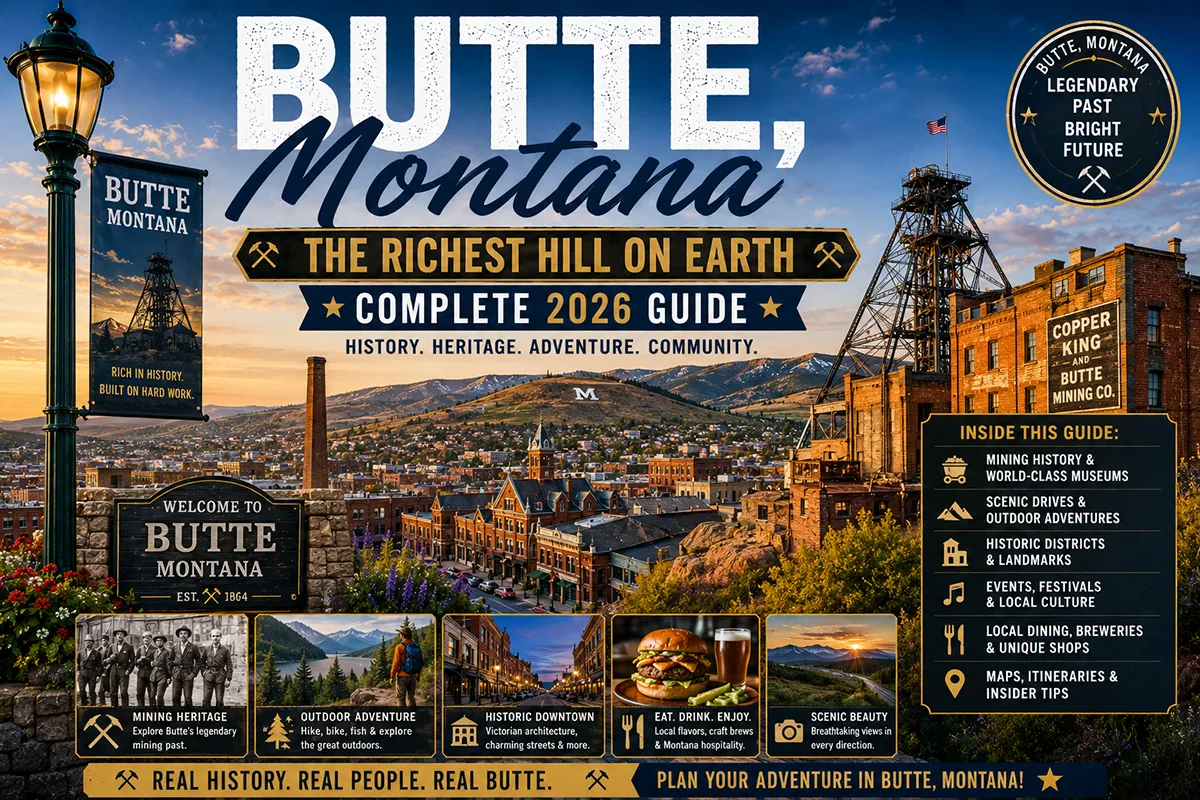
The result is the most architecturally dense and historically layered city in Montana. Butte’s Uptown District has been called “the best preserved late 19th century industrial city in the United States.” Walk down Park Street or Broadway and you’ll see Romanesque Revival bank buildings, ornate brick Victorian hotels, Irish pubs, and mining headframes against the same skyline.
The Berkeley Pit — a mile-wide open-pit copper mine that replaced much of the underground mining operation — closed in 1982 and has been filling with toxic water ever since. The viewing platform over it is one of the most sobering industrial tourism experiences in America.
For broader trip planning, see the Montana cities and towns hub. For a detailed activity guide, see things to do in Butte MT.
The Top 10 Things to Do in Butte
1. World Museum of Mining
Located on the grounds of the Orphan Girl Mine, the World Museum of Mining re-creates an entire 1890s mining town — Hell Roarin’ Gulch — with 50+ original buildings. Underground mine tours are available. One of the best mining museums in the country; plan 2–3 hours.
2. Berkeley Pit Viewing Platform
A mile-wide open-pit mine that operated from 1955 to 1982, now filled with toxic water (arsenic, copper, sulfuric acid) that rises ~1 foot per year. The viewing platform charges a nominal fee and provides an extraordinary, sobering perspective on industrial scale and environmental impact.
3. Walk the Uptown Historic District
Over 6,000 historic buildings in the Uptown District — arguably the most intact Victorian commercial district in the West. Self-guided walking tour maps available; the Butte Trolley does guided tours in summer.
4. Copper King Mansion Tour (and B&B)
W.A. Clark’s 1884 Victorian mansion is open for guided tours and operates as a bed and breakfast — one of the most distinctive places to sleep in Montana.
5. Clark Chateau Museum
A 26-room French chateau-style mansion (1898) built for Clark’s son, now a museum and gallery.
6. Our Lady of the Rockies
A 90-foot statue of the Virgin Mary on the Continental Divide ridgeline above Butte. Built entirely by volunteers between 1979 and 1985. Tours to the statue depart from the Butte Visitor Center.
7. Montana Tech’s Mineral Museum
Exceptional collection of minerals, gems, and mining artifacts on the Montana Tech campus. Free admission. One of the better mineral collections in the Northwest.
8. Evel Knievel Days (Late July)
Annual event celebrating Butte’s most famous son — the legendary daredevil motorcyclist. Motorcycle shows, stunts, and concerts. One of Butte’s most distinctive events.
9. St. Patrick’s Day (March 17)
Butte’s single most attended annual event. With 15,000+ Irish-descended residents, St. Patrick’s Day in Butte is the largest celebration per capita in the Northwest. If you can get there, it’s extraordinary.
10. An Rí Rá Montana Irish Festival (August)
An annual celebration of Butte’s Irish cultural heritage with live traditional music, dance performances, and cultural programming.
Where to Stay
| Hotel | Vibe | Price | Best For |
|---|---|---|---|
| Copper King Mansion B&B | Historic Victorian mansion | $180–280 | Splurge, history enthusiasts |
| Hampton Inn Butte | Modern, reliable chain | $140–210 | Most travelers |
| Best Western Plus Butte Plaza | Full-service, close to freeway | $130–200 | Practical travelers |
| Holiday Inn Express Butte | Reliable chain | $130–190 | Business travelers |
| Comfort Inn Butte | Budget chain | $110–170 | Budget |
| Toad Hall Manor B&B | Victorian-era character | $160–240 | Couples, character seekers |
Where to Eat
Butte has a distinctive food culture shaped by its immigrant mining heritage — the Cornish pastry (a meat-filled turnover the miners carried for lunch) is a local food tradition:
- Pork Chop John’s — pork chop sandwiches since 1924; a Butte institution
- Metals Bar & Grill — gastropub, solid food in a historic setting
- Casagranda’s Steakhouse — upscale steak dinner
- Pekin Noodle Parlor — Chinese restaurant since 1911 (one of the oldest in America)
- Uptown Café — best fine dining in Butte
- M&M Cigar Store — 24-hour bar and restaurant, a Butte institution since 1890
- Joe’s Pasty Shop — traditional Cornish pasties
Getting There & Around
From Helena: ~65 miles west on I-15, about 1 hour.
From Missoula: ~120 miles east on I-90, about 2 hours.
From Bozeman: ~80 miles west on I-90, about 1.5 hours.
By plane: Bert Mooney Airport (BTM) offers limited service; most travelers fly into Missoula or Bozeman.
Around town: Butte is driving-centric. The Butte Trolley runs tours in summer. Uptown is walkable once you’re there.
What Butte Unlocks
Anaconda (25 miles west)
The companion company town built by Marcus Daly — includes the 585-foot Anaconda Smelter Stack (tallest masonry structure in North America), the Washoe Park, and an excellent community museum.
Georgetown Lake (30 miles west)
Mountain reservoir popular for boating and fishing.
Dillon & Bannack (1 hour south)
First territorial capital ghost town at Bannack State Park.
Helena (1 hour northeast)
Montana’s capital. See Helena guide.
When to Visit
Summer (June–August) is the most comfortable and most visited.
September is excellent — fall colors, fewer crowds, all attractions open.
St. Patrick’s Day (March 17) is a unique reason to visit in winter — the largest St. Patrick’s Day celebration in the Mountain West.
Winter otherwise is cold but Butte has the indoor museum infrastructure to make it work.
Personal Tips
Give Butte more time than you plan to. Most travelers treat it as a one-night interstate stop. Two nights lets you do the World Museum of Mining properly, walk the Uptown, and see the Berkeley Pit.
The M&M Cigar Store never closes. A 24-hour bar and restaurant since 1890. There’s nothing else quite like it in Montana.
Try a Cornish pasty. Joe’s Pasty Shop carries the direct descendant of the lunch the Cornish miners brought to Butte in the 1880s. Authentically Butte.
Evel Knievel Days fills the town. If your dates overlap with late July, book early.
October is underrated. Fall colors on the mountain, empty hotels, all museums open.
Butte Quick Facts
| Founded | 1874 (gold discovery) |
|---|---|
| Peak population | ~100,000 (ca. 1917) |
| Copper produced | 20+ billion pounds |
| Famous residents | Evel Knievel, W.A. Clark, Marcus Daly, Charles Bovey |
| Average summer high | 77°F |
| Average winter low | 11°F |
Conclusion
Butte is Montana’s most complex and historically significant city. It produced the wealth that funded Victorian mansions still standing today, and the environmental legacy of that extraction is visible in the Berkeley Pit every day. For travelers willing to engage with that complexity — and who want an authentic, unpolished, genuinely working-class Montana city — Butte is irreplaceable.
For the full activity breakdown with 29 things to do, see our detailed Butte guide.
Have a Butte question? Drop it in the comments — I read every one.
Frequently Asked Questions
Is Butte, Montana worth visiting?
Yes — Butte is one of Montana’s most historically significant and culturally distinctive cities, and often called the most underrated Montana destination. The World Museum of Mining, Berkeley Pit, Uptown Historic District with 6,000+ Victorian-era buildings, and the authentic Irish-heritage culture make it unlike any other Montana city. For history travelers or anyone wanting the real story of Montana’s industrial past, it’s essential.
Why is Butte called the Richest Hill on Earth?
Butte earned the nickname “the Richest Hill on Earth” because of the extraordinary mineral wealth beneath the city. At its peak around 1917, Butte was the world’s largest copper producer, providing 25% of global copper supply and over 50% of the U.S. supply. The hill also produced significant gold, silver, zinc, and manganese. Total copper output over the mining era exceeded 20 billion pounds.
What is the Berkeley Pit?
The Berkeley Pit is a mile-wide, 1,780-foot-deep open-pit copper mine in Butte that operated from 1955 until Anaconda Company’s closure in 1982. Since closure, the pit has been filling with highly acidic, metal-laden water (containing arsenic, copper, iron, and sulfuric acid) that rises approximately one foot per year. A viewing platform overlooks the pit and provides one of the most striking industrial tourism experiences in the American West.
How many days do you need in Butte?
Plan 2–3 days in Butte: one day for the World Museum of Mining and Berkeley Pit; one day for the Uptown Historic District, Copper King Mansion tour, and Clark Chateau; an optional third day for day trips to Anaconda and Georgetown Lake, or attending an event.
What is Evel Knievel Days in Butte?
Evel Knievel Days is an annual event held in late July celebrating Butte’s most famous native son — Robert Craig Knievel, the legendary motorcycle daredevil. The multi-day event features motorcycle shows, stunt demonstrations, concerts, and community events. Butte fills with motorcycle enthusiasts from around the country.
Is Butte worth visiting in winter?
Yes — Butte’s indoor museum infrastructure (World Museum of Mining, Copper King Mansion, Clark Chateau, Montana Tech Mineral Museum) makes winter visits viable. The most unique winter reason to visit is St. Patrick’s Day (March 17), which Butte celebrates as the largest per-capita celebration in the Mountain West.
What food is Butte Montana known for?
Butte is known for the Cornish pasty — a savory meat and vegetable turnover brought to Montana by Cornish miners in the 1880s and still sold at Joe’s Pasty Shop. The M&M Cigar Store (24-hour bar and restaurant since 1890), Pork Chop John’s (pork chop sandwiches since 1924), and the Pekin Noodle Parlor (Chinese restaurant since 1911) are all Butte food institutions.