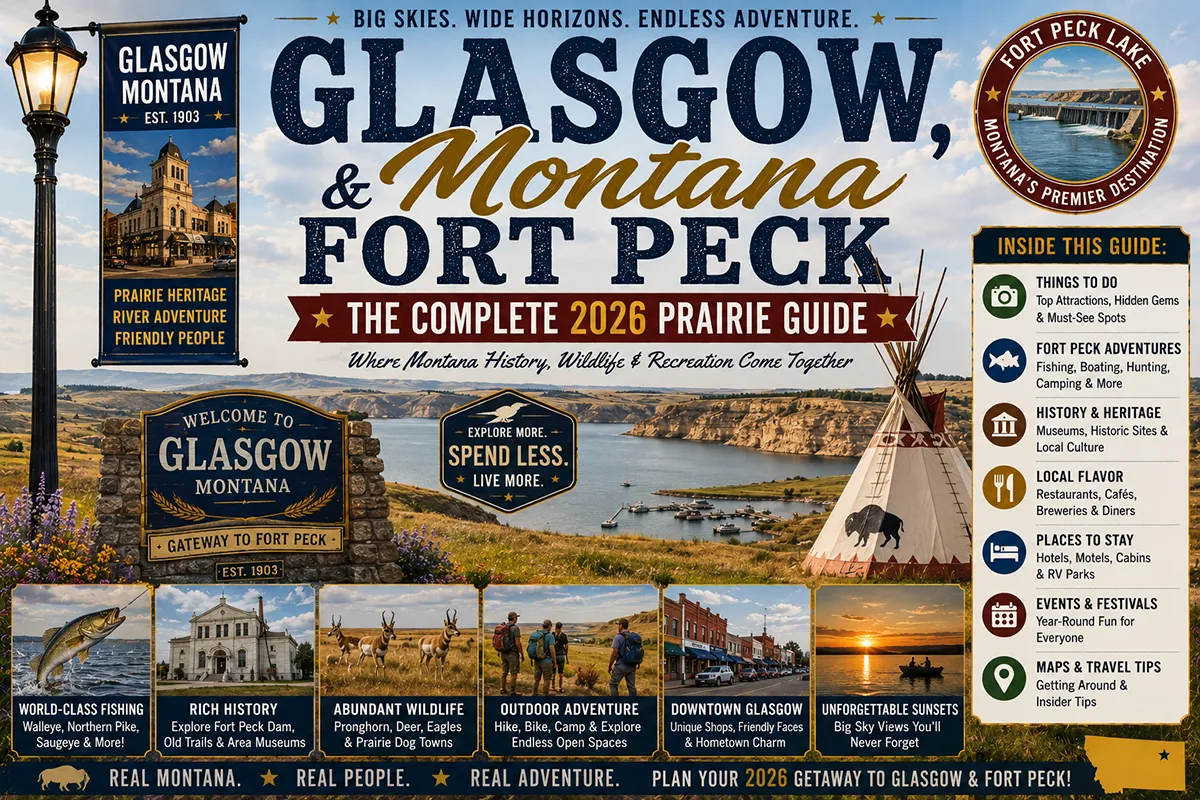
Fort Peck Dam is one of the largest earth-filled dams in the world. Built during the Great Depression (1933–1940) by 10,000 workers, it created Fort Peck Lake — 134 miles long, with 1,520 miles of shoreline. That’s more shoreline than the entire California coast. The dam itself is open for tours.
The Fort Peck Lake is one of Montana’s best fisheries for walleye and northern pike. And the town of Fort Peck, built by the Army Corps of Engineers in 1934 with a Tudor Revival style that looks completely surreal on the Montana prairie, has a WPA-era theater still showing movies. Glasgow, 17 miles north, is the regional city.
This guide covers Glasgow and the broader Fort Peck area. For a standalone deep-dive on the town of Fort Peck — the Theatre, the dam construction story, the Tudor Revival townsite, and the dinosaur paleontology — see my Fort Peck guide.
TL;DR
- Glasgow (~3,200) is the largest city in northeastern Montana and the practical hub for the Fort Peck Dam area.
- Fort Peck Dam — one of the world’s largest earth-filled dams, built 1933–1940 — creates Fort Peck Lake, a 134-mile reservoir that is Montana’s largest.
- Fort Peck Theatre is a WPA-era Tudor Revival building still operating as a theater and art museum.
- Scotty — the world’s largest and most complete T. rex skeleton — was found nearby and is now at the Royal Saskatchewan Museum, but the area’s dinosaur heritage is celebrated locally.
- Best for: remote northeastern Montana travelers, dam history enthusiasts, walleye/pike anglers, and travelers wanting the least-visited corner of the state.
Liked this article?
Add Roaming Montana as a preferred source so you see more of our articles and guides on Google.
Glasgow & Fort Peck at a Glance
| Glasgow Population (2020) | ~3,200 |
|---|---|
| County | Valley County (county seat: Glasgow) |
| Region | Northeastern Montana |
| Fort Peck Lake | 134 miles long; 1,520 miles of shoreline; Montana’s largest |
| Distance to Havre | ~225 miles (~3.5 hours) |
| Distance to Malta | ~52 miles (~50 min) |
| Distance to Williston, ND | ~165 miles (~2.5 hours) |
| Best for | Fort Peck Dam, walleye fishing, remote prairie travel, WPA history |
What Makes Glasgow & Fort Peck Different
Glasgow exists as a service center. Fort Peck is the spectacle. The town of Fort Peck itself — built from scratch by the Army Corps of Engineers in 1934 to house dam workers — is a National Historic Landmark District.
The building style was chosen deliberately: Tudor Revival, with half-timber facades and steep rooflines, to make 10,000 Depression-era workers feel they were building something of permanence and worth.
Walking through Fort Peck’s streets today feels slightly surreal — a perfectly preserved 1930s government town in the middle of the Montana prairie.
The dam project was Roosevelt’s New Deal in action. At its peak, 10,000 workers earned $0.50/hour in a country with 25% unemployment. The Fort Peck Theatre — still operating — was built to entertain them.
The fishing is the practical draw. Fort Peck Lake is one of Montana’s premier walleye fisheries; northern pike exceeding 40 inches are caught regularly. The surrounding CMR Refuge country provides genuine wildlife habitat.
For broader trip context, see my Montana cities and towns hub.
The Top 10 Things to Do in Glasgow & Fort Peck
1. Fort Peck Dam Tour
Free guided tours of the dam are available in summer — a 20-minute walk through the tunnels inside the earthwork structure, with excellent interpretive exhibits on the construction history. The scale is genuinely hard to grasp until you’re standing on top of it. For the full Fort Peck dam, theater, and townsite story, see my dedicated Fort Peck guide.
2. Fort Peck Interpretive Center & Museum
Adjacent to the dam, this museum covers the dam’s Depression-era construction with photographs, oral histories, and artifacts — including exhibits on “Scotty” the T. rex and the broader paleontology of the Missouri Breaks.
3. Walleye & Northern Pike Fishing on Fort Peck Lake
One of Montana’s best walleye fisheries and a premier pike destination. Boat launches at Fort Peck Marina, Hell Creek State Park, and multiple points along the 1,520-mile shoreline. The lake is also good for lake trout and sauger. Charter fishing operations available from Glasgow-area outfitters.
4. Fort Peck Theatre
The 1934 WPA-era Tudor Revival theater still shows first-run films and hosts live performances. Inside, the lobby features Native American art and Fort Peck construction photography. The building alone is worth a visit. The Fort Peck guide has the theater’s full programming history and current season.
5. Valley County Pioneer Museum (Glasgow)
Strong regional history museum in Glasgow covering homestead, Native American, military, and railroad history of Valley County.
6. Charles M. Russell National Wildlife Refuge (South)
The CMR’s northern sector is accessible from the Fort Peck area. Elk, deer, antelope, and bighorn sheep in the breaks country. The Fred Robinson Bridge on US-191 south of Malta is the main access point; the refuge also borders the south shore of Fort Peck Lake.
7. Hell Creek State Park
About 25 miles south of Glasgow on a dirt road — on the shore of Fort Peck Lake in classic Missouri Breaks badlands country. Excellent camping, boating, and fishing. The surrounding formations have produced significant dinosaur fossils, including the Tyrannosaurus rex “Scotty” (now in Saskatchewan).
8. Paddling Fort Peck Lake
The lake’s 1,520 miles of shoreline includes remote coves and inlets inaccessible by road. Multi-day kayak camping on Fort Peck is one of Montana’s great hidden adventure experiences.
9. Milk River Bird Trail
The Milk River valley north of Glasgow is an excellent birding corridor — sharp-tailed grouse, short-eared owls, northern harriers, and prairie falcons are all present. Spring and fall migration add waterfowl in significant numbers.
10. Shodair Children’s Hospital Mosasaur Fossil
A 30-foot marine mosasaur fossil found near Fort Peck Lake is on display at the Fort Peck Interpretive Center — a reminder that this landscape was once the floor of a shallow inland sea.
Where to Stay
| Hotel | Vibe | Price | Best For |
|---|---|---|---|
| Cottonwood Inn & Suites Glasgow | Best in area, full service | $120–190 | Most travelers |
| Fort Peck Hotel | Historic 1930s WPA building | $100–160 | History enthusiasts |
| Hell Creek State Park | Camping on Fort Peck Lake | $20–35 | Campers, anglers |
| Fort Peck Lake Cabins | Various rental options | $100–200 | Anglers, longer stays |
Where to Eat
- Sam’s Supper Club (Glasgow) — steaks and prime rib; the area’s best dinner
- Durum Restaurant (Glasgow) — casual American
- Ice Cream Station (Glasgow) — local institution
- Fort Peck Hotel Restaurant — basic meals in a historic setting
Getting There
From Malta: 52 miles east on US-2, about 50 minutes.
From Havre: ~225 miles east on US-2, about 3.5 hours.
From Williston, ND: ~165 miles west, about 2.5 hours.
By plane: Glasgow Airport (GGW) has limited service to Billings.
What Glasgow & Fort Peck Unlock
Fort Peck Town (17 min south)
The Tudor Revival WPA townsite, Fort Peck Theatre, Fort Peck Dam, and the Interpretive Center — covered in depth in my standalone Fort Peck guide.
Hell Creek State Park (25 min south)
Fort Peck Lake shoreline camping and fishing in Missouri Breaks country.
Malta (50 min west)
Phillips County Museum, Bowdoin NWR, dinosaur country. See Malta guide.
CMR National Wildlife Refuge
Wildlife watching in 1.1 million acres of Missouri Breaks.
The Hi-Line Road Trip
Glasgow is a natural overnight stop on the eastern end of the Hi-Line corridor. Continue west through Malta to Havre.
When to Visit
Summer (June–August) — dam tours, full lake access, all museums open.
Spring/Fall — fishing season peaks, birding is excellent.
Winter — cold and remote. Ice fishing on Fort Peck Lake is a local tradition.
Personal Tips
Take the dam tour. It’s free and most travelers skip it. Walking inside Fort Peck Dam is unexpectedly moving.
The Fort Peck Hotel is the right lodging choice for the atmosphere. Staying in a 1930s WPA building — preserved but functional — adds enormous context to the visit.
Hell Creek requires a dirt road. Check conditions with Valley County road maintenance before driving to Hell Creek in wet weather.
Fort Peck Lake is genuinely massive. Don’t underestimate how much fuel you need to reach remote sections.
Glasgow Quick Facts
| Founded | 1887 (Great Northern Railroad) |
|---|---|
| County seat | Valley County |
| Fort Peck Dam construction | 1933–1940 (New Deal) |
| Fort Peck Lake size | 134 miles long, 1,520 miles of shoreline |
| Average summer high | 87°F |
| Average winter low | -2°F |
Conclusion
Glasgow and Fort Peck together constitute one of Montana’s most complete “remote Montana” experiences — an extraordinary WPA-era dam, a Tudor Revival prairie theater, world-class walleye fishing, and Missouri Breaks badlands. It’s a long drive from anywhere, and that’s exactly the point.
Have a Glasgow or Fort Peck question? Drop it in the comments — I read every one.
Frequently Asked Questions
Is Glasgow Montana worth visiting?
Yes — Glasgow and nearby Fort Peck are worth visiting for the Fort Peck Dam (free tours, extraordinary New Deal history), Fort Peck Theatre (1934 WPA Tudor Revival building still operating), Hell Creek State Park on Fort Peck Lake, and excellent walleye and northern pike fishing. For travelers completing the Hi-Line road trip, Glasgow is the natural eastern anchor.
What is Fort Peck Dam?
Fort Peck Dam is one of the largest earth-filled dams in the world, built between 1933 and 1940 by up to 10,000 workers as a New Deal project under President Roosevelt. The dam created Fort Peck Lake — 134 miles long with 1,520 miles of shoreline, Montana’s largest body of water. Free guided tours of the dam’s interior tunnels are available in summer.
What is the Fort Peck Theatre?
Fort Peck Theatre is a 1934 Tudor Revival building constructed by the Army Corps of Engineers to entertain dam workers. It’s a National Historic Landmark and still operates as a first-run cinema and venue for live performances. The building’s half-timber Tudor facade looks dramatically out of place on the Montana prairie — that contrast is part of what makes it worth seeing.
Is Fort Peck Lake good for fishing?
Yes — Fort Peck Lake is one of Montana’s premier fishing destinations, particularly for walleye, northern pike, sauger, and lake trout. The lake’s 1,520 miles of shoreline and 245,000+ acres of surface area create diverse habitat. Walleye fishing is especially productive and draws anglers from across the region.
Where is Scotty the T-rex from?
Scotty, described as the world’s largest and most complete Tyrannosaurus rex skeleton, was found near Fort Peck Lake in 1991. After decades of preparation, Scotty was unveiled at the Royal Saskatchewan Museum in Regina, Canada in 2019, where it is now on permanent display. The Fort Peck Interpretive Center displays local context on Scotty’s discovery and the area’s rich fossil heritage.