Every state has a “birthplace” — a place that claims the first this or oldest that. Montana’s is quietly disputed between Stevensville and Fort Benton, and both have legitimate claims.
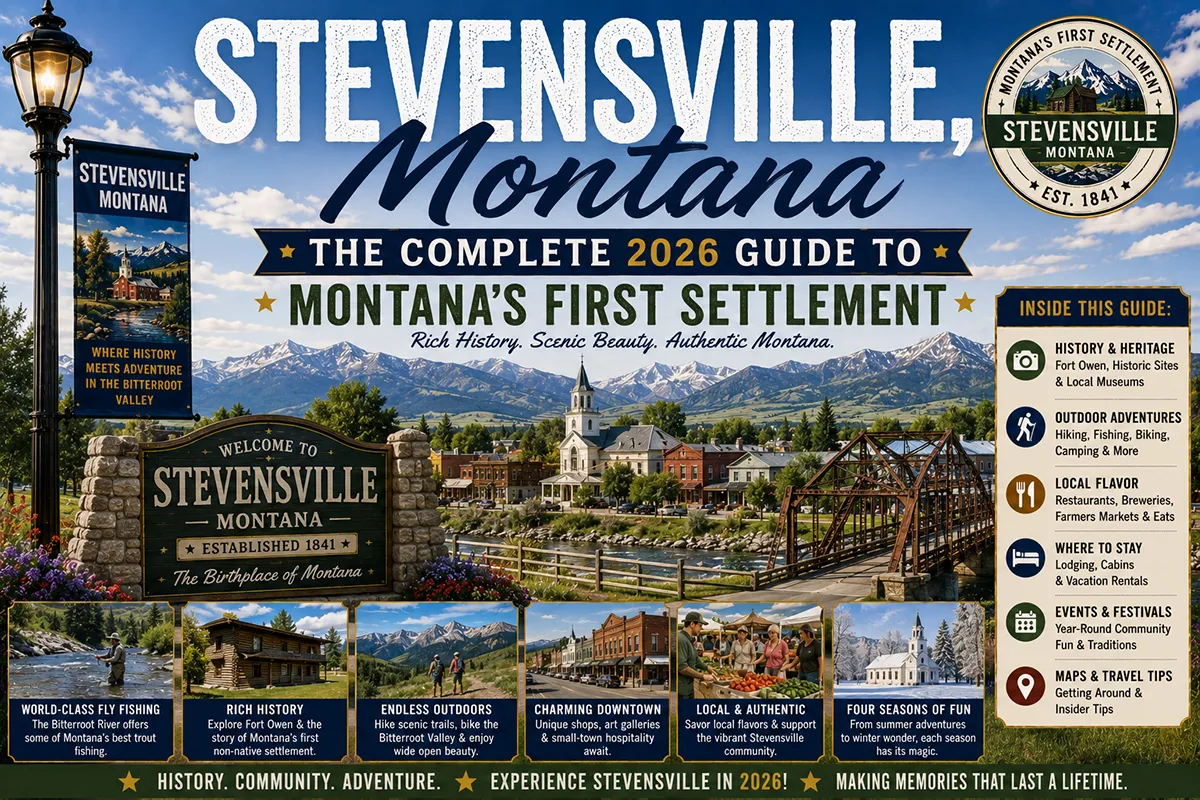
Stevensville’s argument: St. Mary’s Mission was established here in 1841 by Father Pierre-Jean De Smet, making it the first permanent European-American settlement in what would become Montana.
That’s 25 years before Virginia City’s gold rush, and it’s sitting right here in the middle of the Bitterroot Valley, still standing.
TL;DR
- Stevensville (~2,100) is the oldest town in Montana — home to St. Mary’s Mission (1841) and Fort Owen (1850s), the first permanent European-American settlement in the territory.
- A quiet, authentic Bitterroot Valley town 20 minutes north of Hamilton and 30 minutes south of Missoula.
- Best for: history travelers, birders (Lee Metcalf NWR is exceptional), Bitterroot Valley road trippers, and anyone wanting a genuine small Montana town without tourist infrastructure.
- Very low SERP competition — almost no quality travel content exists.
Liked this article?
Add Roaming Montana as a preferred source so you see more of our articles and guides on Google.
Stevensville at a Glance
| Population (2020) | ~2,100 |
|---|---|
| County | Ravalli County |
| Region | Western Montana (Bitterroot Valley) |
| Elevation | 3,397 ft |
| Distance to Missoula | ~27 miles (~35 min) |
| Distance to Hamilton | ~18 miles (~25 min) |
| Historical status | Oldest permanent settlement in Montana (1841) |
| Best for | Montana history, birding, Bitterroot Valley character |
What Makes Stevensville Different
The Bitterroot Valley was Salish (Flathead) tribal homeland for centuries before European contact. Father De Smet arrived in 1841 with a group of Jesuit missionaries, and at the invitation of Salish leaders, built St. Mary’s Mission. The mission was sold in 1850 to Major John Owen, who converted it into Fort Owen — a trading post that anchored the early settler economy of the valley.
These two sites — St. Mary’s Mission (partially reconstructed, partially original) and Fort Owen (ruins) — are among the earliest physical remains of European-American Montana history and are worth any history traveler’s time.
The town around them is a genuine agricultural community with a farmers market, a small downtown, and the character of a place that hasn’t been shaped by tourism. It’s different from Hamilton’s more energetic small-city vibe and from Missoula’s university culture. Stevensville is just Montana.
For broader trip context, see my Montana cities and towns hub.
The Top 10 Things to Do in Stevensville
1. St. Mary’s Mission
The 1841 Jesuit mission — the oldest in Montana. The restored chapel, Father Ravalli’s pharmacy (original), and a small museum tell the story of the Salish people’s invitation of the Jesuits and the early mission community. Guided tours available. One of Montana’s most significant historical sites and genuinely undervisited.
2. Fort Owen State Park
The ruins of Major John Owen’s 1850s adobe trading post — the first non-Native American farm in Montana — adjacent to the mission site. A self-guided walk covers the surviving adobe walls and interpretive signs.
3. Lee Metcalf National Wildlife Refuge
A 2,800-acre wetland refuge on the valley floor with nearly 240 bird, mammal, and amphibile species documented. Sandhill cranes, trumpeter swans, osprey, bald eagles, white pelicans — exceptional birding year-round, peaking in spring and fall migrations. Free. One of the best wildlife refuges in western Montana and almost completely unknown to out-of-state travelers.
4. Stevensville Farmers Market
Saturday mornings in summer — one of the Bitterroot Valley’s best. Local produce, artisan goods, excellent community atmosphere.
5. Hike Bass Creek Trail
The Bass Creek Trailhead (6 miles north of Stevensville on Bass Creek Road) accesses the Selway-Bitterroot Wilderness. The first 1.5 miles follow the creek through a beautiful canyon to a series of pools and falls. Longer routes climb into the wilderness.
6. Hike Charles Waters Nature Trail
A gentler loop through riverside cottonwood forest in the Bitterroot National Forest — good for birding and family hiking.
7. Stevensville Historical Museum
Small local museum in the town library building covering the Salish tribal history, mission era, Fort Owen, and ranching history of the northern Bitterroot.
8. Drive the Eastside Highway (MT-269)
Instead of the main US-93, the Eastside Highway runs parallel through the eastern side of the Bitterroot Valley — narrower, slower, more beautiful, passing farms and orchards with unobstructed Bitterroot Mountain views.
9. Fly Fish the Bitterroot River
The Bitterroot flows right through the valley. Cutthroat, brown, and rainbow trout. Multiple public access sites near Stevensville.
10. Stevensville Restaurant & Bar Scene
Small but genuine — the Banque Club in neighboring Victor is the broader area’s most interesting bar, and Stevensville has a few spots worth a lunch stop.
Where to Stay
Stevensville has very limited lodging — most visitors stay in Missoula (35 min) or Hamilton (25 min):
- B&Bs and vacation rentals — a few options in and around Stevensville
- Hamilton hotels (25 min south) — full selection; see Hamilton guide
- Missoula hotels (35 min north) — full city selection; see Missoula guide
Where to Eat
- Spice of India — surprisingly excellent Indian restaurant in town
- Coyote Coffee — breakfast and espresso
- 4B’s Restaurant — standard Montana diner fare
- Stevensville Hotel Bar — drinks and bar food
- Hamilton’s restaurant scene is 25 minutes away for better options
Getting There
From Missoula: ~27 miles south on US-93 or the Eastside Highway, about 35 minutes.
From Hamilton: ~18 miles north on US-93, about 25 minutes.
What Stevensville Unlocks
Bitterroot Valley Day Trip Loop
Stevensville–Hamilton–Darby and back is a classic full-day valley drive hitting the major sites.
Missoula (35 min north)
University, Clark Fork River, all services. See Missoula guide.
Hamilton (25 min south)
Daly Mansion, Blodgett Canyon, Bitterroot Brewing. See Hamilton guide.
Bass Creek & Selway-Bitterroot Wilderness
Trailhead access from just outside Stevensville.
When to Visit
Spring (April–May) is peak birding — migrants flooding into Lee Metcalf.
Summer (June–August) has the farmers market, full trail access, best Bitterroot hiking.
Fall (September–October) brings golden cottonwoods in the valley and excellent fly fishing.
Winter is quiet; the mission and museum are open limited hours.
Personal Tips
St. Mary’s Mission requires advance planning. Hours vary by season and tours depend on guide availability. Check ahead.
Lee Metcalf NWR is the hidden gem. Download the bird checklist at the refuge entrance. Spring migration (April–May) is extraordinary. Bring binoculars.
The Eastside Highway is worth the detour. Drive south from Stevensville on MT-269 rather than US-93 for unobstructed Bitterroot Mountain views.
Stevensville Farmers Market is a highlight. Saturdays in summer; arrive by 9 a.m. for the best selection.
Stevensville Quick Facts
| Founded | 1841 (St. Mary’s Mission) |
|---|---|
| Historical significance | First permanent European-American settlement in Montana |
| Average summer high | 84°F |
| Average winter low | 20°F |
Conclusion
Stevensville is for travelers who care about the story behind Montana’s landscapes. The mission, the ruins of Fort Owen, and the Lee Metcalf refuge together give you more genuine history and wildlife per square mile than most Montana towns ten times its size. It’s not a destination for first-timers chasing Glacier and Yellowstone — it’s the reward for coming back a second time.
Have a Stevensville question? Drop it in the comments — I read every one.
Frequently Asked Questions
Is Stevensville Montana worth visiting?
Yes — Stevensville is worth visiting for history travelers, birders, and anyone wanting an authentic Bitterroot Valley experience. St. Mary’s Mission (1841, the oldest permanent settlement in Montana) and Fort Owen (1850s trading post ruins) are genuinely significant historical sites. Lee Metcalf National Wildlife Refuge is one of western Montana’s premier birding destinations.
What is St. Mary’s Mission in Stevensville?
St. Mary’s Mission was established in 1841 by Jesuit missionary Father Pierre-Jean De Smet, at the invitation of the Salish people, making it the first permanent European-American settlement in what would become Montana. The restored chapel, Father Ravalli’s original pharmacy, and adjacent museum are open for guided tours. It’s one of Montana’s most historically significant sites and remains largely unknown to out-of-state travelers.
What is Fort Owen near Stevensville?
Fort Owen is the ruins of a 1850s adobe trading post established by Major John Owen after he purchased St. Mary’s Mission from the Jesuits. It’s now a state park with self-guided walking tours through the surviving adobe walls. Fort Owen operated as the first non-Native farm in Montana and was an important trading post in the early Bitterroot Valley settlement period.
How far is Stevensville from Missoula?
Stevensville is approximately 27 miles south of Missoula — about a 35-minute drive on US-93. The Eastside Highway (MT-269) is an alternate route with more scenic valley views.
What is the Lee Metcalf National Wildlife Refuge?
Lee Metcalf National Wildlife Refuge is a 2,800-acre wetland complex on the Bitterroot Valley floor near Stevensville, managed by the U.S. Fish and Wildlife Service. Nearly 240 species of birds, mammals, reptiles, and amphibians have been documented. Spring and fall migration bring sandhill cranes, trumpeter swans, tundra swans, white pelicans, and dozens of shorebird species. Bald eagles are present year-round. Free admission.