East Helena’s story is one of the most genuinely complicated small-town stories in Montana, and you can’t understand the town today without understanding what happened on a 140-acre parcel of land between 1888 and 2001.
For 113 years — longer than most American institutions exist — the American Smelting and Refining Company operated a lead smelter that produced more than 70,000 tons of bullion every year and supported thousands of families across multiple generations.
Workers came to East Helena from Italy, Serbia, Mexico, and dozens of other countries to take dangerous, well-paid jobs that built houses, paid for college, and made the town’s school sports teams the envy of Lewis and Clark County.
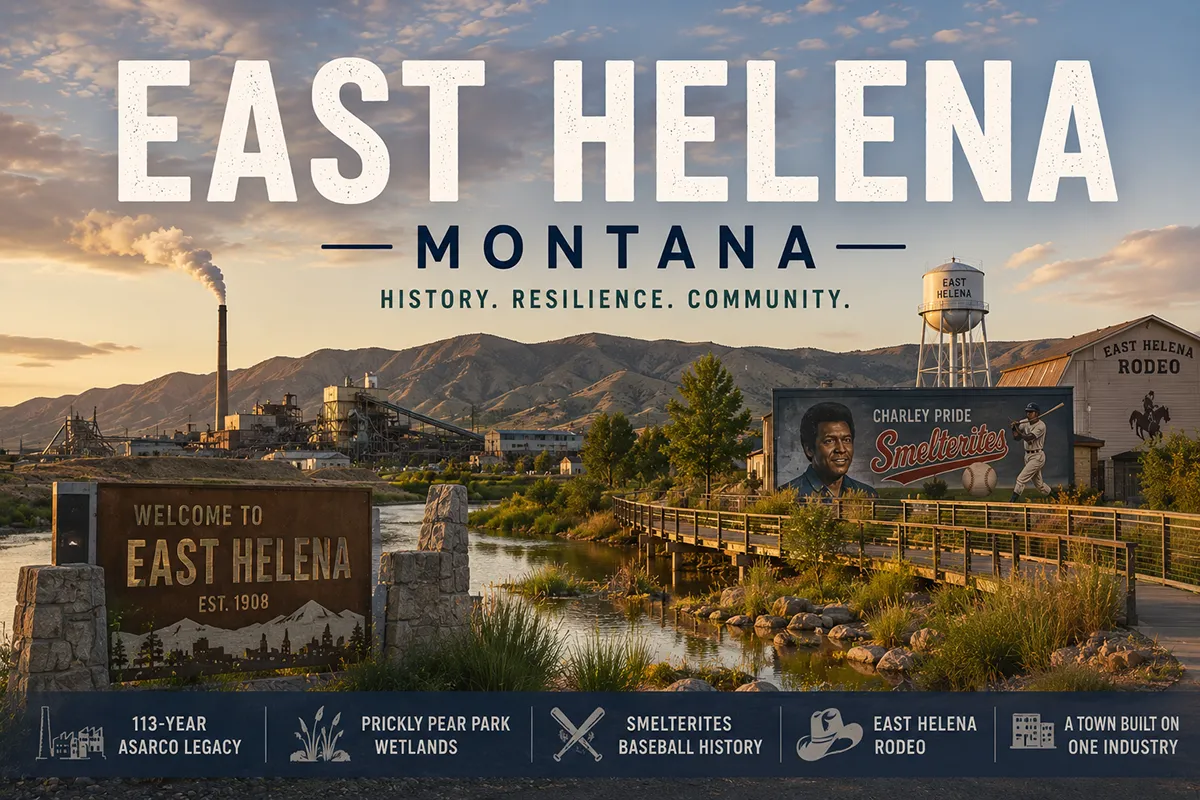
ASARCO sponsored the East Helena Smelterites — a semi-professional baseball team that, for a brief and unlikely period, included a young pitcher named Charley Pride before he traded his glove for a guitar and became one of the most successful country music artists in American history.
The smelter closed in 2001. ASARCO declared bankruptcy in 2005. And then East Helena began the longer, harder work of figuring out what comes next.
In 1984, even before the closure, the EPA had designated the smelter area a Superfund site after testing revealed elevated lead and arsenic in soil, groundwater, and — most alarmingly — in the blood of local children.
Cleanup has continued for over four decades under the Montana Environmental Trust Group (METG), an independent court-appointed trustee established from the ASARCO bankruptcy settlement.
The most visible recent milestone: in May 2025, Prickly Pear Park opened on a portion of the former smelter site — a two-mile loop trail through restored wetlands that connects to the nine-mile Sunderlin Trail running south to Montana City.
This is the East Helena of 2026. A town of about 1,944 residents, ten miles east of the state capital, in the middle of a transformation that has taken longer than the original smelter’s first century of operation.
Worth visiting? Genuinely yes. But for reasons that have nothing to do with the obvious tourist circuit, and that’s exactly what makes it worthwhile.
TL;DR
- East Helena (~1,944) sits 10 miles east of Helena in Lewis and Clark County on US-12.
- The ASARCO lead smelter operated from 1888 to 2001 — 113 years — defining the town’s economy, culture, and ethnic diversity (Italian, Serbian, Mexican, and other immigrant communities).
- Prickly Pear Park (opened May 2025) transforms part of the former smelter site into restored wetlands with a 2-mile loop trail and connections to the 9-mile Sunderlin Trail to Montana City.
- Charley Pride — the country music legend — pitched for the ASARCO-sponsored East Helena Smelterites semi-pro baseball team while living in Helena in the 1960s.
- The East Helena Rodeo (July) is one of the region’s authentic small-town rodeo events.
- Black Sandy State Park on Hauser Lake (15 minutes north) offers swimming, boating, and camping.
- Best for: industrial-history travelers, Helena-area visitors seeking authentic context, fishing and boating on the Missouri River reservoirs, and the new Prickly Pear Park trail system.
Liked this article?
Add Roaming Montana as a preferred source so you see more of our articles and guides on Google.
East Helena at a Glance
| Population (2020) | ~1,944 |
|---|---|
| County | Lewis and Clark County |
| Region | West-Central Montana (Helena Valley) |
| Distance to Helena | ~10 miles east (~15 min on US-12) |
| Distance to Bozeman | ~95 miles southeast (~1.75 hours) |
| Distance to Great Falls | ~95 miles northeast (~1.5 hours) |
| Distance to Black Sandy State Park | ~15 miles north (~25 min) |
| Best for | Industrial history, Prickly Pear Park, Helena-area base, Hauser Lake access |
What Makes East Helena Different
East Helena is a company town that lost its company. That’s the foundational fact, and almost everything else about the place — the layout, the architecture, the demographic mix, the small-town civic infrastructure, even the slag piles that remain as a geological feature of the landscape — flows from it.
Driving into East Helena from Helena on US-12, the first thing you notice if you know what to look for is the dark mass of the slag pile on the south side of the road. It’s a synthetic mountain, the accumulated byproduct of 113 years of lead smelting, and it stands as the most honest monument the town has.
The smelter’s social legacy is more complicated and in some ways more interesting than its environmental one. ASARCO recruited workers globally during the late 19th and early 20th centuries.
The result was a tiny Montana town with neighborhoods organized by ethnicity — Serbian Town, Italian Town, Mexican Town — and a Catholic parish, an Orthodox church, and a Methodist church serving overlapping but distinct communities.
Festivals, weddings, baseball games, and funerals all carried the cultural markers of the workers’ countries of origin.
The ASARCO-sponsored East Helena Smelterites baseball team became one of the most beloved local institutions; Charley Pride’s brief tenure as their pitcher (during his Helena years in the early 1960s, before he made the leap to country music in Nashville) is the kind of cultural footnote that captures everything about how this town worked.
The environmental story is what’s gotten the most national attention, and rightly so. The 1984 Superfund designation came after testing revealed lead concentrations in residential soil at levels far above safe limits, and elevated blood-lead levels in children living near the smelter.
The cleanup work — undertaken by the Montana Environmental Trust Group under EPA oversight since 2009 — has involved excavating contaminated soil from yards and gardens across the community, remediating groundwater, and ultimately transforming portions of the site itself into public use space. Prickly Pear Park is the most visible result.
The new park is genuinely worth visiting and worth understanding. Two miles of loop trail through restored wetlands; connections to the longer Sunderlin Trail running south through agricultural land to Montana City; native plant restoration efforts; and interpretive elements that don’t shy away from the site’s history.
The Prickly Pear Land Trust manages the property. It’s a working example of what post-industrial small-town transformation can look like when done with patience and community involvement.
For broader trip context, see my Montana cities and towns hub.
The Top 10 Things to Do In & Around East Helena
1. Prickly Pear Park (Opened May 2025)
The newest public space in the Helena area, built on a portion of the former ASARCO smelter site. A 2-mile loop trail through restored wetlands; native vegetation; bird habitat for waterfowl, marsh birds, and migratory species; and interpretive elements covering both the natural restoration and the industrial history.
Connects to the 9-mile Sunderlin Trail running south to Montana City. Free and open year-round. Managed by Prickly Pear Land Trust.
2. Sunderlin Trail
The 9-mile hiking and biking trail running south from Prickly Pear Park through agricultural land to Montana City.
Combines wetland, prairie, and creek-side terrain. Excellent for cycling, dog walking, and shorter day hikes. The full length is challenging on foot but rewarding; the northern sections from Prickly Pear Park are accessible to all fitness levels.
3. East Helena Rodeo (July)
The annual rodeo held at the East Helena rodeo grounds — bucking horses, bucking bulls, barrel racing, and team roping in a genuine small-town setting.
The Main Street Parade precedes the rodeo. One of Lewis and Clark County’s authentic community events. Check current schedule for exact dates.
4. East Helena History Walking Tour (Self-Guided)
The Lewis and Clark County Historic Preservation Office has developed materials covering East Helena’s industrial heritage.
Notable surviving structures include the Assistant Superintendent’s House at 416 Montana Avenue South (built circa 1910 for ASARCO management, documented in the Historic American Buildings Survey), the original Northern Pacific railroad alignments, and the ethnic-neighborhood housing patterns.
Maps and historical materials are available through the Helena Lewis and Clark County Library system.
5. Black Sandy State Park (15 min north, Hauser Lake)
The closest state park to Helena and East Helena. Swimming beach, boat ramp, fishing access to Hauser Lake (rainbow trout, brown trout, walleye, perch, kokanee salmon), camping, picnic areas. One of the Helena Valley’s primary summer recreation destinations.
6. Hauser Lake & Spring Meadow Lake Fishing
Hauser Lake — the Missouri River reservoir north of East Helena — provides exceptional fishing for rainbow trout, brown trout, walleye, perch, and kokanee. Spring Meadow Lake (closer to Helena) is family-friendly with fishing, swimming, and picnic areas. Multiple fishing access sites available in the area. Montana fishing license required.
7. Prickly Pear Creek Drive
The creek that the wetlands park is named for runs through the East Helena area before joining the Missouri River.
County roads following the creek provide pleasant short drives with abundant cottonwood corridor and occasional wildlife sightings. The creek is also a fishable trout stream in its upper sections.
8. Smelterman’s Picnic (Annual, Mid-July)
The annual reunion of former ASARCO employees and their families, held at Main Street Park following the East Helena Rodeo parade.
Open to all former ASARCO employees, their families, and anyone interested in East Helena history. Over 100 attendees in recent years.
A genuinely moving community event for visitors interested in the human dimension of the town’s industrial story.
9. Day Trip to Helena (10 minutes west)
The state capital — Montana State Capitol building, Cathedral of St. Helena, Last Chance Gulch historic district, Montana Historical Society, Reeder’s Alley, Mount Helena.
East Helena is 15 minutes from downtown Helena via US-12, making it a viable alternative base for travelers visiting the capital. See Helena guide.
10. Charley Pride / Smelterites Baseball Cultural Pilgrimage
For country music fans, the Charley Pride connection is the kind of footnote that genuinely adds depth. Pride lived in Helena in the early 1960s while working at the ASARCO smelter, and pitched for the company-sponsored East Helena Smelterites semi-pro baseball team.
He eventually traded baseball for a Nashville country music career, becoming the first Black artist inducted into the Country Music Hall of Fame. The original Smelterites field is still visible in town; informal community markers acknowledge the connection.
Where to Stay
| Hotel | Vibe | Price | Best For |
|---|---|---|---|
| Helena hotels (15 min west) | Best selection | $130–280 | Most travelers |
| Vacation rentals (East Helena) | Local homes | $130–250 | Longer stays, families |
| Black Sandy State Park camping | Lakeside sites | $20–35 | Campers, anglers |
| Helena Valley vacation rentals | Mix of properties | $150–350 | Quieter base than Helena |
Where to Eat
- Main Street establishments in East Helena — small local cafés and bars
- Steve’s Café — long-standing breakfast and lunch spot in East Helena
- Helena dining (15 min west) — full restaurant variety including The Brewhouse, Lucca’s, and the Windbag; see Helena guide
- Bring picnic supplies for Prickly Pear Park — covered tables but no concessions on-site
Getting There & Around
From Helena: 10 miles east on US-12, about 15 minutes.
From Bozeman: ~95 miles via I-90 west and US-287 north through Townsend, about 1.75 hours.
From Great Falls: ~95 miles south on I-15, then east on US-12, about 1.5 hours.
From Helena Regional Airport (HLN): ~12 miles via US-12 east, about 15 minutes.
What East Helena Unlocks
Helena & the State Capitol (15 min west)
Montana’s capital city with full attractions, restaurants, and services.
Black Sandy State Park & Hauser Lake (15 min north)
Primary summer recreation; swimming, boating, fishing.
Canyon Ferry Lake (~30 min east)
Montana’s third-largest reservoir; fishing, sailing, camping.
Gates of the Mountains (~25 min north)
Lewis and Clark’s named landmark on the Missouri; tour boats access the canyon.
Continental Divide Trail Sections
Multiple access points within an hour of East Helena.
When to Visit
May–September: Prickly Pear Park fully accessible; Black Sandy State Park open; East Helena Rodeo (July); Smelterman’s Picnic (July).
Year-round: Prickly Pear Park trails accessible (though winter snow can affect conditions); Helena attractions all open year-round.
Winter: Cross-country skiing on the Sunderlin Trail; ice fishing on Hauser Lake; quieter Helena valley character.
Personal Tips
Don’t skip the slag pile context. It’s tempting to drive past the ASARCO industrial remnants without absorbing what they represent. Stop at one of the US-12 pullouts on the east side of Helena and just look at the slag pile for a few minutes. It’s a 113-year accumulation, and the scale tells a story no museum exhibit captures the same way.
Time a visit for July if possible. The East Helena Rodeo and Smelterman’s Picnic fall in the same general window, giving travelers a genuine taste of community character that off-season visits won’t replicate.
Walk the full Prickly Pear Park loop. Two miles isn’t long. Allow an hour to absorb the restoration story rather than rushing through. The interpretive elements reward attention.
Helena is the practical overnight base. East Helena lodging is limited; the 15-minute drive to downtown Helena is short and easy. Use Helena as the base and East Helena as the day-trip destination.
The Charley Pride connection is real but understated. Don’t expect a major museum or tourist marker. The Smelterites baseball field exists; informal community knowledge of the connection runs deep. Ask at the local cafés — locals will share the stories.
East Helena Quick Facts
| Founded | 1888 (around the ASARCO smelter) | | ASARCO smelter operations | 1888–2001 (113 years) | | Smelter production | ~70,000 tons of lead bullion annually at peak | | Superfund designation | 1984 | | Smelter closure | 2001 | | Charley Pride | Pitched for the East Helena Smelterites in the early 1960s | | Prickly Pear Park opened | May 2025 | | Average summer high | 84°F | | Average winter low | 16°F |
Conclusion
East Helena is one of the most genuinely thoughtful stops on a Helena-area itinerary — not because it has more attractions than the capital next door, but because it captures the long arc of Montana’s industrial story more honestly than any other place in the state.
A 113-year company town, an EPA Superfund site, a working post-industrial transformation, and a country music legend’s brief baseball career are all part of the same compact community ten miles east of the state capitol building.
Walk the new Prickly Pear Park, talk to anyone over sixty in the local café, and you’ll understand more about how Montana actually works than most polished tourist destinations will ever teach you.
Have an East Helena question? Drop it in the comments — I read every one.
Frequently Asked Questions
Is East Helena Montana worth visiting?
Yes — East Helena is worth visiting for the newly opened Prickly Pear Park (May 2025, on the former ASARCO smelter site), the Sunderlin Trail, the East Helena Rodeo (July), Black Sandy State Park on Hauser Lake (15 minutes north), and as a quieter alternative base for travelers visiting Helena. The town’s 113-year ASARCO smelter history makes it one of Montana’s most substantive industrial-heritage destinations.
What was the ASARCO smelter in East Helena?
The American Smelting and Refining Company (ASARCO) operated a lead smelter in East Helena from 1888 to 2001 — 113 years — producing approximately 70,000 tons of lead bullion annually at peak. The smelter defined the town’s economy, ethnic composition (Italian, Serbian, Mexican, and other immigrant communities), and social institutions for over a century. The site was designated an EPA Superfund area in 1984; the smelter closed in 2001; cleanup has continued under the Montana Environmental Trust Group since 2009.
Did Charley Pride play baseball in East Helena?
Yes — country music legend Charley Pride pitched for the East Helena Smelterites, a semi-professional baseball team sponsored by ASARCO, during his time living in Helena in the early 1960s. Pride worked at the smelter and played for the company team before launching his country music career in Nashville. He later became the first Black artist inducted into the Country Music Hall of Fame.
What is Prickly Pear Park?
Prickly Pear Park is a new public park that opened in May 2025 on a portion of the former ASARCO smelter site in East Helena. The park features a 2-mile loop trail through restored wetlands, native vegetation restoration, bird habitat, and interpretive elements covering both the natural restoration and the industrial history. It connects to the 9-mile Sunderlin Trail running south to Montana City. Managed by Prickly Pear Land Trust. Free and open year-round.
How far is East Helena from Helena Montana?
East Helena is 10 miles east of Helena on US-12 — about a 15-minute drive. From Helena Regional Airport (HLN), East Helena is approximately 12 miles east, also about 15 minutes. The two communities are close enough that East Helena functions as a quieter lodging and dining alternative for travelers visiting the state capital.