The story of how a small Montana farming town came to be called Manhattan is one of those name-origin stories that turns out to be more interesting than the obvious explanation. The town wasn’t named after Manhattan in New York City directly — at least not the way you’d think.
It was originally called Hamilton when established in 1864, then moved a mile north near the Northern Pacific Railroad and renamed Moreland. In the 1880s, New York City investors arrived in the Gallatin Valley to build a major barley malting operation.
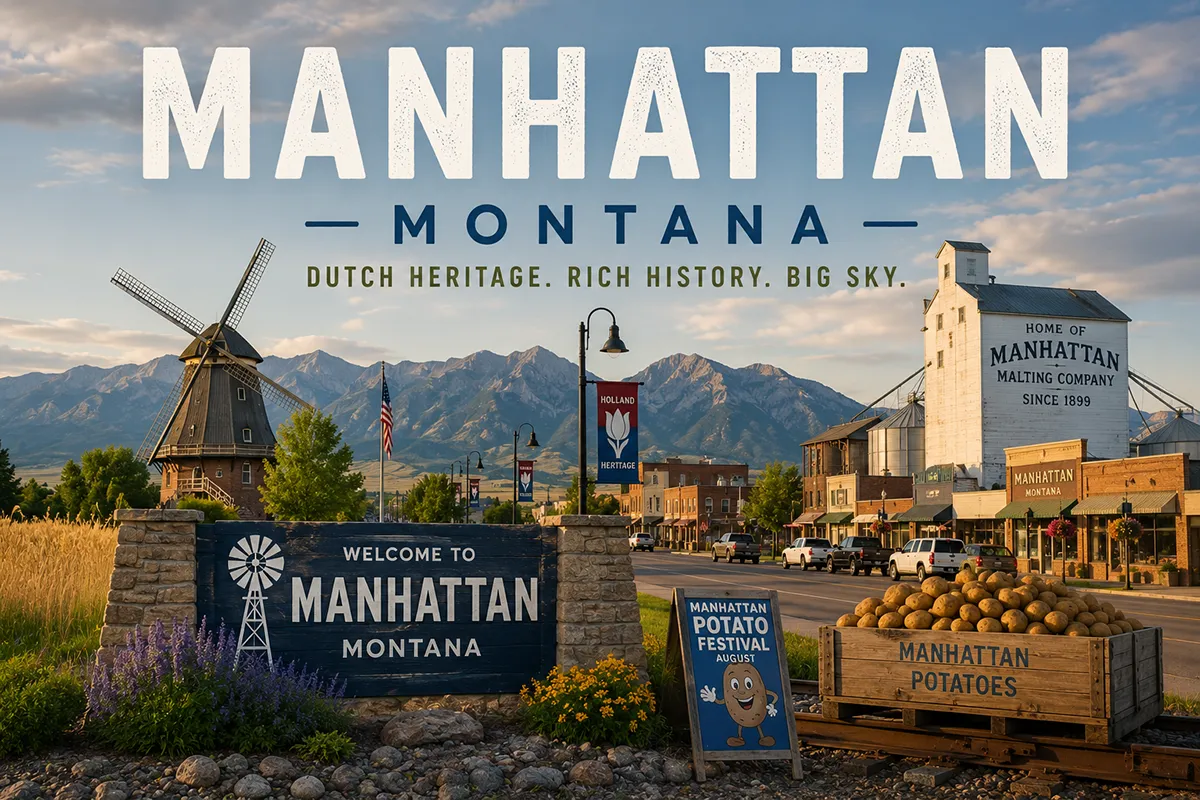
They formed the Manhattan Malting Company, named for their own corporate origin in New York. By 1890 they had renamed the town to match the company, and Manhattan, Montana, was born — barley fields stretching to the horizon, a malting operation supplying breweries across the West, and Dutch immigrant farmers driving the agricultural economy.
The Dutch piece of that story is the part that locals still talk about. Families from the Netherlands started arriving in the 1890s to farm the rich Gallatin Valley soils. Within a generation they had built one of the most significant Dutch settlements in the American West — centered not in Manhattan proper but in two adjacent communities to the south: Amsterdam and Churchill.
Neither was ever incorporated, but together they form the cultural and religious heart of Montana’s Dutch community.
Streets in the area carry names like Wooden Shoe Road, Windmill Lane, Canal Road, and Dyk Road.
The Manhattan Christian Reformed Church (founded as the 1st Christian Reformed Church in Churchill) and the parent-operated Manhattan Christian School still serve the community.
Even today, the Manhattan zip code 59741 covers Amsterdam and Churchill, because neither has its own post office.
What surprised me most on my first visit was the scale of the agricultural identity. This isn’t a Bozeman suburb pretending to have heritage — it’s a working farming community of about 2,086 people that happens to sit 25 minutes west of Bozeman on I-90.
The barley is mostly gone now, but seed potatoes, wheat, dairy, and beef sustain the same families that built the Christian Reformed Church a century ago.
TL;DR
- Manhattan (~2,086) sits in the Gallatin Valley on I-90, 25 minutes west of Bozeman and 10 minutes east of Three Forks.
- Named in 1890 for the Manhattan Malting Company, a New York investor venture that bought barley from Dutch immigrant farmers.
- The Amsterdam-Churchill Dutch heritage corridor 5–10 miles south is the largest Dutch settlement in Montana — home to Manhattan Christian School and Manhattan Christian Reformed Church.
- The Manhattan Potato Festival in mid-August draws ~7,000 visitors — parade, 5K run, car show, live music, and the tater-tot tricycle grand prix.
- Wheat Montana Farms operates 13,000+ acres of grain between Manhattan and Three Forks; the famous Wheat Montana Bakery & Deli is at the Three Forks I-90 exit nearby.
- The Manhattan Area Museum covers Dutch settlement, Northern Pacific Railroad history, and the malting industry.
- Land of Magic Steakhouse in Logan (5 minutes west) is one of the Gallatin Valley’s most beloved dinner spots.
- Best for: Bozeman-area travelers wanting an authentic small-town counterpoint, Dutch heritage seekers, August festival timing, and Gallatin River fly fishing access.
Liked this article?
Add Roaming Montana as a preferred source so you see more of our articles and guides on Google.
Manhattan at a Glance
| Population (2020) | ~2,086 |
|---|---|
| County | Gallatin County |
| Region | Southwest Montana (Gallatin Valley) |
| Elevation | 4,251 ft |
| Distance to Bozeman | ~25 miles east (~25 min on I-90) |
| Distance to Three Forks | ~10 miles west (~12 min on I-90) |
| Distance to Belgrade | ~13 miles east (~15 min) |
| Distance to Amsterdam-Churchill | ~5–10 miles south |
| Distance to Bozeman Yellowstone International Airport (BZN) | ~22 miles east |
| Best for | Dutch heritage, Potato Festival (August), Gallatin River fishing, Bozeman alternative |
What Makes Manhattan Different
Manhattan exists as a working agricultural town inside one of the fastest-growing valleys in the American West.
The Gallatin Valley around Bozeman has been adding population at a pace that’s transformed Belgrade and the I-90 corridor into something almost unrecognizable from a decade ago. Manhattan has felt that pressure, but it hasn’t been overwhelmed by it.
The town center still looks and functions like what it has been for 130 years: a railroad town serving the surrounding farms. The grain elevator is still the tallest structure. Broadway, the main street, is short enough to walk in five minutes.
The Manhattan-Amsterdam-Churchill triangle south of town is where the Dutch heritage actually lives.
Drive south on Churchill Road from the I-90 Manhattan exit and within ten minutes you’re in farmland that feels Midwestern in a specific way — neat farmhouses, well-maintained barns, Reformed Church steeples visible from the section roads, and the kind of agricultural prosperity that comes from generations of disciplined farming on good soil.
Amsterdam was the retail center of the Dutch settlement historically; Churchill was the cultural and religious center.
The 1st Christian Reformed Church (now Manhattan Christian Reformed Church) anchored the community from its founding, and the Manhattan Christian School — parent-operated, parochial in the Reformed tradition — still serves families across the area.
The seed potato story is the agricultural angle most travelers don’t know about. Seed potato farming arrived in the Manhattan-Amsterdam-Churchill area in 1950 and grew into one of the region’s signature crops.
The fields here produce certified seed potatoes shipped across the country to potato-growing regions like Idaho and Washington.
The annual Manhattan Potato Festival in mid-August (typically the third Saturday) commemorates this agricultural identity — a parade, a 5K run, a car show, live music, food vendors, and yes, a competitive tater-tot tricycle grand prix race.
Roughly 7,000 people attend, which is more than three times the town’s population. The festival is the right reason to time a Gallatin Valley trip for August.
Wheat Montana Farms operates the area’s most visible agricultural enterprise: 13,000+ acres of conservation-farmed dry-land wheat between Manhattan and Three Forks, with their mill and the famous Wheat Montana Bakery & Deli at the Three Forks I-90 exit.
The bakery is one of Montana’s iconic interstate stops — fresh bread, the breakfast bagel sandwich, Bronze Chief and Prairie Gold wheat varieties — and the operation collectively employs over 100 people.
It’s not literally in Manhattan, but it’s grown in Manhattan’s farmland and operated from Manhattan-area corporate offices.
For broader trip context, see my Montana cities and towns hub.
The Top 10 Things to Do In & Around Manhattan
1. Manhattan Potato Festival (Mid-August)
The town’s defining annual event. Held the third Saturday in August in downtown Manhattan, the festival opens with a Fireman’s Breakfast, features a Tater-Tot Grand Prix tricycle race, the Potato Festival Parade at 11 a.m., a car show, a 5K run, live music in Railroad Park’s gazebo, and food vendors deep-frying potatoes in every form imaginable.
Approximately 7,000 attendees — three times the town’s population. The festival celebrates the Manhattan-Amsterdam-Churchill seed potato industry that has anchored the region since 1950.
2. Wheat Montana Bakery & Deli (Three Forks I-90 Exit, 10 min west)
The famous Wheat Montana flagship at the Three Forks exit. Fresh bread (Prairie Gold and Bronze Chief varieties grown locally), the breakfast bagel sandwich, deli sandwiches, fountain drinks, and a substantial gift shop. One of Montana’s iconic interstate stops. Open daily.
3. Amsterdam-Churchill Dutch Heritage Drive
Drive south on Churchill Road from I-90 to experience the Dutch heritage corridor. Stop at the Manhattan Christian Reformed Church (the founding 1st Christian Reformed Church in Churchill), see Manhattan Christian School, drive the Dutch-named country roads (Wooden Shoe Road, Windmill Lane, Canal Road, Dyk Road).
Genuinely distinct cultural geography in a part of Montana most travelers blow through on I-90.
4. Manhattan Area Museum
The small but well-curated museum covers the town’s three foundational stories: early Dutch settlement, the Manhattan Malting Company and the barley malting industry, and the Northern Pacific Railroad. The exhibits include artifacts from the Manhattan Malting era and original Dutch settler material. A right first stop for understanding the town.
5. Gallatin River Fly Fishing
Public access points to the Gallatin River are nearby (within a 15–20 minute drive). Brown and rainbow trout in scenic settings. The Gallatin is less famous than the Madison but produces excellent fishing with lower pressure.
Montana fishing license required. Local fly shops in Bozeman provide current conditions and fly recommendations.
6. Madison Buffalo Jump State Park (~25 min south)
One of Montana’s most significant Indigenous-history sites — a cliff used by Native peoples for centuries to hunt buffalo by stampeding them off the edge. A short hike accesses the top of the jump with interpretive panels. Genuinely moving. Free.
7. Missouri River Headwaters State Park (~15 min west, near Three Forks)
The confluence of the Madison, Jefferson, and Gallatin Rivers — the geographic point where the Missouri River begins, named by Lewis and Clark in 1805. Hiking trails, interpretive panels, picnic areas. One of the most historically significant sites in Montana.
8. Land of Magic Steakhouse (Logan, 5 min west)
The locally legendary steakhouse in Logan — just off I-90 a few miles west of Manhattan. Locals swear by the house seasoning, which is allegedly top-secret.
The steaks, the prime rib, and the supper club atmosphere combine into one of the Gallatin Valley’s most-loved dinner experiences. Reservations recommended weekends.
9. 406 Brewing Company
Manhattan’s local brewery — a small, community-focused taproom serving rotating beers brewed on-site. Tasting room hours vary; check current schedule. A good casual stop for visitors and locals alike.
10. Manhattan Wednesday Farmers Market (July–September)
Town Park hosts the Manhattan Farmers Market on Wednesday evenings July through September. Local produce, baked goods, crafts. Strong community character; smaller and less commercial than Bozeman’s market.
Where to Stay
| Hotel | Vibe | Price | Best For |
|---|---|---|---|
| Manhattan area inns & B&Bs | Small, local | $130–220 | Quieter base than Bozeman |
| Sacajawea Hotel (Three Forks, 10 min west) | Historic luxury, restored 1910 | $250–450 | Bucket-list lodging |
| Belgrade hotels (15 min east) | Standard chains | $130–220 | Airport proximity |
| Bozeman hotels (25 min east) | Full selection | $180–400+ | Most travelers |
| Vacation rentals (Gallatin Valley) | Farmhouses, cabins | $200–400 | Families, longer stays |
Where to Eat
- Land of Magic Steakhouse (Logan, 5 min west) — the area’s iconic dinner spot; steaks and prime rib
- Wheat Montana Bakery & Deli (Three Forks exit) — breakfast and lunch institution
- 406 Brewing Company — local taproom; light food
- Local cafés in downtown Manhattan — breakfast and lunch
- Three Forks restaurants (10 min west) — Pompey’s Grill at the Sacajawea Hotel
- Bozeman dining (25 min east) — full restaurant variety
Getting There & Around
From Bozeman: 25 miles west on I-90 (Exit 288), about 25 minutes.
From Three Forks: 10 miles east on I-90, about 12 minutes.
From Belgrade: 13 miles west on I-90, about 15 minutes.
From Bozeman Yellowstone International Airport (BZN): 22 miles west via I-90, about 25 minutes — making Manhattan a viable base for travelers who want quieter accommodations near BZN.
Cell service: Excellent throughout the Gallatin Valley.
What Manhattan Unlocks
Amsterdam-Churchill (5–10 min south)
Montana’s largest Dutch settlement community; Manhattan Christian Reformed Church, Manhattan Christian School, Dutch-named country roads.
Three Forks & Missouri River Headwaters (10 min west)
Confluence of Madison, Jefferson, and Gallatin Rivers; Lewis and Clark history; Sacajawea Hotel.
Madison Buffalo Jump State Park (25 min south)
Significant Indigenous-history site; short hike to the jump cliff.
Bozeman & Museum of the Rockies (25 min east)
Montana’s fastest-growing city; world-class dinosaur museum.
Big Sky Resort (~1 hour south)
Year-round mountain resort via US-191 south from Bozeman.
Yellowstone National Park (~2 hours south)
North entrance via Bozeman and Livingston.
When to Visit
Mid-August: Manhattan Potato Festival — the year’s signature event.
Summer (June–August): Farmers Market on Wednesdays; Gallatin River fly fishing at its best; all attractions open.
Fall (September–October): Montana Corn Maze (family attraction); harvest activity in the surrounding fields; fall colors in the Bridger and Tobacco Root foothills.
Spring (April–May): Quieter, fewer crowds, ranch country at its greenest.
Winter (December–March): Close enough to Bozeman for Bridger Bowl skiing (~45 minutes); quiet small-town atmosphere.
Personal Tips
Time a visit for the Potato Festival weekend. Mid-August in the Gallatin Valley is genuinely beautiful — long days, working farms in full activity, mountain views in every direction, and the festival itself is the kind of authentic small-town event that’s getting harder to find. Book Bozeman or Belgrade lodging weeks ahead; Sacajawea Hotel in Three Forks fills up months out.
Don’t skip Amsterdam-Churchill. The Dutch heritage drive south of Manhattan is genuinely distinct from anything else in Montana. Allow at least an hour to drive Churchill Road, visit the church, and absorb the agricultural landscape.
Manhattan is a smart Bozeman alternative. If you’re flying into BZN and Bozeman lodging prices have hit your patience limit, look at Manhattan-area vacation rentals. You’re 25 minutes from downtown Bozeman, 25 minutes from BZN, and you’re sleeping in actual Montana farmland rather than a commercial corridor.
Land of Magic Steakhouse is worth the small detour. The steakhouse is in Logan, 5 minutes west of Manhattan, and it’s the meal locals will quietly recommend over any of Bozeman’s higher-priced options. Make a reservation.
Combine with Three Forks for a full day. Manhattan, Three Forks, and Missouri River Headwaters State Park together fill an excellent day — Manhattan Potato Festival in the morning if it’s August, Wheat Montana for lunch, Missouri Headwaters in the afternoon, Sacajawea Hotel dinner.
Manhattan Quick Facts
| Founded | 1864 (as Hamilton); moved and renamed Moreland; renamed Manhattan 1890 | | Named for | Manhattan Malting Company (NYC investors) | | Dutch settlement | Began 1890s; Amsterdam & Churchill founded by 1911 | | Seed potato farming | Began 1950; now anchors Manhattan-Amsterdam-Churchill agriculture | | Manhattan Potato Festival | Mid-August; ~7,000 attendees | | Wheat Montana Farms | 13,000+ acres of conservation-farmed dryland wheat | | Average summer high | 82°F | | Average winter low | 12°F |
Conclusion
Manhattan is what the Gallatin Valley looked like before it became one of the fastest-growing parts of the American West — a working farming community with Dutch heritage, a barley malting origin story, a seed potato industry, and a small-town festival that draws three times the town’s population.
Twenty-five minutes from Bozeman and ten minutes from the Missouri River headwaters, it’s the right kind of base for travelers who want the proximity without the price tag, and the right kind of detour for travelers who want a glimpse of the Gallatin Valley before the growth corridor swept past.
Have a Manhattan question? Drop it in the comments — I read every one.
Frequently Asked Questions
Is Manhattan Montana worth visiting?
Yes — Manhattan is worth visiting for the Manhattan Potato Festival in August (~7,000 attendees), the Amsterdam-Churchill Dutch heritage corridor (Montana’s largest Dutch settlement community), Wheat Montana’s flagship bakery operation, and as a quieter base for travelers visiting Bozeman or flying into BZN airport. The Gallatin Valley agricultural landscape and proximity to Three Forks’ Missouri River headwaters make it a substantive day-trip or overnight destination.
Why is Manhattan Montana called Manhattan?
The town was renamed in 1890 by New York City investors who built the Manhattan Malting Company in the Gallatin Valley to process barley from Dutch immigrant farmers. The community had previously been called Hamilton (1864) and then Moreland after the town moved to be nearer the Northern Pacific Railroad. The Manhattan name was chosen for the malting company’s New York corporate identity rather than a direct reference to Manhattan, NY.
What is the Manhattan Potato Festival?
The Manhattan Potato Festival is held annually on the third Saturday of August in downtown Manhattan. The event celebrates the seed potato farming industry that has anchored the Manhattan-Amsterdam-Churchill area since 1950. Activities include a Fireman’s Breakfast, the Tater-Tot Grand Prix tricycle race, the Potato Festival Parade at 11 a.m., a car show, a 5K run, live music in Railroad Park, and food vendors. Approximately 7,000 attendees — three times the town’s population.
What is the Amsterdam-Churchill Dutch settlement?
Amsterdam-Churchill is an unincorporated community 5–10 miles south of Manhattan that constitutes Montana’s largest Dutch immigrant settlement. Established by Dutch immigrants beginning in the 1890s and growing significantly with the founding of Amsterdam in 1911, the community is the cultural and religious center of Montana’s Dutch population. Manhattan Christian Reformed Church (founded as the 1st Christian Reformed Church) and the parent-operated Manhattan Christian School both serve the area. Roads named Wooden Shoe Road, Windmill Lane, Canal Road, and Dyk Road reflect the Dutch heritage. Both Amsterdam and Churchill receive mail through the Manhattan, Montana zip code 59741.
Is Wheat Montana in Manhattan?
Wheat Montana Farms operates 13,000+ acres of conservation-farmed dryland wheat in the Manhattan-Three Forks corridor, and Manhattan-area land contributes significantly to the operation. However, the famous Wheat Montana Bakery & Deli — the iconic interstate stop — is located at the Three Forks I-90 exit, about 10 minutes west of Manhattan. The bakery operates a mill, deli, and gift shop and employs over 100 people. Both locations are part of the same family-owned operation.
How far is Manhattan from Bozeman?
Manhattan is 25 miles west of Bozeman on Interstate 90 — about a 25-minute drive. From Bozeman Yellowstone International Airport (BZN), Manhattan is approximately 22 miles west, also about 25 minutes via I-90.