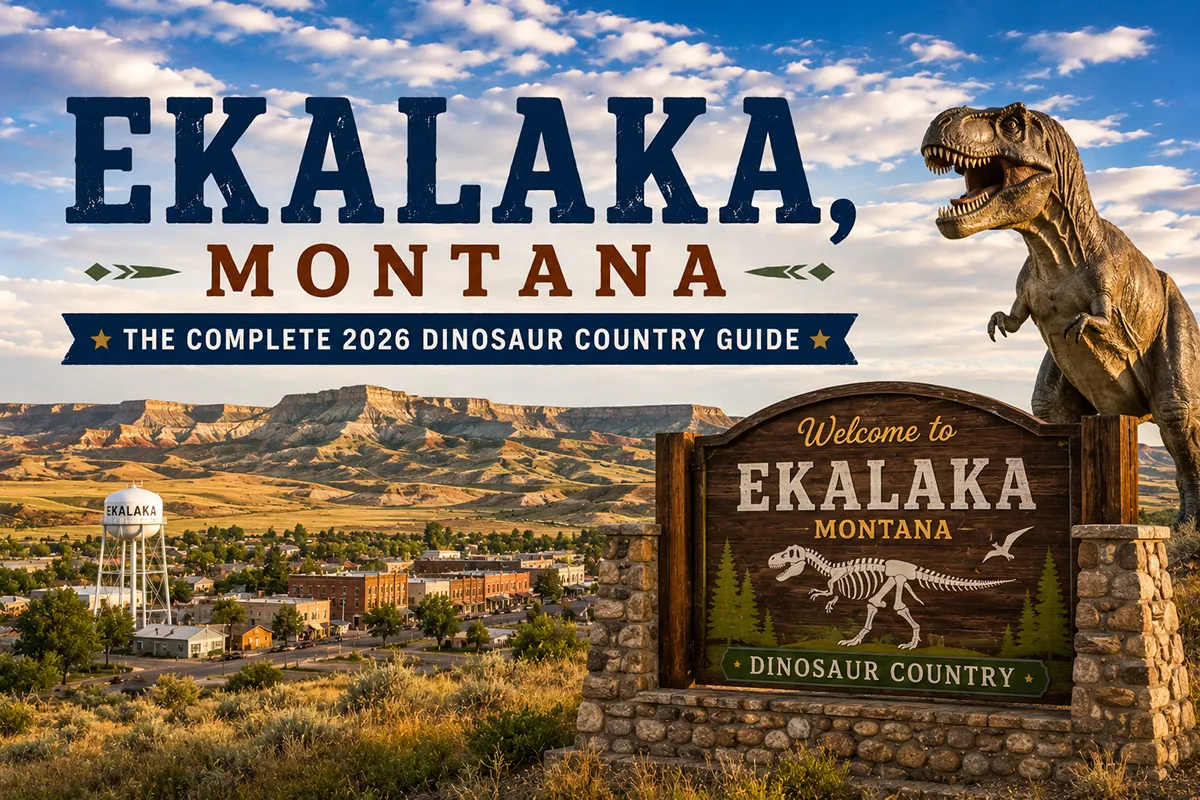
In 1936, a Carter County rancher named Walter Peck found a Triceratops skull on his land. He brought it to town. Local citizens — schoolteachers, ranchers, anyone who’d help — built a museum around it.
The Carter County Museum, founded that year, became Montana’s first county museum and started a dinosaur fossil collection that today rivals institutions ten times its size.
Ekalaka itself is one of the most remote county seats in the lower 48, sitting at the literal end of MT-7 in Carter County, surrounded by the Custer National Forest’s pine-covered ridges. Most maps don’t show it. Most travelers don’t get here. Both of those facts are reasons to come.
TL;DR
- Ekalaka (~330) is the county seat of Carter County in Montana’s far southeast corner — one of the most remote county seats in the contiguous United States.
- The Carter County Museum was the first county museum in Montana (founded 1936) and houses a significant dinosaur fossil collection — Triceratops, Tyrannosaurus rex specimens, hadrosaurs.
- Medicine Rocks State Park is 14 miles north — Montana’s first International Dark Sky Sanctuary.
- The Chalk Buttes and Long Pines offer dramatic landscapes within Custer National Forest.
- Best for: paleontology enthusiasts, dinosaur trail completionists, remote Montana road trippers, stargazers, and travelers wanting an authentic far southeast Montana experience.
Liked this article?
Add Roaming Montana as a preferred source so you see more of our articles and guides on Google.
Ekalaka at a Glance
| Population (2020) | ~330 |
|---|---|
| County | Carter County (county seat) |
| Region | Far Southeast Montana |
| Elevation | 3,468 ft |
| Distance to Baker | ~35 miles north (~45 min) |
| Distance to Medicine Rocks State Park | ~14 miles north (~20 min) |
| Distance to Belle Fourche, SD | ~85 miles south (~1.5 hours) |
| Best for | Dinosaur fossils, remote Montana, Medicine Rocks access, Chalk Buttes hiking |
What Makes Ekalaka Different
Ekalaka exists in a geographic isolation that’s hard to overstate. The town sits at the end of paved MT-7 — beyond it, dirt roads thread into the Custer National Forest and toward the South Dakota and Wyoming borders.
The population peaked decades ago; today’s 330 residents represent a stable, deeply rooted community in one of the most lightly populated counties in Montana.
What’s geologically rich here is the Hell Creek Formation — Cretaceous-era sediment laid down 65–67 million years ago during the era of T. rex and Triceratops.
The same formation produces world-class fossils in nearby Garfield County (Jordan/Hell Creek area) and Carter County. Walter Peck’s 1936 Triceratops find was just one of hundreds of significant fossils that have come out of the surrounding ranches.
The town’s character is shaped by ranching, the museum’s quiet international reputation, and the surrounding Custer National Forest — the Long Pines unit and the Chalk Buttes create landscapes more like the South Dakota Black Hills than typical eastern Montana plains.
For broader trip context, see my Montana cities and towns hub.
The Top 10 Things to Do In & Around Ekalaka
1. Carter County Museum
The destination. Founded in 1936 around Walter Peck’s Triceratops skull, the museum has grown into a major regional paleontology collection — complete dinosaur skeletons, T. rex teeth and bones, hadrosaur specimens, and significant Hell Creek Formation finds. Also covers Carter County’s pioneer history, Native American artifacts, and natural history. Montana’s first county museum. Free admission. Plan 2 hours.
2. Medicine Rocks State Park (14 miles north)
Just 20 minutes north of Ekalaka on MT-7 — Montana’s first International Dark Sky Sanctuary, with dramatic sandstone pillar formations. See Baker guide for full details. Easily combined with Ekalaka as a single trip.
3. Chalk Buttes (Custer National Forest)
A dramatic white sandstone butte complex in the Custer National Forest west of Ekalaka — the Chalk Buttes rise 600+ feet above the surrounding prairie and offer hiking, wildlife viewing, and exceptional landscape photography. Access via forest roads from Ekalaka — high-clearance vehicle recommended.
4. Long Pines (Custer National Forest)
A ponderosa pine forest district of the Custer National Forest east of Ekalaka — dramatic landscape including the area called Capitol Rock (a sandstone formation similar to a smaller version of South Dakota’s Devils Tower) and excellent hiking and camping. Less developed than most National Forest areas; remote feel.
5. Capitol Rock National Natural Landmark
A distinctive sandstone monolith in the Long Pines unit — designated a National Natural Landmark. Resembles the U.S. Capitol Building dome in profile. Accessible via Forest Service roads; the landmark itself can be hiked around.
6. Powder River Day Trip
Drive south from Ekalaka toward Broadus and the Powder River country — pristine prairie river landscape with significant Indigenous and Western history. See Broadus guide.
7. Stargazing at Medicine Rocks or Capitol Rock
Far southeast Montana has some of the darkest skies in the lower 48. Both Medicine Rocks (designated Dark Sky Sanctuary) and the Long Pines unit offer exceptional Milky Way viewing.
8. Ekalaka Town & Carter County Courthouse
The town itself is genuinely small but worth a walk — the Carter County Courthouse anchors the small downtown. Local businesses include a few restaurants, a small grocery, and gas — last reliable services before heading into the Custer National Forest.
9. Dahl Memorial Healthcare Building
Ekalaka’s regional medical facility — notable mainly as the practical service center for far southeast Montana. Useful to know about if you’re exploring the remote backcountry.
10. Eastern Montana Dinosaur Trail Loop
Combine Ekalaka with Baker (1 hour north — Medicine Rocks and Fallon County), Glendive (Makoshika State Park, 2.5 hours), Jordan (Hell Creek Formation, 4 hours), and Miles City (Range Riders Museum, 3 hours) for the full Montana Dinosaur Trail eastern circuit.
Where to Stay
| Hotel | Vibe | Price | Best For |
|---|---|---|---|
| Wagon Wheel Inn (Ekalaka) | Basic motel | $80–120 | Most travelers |
| Midway Motel | Budget basic | $70–110 | Very budget |
| Medicine Rocks Campground (14 miles north) | Primitive, in state park | Free | Campers |
| Long Pines Forest Service campgrounds | Dispersed/developed | Free–$15 | Campers |
| Baker hotels (45 min north) | More variety | $100–180 | Travelers wanting more options |
Where to Eat
- Old Stand Restaurant — Ekalaka’s main restaurant; reliable American diner
- Wagon Wheel Cafe — local breakfast/lunch
- Carter County local bars — limited but functional
- Baker (45 min north) — more dining variety
Plan ahead: Ekalaka has very limited dining hours. Stock provisions for backcountry days.
Getting There
From Baker: 35 miles south on MT-7, about 45 minutes — the route passes Medicine Rocks State Park.
From Belle Fourche, SD: 85 miles north on US-212 and MT-7, about 1.5 hours.
From Glendive: 130 miles south via MT-7, about 2.5 hours.
From Miles City: 120 miles southeast via US-12 and MT-7, about 2 hours.
When to Visit
Summer (June–September): Best weather; full museum and park access; Custer National Forest fully accessible.
Fall (September–October): Excellent for photography (golden light), hunting season activity, fewer visitors at Medicine Rocks.
Year-round for Dark Sky stargazing: New moon weekends optimal.
Winter: Cold, isolated; check road conditions before any backcountry travel. Most facilities operating but limited hours.
Personal Tips
Carter County Museum is essential. Don’t undersell the trip — this is genuinely one of Montana’s significant paleontology collections, and free.
Plan provisions. Ekalaka’s dining hours can be limited. Bring picnic supplies for hiking days.
Combine Ekalaka and Medicine Rocks as a single trip. They’re 20 minutes apart on the same highway. Half-day at the museum, half-day at the park (or vice versa), overnight if camping.
The Long Pines deserve more time than most visitors give them. Capitol Rock and the surrounding forest country are dramatic landscapes that almost nobody sees.
Gas up before backcountry exploration. Ekalaka has fuel but the forest roads have none — fill up before heading to Capitol Rock or remote forest areas.
This is a long, deliberate visit. Ekalaka isn’t a quick stop — it requires 1–2 days minimum to do well. Plan accordingly.
Ekalaka Quick Facts
| Founded | 1885 (early settlement era) |
|---|---|
| Named for | Ekalaka, a niece of Sitting Bull who married into the area |
| Carter County Museum | Montana’s first county museum (founded 1936) |
| Hell Creek Formation | Major late Cretaceous dinosaur fossil formation |
| Average summer high | 84°F |
| Average winter low | 4°F |
Conclusion
Ekalaka is for travelers who measure a destination by what it preserves rather than what it builds. The Carter County Museum is a genuine national-quality collection in an unlikely setting. The surrounding Custer National Forest country — Chalk Buttes, Capitol Rock, Long Pines — offers landscapes most Montanans haven’t seen. And the remote, end-of-the-road quality of the town itself is increasingly rare in the American West.
Have an Ekalaka question? Drop it in the comments — I read every one.
Frequently Asked Questions
Is Ekalaka Montana worth visiting?
Yes — for the right kind of traveler. Ekalaka offers the Carter County Museum (Montana’s first county museum, with a significant dinosaur fossil collection), proximity to Medicine Rocks State Park (14 miles north), and access to the dramatic Custer National Forest landscapes including the Chalk Buttes and Capitol Rock. The remote location and small size make it a destination rather than a stopover.
What is the Carter County Museum?
The Carter County Museum in Ekalaka was founded in 1936 around a Triceratops skull discovered by rancher Walter Peck on his land. It was Montana’s first county museum. The collection has grown to include significant Hell Creek Formation dinosaur fossils (Triceratops, T. rex specimens, hadrosaurs), Native American artifacts, and pioneer history. Free admission; among the best small-town paleontology museums in the United States.
How was Ekalaka named?
Ekalaka was named for a Sioux woman who was a niece of Sitting Bull. She married a settler in the area in the late 1800s, and her name became associated with the community. The unusual name (pronounced “ee-ka-LAH-ka”) is one of the most distinctive in Montana.
How far is Ekalaka from Medicine Rocks State Park?
Ekalaka is approximately 14 miles south of Medicine Rocks State Park on Montana Highway 7 — about a 20-minute drive. The two destinations are commonly combined as a single trip, with the museum in Ekalaka and the state park to the north.
What is Capitol Rock near Ekalaka?
Capitol Rock is a sandstone monolith in the Long Pines unit of the Custer National Forest east of Ekalaka, designated a National Natural Landmark for its distinctive geological character. The formation resembles the U.S. Capitol Building dome in profile. Accessible via Forest Service roads; the surrounding pine forest country is excellent for hiking and camping.
How remote is Ekalaka Montana?
Ekalaka is one of the most remote county seats in the contiguous United States. The nearest larger town (Baker) is 35 miles north; the nearest city (Miles City) is 120 miles northwest. Ekalaka sits at the end of paved MT-7. The town has approximately 330 residents.