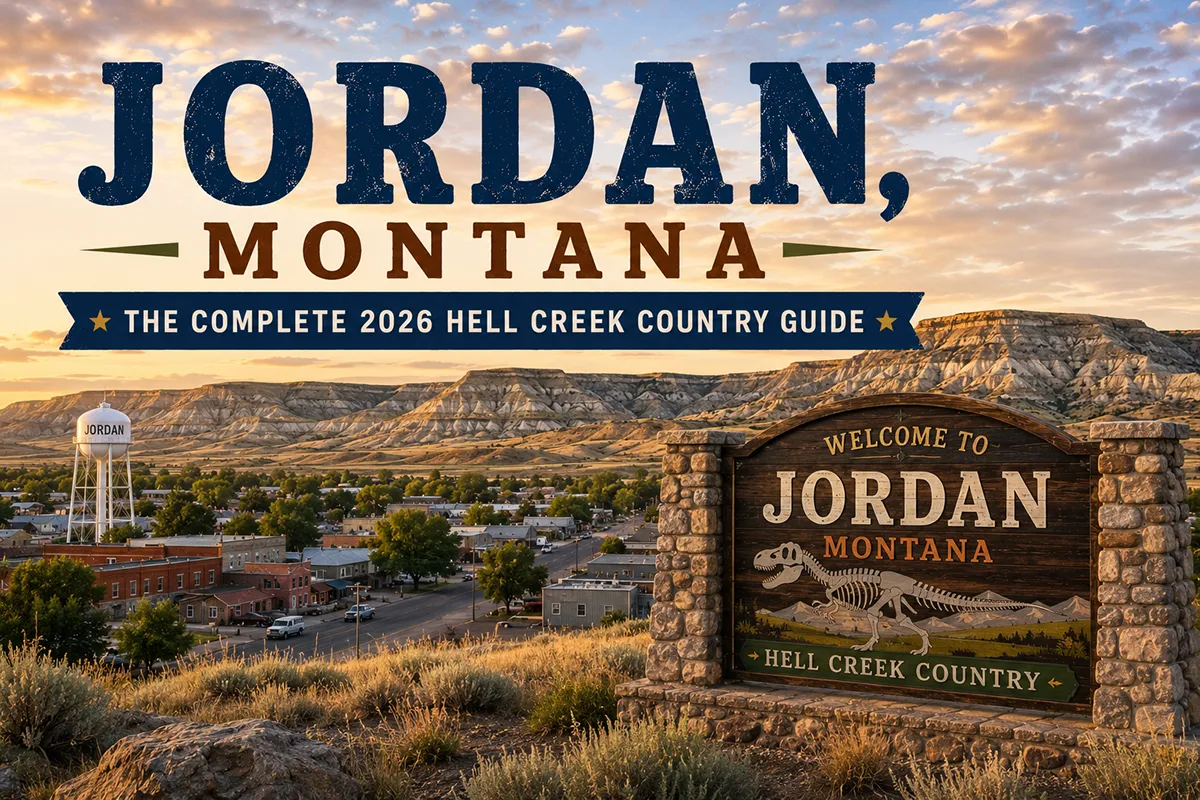
Jordan, Montana is often called the most remote county seat in the contiguous United States — the closest interstate is hours away, the nearest movie theater is 80 miles distant, and the entire town has fewer residents than many city blocks.
But the rocks around Jordan are some of the most important on Earth. The Hell Creek Formation — the Cretaceous-era sedimentary layers exposed in the badlands south of town — has produced more complete Tyrannosaurus rex skeletons than any geological formation in the world.
The Field Museum’s “Sue,” the world’s most famous T. rex, was found in a related formation; the “Wankel Rex” at the Smithsonian came from right here in Garfield County.
TL;DR
- Jordan (~340) is the county seat of Garfield County in remote north-central Montana — often called the most remote county seat in the lower 48.
- The Hell Creek Formation exposed in the badlands south of town has produced more complete T. rex skeletons than any geological formation on Earth.
- The Garfield County Museum displays significant local dinosaur finds.
- Access to the Charles M. Russell National Wildlife Refuge (1.1 million acres) and Fort Peck Reservoir’s eastern arm.
- Best for: paleontology enthusiasts, dinosaur trail completionists, extreme remote Montana travelers, and CMR Refuge wildlife watchers.
- This is genuinely off-grid Montana — plan accordingly.
Liked this article?
Add Roaming Montana as a preferred source so you see more of our articles and guides on Google.
Jordan at a Glance
| Population (2020) | ~340 |
|---|---|
| County | Garfield County (county seat) |
| Region | North-Central/Eastern Montana |
| Elevation | 2,659 ft |
| Distance to Miles City | ~85 miles south (~1.5 hours) |
| Distance to Lewistown | ~120 miles west (~2 hours) |
| Distance to Glasgow | ~120 miles north (~2 hours) |
| Nearest interstate | I-94 at Miles City (85 miles) |
| Best for | Hell Creek dinosaur fossils, Garfield County Museum, CMR Refuge access, extreme remote Montana |
What Makes Jordan Different
Jordan’s defining feature is the Hell Creek Formation. This Cretaceous-era geological layer — exposed in the badlands south of town and extending into adjacent counties — represents the final 2 million years of the dinosaur era, ending precisely at the K-Pg boundary (the asteroid impact 66 million years ago).
The formation contains the fossilized remains of the last T. rexes, Triceratops, Edmontosaurus, and dozens of other species — preserved in extraordinary detail because the conditions of deposition were ideal.
Field paleontologists from major institutions (Field Museum, Museum of the Rockies, Smithsonian, American Museum of Natural History) work in the Hell Creek formation every summer.
The Wankel T. rex — now displayed at the Smithsonian as “The Nation’s T. rex” — was excavated near Jordan in 1988. Significant new specimens are discovered annually.
The town itself is small — 340 people — and exists primarily as a service center for surrounding ranches and the dinosaur paleontology community. The character is genuinely frontier-remote, with services limited and weather extreme.
For broader trip context, see my Montana cities and towns hub.
The Top 10 Things to Do In & Around Jordan
1. Garfield County Museum
The local museum that interprets the Hell Creek Formation’s significance — significant dinosaur fossils (Triceratops skull, hadrosaur material, T. rex bones), plus Garfield County pioneer history and ranching culture. Among the most important small-town paleontology displays in Montana. Free admission. Plan 90 minutes.
2. Hell Creek Formation Badlands
The badlands south of Jordan are the geological feature that draws scientists from around the world. Hell Creek State Park (about 25 miles southwest on a gravel road, near Fort Peck Reservoir) provides public access to representative Hell Creek terrain. Hiking the badlands gives a sense of the landscape that produced dozens of complete dinosaur skeletons.
3. Hell Creek State Park
On the shore of Fort Peck Reservoir about 25 miles southwest of Jordan — camping, boating, fishing (walleye, northern pike, lake trout), and access to badlands hiking. The state park sits in the heart of the Hell Creek country geographically and is named for it.
4. Charles M. Russell National Wildlife Refuge
Jordan sits in the middle of the CMR Refuge — 1.1 million acres of Missouri Breaks badlands, grassland, and reservoir habitat. Elk, deer, antelope, bighorn sheep, golden eagles, prairie dog towns. The refuge requires good navigation, 4WD or high-clearance vehicle for backcountry roads, and self-sufficiency — but the wildlife and landscape are extraordinary.
5. Fort Peck Reservoir (Eastern Arm)
The eastern arm of Fort Peck Reservoir is accessible from Jordan via gravel roads. Excellent walleye and northern pike fishing; remote camping; significant wildlife. The reservoir is 134 miles long total; Jordan accesses the southern Hell Creek section.
6. Watch for Active Paleontology Digs (Summer)
Field paleontology crews from major institutions work in the Hell Creek formation every summer. The Garfield County Museum sometimes coordinates public visits to active dig sites; contact in advance. Public lands fossil collection is illegal — never collect or move fossils, even if you find them.
7. Drive the Big Dry Country
The Big Dry Creek drainage south of Jordan is one of the most remote and dramatic landscapes in Montana — vast badlands, rolling rangeland, and very few humans. Gravel roads connect the area; high-clearance vehicle recommended.
8. Stargazing
Jordan and the surrounding ranchland have some of the darkest night skies in the lower 48. Light pollution is essentially nonexistent. The Milky Way is brilliantly visible to the naked eye on any clear night.
9. Hellbenders Restaurant & Bar
Jordan’s local restaurant and gathering place — named after the dinosaur-hunter culture of the area. Authentic community spot for meals and to hear about local paleontology activity.
10. Make the Drive Itself the Experience
The drive into Jordan from any direction is part of the destination — long stretches of remote rangeland, the badlands appearing on horizons, almost no traffic, no services. Plan fuel, supplies, and timing accordingly.
Where to Stay
| Hotel | Vibe | Price | Best For |
|---|---|---|---|
| Garfield Hotel (Jordan) | Basic motel, historic | $80–130 | Most travelers |
| Hell Creek State Park (25 miles) | Camping, reservoir access | $20–30 | Campers, anglers |
| Glasgow hotels (2 hours north) | Full range | $100–190 | Travelers wanting more |
| Miles City hotels (1.5 hours south) | Full range | $100–190 | Day-trip base |
| Dispersed CMR camping | Free, primitive | Free | Self-sufficient travelers |
Jordan has minimal lodging — book the Garfield Hotel ahead during summer paleontology season.
Where to Eat
- Hellbenders Restaurant & Bar — Jordan’s main restaurant and community gathering spot
- QT Quick Stop — convenience store with hot food, gas (essential to know about)
- Provision in Miles City or Glasgow before extended visits
Jordan’s dining options are very limited. Plan provisions for any backcountry exploration.
Getting There
From Miles City: 85 miles north on MT-59, about 1.5 hours.
From Glasgow: 120 miles south via MT-24 and gravel routes, about 2 hours.
From Lewistown: 120 miles east on US-200 and county roads, about 2 hours.
From Billings: ~230 miles via I-94 and MT-59, about 4 hours.
No interstate access: The nearest interstate (I-94) is 85 miles south at Miles City.
What Jordan Unlocks
Hell Creek Formation
The geological reason the town exists for travelers — accessible at Hell Creek State Park and via county roads through the surrounding badlands.
Charles M. Russell National Wildlife Refuge
1.1 million acres of remote wildlife habitat surrounding Jordan.
Fort Peck Reservoir Eastern Arm
Walleye fishing, remote camping, dramatic shoreline.
Glasgow & Fort Peck Dam (2 hours north)
WPA-era Fort Peck Theatre, dam tours, Glasgow services. See Glasgow guide.
Miles City (1.5 hours south)
Cowboy Capital with full services. See Miles City guide.
When to Visit
Summer (June–August): Best weather; full museum and park access; active paleontology field season.
Fall (September–October): Excellent for hunting (significant elk, mule deer, antelope hunting in CMR Refuge), photography, cooler temperatures.
Year-round for Dark Sky stargazing: Some of the darkest skies in the continental U.S.
Winter: Cold and isolated. Travel requires careful planning; sudden weather can make remote roads impassable.
Personal Tips
This is serious remote travel. Full tank of gas before leaving Miles City or Glasgow. Spare tire, extra water, navigation that doesn’t require cell service (downloaded maps).
The museum first. Visit the Garfield County Museum before exploring the formations — it provides essential geological and paleontological context.
Don’t collect fossils on public land. Removing fossils from public land — including BLM and CMR — is a federal offense. Photograph instead. Many spectacular fossils have been damaged or lost to amateur collecting.
Plan a multi-day trip. Jordan is not a quick stop. The drive in, the museum, the badlands, and the CMR Refuge together justify 2–3 days minimum.
Check road conditions. Many of the most interesting areas around Jordan require gravel-road access. After rain or in winter, these roads can be impassable.
This is a destination for travelers who understand remoteness. If you need cell service, restaurant variety, or quick exits, Jordan isn’t the right fit. If you want to see one of the most geologically significant landscapes on Earth in genuine solitude, it’s perfect.
Jordan Quick Facts
| Founded | 1881 (homestead era) |
|---|---|
| Most remote county seat in lower 48 | Often cited (closest interstate 85 miles) |
| Hell Creek Formation | Most productive T. rex fossil formation on Earth |
| Wankel T. rex | Found near Jordan 1988; now Smithsonian’s “Nation’s T. rex” |
| CMR Refuge | 1.1 million acres surrounding the town |
| Average summer high | 87°F |
| Average winter low | 0°F |
Conclusion
Jordan is genuine remote Montana — the kind of place where the geology is more famous than the town, where T. rex skeletons come out of the ground every summer, and where the night sky still works the way it has for the last 4 billion years. For paleontology enthusiasts, dinosaur trail completionists, and travelers who can handle real backcountry, it’s irreplaceable.
Have a Jordan question? Drop it in the comments — I read every one.
Frequently Asked Questions
Is Jordan Montana worth visiting?
Yes — for the right kind of traveler. Jordan is a destination for paleontology enthusiasts (the Hell Creek Formation here has produced more complete T. rex skeletons than any geological formation on Earth), serious remote Montana road trippers, hunters and wildlife watchers (Charles M. Russell National Wildlife Refuge surrounds Jordan), and stargazers. The remoteness is the experience; if that’s not appealing, Jordan isn’t the right choice.
What is the Hell Creek Formation?
The Hell Creek Formation is a Cretaceous-era geological layer dating from approximately 66–68 million years ago, exposed in the badlands of central and eastern Montana, including extensively around Jordan. The formation represents the last 2 million years of the dinosaur era, ending precisely at the K-Pg extinction boundary. It contains exceptionally well-preserved fossils of Tyrannosaurus rex, Triceratops, hadrosaurs, and many other late Cretaceous species — making it the most productive T. rex fossil formation in the world.
Is Jordan really the most remote town in the lower 48?
Jordan is often cited as the most remote county seat in the contiguous United States, with the nearest interstate (I-94 at Miles City) approximately 85 miles south. The exact “most remote” designation depends on methodology, but Jordan’s combination of small population (~340), distance from interstates, and surrounding wilderness make it a strong contender for the title.
Can you see dinosaur fossils near Jordan?
Yes — the Garfield County Museum in Jordan displays significant Hell Creek dinosaur fossils including Triceratops material and T. rex bones found in the surrounding county. Hell Creek State Park (25 miles southwest) provides access to representative Hell Creek formation badlands. Note: Collecting fossils from public land is illegal — photograph, don’t remove. Active paleontology dig sites are visited occasionally on coordinated tours; contact the museum for current opportunities.
How do I get to Jordan Montana?
Jordan is accessible only by highway — there is no air service. From Miles City (the nearest larger town with services), drive 85 miles north on MT-59 (about 1.5 hours). From Glasgow to the north, drive 120 miles south (about 2 hours, with some gravel road). Plan for full tanks of gas, navigation that doesn’t require cell service, and self-sufficient supplies.
What was the Wankel T. rex?
The Wankel T. rex was a remarkably complete Tyrannosaurus rex skeleton discovered in 1988 near Jordan by Kathy Wankel, a local rancher. The specimen is now permanently displayed at the Smithsonian’s National Museum of Natural History in Washington, D.C., where it’s known as “The Nation’s T. rex.” It’s one of the most significant T. rex specimens ever recovered.