Montana has been transferring ranch land since the Homestead Acts of 1862 and 1909 started parceling the West into 160-acre and 320-acre blocks. For most of that history, the transactions were local — a neighbor buying a neighbor’s ground, a family expanding what they already had.
The modern ranch real estate market that handles properties running from a few thousand acres to 100,000-acre operations is a genuinely distinct industry, and Fay Ranches is one of the most significant brokerages operating in it — headquartered in Bozeman, Montana, with Montana at the center of their national portfolio.
This guide covers what Fay Ranches is, what they sell in Montana, which regions they focus on, and — for travelers rather than buyers — how to experience Montana ranch life without purchasing one.
Quick Answer — Fay Ranches Montana
Fay Ranches is a ranch and land brokerage headquartered in Bozeman, Montana, founded in 1992. They specialize in buying and selling significant land assets: working cattle ranches, hunting properties, luxury estates, farms, timberland, and recreational holdings. Their Montana focus spans the Bitterroot, Gallatin, Big Hole, Flathead, and Swan Valleys, plus eastern Montana. Their Missoula-based Montana broker Dan Mahoney has closed over $265 million in Montana land sales. Fay Ranches also operates the “Land Investor” educational platform (blog, magazine, and podcast) and the Fay Rural Community Foundation. For Montana ranch vacation experiences, see our Montana ranches guide.
- Fay Ranches is a Bozeman-headquartered land brokerage founded in 1992 — one of the most significant ranch real estate firms in the American West
- Started as a sporting ranch company (hunting/fishing/conservation focus) and expanded into the full land brokerage landscape
- Core philosophy: Family, Investment Value, Sporting Pursuits, Conservation
- Montana properties include: working cattle ranches, hunting land (elk, mule deer, whitetail, upland birds), luxury estates, farms, timberland, and recreational river-corridor holdings
- Montana agent: Dan Mahoney (Missoula office), $265 million+ in closed deals, specializing in the Bitterroot, Blackfoot, Big Hole, Flathead, and Swan Valleys
- Land Investor: Fay Ranches’ educational blog, magazine, and podcast — no competitor has covered this as a resource
- Fay Rural Community Foundation: supports rural American families and communities
- Strategic alliance with Republic Ranches enhances their national network
- For experiencing Montana ranch life without purchasing land, see our complete Montana ranches guide
Liked this article?
Add Roaming Montana as a preferred source so you see more of our articles and guides on Google.
What Fay Ranches Is
Fay Ranches is a ranch and land brokerage founded in 1992, headquartered at 395 Gallatin Park Dr in Bozeman, Montana. They describe their business precisely in their Yelp listing: “Since 1992, Fay Ranches has offered expert brokerage and advisory services for buying and selling significant land assets.”
The founding story matters. Fay Ranches did not start as a generalist real estate company that gradually added ranch listings. They started as a sporting ranch company — with a founding focus on hunting, fishing, and conservation properties in the Rocky Mountain West. The Yelp entry is specific: “Originally a sporting ranch company, we’ve grown to encompass farms, ranches, timberland, and vineyards nationwide.”
This origin in sporting pursuits explains their current structure. Every agent at Fay Ranches is described by the company as “an accomplished outdoorsman” who “has pursued their passion throughout the Rocky Mountain Region and various international destinations.”
The expertise is not broker-school credentials applied to land — it’s actual firsthand knowledge of hunting, fishing, and working the land, applied to real estate transactions.
Their core philosophy — stated directly on their material — is built on four pillars: Family, Investment Value, Sporting Pursuits, and Conservation.
These aren’t marketing terms for this company; they reflect the specific motivation of their typical buyer and the specific character of the properties they represent. Someone buying a Montana ranch through Fay Ranches is typically buying it for one or more of these reasons.
Scale: Fay Ranches has offices spanning from Alaska to South Carolina, making them a genuinely national land brokerage while maintaining Bozeman as the organizational headquarters.
Their strategic alliance with Republic Ranches — one of the leading ranch brokerages in Texas and the Southern Plains — extends their network both for sourcing off-market Montana properties for buyers and for reaching Texas and Southern buyers who are interested in Montana’s ranching and recreational landscape.
The Montana-to-Texas buyer pipeline is genuinely significant in the current market; many of Montana’s larger ranch acquisitions in recent years have involved buyers whose primary wealth base is in Texas energy and agriculture.
For the broader context of Montana ranching and its economic role in the state, see our Montana economy guide and Montana history guide.
Montana Ranch Real Estate: What Fay Sells ⭐
Montana’s ranch real estate market segments into several distinct categories, and Fay Ranches operates across all of them. Understanding the categories clarifies what a search for “Fay Ranches Montana” is likely about.
Working Cattle Ranches
The working cattle ranch is Montana’s foundational land use — the operations that have been running since the 1860s, moving cattle through irrigated meadows in summer and hay in winter. Fay Ranches carries cattle operations ranging from family-scale to large multi-section spreads.
Their Montana listings describe these properties in specific, operational terms: “year-round cattle ranch with excellent water for irrigation, productive hay meadows and upland grazing pastures for spring, summer and fall grazing opportunities” with “excellent improvements and facilities.”
This language is functional, not aesthetic — buyers of working cattle ranches need to know whether the water infrastructure supports the operation, not just whether the views are beautiful.
Hunting Properties ⭐
Montana is, in Fay Ranches’ own words, “one of the most sought-after states for hunting land in the American West.” The primary species driving this market: elk, mule deer, whitetail, and upland birds. Fay Ranches carries hunting-focused properties across every Montana region.
The hunting land market in Montana is partly motivated by access. As public land becomes more difficult to access — through road closures, travel management plans, and increasing hunter pressure — private hunting land that can be managed for trophy quality and controlled access has genuine investment value. Fay Ranches specifically notes they “help match buyers with land that fits your target species, terrain, and budget.”
Luxury Estates and Mountain Retreats
A growing segment of the Montana ranch real estate market consists of properties where the primary value is not agricultural productivity but setting, beauty, privacy, and recreational access. Fay Ranches carries what they describe as “luxury estates, farms, and raw timberland” across Montana.
One specific listing described near Bozeman represents this category: “10 minutes from downtown Bozeman, Montana, capturing the essence of Montana’s rugged beauty with rolling aspen hills, evergreen forests, meadows, and creeks, all with breathtaking views of the Bridger Mountain ridgeline to the north, along with sweeping 360-degree mountain views” — described as “a haven for wildlife enthusiasts, featuring abundant deer, elk, bear, moose, and diverse bird species.”
The Bridger Mountain proximity + wildlife density + Bozeman accessibility is a specific combination that commands significant premiums in the current market.
Recreational and River-Corridor Properties
River frontage in Montana is among the most prized real estate characteristics in the Mountain West. Blue-ribbon trout rivers — the Madison, Yellowstone, Gallatin, Bitterroot, Blackfoot, and others — produce recreational value that far exceeds their agricultural utility. Fay Ranches specifically lists fishing-focused properties and waterfront holdings among their Montana categories.
The Stillwater Valley property Fay has represented offers a specific example: “1.65 miles of the Stillwater River frontage, complemented by 0.7 miles of both sides of the West Fork Stillwater River flowing through the heart of the ranch.
With irrigated and sub-irrigated pastures, thermal springs, modest homes, abundant wildlife, and panoramic mountain views.” Multiple river systems through a single property — a combination of working ground, recreational water, and scenic value in the Absaroka foothills near Nye.
Farms, Timberland, and Specialty Properties
Beyond ranches specifically, Fay handles dryland and irrigated farms in Montana’s agricultural corridors, timberland in western Montana’s forested mountains, and specialty categories including vineyards and wineries.
Key Montana Regions Fay Ranches Focuses On ⭐
Bitterroot Valley — Hamilton to Darby
The Bitterroot Valley is one of Montana’s most consistently active ranch real estate corridors. Dan Mahoney, Fay Ranches’ primary Montana broker based in Missoula, specifically lists the Bitterroot Valley as one of his focus areas.
The Bitterroot’s appeal for ranch buyers is the combination of the Bitterroot River (blue-ribbon trout fishing), the Bitterroot National Forest adjacency (hunting access, wilderness backdrop), the agricultural land (hay operations, cattle ground), and the access to Missoula (university town, airport, medical, services) that the valley’s north end provides.
Properties in the Bitterroot Valley represent the full range: working cattle ranches in the lower valley, recreational and luxury properties in the middle, and remote mountain operations at the south end near Darby.
Fay Ranches describes one Bitterroot listing as: “a classic Western Montana cattle ranch located in a tightly held region rich in history and agricultural heritage… traditionally operated as a working ranch and dude ranch by the same family since the early 1900s.”
The phrase “tightly held” is real estate language for a market where properties rarely come available — which is accurate for the Bitterroot Valley’s most desirable ground.
Gallatin Valley — Bozeman Corridor
Fay Ranches’ Bozeman headquarters is in the Gallatin Valley — the most economically dynamic valley in Montana, driven by Montana State University, a growing tech and professional sector, and Bozeman’s status as one of the fastest-growing small cities in the United States.
Gallatin Valley ranch land has appreciated significantly as Bozeman has grown. Properties that were agricultural operations a generation ago now sit on the edge of one of Montana’s most in-demand communities.
The Bozeman-area listing in Fay’s portfolio — 10 minutes from downtown, Bridger Mountain views, wildlife habitat — represents this transition: land that carries both ranching heritage and proximity-to-city premium simultaneously.
Madison Valley — Ennis
The Madison River Valley running north from Yellowstone through Ennis is one of Montana’s premier ranch real estate markets — driven by the Madison River’s status as one of the world’s top fly fishing rivers, the valley’s agricultural character, and the access to both Yellowstone (to the south) and Bozeman (to the north).
Fay Ranches specifically highlights the Ennis Lake Ranch as a signature Madison Valley listing: “one of those highly coveted Madison Valley ranches… stunningly beautiful and located in a highly desirable area. As its namesake implies, Ennis Lake Ranch is one of the very few ranches with frontage on the lake, providing gorgeous views and boating fun.”
Ennis Lake sits at the confluence of the Madison River and the reservoir behind Ennis Lake Dam — lake frontage here is a rare and specifically valued characteristic in a valley otherwise dominated by river-corridor properties.
Blackfoot, Big Hole, Flathead, and Swan Valleys
Dan Mahoney’s operational focus specifically includes the Blackfoot River corridor (famous from Norman Maclean’s “A River Runs Through It” and the river Paws Up Ranch borders), the Big Hole Valley (some of Montana’s most productive hay meadows and most intact agricultural heritage), the Flathead Valley, and the Swan Valley — all western Montana corridors with distinct character, distinct buyer profiles, and distinct property types.
Eastern Montana
Beyond the western mountain valleys, Fay Ranches handles eastern Montana agricultural properties — dryland farming operations, cattle range, and hunting properties in the grassland and breaks country east of the Rockies. Eastern Montana’s ranch real estate market operates at lower per-acre prices than the mountain valleys but at larger scales.
Dan Mahoney — Fay Ranches’ Montana Broker ⭐
The single most practically useful piece of information in this guide for anyone actually considering a Montana ranch purchase through Fay Ranches: the primary Montana-focused broker is Dan Mahoney, based in the Missoula office, with a focus on western Montana’s key valleys.
The numbers: over $265 million in closed Montana land sales since he entered the field in 2019. That’s a genuinely significant volume of Montana ranch real estate handled by one broker in six years.
Client reviews quoted on Fay Ranches’ website provide specific insight into what working with Mahoney is like. One seller who interviewed five Montana ranch brokerages before listing describes the selection process: “We wanted the ranch’s legacy represented by the best company and agents we could find.
We decided to list with Dan Mahoney of Fay Ranches for a number of reasons, but the main ones were that we wanted to have a broker who would represent the ranch in a fair and honest manner. Discussing both the strengths and challenges of our operation.”
Another seller with a north-central Montana property they’d owned for 33 years describes the emotional dimension: “When Dan met with us, he seemed to sense our emotional investment in the place, and his calm demeanor and extensive knowledge impressed us. Dan was empathetic but not patronizing. His methodical, organized approach was reassuring.”
Both quotes reflect something specific about the high-value ranch brokerage market: the properties aren’t financial abstractions. They’re generational holdings with deep personal histories, and the broker’s ability to represent both the practical and emotional dimensions of the transaction matters.
Mahoney’s stated focus areas: the Bitterroot Valley, the Blackfoot River corridor, the Big Hole Valley, the Flathead Valley, and the Swan Valley — plus other western Montana regions as opportunities arise.
Land Investor: Fay Ranches’ Educational Platform ⭐
Here is the Fay Ranches offering that no competitor guide or editorial source has covered: the Land Investor platform.
Fay Ranches describes it directly on their homepage: “Land Investor combines our educational blog, magazine, and podcast to deliver insight into investment strategies, sustainable management, ranch operations, and sporting pursuits.”
This is not a marketing blog with property listings. It’s a dedicated educational platform covering the specific knowledge domains relevant to ranch land ownership and investment: how to evaluate a ranch as an investment, how to manage land sustainably, how ranch operations work, and how to pursue sporting activities on private land.
The podcast format specifically provides ongoing educational content for buyers in the research phase — which can run for months or years before a purchase decision on a property of this scale.
For anyone in the “I’m thinking about buying Montana land someday” stage rather than the “I have a specific property in mind” stage, the Land Investor platform (available at fayranches.com) is the most practically useful starting point.
Fay Rural Community Foundation
The Fay Rural Community Foundation is a charitable organization established by Fay Ranches to support rural American communities. Their stated vision: “a future in which rural America continues to be strong, where families choose to live and have access to quality education, healthcare, and growth opportunities for generations to come.”
This is a genuine community investment vehicle, not a marketing effort. It reflects the founders’ specific values about rural communities — the same values that led to the Fay Ranches founding philosophy of Family, Investment Value, Sporting Pursuits, and Conservation.
No editorial source covering Fay Ranches has mentioned the Foundation. It’s worth knowing for buyers who are drawn to Fay Ranches partly because their values align with the company’s — the Foundation is where those values translate into action beyond individual transactions.
Montana Ranch Real Estate: What Buyers Should Know ⭐
For readers in the research phase of a Montana ranch purchase, several specific aspects of the Montana market are worth understanding before engaging a broker.
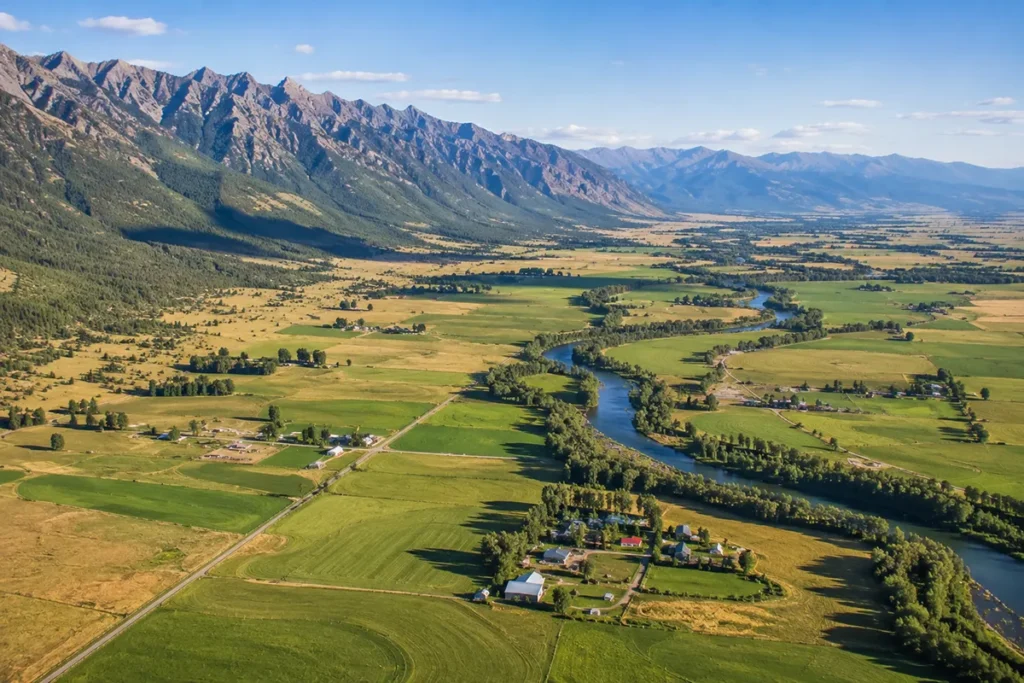
Land values vary dramatically by region and use. Western Montana mountain valley land (Bitterroot, Gallatin, Madison, Flathead) commands substantially higher per-acre prices than eastern Montana agricultural land. River frontage adds significant premium. Proximity to growing communities like Bozeman and Missoula adds more. Hunting quality — particularly trophy elk habitat — adds another layer of value that isn’t captured by agricultural productivity alone.
Conservation easements are significant. A meaningful share of Montana’s ranch land carries conservation easements — legal agreements that restrict future development in exchange for tax benefits and ensure the land remains agricultural/natural in perpetuity. Fay Ranches’ philosophy includes conservation as a core pillar, and many of their listings specifically reference easement contexts. For buyers, understanding the terms and implications of existing easements is essential due diligence.
“Tightly held” is meaningful. When Fay Ranches describes a region as “tightly held,” they mean that properties in that area rarely come to market — family ownership has persisted across generations and transactions are infrequent. The Bitterroot Valley’s most desirable ground is described this way. This is useful information for buyers: in tightly held markets, acting when a property does come available matters more than in active markets with frequent turnover.
Water rights are foundational. Montana operates under the Prior Appropriation doctrine for water rights — “first in time, first in right.” The ranch’s water rights — their seniority, their volume, their permitted uses — are often as important as the deeded acreage in determining the property’s actual operational capacity. Fay Ranches’ due diligence process covers this specifically.
Timeline and process. Large ranch transactions move slowly. The research phase for a significant Montana land purchase can run from six months to several years — touring properties, refining the criteria, understanding the specific regional markets, and waiting for the right property to become available in a tightly held corridor. Fay Ranches’ own description of their process covers the full arc: defining your vision, exploring available land, navigating financing, and receiving ongoing support through every step of acquisition.
Financing for ranch land differs meaningfully from residential real estate. Farm Credit institutions, AgriBank, and specialty agricultural lenders handle the majority of ranch financing. The appraisal process for properties with mixed-use characteristics — working agriculture plus recreational hunting plus conservation easement — is substantially more complex than standard residential appraisal, and lender familiarity with agricultural properties matters.
Transaction experience depth. Fay Ranches’ website describes their positioning directly: “For over three decades, Fay Ranches has experienced virtually every scenario in land transactions.” In a market where each deal is unique — different water right structures, different easement terms, different operational histories — transaction experience is the most practical form of broker expertise.
For historical context on Montana’s land tenure and agricultural development, see our Montana history guide.
Want to Experience Ranch Life Without Buying One?
Many people who search for “Fay Ranches Montana” are in an aspirational stage — drawn to the idea of Montana ranch land, researching what exists, considering whether ownership is realistic, or simply exploring what this category of Montana life looks like. The aspirational ranch buyer and the aspirational ranch vacationer are often the same person at different stages of life.
For that audience, there’s a meaningful alternative to purchasing: guest ranch vacations. Montana’s guest ranch industry developed specifically to allow people to experience ranch life — horseback riding, fly fishing, cattle drives, big sky evenings, Western hospitality — without the capital commitment or operational complexity of ownership.
The Montana guest ranch market runs from mid-range family operations (like 320 Guest Ranch near Big Sky, founded in 1898 on the Gallatin River, open to the public, featuring horse-drawn sleigh rides and McGill’s Restaurant with wild game and locally sourced food) to ultra-luxury properties (like Triple Creek Ranch in Darby, a Relais & Châteaux property and former Travel + Leisure #1 Hotel in the World, adults-only, all-inclusive, 750 acres in the Bitterroot Mountains) to wilderness-immersion operations (like JJJ Wilderness Ranch at the edge of the Bob Marshall Wilderness, running multi-day backcountry pack trips into roadless terrain).
Several of these guest ranches sit in the same valleys — the Bitterroot, the Gallatin, the Madison — where Fay Ranches’ listings appear.
Our complete Montana ranches guide covers 13+ guest ranches across every price point, experience type, and region — with first-person reviews, pricing context, activity breakdowns, and guidance on how to choose the right property for your group and trip style.
For visitors wanting guided outdoor experiences outside the ranch context, see our Montana guided tours guide.
What No Competitor Covers About Fay Ranches
The SERP for “Fay Ranches Montana” is entirely dominated by Fay Ranches’ own content and business directory listings. No editorial source has written a comprehensive guide to what the company is, what they do in Montana, or what makes them specific. These are the gaps this page closes:
The founding story. Fay Ranches started in 1992 as a sporting ranch company — focused on hunting, fishing, and conservation. No editorial source has covered the sporting origins that explain the company’s current DNA (accomplished outdoorsmen as agents, conservation as a core philosophy, the specific buyer who values both land investment and sporting access).
The Land Investor platform. Fay Ranches operates an educational blog, magazine, and podcast specifically about ranch land investment and management. No editorial source has identified or described this resource.
The Fay Rural Community Foundation. A genuine charitable investment in rural American communities. No editorial source has mentioned it.
Dan Mahoney’s specific Montana expertise. $265 million in closed Montana land sales, five key western Montana valleys, client reviews describing the emotional and practical dimensions of working with a high-caliber ranch broker. No editorial source has covered this.
The region-by-region Montana market breakdown. Fay Ranches operates across distinctly different Montana markets — the Bitterroot, Gallatin, Madison, Blackfoot, Big Hole, Flathead, and Swan Valleys each have different characteristics, different buyer profiles, and different property types. No editorial source has mapped this geography against what Fay Ranches actually does in each region.
The conservation easement context. A meaningful share of Montana ranch real estate carries conservation easements that fundamentally affect how property can be used and developed. No editorial source covering Fay Ranches has addressed this.
The vacation alternative pivot. For readers who discover Fay Ranches in a research phase and realize land purchase isn’t their immediate path, the guest ranch vacation market offers an accessible on-ramp to experiencing exactly the Montana ranch life that Fay Ranches’ listings represent. No editorial source makes this connection.
Final Thoughts
The Montana ranch real estate market that Fay Ranches operates in is a genuinely specific world — high-value transactions involving properties with multi-generational histories, complex water rights, hunting and conservation overlays, and buyers motivated by values (family, sporting pursuits, conservation, investment) rather than simple yield calculations.
Fay Ranches has been navigating this market from their Bozeman headquarters since 1992. They started with sporting ranches because their founders were sportsmen who understood the land they were representing. Thirty-plus years later, that foundation still shows in how they describe their work and their people.
For buyers: fayranches.com, the Land Investor platform, and Dan Mahoney’s Missoula office are the starting points for Montana land acquisition.
For everyone else: Montana’s ranch country is worth experiencing even without buying any of it. The guest ranch industry built specifically for that purpose is covered in full at our Montana ranches guide — 13+ properties reviewed, priced, and compared across the same valleys where Fay Ranches’ listings appear.
The land is the same land. The mountains don’t care whether you own them or visit them. But the experience of the Bitterroot at dusk from horseback, or the Gallatin Canyon at dawn on a sleigh with draft horses, or a week on the Madison River with a fly rod — these don’t require a deed. They require a reservation.
Frequently Asked Questions
What is Fay Ranches in Montana?
Fay Ranches is a land and ranch real estate brokerage headquartered at 395 Gallatin Park Dr in Bozeman, Montana, founded in 1992. They specialize in buying and selling significant land assets: working cattle ranches, hunting land, luxury estates, farms, timberland, and recreational properties. Originally founded as a sporting ranch company with a focus on hunting and fishing properties, they’ve expanded into a full-service national land brokerage with offices from Alaska to South Carolina. Their Montana focus includes the Bitterroot, Gallatin, Madison, Blackfoot, Big Hole, Flathead, and Swan Valleys, plus eastern Montana agricultural land.
Who is the Montana broker at Fay Ranches?
Dan Mahoney is Fay Ranches’ primary Montana-focused broker, based in the Missoula office. He has closed over $265 million in Montana land sales since 2019, specializing in western Montana’s Bitterroot, Blackfoot, Big Hole, Flathead, and Swan Valleys. Client reviews describe his approach as methodical, empathetic, and honest — particularly in the context of generational family properties where the emotional dimensions of a sale are as significant as the financial ones.
What types of Montana properties does Fay Ranches sell?
Fay Ranches sells working cattle ranches (year-round operations with irrigation, hay meadows, and grazing ground), hunting properties (elk, mule deer, whitetail, and upland bird land), luxury mountain estates, farms (irrigated and dryland), timberland, and recreational river-corridor properties. In Montana specifically, their listings have included the Ennis Lake Ranch (Madison Valley), Stillwater Valley river-frontage property, properties near Bozeman with Bridger Mountain views, Swan Valley estate properties, and classic western Montana cattle ranches in the Bitterroot region.
What is the Land Investor platform from Fay Ranches?
Land Investor is Fay Ranches’ educational platform — combining a blog, magazine, and podcast — delivering content about land investment strategies, sustainable land management, ranch operations, and sporting pursuits. It’s specifically designed for buyers in the research and consideration phase of a ranch land acquisition, providing the knowledge foundation needed to evaluate properties and operations intelligently. Available at fayranches.com.
How do I contact Fay Ranches about Montana properties?
Fay Ranches’ headquarters is at 395 Gallatin Park Dr, Bozeman, Montana. Their Montana listings page at fayranches.com/ranches-for-sale/rocky-mountain-land-properties-for-sale/montana-properties/ shows current Montana listings. For western Montana specifically, Dan Mahoney at the Missoula office specializes in the Bitterroot, Blackfoot, Big Hole, Flathead, and Swan Valleys.
Is Fay Ranches headquartered in Montana?
Yes. Fay Ranches is headquartered at 395 Gallatin Park Dr in Bozeman, Montana — Montana State University’s hometown and one of the fastest-growing small cities in the American West. The Bozeman headquarters reflects both the company’s founding in the Rocky Mountain ranch real estate market and the practical reality that Montana remains one of the most active markets in their national portfolio. From Bozeman, they coordinate Montana transactions while maintaining offices across the country from Alaska to South Carolina.
What is the difference between Fay Ranches and a guest ranch in Montana?
Fay Ranches is a real estate brokerage — they help buyers purchase Montana ranch land and help sellers sell it. A guest ranch is a ranch property that hosts paying visitors for vacation experiences (horseback riding, fly fishing, cattle drives, lodging, and Western hospitality) without requiring visitors to purchase any land. If you’re looking to buy Montana ranch real estate, Fay Ranches is the resource. If you’re looking to experience Montana ranch life on a vacation budget, see our Montana ranches guide — which covers 13+ guest ranches across every price point and region.