In April 1933, Franklin Roosevelt’s new administration authorized one of the largest single construction projects in American history: a $72 million earth-filled dam across the Missouri River in remote northeastern Montana, designed to control floods, generate electricity, and provide irrigation to a region that desperately needed economic activity during the Great Depression. Within a year, an “instant city” rose out of the high prairie 17 miles south of Glasgow.
The U.S. Army Corps of Engineers designed and built a model government town to house the 10,000-plus workers needed for the dam project. Construction crews arrived from across the country and the world.
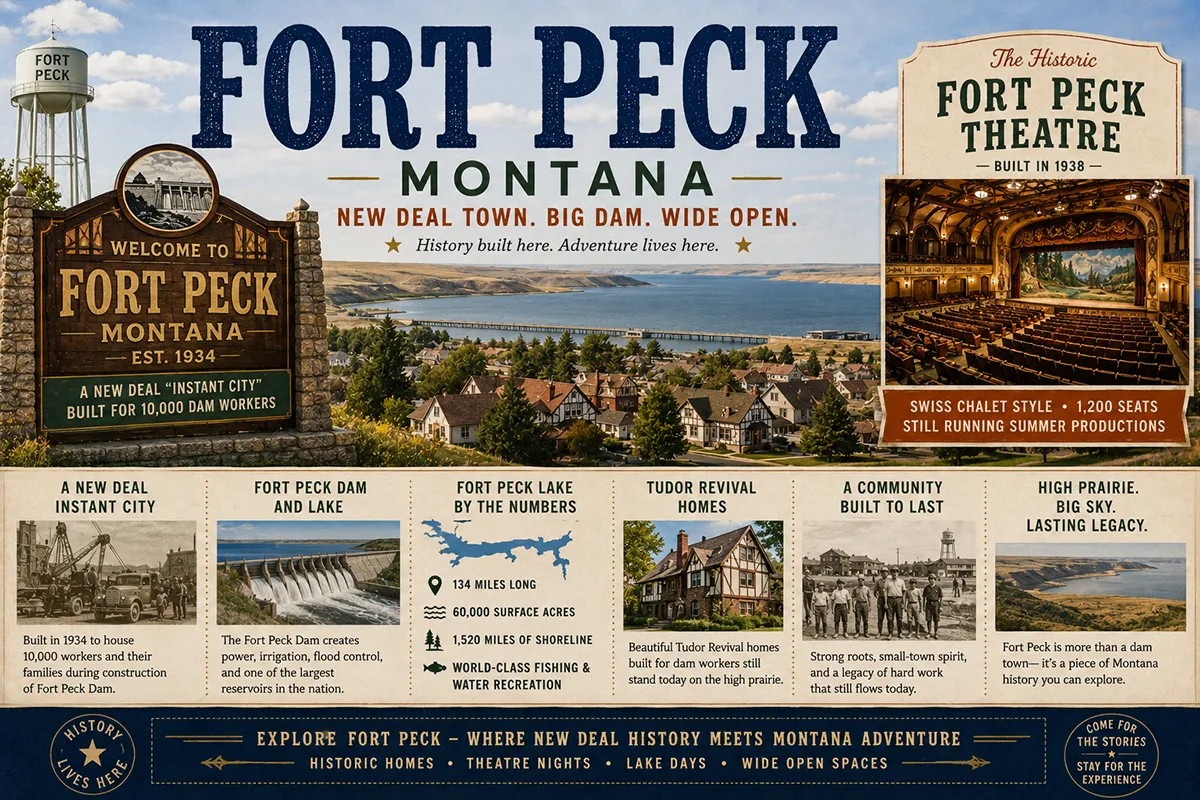
A bowling alley, hospital, recreation hall, hotel, administrative offices, and — most surprisingly for a temporary frontier construction camp — a Swiss Chalet-style theater with 1,200 seats all materialized in the same building boom.
Movies ran at the Fort Peck Theatre 24 hours a day, seven days a week. Lines reportedly stretched seven blocks for new releases.
The shanty towns surrounding the official Fort Peck townsite swelled to even larger populations. Wheeler, New Deal, Delano Heights, and Park Grove — none of them officially planned, none of them built to last — housed thousands more workers and their families.
At peak construction, the Fort Peck Dam project employed approximately 10,000 people directly and supported a regional population of more than 50,000 — temporarily one of the most populous areas in Montana, despite being one of the most remote.
Today Fort Peck has about 239 permanent residents. The dam was completed in 1940 and continues to operate. Fort Peck Lake — created by the dam — extends 134 miles upstream, with 1,520 miles of shoreline (more than the entire California coast).
The Fort Peck Theatre still operates as a summer theatre run by the Fort Peck Fine Arts Council. The original Tudor Revival worker housing in the Fort Peck Original Houses Historic District is still standing.
And the Fort Peck Interpretive Center & Museum on the lake’s south shore preserves the dam’s construction history alongside the region’s remarkable dinosaur paleontology — including the locally-discovered Peck’s Rex.
TL;DR
- Fort Peck (~239) is in Valley County on Missouri River backwater, 17 miles south of Glasgow.
- Built as a New Deal “instant city” in 1934 to house up to 10,000 workers building Fort Peck Dam (1933-1940), one of the largest earth-filled dams in the world.
- The Fort Peck Theatre — built in 1934, Swiss Chalet style (not Tudor Revival — that’s the residential houses), 1,200 seats — still operates as a summer theatre run by the Fort Peck Fine Arts Council.
- The Fort Peck Original Houses Historic District preserves the Tudor Revival worker housing on the National Register.
- Fort Peck Lake is Montana’s largest reservoir — 134 miles long with 1,520 miles of shoreline, more than the California coast.
- The Fort Peck Interpretive Center & Museum includes dam construction history and dinosaur exhibits featuring Peck’s Rex (a T. rex found in the local Hell Creek Formation in 1997).
- Best for: New Deal history, dam tours, Fort Peck Lake fishing (walleye, northern pike, lake trout), dinosaur paleontology, and the most photogenic remote town in northeastern Montana.
Liked this article?
Add Roaming Montana as a preferred source so you see more of our articles and guides on Google.
Fort Peck at a Glance
| Population (2020) | ~239 |
|---|---|
| County | Valley County |
| Region | Northeast Montana (Missouri River) |
| Elevation | 2,125 ft |
| Distance to Glasgow | ~17 miles north (~20 min) |
| Distance to Billings | ~290 miles southwest (~5 hours) |
| Distance to Williston, ND | ~135 miles east (~2.5 hours) |
| Distance to Great Falls | ~280 miles west (~5 hours) |
| Fort Peck Dam completion | 1940 (construction 1933-1940) |
| Fort Peck Lake length | 134 miles (Montana’s largest reservoir) |
| Best for | Dam tour, Theatre summer season, Lake fishing, dinosaur paleontology, New Deal history |
What Makes Fort Peck Different
The thing to understand about Fort Peck is the scale of what was attempted here and the surrealism of the result. In 1933, the U.S. Army Corps of Engineers proposed to dam the Missouri River using a hydraulic earth-fill method that had never been attempted at this scale.
The plan required 125 million cubic yards of fill material — enough to build the Great Pyramid of Giza about 50 times over. Engineers calculated they needed approximately 10,000 workers continuously employed for seven years to complete the project, plus the infrastructure to house and supply them in the middle of one of the most remote stretches of the American interior. The proposed Fort Peck Dam would, when complete, be the largest earth-filled dam in the world.
The Army Corps of Engineers solved the housing problem with characteristic ambition. They designed a complete model town — Fort Peck — and built it from scratch in a matter of months in 1934, two miles north of the original Fort Peck site (a Missouri River trading post and Indian Agency established in 1873 and named for Campbell K. Peck of the Durfee and Peck trading firm).
The new Fort Peck included an administrative headquarters, a hospital, stores, the famous 1,200-seat theatre, a recreation hall, a hotel, schools, churches, and several hundred Tudor Revival worker houses. The whole town was government-owned and government-built.
The Tudor Revival housing is part of what makes Fort Peck visually unique today. Most New Deal construction towns were built temporarily — barracks, sheds, utilitarian structures designed to be torn down when the project ended.
Fort Peck’s planners deliberately built more permanent residential architecture in a style — half-timbering, steep gables, decorative chimneys — that would have looked at home in suburban Connecticut.
The contrast with the surrounding Montana prairie is genuinely surreal. The Fort Peck Original Houses Historic District preserves dozens of these residences on the National Register, and many are still occupied by current residents.
The Fort Peck Theatre is the architectural showpiece. Designed by Eugene Frank Gilstrap and built by the C.F. Haglin Company in 1934 at a cost of approximately $90,000, the theatre was specifically built as a temporary structure.
The Swiss Chalet styling — chevron-patterned wood siding, bracketed eaves, jig-sawed ornamentation, exposed interior trusses, steep-roofed false dormer with miniature balcony — reflected the PWA-era taste for rustic-themed Arts and Crafts architecture. (Nomination materials for the National Register compared the design to Timberline Lodge on Mount Hood, Oregon, another labor-intensive New Deal rustic project.)
The theatre opened November 16, 1934. During the dam construction years, movies ran 24 hours a day, 7 days a week, with admission of 40 cents for floor seats and 30 cents for balcony — patrons sometimes waited in lines stretching seven blocks.
When the dam was completed and the worker population departed, many of Fort Peck’s “temporary” buildings were demolished. The theatre survived because in the late 1960s, the Fort Peck Fine Arts Council formed specifically to save it, and converted it from a movie house to a live summer theatre that has operated continuously since. It was added to the National Register of Historic Places in 1983.
The Fort Peck Dam itself opened to operations in 1940. Statistics: 21,026 feet long across the Missouri (nearly four miles), 250 feet high, 125 million cubic yards of fill material, hydraulically deposited using massive pumping operations that drew sediment from the surrounding bluffs and pumped it as a slurry to the dam site.
Construction was interrupted in 1938 by a catastrophic embankment failure — the “Fort Peck Slide” — that killed eight workers and pushed back the completion schedule. Today the dam generates approximately 185 megawatts of hydroelectric power and remains a key component of the Missouri River flood control system.
For broader trip context, see my Montana cities and towns hub.
The Top 10 Things to Do In & Around Fort Peck
1. Fort Peck Interpretive Center & Museum
The interpretive center on the south shore of Fort Peck Lake is the right first stop. Exhibits cover the dam’s construction history (with the original construction photography that made LIFE magazine’s first cover in 1936), the dam’s continuing operation, the surrounding wildlife, and — significantly — the region’s remarkable dinosaur paleontology.
The local Hell Creek Formation has yielded multiple T. rex specimens and other significant Cretaceous-period fossils. Peck’s Rex — a T. rex found in the formation in 1997 — is featured in exhibits and casts. Free admission; allow at least 90 minutes.
2. Fort Peck Dam Tour
Free guided tours of the dam are available during summer months, departing from the Interpretive Center.
The tour takes visitors inside the dam structure through tunnels constructed for maintenance access, with extensive interpretive information on the construction techniques, the 1938 slide, and the dam’s ongoing operations.
The scale of the structure is genuinely difficult to grasp until you’re standing inside it. Tour schedule varies; verify current times at the Interpretive Center.
3. Fort Peck Theatre (Summer Productions)
The Fort Peck Summer Theatre season runs June through August with multiple stage productions (musicals, comedies, dramas) performed by the Fort Peck Fine Arts Council.
Sitting in a 1934 Swiss Chalet-style theater with 1,200 seats watching a live production is one of the most genuinely distinctive entertainment experiences in Montana.
Tickets are reasonably priced; reserve well in advance for popular dates. The theatre is also open for tours during off-season hours by arrangement.
4. Fort Peck Original Houses Historic District (Walking Tour)
The Tudor Revival residential district preserves dozens of the original 1934 worker houses on the National Register.
A self-guided walking tour shows the steep gables, half-timbering, decorative chimneys, and varied house designs that gave Fort Peck its unique architectural character. Materials available at the Interpretive Center.
5. Fort Peck Lake Fishing
The 134-mile reservoir is one of Montana’s premier fisheries — walleye (the signature species), northern pike, lake trout, sauger, smallmouth bass, and several other species.
Multiple boat ramps and fishing access points around the lake; Fort Peck itself has a marina with rental boats, fuel, and supplies. The Big Dry Arm (south shore) and the dam tailwater (Missouri River below the dam) are particularly productive. Montana fishing license required.
6. Fort Peck Marina & Lakeshore Recreation
The Fort Peck Marina supports boating, fishing, kayaking, paddleboarding, and waterfront recreation on the lake. Camping is available at the marina and at multiple lakeshore sites managed by the U.S. Army Corps of Engineers.
Summer water sports — water skiing, jet skiing, sailing — make the lake one of northeastern Montana’s primary recreation destinations.
7. Charles M. Russell National Wildlife Refuge
The CMR Refuge covers approximately 1.1 million acres surrounding Fort Peck Lake’s upper reaches and adjacent Missouri Breaks.
Significant elk herd (one of the largest in the contiguous United States), mule deer, bighorn sheep, prairie dogs, golden eagles, and abundant other wildlife. Access via gravel roads from the Fort Peck and Glasgow areas; 4WD recommended for backcountry exploration. Free.
8. Hell Creek State Park (~50 miles south via Jordan)
The Hell Creek Formation that has yielded so many of Montana’s significant dinosaur discoveries is accessible at Hell Creek State Park on Fort Peck Lake’s south shore.
Camping, fishing, boating, and paleontology context. The drive south through the Missouri Breaks badlands is dramatic. Best accessed via Jordan.
9. Day Trip to Glasgow (20 minutes north)
The regional service center 17 miles north. Glasgow has the Pioneer Museum, the largest hotel selection in the region, full dining, and serves as the practical base for many Fort Peck travelers. The Glasgow guide covers the broader prairie corridor.
10. Missouri River Fishing Below the Dam
The Missouri River tailwater below Fort Peck Dam is one of Montana’s lesser-known but genuinely excellent fisheries. Cold water released from the dam creates trout habitat in a section of the lower Missouri where trout are otherwise rare.
Brown trout and rainbows in the tailwater zone; walleye, sauger, and smallmouth as the water warms downstream. Boat or wade access available.
Where to Stay
| Hotel | Vibe | Price | Best For |
|---|---|---|---|
| Fort Peck Hotel (Fort Peck) | Historic 1934 hotel | $130–220 | Authentic on-site experience |
| Cottonwood Inn & Suites (Glasgow, 20 min north) | Best regional selection | $130–220 | Most travelers |
| Glasgow hotels (20 min north) | Multiple chains | $100–180 | Standard motel options |
| Fort Peck Lake camping (USACE sites) | Lakeshore camping | $20–35 | Anglers, campers |
| Vacation rentals (Glasgow-Fort Peck area) | Limited options | $140–280 | Families, longer stays |
Where to Eat
- Gateway Inn Bar (Fort Peck) — community gathering place; bar food
- Fort Peck Hotel restaurant — historic dining; check seasonal hours
- Glasgow dining (20 min north) — Eugene’s Pizza, Sam’s Supper Club, the Diner; see Glasgow guide
Fort Peck has very limited dining; bring supplies if planning extended stays. Most travelers eat lunch at the marina or interpretive center and dinner in Glasgow.
Getting There & Around
From Glasgow: 17 miles south on MT-24, about 20 minutes.
From Billings: ~290 miles via US-87 north and MT-24, about 5 hours.
From Great Falls: ~280 miles east via US-2 and MT-24, about 5 hours.
From Williston, ND: ~135 miles west via US-2 and MT-24, about 2.5 hours.
Cell service: Generally available in Fort Peck and along MT-24; limited at the marina and on the lake.
What Fort Peck Unlocks
Fort Peck Lake (134 miles)
Montana’s largest reservoir; world-class walleye and pike fishery.
Charles M. Russell NWR (1.1 million acres)
One of America’s most substantive wildlife refuges; elk, mule deer, bighorn sheep.
Hell Creek Formation Paleontology
The dinosaur-rich Cretaceous-period geology that has produced Peck’s Rex and other significant T. rex specimens.
Missouri River Tailwater Trout Fishery
Cold-water tailwater fishery below the dam.
Glasgow (20 min north)
Regional service center with the most lodging and dining in the area. See Glasgow guide.
Missouri River Country
The broader scenic and historic corridor from Fort Peck downstream toward North Dakota.
When to Visit
Summer (June–August): Fort Peck Theatre summer season; dam tours operating; Fort Peck Lake at peak recreation; longest daylight hours.
Spring (April–May): Walleye spawning season — premier fishing; quieter conditions.
Fall (September–October): Cooler temperatures for hiking the CMR refuge; hunting seasons; fall colors in the Missouri River bottomlands.
Winter (November–March): Cold, quiet, remote; ice fishing on Fort Peck Lake; theatre and museum operate on reduced winter schedules.
Personal Tips
Time a visit for the summer theatre season. A Fort Peck Theatre production in the 1934 Swiss Chalet building is genuinely one of Montana’s most distinctive entertainment experiences. Tickets are reasonably priced; book well in advance for weekend shows.
The dam tour is free and worth doing. Most visitors don’t realize they can actually walk inside the dam structure. The engineering and scale are difficult to appreciate from photographs; the in-person tour through the maintenance tunnels is genuinely impressive.
Stay in Glasgow, day-trip to Fort Peck. Fort Peck itself has very limited lodging (the historic Fort Peck Hotel is the main option and is small). Glasgow 20 minutes north has substantially more lodging and dining. Most travelers use Glasgow as the base and treat Fort Peck as a day-trip destination.
Walleye fishing requires serious preparation. Fort Peck Lake’s walleye fishing reputation is well-deserved but the lake is enormous and conditions vary dramatically by season and weather. Hiring a local guide for at least the first day is the right approach for serious anglers unfamiliar with the lake.
The Tudor Revival housing district is best on foot. Drive to the residential streets near the theatre and walk. The architectural detail rewards close attention; driving past at 25 mph misses most of what makes the district distinctive.
Allow more time than seems necessary. Fort Peck looks small on the map, but the dam tour, interpretive center, theatre, historic district walking tour, and lake recreation easily fill 2-3 days. The remote location rewards slow exploration rather than quick stops.
Fort Peck Quick Facts
| Original Fort Peck Trading Post | 1873 (Indian Agency named for Campbell K. Peck) | | New townsite built | 1934 (Army Corps of Engineers) | | Theatre construction | 1934 (Swiss Chalet style; Eugene F. Gilstrap, designer) | | Theatre opening | November 16, 1934 | | Dam construction | 1933-1940 | | Dam cost | $72 million (1930s dollars) | | Dam dimensions | 21,026 ft long; 250 ft high; 125 million cubic yards fill | | 1938 Slide deaths | 8 workers killed in embankment failure | | Fort Peck Lake | 134 miles long; 1,520 miles shoreline | | Peak construction population | ~10,000 workers + ~50,000 regional | | Theatre NRHP listed | 1983 | | Theatre seats | 1,200 | | Hydroelectric capacity | ~185 MW | | Average summer high | 84°F | | Average winter low | 1°F |
Conclusion
Fort Peck is one of the most genuinely improbable towns in Montana — a New Deal model city built in 1934 from scratch in the middle of nowhere to house 10,000 workers, with a Swiss Chalet-style theatre that has hosted continuous productions for over 90 years, surrounded by Tudor Revival worker housing that still looks transported from Connecticut suburbia, all set against the backdrop of one of the largest earth-filled dams in the world and the 134-mile reservoir it created.
Add Fort Peck Lake’s walleye fishery, the Charles M. Russell Wildlife Refuge, the Hell Creek Formation paleontology including Peck’s Rex, and you have one of the most substantive 2-3 day destinations in northeastern Montana. The drive is long, the location is remote, and the rewards are real.
Have a Fort Peck question? Drop it in the comments — I read every one.
Frequently Asked Questions
Is Fort Peck Montana worth visiting?
Yes — Fort Peck is one of the most distinctive destinations in northeastern Montana. The 1934 Swiss Chalet Fort Peck Theatre still hosts live summer productions, the Fort Peck Dam (one of the world’s largest earth-filled dams) offers free guided tours, Fort Peck Lake is Montana’s largest reservoir and a premier walleye fishery, and the Fort Peck Interpretive Center & Museum covers both dam construction history and remarkable Hell Creek Formation paleontology including the locally-discovered Peck’s Rex T. rex.
What is the Fort Peck Theatre?
The Fort Peck Theatre is a 1,200-seat Swiss Chalet-style theater built in 1934 to entertain the up to 10,000 workers building the Fort Peck Dam. Designed by Eugene Frank Gilstrap and constructed by the C.F. Haglin Company at a cost of approximately $90,000, the theater opened November 16, 1934, and ran movies 24 hours a day, 7 days a week during the dam construction years. The Fort Peck Fine Arts Council formed in the late 1960s to save the theatre when other original Fort Peck buildings were being demolished; it has hosted continuous live summer theatre productions since. The theatre was added to the National Register of Historic Places in 1983.
When was Fort Peck Dam built?
Fort Peck Dam was built between 1933 and 1940 by the U.S. Army Corps of Engineers as one of the largest New Deal construction projects. It measures 21,026 feet long (nearly four miles), 250 feet high, and required 125 million cubic yards of hydraulically deposited earth fill — one of the largest earth-filled dams in the world. The cost was approximately $72 million in 1930s dollars. Construction was interrupted in 1938 by the “Fort Peck Slide,” a catastrophic embankment failure that killed eight workers and pushed back the completion schedule.
How big is Fort Peck Lake?
Fort Peck Lake — created by Fort Peck Dam — is Montana’s largest reservoir, extending 134 miles upstream from the dam with approximately 1,520 miles of shoreline. That is more shoreline than the entire California coast. The lake is one of Montana’s premier fisheries for walleye, northern pike, lake trout, sauger, smallmouth bass, and other species.
What is the difference between Fort Peck the town and the Fort Peck Indian Reservation?
The town of Fort Peck is in Valley County on the Missouri River, 17 miles south of Glasgow. It was built in 1934 by the Army Corps of Engineers to house dam workers. The Fort Peck Indian Reservation is a separate entity — the homeland of the Assiniboine and Sioux tribes (the Fort Peck Tribes), located north of Glasgow with administrative center at Poplar, approximately 90 miles east of the town of Fort Peck. Both share the “Fort Peck” name derived from the original 1873 Fort Peck Trading Post and Indian Agency, named for Campbell K. Peck of the Durfee and Peck trading firm.
What is Peck’s Rex?
Peck’s Rex is a Tyrannosaurus rex specimen discovered in 1997 in the Hell Creek Formation near Fort Peck Lake. The Hell Creek Formation, which surrounds Fort Peck and extends across northeastern Montana, has yielded multiple significant T. rex specimens and is one of the world’s most important sources of late-Cretaceous-period dinosaur fossils. Peck’s Rex is featured in exhibits and casts at the Fort Peck Interpretive Center & Museum.
How far is Fort Peck from Glasgow Montana?
Fort Peck is 17 miles south of Glasgow on MT-24 — about a 20-minute drive. Glasgow serves as the regional service center for Fort Peck travelers, with more lodging, dining, and supply options than the small town of Fort Peck itself.