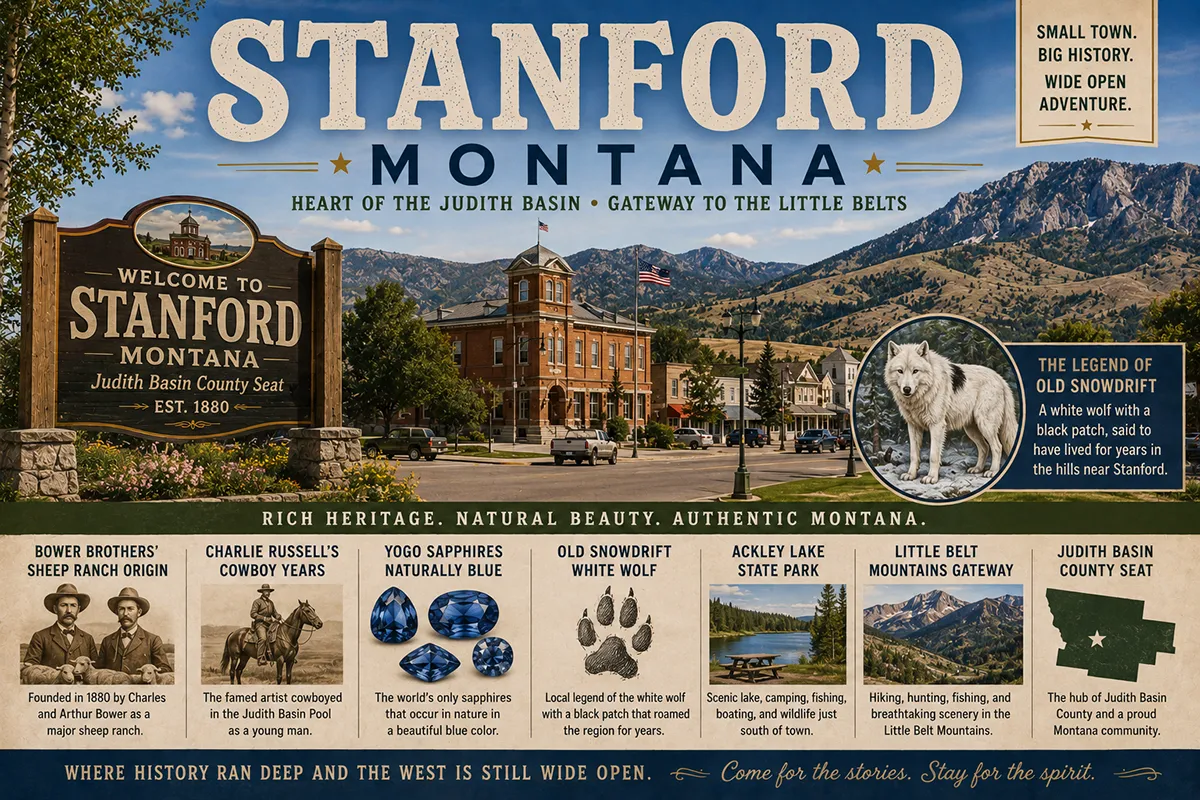
In the spring of 1880, two brothers named Calvin and Edward Bower drove a thousand head of sheep into the Judith Basin from the east and proceeded to buy 100,000 acres of central Montana grassland.
The basin between the Little Belt, Highwood, Big Snowy, and Judith mountain ranges had been buffalo and Crow country for centuries, but the buffalo were gone by 1880, the Crow had been pushed onto the reservation to the south, and the open range that remained was being reorganized for cattle and sheep operations on a scale that’s almost impossible to picture today.
When the Bowers’ settlement needed a name, they reached back to their old hometown in Duchess County, New York: Stanfordville. The post office shortened it to Stanford. The Judith Basin had a town.
The Bowers’ arrival was just one event in what turned out to be the most consequential decade in Judith Basin history. The same years saw the establishment of the Judith Basin Pool — a cooperative cattle operation that grazed something approaching 30,000 cattle across the open range — and the arrival of a young teenager from St.
Louis named Charles Marion Russell, who came west at 16 looking for cowboy work and ended up working with Jake Hoover, a Pike Peakers trapper and prospector, in a cabin near present-day Utica.
Russell would spend most of the 1880s as a working Judith Basin cowboy before discovering, slowly, that he could also paint. His Judith Basin years produced the experiences and observations that fueled the cowboy art that made him, by his 1926 death, the most famous Western artist in America.
Today Stanford is a town of about 403 residents, still the county seat of Judith Basin County (created in 1920 from chunks of Fergus and Cascade counties), still primarily a service center for the wheat farms and cattle ranches that have replaced the open-range pools.
The Judith Basin County Museum tells the local history with the kind of depth that small-town museums sometimes manage and sometimes don’t — this one manages. The Yogo Sapphire deposits 15 miles south at Yogo Gulch continue to produce the only naturally blue sapphires in the world.
And the legendary White Wolf “Old Snowdrift” — an 83-pound outlaw wolf that terrorized basin sheep operations for years before being captured in the 1930s — is still mounted at the Basin Trading Post for visitors who want to see what a serious livestock-killing predator actually looked like.
TL;DR
- Stanford (~403) is the county seat of Judith Basin County, on US-87/MT-200 about midway between Great Falls (70 miles northwest) and Lewistown (50 miles east).
- Founded in 1880 when Bower brothers Calvin and Edward brought 1,000 sheep, bought 100,000 acres, and named the settlement for Stanfordville, New York.
- Anchor town of Charlie Russell country — the Judith Basin where the future Western artist worked as a cowboy in the 1880s.
- The Yogo Sapphire deposits at Yogo Gulch (15 miles SW of Utica) produce the world’s only naturally cornflower-blue sapphires.
- The “Old Snowdrift” white wolf — 83 pounds, 6 feet long including tail — is mounted at the Basin Trading Post.
- The Judith Basin County Museum (1967) holds 2,000 salt-and-pepper sets, 5,000 buttons, Charlie Russell-era artifacts, and the homesteader history.
- Ackley Lake State Park (10 miles south) for fishing.
- Gateway to the Little Belt Mountains via Lewis & Clark National Forest.
- Best for: Charlie Russell heritage travelers, Yogo Sapphire history, central Montana Big Sky country, Little Belt access.
Liked this article?
Add Roaming Montana as a preferred source so you see more of our articles and guides on Google.
Stanford at a Glance
| Population (2020) | ~403 |
|---|---|
| County | Judith Basin County (county seat) |
| Region | Central Montana (Judith Basin) |
| Distance to Great Falls | ~70 miles northwest (~1.25 hours via US-87) |
| Distance to Lewistown | ~50 miles east (~1 hour) |
| Distance to Hobson | ~10 miles east (~12 min) |
| Distance to Denton | ~15 miles northeast (~18 min) |
| Distance to Utica | ~15 miles south (~20 min) |
| Distance to Yogo Gulch | ~25 miles south (~30 min) |
| Best for | Charlie Russell heritage, Judith Basin County Museum, Yogo Sapphire context, Little Belt access |
What Makes Stanford Different
The Judith Basin is one of those Montana landscapes that’s bigger than it looks on the map. Bounded by the Little Belt Mountains to the west, the Highwood Mountains to the northwest, the Big Snowy Mountains to the south, and the Judith Mountains to the southeast, the basin spreads across nearly 2,000 square miles of central Montana wheat and cattle country.
The Judith River and its tributaries drain it. The land is fertile, productive, and almost relentlessly photogenic in the way that central Montana landscapes are — vast open foreground, distant mountain ranges, sky that goes on forever.
This is the country that turned Charlie Russell from a teenage runaway into one of the most consequential American artists of his generation. Russell arrived in Helena in 1880, made his way to Utica, and spent eleven seasons (1880-1891) working in the Judith Basin as a cowboy and night-wrangler. He rode for the Judith Basin Pool.
He lived for a winter with Jake Hoover, the trapper and gold prospector who would later become the first owner of the Yogo Sapphire claim. He watched cattle drives, open range branding, and the transition from the buffalo era to the homesteader era happen in real time.
The paintings he made years later — the cowboys, the chuck wagons, the Indian encampments, the dramatic Western scenes — came directly from what he had observed and lived through in the Judith Basin. The “C.M. Russell Trail” — US-87 between Great Falls and Lewistown — passes through Stanford and follows the corridor Russell traveled throughout his cowboy years.
The Yogo Sapphires deserve a paragraph because they’re one of the world’s genuinely unique geological phenomena. Discovered in 1895 at Yogo Gulch, about 25 miles south of Stanford via Utica and a gravel road into the Little Belt Mountains, the Yogo deposits are the only known source in the world of naturally cornflower-blue sapphires.
Most sapphires worldwide require heat treatment to produce their color; Yogo sapphires come out of the ground already blue, the color saturated and even, the gemstones unusually clear of inclusions.
The six-mile-long dike is still actively mined, though on a much smaller scale than its early-20th-century peak when the Yogo deposits supplied sapphires to British royalty and Tiffany & Co.
“Old Snowdrift” is the kind of regional legend that small towns earn over generations. The big white wolf reportedly took down sheep and cattle across the Judith Basin for years in the 1920s and early 1930s, evading hunters and traps with what locals attributed to nearly supernatural cunning.
When he was finally captured (or killed; sources vary on the exact circumstances) in the 1930s, the body measured six feet long including the tail and weighed 83 pounds — enormous for a North American gray wolf.
The taxidermied mount is on display at the Basin Trading Post in Stanford, where you can see the legend in physical form rather than just in the local oral history.
For broader trip context, see my Montana cities and towns hub.
The Top 10 Things to Do In & Around Stanford
1. Judith Basin County Museum
Located on the south side of the County Courthouse and opened in 1967, the museum is the foundational stop for understanding the Judith Basin story.
Exhibits cover the open-range cattle era, the transition to sheep ranching, the homesteader boom, the Judith Basin Pool cowboys (Charlie Russell among them), the stagecoach and railroad eras, and the broader Indigenous history.
Quirky collections include 2,000 sets of salt and pepper shakers and 5,000 buttons. The Indian artifacts display covers Apsáalooke and Blackfeet material. Allow at least 90 minutes; longer if you want to absorb everything.
2. Basin Trading Post & Old Snowdrift
The Stanford trading post is part general store, part museum. The mounted “Old Snowdrift” white wolf is the centerpiece — the legendary 83-pound predator that terrorized basin sheep operations for years before being captured in the 1930s.
Local history materials, Western art prints, and the genuine working-store atmosphere round out the experience.
3. C.M. Russell Trail (US-87 Scenic Drive)
The Charlie Russell Trail follows US-87 between Great Falls and Lewistown, passing through Stanford and looping south through Utica — Russell’s home base during his cowboy years.
Brochures available at the Judith Basin County Museum identify specific landscapes that appear in Russell’s paintings, many of which remain visually unchanged today. Allow a half day for the corridor exploration with stops at Utica and the surrounding countryside.
4. Jake Hoover’s Cabin (Utica, 15 minutes south)
The reconstructed cabin where Charlie Russell lived for a winter with Jake Hoover — trapper, gold prospector, and first owner of the Yogo Sapphire claim.
The site provides direct connection to Russell’s early cowboy years. Located at the Utica history museum complex.
5. Ackley Lake State Park (10 miles south)
The closest fishing destination from Stanford. Ackley Lake offers rainbow trout, brown trout, and kokanee salmon in a reservoir setting at the base of the Little Belts.
Picnic areas, boat ramp, campground (limited sites, first-come first-served). Open year-round; winter ice fishing is locally popular. Montana fishing license required.
6. Yogo Gulch & Sapphire Mining History (Lewis & Clark National Forest)
The Yogo Sapphire deposits at Yogo Gulch, 25 miles south of Stanford via Utica, are the world’s only source of naturally cornflower-blue sapphires. The six-mile-long Yogo Dike is still actively mined, though access is limited (private claims).
The area can be visited via Forest Service road; check current conditions and access restrictions before going. The Vortex Mine and other Yogo-area operations are not generally open to public tours.
7. Little Belt Mountains Day Hiking
The Little Belt Mountains rise immediately west of Stanford, accessible via county roads and Forest Service routes. Trails in the Lewis & Clark National Forest offer alpine lakes, mountain stream fishing, and significant elevation gain.
Memorial Falls, Crystal Lake, and the Showdown Ski Area access are all within easy day-trip range. Forest Service maps available from the ranger district office in Great Falls.
8. Judith River Wildlife Management Area
The Judith River drainage south of Stanford provides excellent wildlife viewing — elk, mule deer, whitetail, mountain goats in the higher elevations of the Little Belts.
The Wildlife Management Area covers thousands of acres of public-access habitat. Hunting and fishing are popular with appropriate licenses; non-consumptive wildlife viewing is also rewarding.
9. Day Trip to Hobson (12 minutes east)
The Judith Basin’s smaller eastern community — Russell-era ranching heritage continues. See Hobson guide.
10. Day Trip to Lewistown (1 hour east)
Central Montana’s most complete small city — Judith Basin Brewing, the Yogo sapphire context, beautiful downtown, full hotel and dining services. See Lewistown guide.
Where to Stay
| Hotel | Vibe | Price | Best For |
|---|---|---|---|
| Sundown Motel (Stanford) | Basic local motel | $85–130 | Budget |
| Stanford-area vacation rentals | Ranch homes, cabins | $130–250 | Families, longer stays |
| Hobson lodging (12 min east) | Limited options | $90–150 | Quieter base |
| Lewistown hotels (1 hour east) | Best central MT selection | $100–180 | Most travelers |
| Great Falls hotels (1.25 hours northwest) | Full city selection | $130–250 | More amenities |
Where to Eat
- The Sundown Inn & Lounge (Stanford) — community gathering place; bar food
- The Wolves Den Café & Steakhouse (Stanford) — local steakhouse
- Hobson cafés (12 min east) — basic local options
- Lewistown dining (1 hour east) — Judith Basin Brewing, Main Street variety
- Great Falls dining (1.25 hours northwest) — full city selection
Getting There & Around
From Great Falls: 70 miles southeast on US-87 (the Charlie Russell Trail), about 1.25 hours through the Highwood Mountains foothills and Judith Basin.
From Lewistown: 50 miles west on US-87/MT-200, about 1 hour through the eastern Judith Basin.
From Bozeman: ~140 miles via I-90 west and US-89 north, about 2.5 hours.
From Billings: ~155 miles via US-87 northwest, about 3 hours.
Cell service: Generally available in Stanford and along US-87; reduced on Forest Service roads in the Little Belt Mountains.
What Stanford Unlocks
Judith Basin & Charlie Russell Country (US-87 corridor)
The full landscape that shaped Charlie Russell’s cowboy art, including Utica, Hobson, and surrounding ranch country.
Yogo Sapphire Deposits (25 min south)
World’s only source of naturally cornflower-blue sapphires.
Lewis & Clark National Forest / Little Belt Mountains (west)
Hiking, fishing, hunting, Showdown Ski Area, alpine lakes.
Ackley Lake State Park (10 min south)
Rainbow trout, brown trout, kokanee salmon; year-round access.
Lewistown (1 hour east)
Central Montana’s most complete small city.
Great Falls (1.25 hours northwest)
C.M. Russell Museum (the definitive Russell collection), Lewis & Clark Interpretive Center.
When to Visit
Summer (June–August): Best Judith Basin landscape conditions, Little Belt Mountains fully accessible, Ackley Lake State Park at peak season, museums on full hours.
Fall (September–October): Outstanding fall colors in the Judith Basin cottonwoods, hunting season for elk and deer, harvest activity throughout the basin.
Spring (April–May): Quieter shoulder season, basin greens up dramatically, occasional spring snowstorms possible.
Winter (November–March): Cold and quiet but the wheat country covered in snow is genuinely beautiful; Showdown Ski Area in the Little Belts is the closest skiing.
Personal Tips
The C.M. Russell Museum in Great Falls is the essential pairing. Stanford and the Judith Basin provide the landscape and historical context for Charlie Russell; the C.M. Russell Museum in Great Falls provides the art itself. Pairing the two — one day in the basin, one day at the museum — is one of central Montana’s most rewarding two-day cultural itineraries.
Yogo Sapphire access requires research. The Yogo deposits are on private claims with limited public access. Don’t plan to visit expecting open-pit tours; the operations are commercial and not generally open to drop-in visitors. Buy Yogo Sapphire jewelry from authorized dealers in Lewistown or online from licensed sources rather than expecting on-site purchases at Yogo Gulch.
Stanford makes sense as part of the central Montana loop. Don’t treat Stanford as a standalone destination; pair it with Lewistown (1 hour east), Hobson (15 min east), Utica (15 min south), and Great Falls (1.25 hours northwest) for a 2-3 day central Montana itinerary that covers the full Charlie Russell country, the Yogo context, and the Little Belt Mountains access.
The Judith Basin County Museum salt-and-pepper-shaker collection is real. It sounds quirky and it is, but the 2,000-set collection is also a substantive social history of mid-20th-century American kitsch. Allow time for it specifically.
Old Snowdrift deserves a stop. The mounted white wolf at the Basin Trading Post is genuinely impressive — most travelers underestimate the size of historical North American wolves. Worth a few minutes.
Stanford Quick Facts
| Founded | 1880 (Bower brothers’ sheep operation) | | Named for | Stanfordville, Duchess County, New York (Bower brothers’ hometown) | | Judith Basin County formed | December 10, 1920 | | Charlie Russell in the Judith Basin | 1880-1891 (eleven seasons as a cowboy) | | Yogo Sapphire discovered | 1895 at Yogo Gulch (15 mi SW of Utica) | | Yogo Dike length | 6 miles (world’s only naturally blue sapphires) | | Old Snowdrift weight/length | 83 pounds, 6 feet long including tail | | Judith Basin County Museum opened | 1967 | | Average summer high | 80°F | | Average winter low | 10°F |
Conclusion
Stanford is the kind of small Montana town that earns its weight through the specific stories that anchor it — the Bower brothers’ 1880 sheep operation that named the place for an upstate New York hometown, the eleven Judith Basin seasons that turned a teenage Charlie Russell into a working cowboy and eventually one of America’s greatest Western artists, the 1895 discovery of the only naturally blue sapphires in the world, and the legendary White Wolf “Old Snowdrift” that’s still mounted at the Basin Trading Post 90 years after his capture.
Combined with the Judith Basin County Museum, the Little Belt Mountains, and the broader C.M. Russell Trail corridor between Great Falls and Lewistown, Stanford is one of the most substantive small towns in central Montana.
Have a Stanford question? Drop it in the comments — I read every one.
Frequently Asked Questions
Is Stanford Montana worth visiting?
Yes — Stanford is worth visiting for the Judith Basin County Museum (one of central Montana’s best small-town museums), the Old Snowdrift white wolf at the Basin Trading Post, the broader Charlie Russell country context (Russell worked here in the 1880s), the Yogo Sapphire deposits 25 minutes south, Ackley Lake State Park fishing, and the Little Belt Mountains gateway. It’s an essential stop on any central Montana itinerary built around C.M. Russell heritage or Yogo Sapphire history.
Why is Stanford Montana named Stanford?
Stanford was named in 1880 by Calvin and Edward Bower, two brothers from Stanfordville in Duchess County, New York, who arrived in the Judith Basin with a thousand head of sheep and purchased 100,000 acres to graze them. When the settlement needed a name, the Bowers reached back to their hometown — Stanfordville — and the local post office shortened it to Stanford.
What is the Yogo Sapphire?
The Yogo Sapphire is the world’s only naturally cornflower-blue sapphire, discovered in 1895 at Yogo Gulch about 15 miles southwest of Utica (and approximately 25 miles south of Stanford). Unlike most sapphires worldwide, Yogo sapphires don’t require heat treatment to develop their color — they emerge from the ground already cornflower blue, with exceptional clarity and unusually small inclusions. The six-mile-long Yogo Dike is still actively mined on a smaller scale than its early-20th-century peak.
What is Old Snowdrift?
Old Snowdrift was a legendary white wolf that terrorized sheep and cattle operations across the Judith Basin in the 1920s and early 1930s. When finally captured in the 1930s, the wolf measured six feet long including the tail and weighed 83 pounds — enormous for a North American gray wolf. The mounted taxidermy is displayed at the Basin Trading Post in Stanford and remains one of central Montana’s most distinctive local-legend artifacts.
What is the Charlie Russell connection to Stanford?
Charlie Russell — the legendary Western artist — spent his cowboy years (1880-1891) working in the Judith Basin that surrounds Stanford. He rode for the Judith Basin Pool cattle operation, lived for a winter near Utica with trapper Jake Hoover (who would later own the original Yogo Sapphire claim), and observed the open-range cattle era that became the source material for his most famous paintings. The “C.M. Russell Trail” — US-87 between Great Falls and Lewistown — passes through Stanford and follows the corridor Russell traveled throughout his cowboy years.
How far is Stanford from Great Falls Montana?
Stanford is approximately 70 miles southeast of Great Falls on US-87 (the Charlie Russell Trail) — about a 1.25-hour drive through the Highwood Mountains foothills and into the Judith Basin.