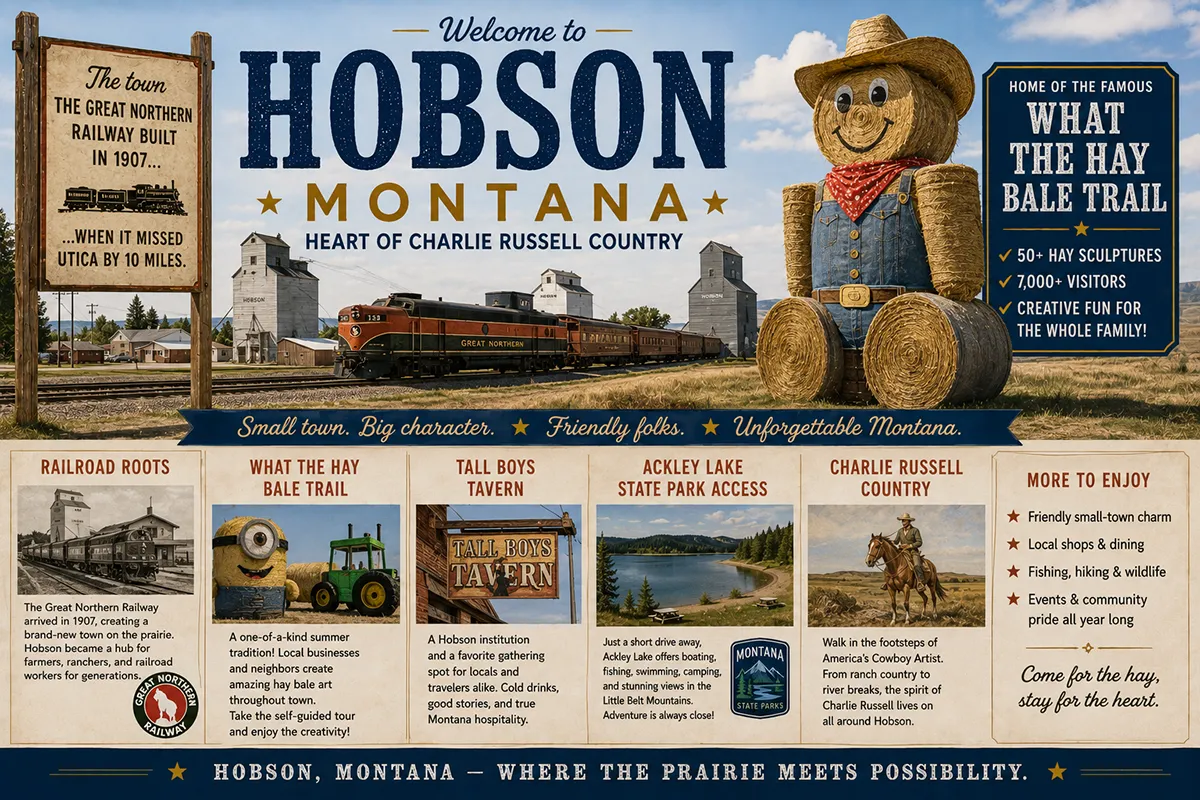
The town of Hobson exists because of a railroad decision made in 1907. The Great Northern Railway was extending tracks through the Judith Basin and needed to place a station somewhere in the central section of the basin.
The obvious candidate was Utica, which had been the regional cattle hub since the 1880s — headquarters of the Judith Basin Cattle Pool, the trading post that fed Charlie Russell during his cowboy years, the town where Russell finished his famous painting A Quiet Day in Utica in 1907.
But the railroad’s chosen route bypassed Utica by 10 miles to the north. The new station went in at a fresh townsite that became Hobson. Within a few years, Utica was draining of business, the Judith Hotel and Silver Dollar Saloon were on the path to demolition, and Hobson — the brand-new railroad town — was becoming the new commercial center for the Judith Basin’s central section.
That railroad decision is the foundational fact of Hobson’s existence. The town today has about 179 residents and the modest civic infrastructure you’d expect for a community its size — a school, a tavern that serves serious food, a country store, and the kind of well-maintained streetscape that has earned Hobson a quietly persistent local reputation as “one of the cleanest little towns in Montana.”
But once a year, on the first Sunday after Labor Day weekend, Hobson becomes the start of one of the most genuinely strange and beloved annual events in the entire American West.
The Montana Bale Trail — What the Hay brings 7,000 visitors (40 times Hobson’s population) down a 21-mile country highway between Hobson, Utica, and Windham to see fifty-plus elaborately decorated hay bale sculptures arranged by local farmers and ranchers.
The sculptures are creative, often hilarious, and a genuine expression of the kind of agricultural-community wit that thrives in small Montana towns.
Hobson is also the gateway to broader Charlie Russell country. The C.M. Russell Trail — Highway 87 between Great Falls and Lewistown, formally designated in 1993 — passes through Hobson, with Utica 10 miles south, Stanford 10 miles west, and the broader Judith Basin landscape spreading in every direction.
The Judith Basin is the country Russell rode for eleven seasons (1880-1891) as a working cowboy, the landscape that fueled his most famous paintings, and the heart of what Montana refers to as “Russell Country.”
TL;DR
- Hobson (~179) is in Judith Basin County on US-87 / MT-200, about 10 miles east of Stanford and 40 miles west of Lewistown.
- The town was created in 1907 when the Great Northern Railway built its station 10 miles north of Utica, effectively ending Utica’s role as the regional hub.
- The Montana Bale Trail — What the Hay is held the first Sunday after Labor Day weekend: 50+ hay bale sculptures along 21 miles from Hobson through Utica to Windham; draws approximately 7,000 visitors.
- The town is part of the C.M. Russell Trail (US-87 from Great Falls to Lewistown), the corridor of Charlie Russell’s eleven cowboy years.
- Tall Boys Tavern is locally famous for authentic Montana beef, scratch cooking, and Rocky Mountain oysters.
- Ackley Lake State Park is 15 miles west via gravel road — rainbow trout, brown trout, kokanee salmon.
- The annual Hobson Day Fair is the community’s second major event.
- Best for: Bale Trail visitors (timing the first weekend after Labor Day), C.M. Russell Trail travelers, Judith Basin agricultural heritage, and travelers looking for an authentic small-town stop on the Great Falls-Lewistown corridor.
Liked this article?
Add Roaming Montana as a preferred source so you see more of our articles and guides on Google.
Hobson at a Glance
| Population (2020) | ~179 |
|---|---|
| County | Judith Basin County |
| Region | Central Montana (Judith Basin) |
| Distance to Stanford (county seat) | ~10 miles west (~12 min) |
| Distance to Lewistown | ~40 miles east (~45 min) |
| Distance to Utica | ~10 miles south (~15 min) |
| Distance to Windham | ~10 miles southwest (~15 min) |
| Distance to Great Falls | ~80 miles northwest (~1.5 hours) |
| Distance to Ackley Lake State Park | ~15 miles west (~30 min, partial gravel) |
| Founded | 1907 (Great Northern Railway) |
| Best for | Montana Bale Trail (early September), Tall Boys Tavern, Russell Country corridor, Ackley Lake access |
What Makes Hobson Different
The Hobson-Utica naming relationship is one of those small-town stories that captures how the American West actually got organized. Utica was established in the late 1870s as the headquarters of the Judith Basin Cattle Pool — the cooperative cattle operation that grazed something approaching 30,000 cattle across the open range during the basin’s open-range era.
Cowboys returning to Utica between roundups had access to the Judith Hotel, the Silver Dollar Saloon, a substantial trading post, multiple boarding houses, and — most importantly — Jake Hoover, the trapper and gold prospector who took in young Charlie Russell during a hard winter in 1880-81 and effectively launched the artist’s career.
Charlie returned to Utica repeatedly during his eleven cowboy seasons, and his 1907 painting A Quiet Day in Utica (which Russell originally called Tin Canning a Dog) shows the town’s main street with the artist himself leaning on a hitching rail at the lower right of the frame, smoking a cigarette.
The year Russell finished that painting, the Great Northern Railway extended its line through the Judith Basin. The railroad surveyors decided the best route ran 10 miles north of Utica. They built a station, a depot, and the infrastructure of a railroad town at the new site. Settlers and businesses followed the rails. Utica started shrinking almost immediately.
By 1913, a mysterious fire destroyed a Utica saloon and several other buildings. The Judith Hotel and Silver Dollar Saloon were torn down in the 1940s. By the late 20th century, Utica had no church, no post office, and only a single full-time operating business (the Oxen Yoke Inn restaurant). The new railroad town — Hobson — became the regional hub.
The Montana Bale Trail event is the contemporary expression of what makes Hobson distinctive. The “What the Hay” hay-bale sculpture exhibition began in the 1980s as a small local fundraising effort and has grown into one of the most genuinely beloved annual events in central Montana.
The first Sunday after Labor Day weekend, farmers and ranchers along the 21-mile route from Hobson south through Utica and on to Windham create elaborate hay-bale sculptures in their fields. Past sculptures have included everything from massive haystack dragons to politically pointed satire to faithful recreations of famous paintings.
Travelers drive the route slowly, stopping to photograph the bales, voting for their favorites, and pausing in Utica for the simultaneous Utica Day craft fair, flea markets, and food vendors. Approximately 7,000 visitors arrive over the day.
The Hobson school typically operates a fundraising lunch; the Oxen Yoke Inn in Utica is overwhelmed with diners; and the entire stretch of US-87 and the connecting roads see traffic levels Hobson doesn’t experience any other day of the year.
The town’s broader Charlie Russell context is essential. The C.M. Russell Trail — designated by the Montana Legislature in 1993 — runs from Great Falls to Lewistown along US-87 and passes directly through Hobson.
The trail offers a self-guided exploration of Russell’s working cowboy years (1880-1891), with stops at the Hobson school’s small Russell display, the substantially better Judith Basin County Museum in Stanford (10 miles west), the Utica Museum (10 miles south), and ultimately the definitive C.M. Russell Museum in Great Falls (80 miles northwest, holds the largest collection of Russell’s work in the world).
Travelers serious about Russell can spend a long weekend on the corridor and not run out of substantive material.
For broader trip context, see my Montana cities and towns hub.
The Top 10 Things to Do In & Around Hobson
1. Montana Bale Trail – What the Hay (First Sunday after Labor Day)
The annual hay-bale sculpture exhibition that defines Hobson’s contemporary identity. Drive the 21-mile route from Hobson south through Utica to Windham to see 50+ farmer-created hay-bale sculptures. Plan a full day. Vote for your favorites (ballots available at multiple stops).
Stop in Utica for the simultaneous Utica Day craft fair, hay maze, flea markets, and food vendors. Approximately 7,000 visitors arrive over the day; plan accordingly for traffic and parking. The Hobson school usually runs a fundraising lunch; the Oxen Yoke Inn in Utica is the lunch destination but expect waits.
2. Tall Boys Tavern
The locally famous Hobson restaurant — authentic Montana beef, scratch cooking, Rocky Mountain oysters as an appetizer if you’re brave, and the kind of bar atmosphere that locals genuinely use as a community gathering place.
The food is the reason; the community character is the bonus. Most Tall Boys regulars consider it some of the best meat-and-potatoes cooking in the Judith Basin.
3. Charlie Russell C.M. Russell Trail
The Charles M. Russell Trail runs through Hobson on its way between Great Falls and Lewistown along US-87. The trail is a self-guided exploration of Russell’s eleven cowboy seasons (1880-1891) with stops at the major museums and the actual landscapes Russell painted.
Hobson is the central-corridor anchor; Stanford (10 miles west) has the substantially larger Judith Basin County Museum; Utica (10 miles south) has the Utica Museum; Great Falls has the definitive C.M. Russell Museum. Allow at least a full day for the corridor.
4. Utica Day Trip (10 miles south)
Utica — the original Judith Basin hub Russell knew — is essentially a single-business town today, but it remains worth visiting. The Oxen Yoke Inn (the one full-time business in town) serves famous hamburgers.
Don Waite’s slow reconstruction project recreates miniature versions of frontier-era Utica buildings on his retirement property. The Utica Museum covers homestead-era artifacts. The reconstructed Jake Hoover’s cabin (where young Charlie Russell lived for the winter of 1880-81) is accessible.
5. Ackley Lake State Park (~15 miles west)
The closest fishing destination from Hobson — Ackley Lake offers rainbow trout, brown trout, and kokanee salmon in a reservoir setting at the base of the Little Belts. Picnic areas, boat ramp, campground (limited sites, first-come first-served).
Open year-round; winter ice fishing is locally popular. Access requires a few miles of gravel road; verify conditions before going. Montana fishing license required.
6. Hobson Day Fair (Annual)
The town’s smaller community event — parades, contests, local food, music, and the kind of authentic small-town gathering that defines summer in agricultural Montana. Check the current schedule with the Judith Basin County Chamber for exact dates.
7. Judith River Wildlife Management Area (south of Utica, ~25 miles)
The 9,408-acre WMA on the Judith River south of Utica provides excellent wildlife habitat — wintering elk, mule deer, whitetail, and the occasional moose. Access roads can be rough; verify current conditions. Free.
8. C.M. Russell Trail Driving Tour (Full Corridor)
The full Charles M. Russell Trail from Great Falls to Lewistown via Stanford, Hobson, Utica, and Windham is one of central Montana’s most rewarding scenic drives.
Allow a full day or two. The trail covers the actual landscapes Russell painted, the museums that preserve his work, and the towns that grew out of the Judith Basin’s transition from open-range cattle country to homesteader agriculture.
9. Day Trip to Stanford (10 minutes west)
Judith Basin County seat, the substantial Judith Basin County Museum, the Basin Trading Post with the mounted “Old Snowdrift” white wolf, the Sundown Inn dinner option. See Stanford guide.
10. Day Trip to Lewistown (45 minutes east)
Central Montana’s most complete small city — Judith Basin Brewing, full restaurant variety, the Yogo Sapphire context, and the central Montana arts and culture scene. See Lewistown guide.
Where to Stay
Hobson has very limited lodging. Stanford (10 minutes west) and Lewistown (45 minutes east) provide more options.
| Hotel | Vibe | Price | Best For |
|---|---|---|---|
| Vacation rentals (Hobson area) | Limited options | $130–240 | Families |
| Sundown Motel (Stanford, 10 min west) | Basic local motel | $85–130 | Budget |
| Lewistown hotels (45 min east) | Best central MT selection | $100–180 | Most travelers |
| Judith Guard Station (Lewis & Clark NF) | USFS rental cabin | $70–90 | Backcountry experience |
| Ackley Lake camping (15 min west) | State park campground | $20–30 | Anglers, campers |
Where to Eat
- Tall Boys Tavern (Hobson) — locally famous; authentic Montana beef, Rocky Mountain oysters, scratch cooking
- Nancy’s Country Market (Hobson) — small local grocery for snacks and supplies
- Oxen Yoke Inn (Utica, 10 min south) — famous burgers; the only full-time business in Utica
- Stanford restaurants (10 min west) — The Sundown Inn & Lounge, The Wolves Den Café
- Lewistown dining (45 min east) — Judith Basin Brewing, full Main Street variety
Getting There & Around
From Stanford: 10 miles east on US-87, about 12 minutes.
From Lewistown: 40 miles west on US-87/MT-200, about 45 minutes through the eastern Judith Basin.
From Great Falls: ~80 miles southeast on US-87 (the C.M. Russell Trail), about 1.5 hours.
From Billings: ~165 miles via US-87 northwest, about 3 hours.
Cell service: Generally available in Hobson and along US-87; reduced on county and gravel roads.
What Hobson Unlocks
Utica & Charlie Russell Country (10 min south)
The Judith Basin Cattle Pool headquarters Russell knew; Jake Hoover’s cabin; Oxen Yoke Inn.
Stanford & Judith Basin County Museum (10 min west)
County seat with the substantial county museum and Old Snowdrift white wolf.
Ackley Lake State Park (15 min west)
Trout fishing; State Park camping.
C.M. Russell Trail Corridor (US-87 Great Falls to Lewistown)
The full self-guided Russell exploration corridor.
Lewis & Clark National Forest (south)
Little Belt and Snowy Mountains hiking and fishing.
Lewistown (45 min east)
Central Montana’s most complete small city.
Great Falls (1.5 hours northwest)
The definitive C.M. Russell Museum.
When to Visit
First Sunday after Labor Day: Montana Bale Trail “What the Hay” — the year’s signature event. Book lodging weeks in advance in Stanford, Lewistown, or anywhere within an hour.
Summer (June–August): Best Judith Basin landscape, full Ackley Lake season, all museums on summer hours, Tall Boys Tavern in full operation, longest daylight.
Fall (September–October): Outstanding fall colors in the Judith Basin cottonwoods, hunting season for elk and deer, harvest activity throughout the basin, comfortable temperatures.
Spring (April–May): Quieter shoulder season, basin greens up dramatically, occasional spring snow possible.
Winter (November–March): Cold and quiet, ice fishing on Ackley Lake, restaurants and shops on reduced winter hours.
Personal Tips
Time a visit for the Bale Trail. First Sunday after Labor Day is the answer. The event genuinely transforms Hobson, Utica, and Windham for one extraordinary day. Plan ahead — book lodging weeks in advance in Stanford or Lewistown, fuel up before arriving, and be prepared for traffic that the corridor doesn’t experience any other day of the year.
Eat at Tall Boys when you’re in town. The restaurant has earned its local reputation honestly. Plan dinner around it rather than treating it as a backup option.
Combine Hobson with Utica. The two towns are inseparably linked by history — Utica was the original 1880s hub, Hobson is the 1907 railroad replacement. Visit both. Allow time for Utica’s slower pace and the Oxen Yoke Inn lunch.
The C.M. Russell Trail rewards a full day. Hobson is one stop on a substantial corridor — Great Falls (the museum) to Lewistown (full services), via Stanford, Hobson, Utica, and Windham. Treat the corridor as the destination rather than the route.
Don’t skip the smaller museums. The Judith Basin County Museum in Stanford and the Utica Museum may be small, but both genuinely contribute to understanding Charlie Russell and the basin’s history. The Hobson school’s smaller display is worth a quick stop if your timing allows.
Ackley Lake is worth a detour. The 15-mile drive west to Ackley Lake State Park covers good fishing and quiet camping in a beautiful setting. The road is partially gravel — verify conditions before going in wet weather.
Hobson Quick Facts
| Founded | 1907 (Great Northern Railway) | | Created when railroad bypassed | Utica (by 10 miles to the south) | | Montana Bale Trail | First Sunday after Labor Day weekend annually | | Bale Trail route length | 21 miles (Hobson – Utica – Windham) | | Bale Trail visitors | ~7,000 (vs. Hobson population of ~179) | | Hay sculptures | 50+ along the route | | Russell painting “A Quiet Day in Utica” | 1907 (the year Hobson was founded) | | Russell’s cowboy years in the area | 1880-1891 | | Average summer high | 81°F | | Average winter low | 9°F |
Conclusion
Hobson is the kind of small Montana town that earns its weight through specific, locally meaningful detail — the 1907 railroad decision that built the town in the first place and effectively killed Utica’s role as the regional hub, the annual hay-bale sculpture exhibition that brings 40 times the town’s population in for one extraordinary September Sunday, the Tall Boys Tavern that’s earned its food reputation honestly, and the broader Charlie Russell country context that makes Hobson part of one of central Montana’s most substantive cultural corridors.
For travelers building a serious Russell Country itinerary or timing a central Montana trip for the Bale Trail, Hobson is exactly the kind of stop that justifies slowing down.
Have a Hobson question? Drop it in the comments — I read every one.
Frequently Asked Questions
Is Hobson Montana worth visiting?
Yes — Hobson is worth visiting for the annual Montana Bale Trail “What the Hay” (first Sunday after Labor Day, 50+ hay bale sculptures from Hobson through Utica to Windham, drawing ~7,000 visitors), Tall Boys Tavern (locally famous for authentic Montana beef and scratch cooking), the broader Charlie Russell country and C.M. Russell Trail corridor, and Ackley Lake State Park (15 miles west for trout fishing).
Why was Hobson Montana founded?
Hobson was founded in 1907 when the Great Northern Railway built its station 10 miles north of Utica, the established Judith Basin Cattle Pool hub. The railroad’s decision to bypass Utica effectively created the new town of Hobson, drained business from Utica, and shifted the regional commercial center to the railroad town. Within years, the Judith Hotel and Silver Dollar Saloon in Utica were on the path to demolition, and Hobson became the new central Judith Basin hub.
What is the Montana Bale Trail (What the Hay)?
The Montana Bale Trail — also called “What the Hay” — is an annual hay-bale sculpture exhibition held the first Sunday after Labor Day weekend along the 21-mile route from Hobson south through Utica to Windham. Local farmers and ranchers create more than 50 elaborately decorated hay bale sculptures in their fields along the route. Visitors drive the corridor, photograph the sculptures, vote for favorites, and stop in Utica for the simultaneous Utica Day craft fair, hay maze, flea markets, and food vendors. The event draws approximately 7,000 visitors — about 40 times Hobson’s population of 179.
Did Charlie Russell live in Hobson?
No — Charlie Russell never lived in Hobson, which didn’t exist until 1907 when the Great Northern Railway built its station. Russell’s actual home base during his Judith Basin cowboy years (1880-1891) was Utica, 10 miles south of present-day Hobson. He lived for the winter of 1880-81 with trapper and prospector Jake Hoover in a cabin near Utica, and he returned to Utica repeatedly throughout his eleven cowboy seasons. Hobson is part of the broader “Russell Country” and the C.M. Russell Trail corridor, but the deeper Russell history is in Utica.
How far is Hobson from Stanford Montana?
Hobson is 10 miles east of Stanford on US-87 — about a 12-minute drive. The two towns are the primary anchors of the Judith Basin County US-87 corridor, with Stanford (the county seat) holding the more substantial Judith Basin County Museum and Hobson holding the Bale Trail event and Tall Boys Tavern.
What is on the C.M. Russell Trail?
The Charles M. Russell Trail — designated by the Montana Legislature in 1993 — runs along US-87 between Great Falls and Lewistown, covering approximately 125 miles of the country Charlie Russell rode during his cowboy years (1880-1891). Key stops include the C.M. Russell Museum in Great Falls (the world’s largest collection of Russell’s work), Stanford’s Judith Basin County Museum, Hobson, the Utica Museum and reconstructed Jake Hoover cabin, Windham’s Bar 87, and Lewistown for full services. The trail can be done as a day or weekend self-guided driving exploration.