In 1910, two things happened almost simultaneously that would define this corner of northwestern Montana for the next century. President Taft signed the legislation creating Glacier National Park on May 11, 1910, designating one million acres of glaciated mountain wilderness along the Canadian border as America’s tenth national park.
That same year, the Great Northern Railway — under the visionary leadership of railroad president Louis W. Hill — began an ambitious program to build a chain of grand lodges, chalets, and trail infrastructure that would transform the new park into a tourist destination.
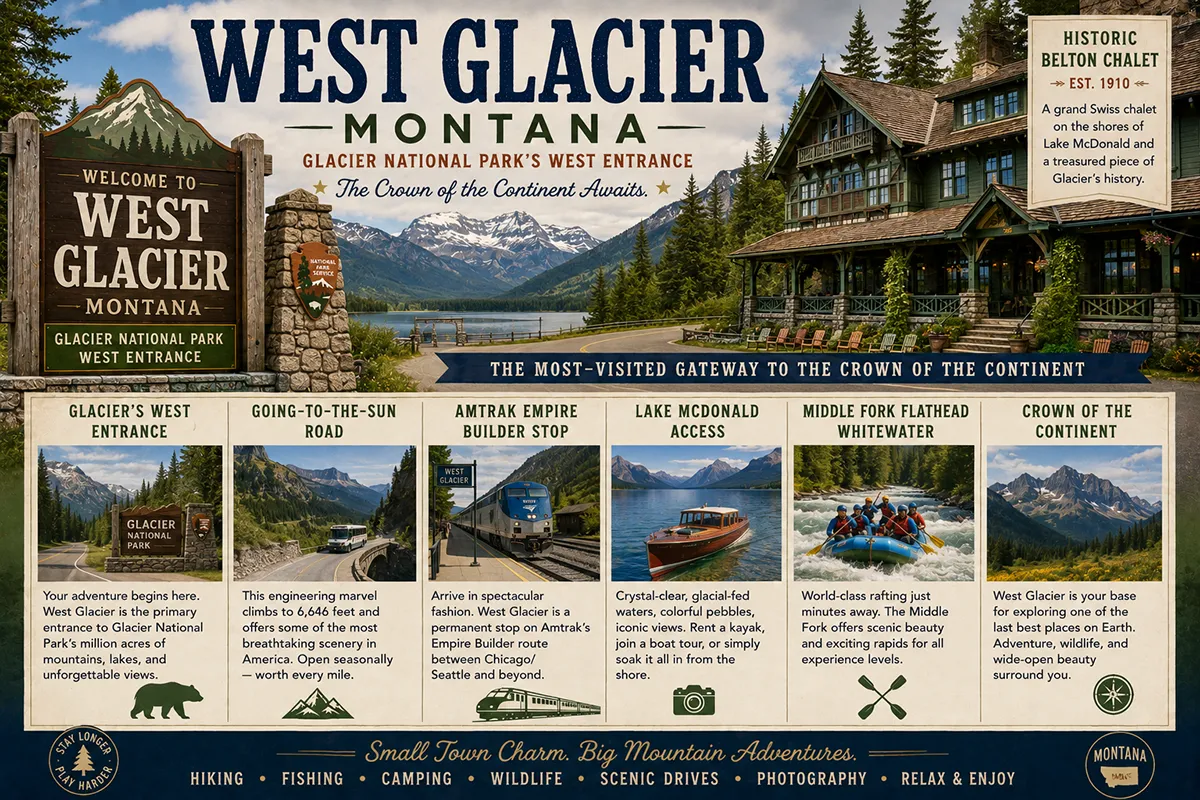
The first piece of that infrastructure was the Belton Chalet, a Swiss Chalet Revival hotel designed by architects Cutter & Malgren and constructed in 1910-11 at the rail stop closest to the park’s western boundary. The community that grew up around the chalet was called Belton.
By the late 1940s, “Belton” had become “West Glacier” — the name made more intuitive sense for the millions of park visitors arriving from outside Montana.
The Belton Chalet kept its original name. The Amtrak Empire Builder still stops at the historic Belton train depot twice daily on its Chicago-Seattle/Portland route, making West Glacier one of the only places in America where you can step off a passenger train and walk into a national park.
The Belton Chalet was restored extensively between 1997 and 2000, listed on the National Register of Historic Places in 1978, and continues to operate as a hotel and restaurant where guests sleep in rooms with no electronic distractions — no televisions, radios, or telephones — by deliberate design.
Today West Glacier itself is small — population around 221 — but its strategic role is enormous. This is the busiest gateway to Glacier National Park, the western terminus of the Going-to-the-Sun Road, the access point for Lake McDonald, the Middle Fork of the Flathead River, Apgar Village, and the broader Crown of the Continent ecosystem.
During peak summer season the village swells with park visitors, the parking lots fill before 8 a.m., and the Amtrak platform sees travelers from across the country boarding eastbound for Essex and East Glacier Park or westbound toward Whitefish and the Pacific Northwest.
TL;DR
- West Glacier (~221) is an unincorporated community in Flathead County at the primary western entrance to Glacier National Park.
- Originally named Belton — the rail stop closest to the new park’s western boundary, renamed in the late 1940s.
- The Belton Chalet (built 1910-11 by the Great Northern Railway, designed by Cutter & Malgren in Swiss Chalet Revival style, NRHP listed 1978) was the first component of the GN’s grand park hotel program.
- Amtrak Empire Builder still stops twice daily at the historic Belton train depot — one of the only US national parks with passenger rail access.
- The western terminus of Going-to-the-Sun Road — one of America’s most spectacular mountain drives. Typically open late June/early July through mid-September to mid-October.
- Vehicle reservations are now required for the Going-to-the-Sun corridor during peak summer dates — book months in advance.
- Lake McDonald (10 miles long, 472 ft deep, largest lake in Glacier NP) is 2 miles inside the park via Apgar Village.
- The Middle Fork of the Flathead River is one of America’s premier whitewater destinations.
- Best for: Glacier National Park travelers, Amtrak-to-park travelers, Going-to-the-Sun Road drivers, Middle Fork rafters, and Lake McDonald visitors.
Liked this article?
Add Roaming Montana as a preferred source so you see more of our articles and guides on Google.
West Glacier at a Glance
| Population (2020) | ~221 |
|---|---|
| County | Flathead County |
| Status | Unincorporated community (CDP) |
| Region | Northwest Montana (Glacier National Park gateway) |
| Elevation | 3,160 ft |
| Distance to Kalispell | ~30 miles southwest (~40 min via US-2) |
| Distance to Whitefish | ~25 miles southwest (~35 min) |
| Distance to Glacier Park International Airport (FCA) | ~28 miles (~35 min) |
| Distance to Apgar Village | ~2 miles east (inside park) |
| Distance to Lake McDonald Lodge | ~10 miles east on Going-to-the-Sun Road |
| Distance to Logan Pass | ~32 miles east on Going-to-the-Sun Road |
| Distance to East Glacier Park Village | ~55 miles southeast via US-2 |
| Distance to St. Mary (east entrance) | ~50 miles via Going-to-the-Sun Road |
| Best for | Glacier NP western access, Lake McDonald, Going-to-the-Sun Road, Middle Fork rafting |
What Makes West Glacier Different
West Glacier is essentially defined by what it gives access to. Glacier National Park’s one million acres of mountain wilderness, twenty-six remaining glaciers (down from 80+ when the park was created and still shrinking due to climate change), 700+ miles of hiking trails, 130+ named lakes, alpine wildflower meadows, grizzly bears, mountain goats, bighorn sheep, wolverines, and the legendary Going-to-the-Sun Road are all behind the boundary gate just east of town. The Belton Chalet and the historical infrastructure of West Glacier exist because someone needed to put the railroad station, the hotel, the staging area, and the visitor services on the outside of that boundary in 1910.
The Great Northern Railway’s role in creating both the park and West Glacier is foundational and deserves more than a passing mention.
Louis Hill — son of railroad magnate James J. Hill — was personally obsessed with developing Glacier as a destination.
He lobbied Congress for the park’s creation, and once it was established in May 1910, he immediately initiated what may be the most ambitious private investment in a national park’s history.
Between 1910 and 1915, the Great Northern built or funded the Belton Chalet, the Lake McDonald Lodge, the Many Glacier Hotel, the Glacier Park Lodge in East Glacier, Sperry Chalet, Granite Park Chalet, Two Medicine Chalets, Cut Bank Chalet, Going-to-the-Sun Chalet, and numerous smaller back-country chalets and trail networks.
Most of those structures still stand. Many are National Historic Landmarks. The “Crown Jewel” branding the Great Northern attached to Glacier was largely successful because of the quality and scale of what they built.
The Going-to-the-Sun Road is the other piece of foundational infrastructure. Begun in 1921 and completed in 1932, the 50-mile mountain road that traverses the park from West Glacier in the west to St. Mary in the east is one of the most spectacular engineering achievements in American national park history.
It crosses the Continental Divide at Logan Pass (6,646 feet), threads through tight switchbacks carved into vertical cliff faces, and connects ecosystems from temperate rainforest at Lake McDonald to alpine tundra at Logan Pass to drier eastern slopes.
The road typically opens in late June or early July (depending on snow removal progress) and closes for winter in mid-September to mid-October. During open season, vehicle reservations are required for the corridor during peak hours — a recent change that travelers should plan for months in advance.
The Amtrak Empire Builder connection deserves attention as one of the most underutilized arrival options for Glacier travelers. The Empire Builder runs daily in both directions between Chicago and Seattle/Portland, with stops at Browning, East Glacier Park, Essex, and West Glacier.
For travelers willing to plan a multi-day trip, taking the train to East Glacier, spending several days exploring the east side, taking the shuttle or driving Going-to-the-Sun Road, and then catching the Empire Builder westbound at West Glacier for the return trip is one of the most genuinely classic American national park experiences available. The Belton Chalet sits across the street from the West Glacier Amtrak platform.
For broader trip context, see my Montana cities and towns hub.
The Top 10 Things to Do In & Around West Glacier
1. Drive Going-to-the-Sun Road
The 50-mile mountain road from West Glacier east to St. Mary is one of the great drives in America. Highlights include Lake McDonald, McDonald Falls, the Loop, Logan Pass (Continental Divide), Hidden Lake Overlook trail, Jackson Glacier Overlook, Sunrift Gorge, and Sun Point.
Allow a full day minimum; ideally 2 days. Vehicle reservations required during peak season (typically late May through September) — book at recreation.gov months in advance. The road usually opens late June or early July; check current status before planning a visit.
2. Lake McDonald Visit
The largest lake in Glacier National Park — 10 miles long, 1 mile wide, 472 feet deep. Lake McDonald Lodge (built 1913-14 by the Great Northern, NRHP listed) sits on the shore about 10 miles into the park from West Glacier.
Boat tours, kayak/canoe rentals, the famous multi-colored shoreline pebbles, and the iconic mountain reflections on calm mornings are all accessible. Apgar Village at the lake’s southern shore is the closest park-side service area to West Glacier.
3. Belton Chalet Stay or Visit
Stay overnight at the 1910-11 Belton Chalet for the historic experience — rooms with no electronics, deck views of Apgar Lookout, dining at the Belton Grill (Montana buffalo meatloaf, elk stroganoff are signature dishes), and the Belton Tap Room.
Day visitors are welcome at the restaurant and tap room. The chalet is across the street from the Amtrak depot. Reservations essential for summer stays — book 6+ months ahead.
4. Middle Fork Flathead River Rafting
The Middle Fork of the Flathead — the southern park boundary river — is one of America’s premier whitewater destinations.
Glacier Raft Company (operating 45+ years) and other West Glacier outfitters offer half-day and full-day raft trips ranging from family floats to Class III-IV whitewater. The “John Stevens Canyon” section is the dramatic core. Trips operate roughly May through September depending on water levels.
5. Hiking the Park’s Western Trails
Trails accessible from West Glacier or via the Going-to-the-Sun Road’s western section include: Avalanche Lake (popular, 4.6 miles RT), Trail of the Cedars (accessible boardwalk, 1 mile loop), Apgar Lookout (challenging, 7.2 miles RT with views), Sperry Chalet (strenuous, 13.4 miles RT), and many shorter Lake McDonald shoreline trails.
Carry bear spray; check trail conditions and bear activity reports at the Apgar Visitor Center.
6. Amtrak Empire Builder Experience
Take the train from West Glacier to East Glacier Park (or vice versa) for one of America’s classic national park rail experiences. The Empire Builder runs daily in both directions; the route between West Glacier and East Glacier traverses the park’s southern boundary via Marias Pass with spectacular scenery.
Many travelers take the train one direction and return via car or Going-to-the-Sun Road shuttle. Tickets through Amtrak.
7. Apgar Village
The first park-side village 2 miles from West Glacier — Apgar Village has Lake McDonald shoreline access, a visitor center, lodging at Apgar Village Lodge, restaurants (Eddie’s Café), camping at Apgar Campground (largest in the park), and the historic Apgar Lookout trailhead.
Free park shuttle service operates during peak season; reservations may apply.
8. Glacier Highline Adventure Park
Ziplines, ropes courses, and an adventure park with 50+ high-ropes course activities. Family-friendly. Located in West Glacier. Day passes available; allow 2-4 hours.
9. West Glacier Golf Course
Local 18-hole course with views of Glacier National Park. Reasonable greens fees compared to destination resort courses. Open seasonally May through October. Tee times available; pro shop on site.
10. North Fork Flathead River Day Trip (Polebridge area)
For travelers wanting to escape the West Glacier crowds, drive north on the North Fork Road (gravel, slow) along the western park boundary to Polebridge — the famously off-the-grid community with the legendary Polebridge Mercantile bakery.
Bowman Lake and Kintla Lake (the park’s most remote major lakes) are accessible from the North Fork Road. Plan a full day; 4WD recommended for some sections.
Where to Stay
West Glacier and the surrounding area offer the broadest range of Glacier-adjacent lodging anywhere outside the park itself.
| Hotel | Vibe | Price | Best For |
|---|---|---|---|
| Belton Chalet | Historic 1910 Great Northern lodge | $200–400+ | Heritage lovers, romantic stays |
| West Glacier Village | Pursuit-operated cabin village | $250–500 | Convenient park access |
| Glacier Guides Lodge | Mid-range lodging | $200–400 | Most travelers |
| Apgar Village Lodge (inside park) | Park-side cabins and rooms | $200–450 | Lake McDonald access |
| West Glacier KOA | Large campground | $50–150 | RV and tent campers |
| Glacier Campground | Private campground | $40–100 | Tent campers |
| Apgar Campground (NPS) | First-come or reservation | $20–40 | Park campers |
| Whitefish hotels (25 min) | Wider selection | $180–400 | Town comforts |
| Kalispell hotels (40 min) | Best variety | $140–300 | Budget-conscious |
Where to Eat
- Belton Grill (West Glacier) — Montana buffalo meatloaf, elk stroganoff; reservations recommended
- Belton Tap Room (West Glacier) — local beer, wine, craft cocktails
- West Glacier Restaurant & Bar — casual American
- The Highland (West Glacier) — local mountain dining
- Eddie’s Café & Mercantile (Apgar Village, 2 miles inside park) — casual breakfast and lunch
- Whitefish dining (25 min) — significantly broader range; see Whitefish guide
- Kalispell dining (40 min) — full city selection; see Kalispell guide
Getting There & Around
From Kalispell: 30 miles northeast on US-2, about 40 minutes.
From Whitefish: 25 miles east on US-2, about 35 minutes.
From Glacier Park International Airport (FCA): 28 miles via US-2 east, about 35 minutes. The closest commercial airport to Glacier National Park.
From Missoula: ~155 miles north via US-93 and US-2, about 2.75 hours.
From Spokane: ~280 miles east via I-90 and US-2, about 4.5 hours.
By Amtrak: The Empire Builder runs daily in both directions between Chicago and Seattle/Portland. West Glacier station (the historic Belton depot) is one of the stops.
Vehicle reservations: Required for Going-to-the-Sun Road during peak season — book at recreation.gov well in advance. Reservations also required for Many Glacier and North Fork during peak periods. Verify current requirements with NPS before traveling.
What West Glacier Unlocks
Glacier National Park (all attractions)
One million acres of mountain wilderness, the Going-to-the-Sun Road, Lake McDonald, Logan Pass, Hidden Lake, Avalanche Lake, Sperry Chalet, Apgar Village, the North Fork, the Middle Fork — essentially everything in the park is accessed through West Glacier or the surrounding area.
Lake McDonald (10 miles east)
Largest lake in Glacier NP; boat tours, kayaking, Lake McDonald Lodge.
Middle Fork Flathead River (immediate south)
World-class whitewater rafting.
Polebridge & North Fork (~1 hour north)
The off-the-grid Polebridge Mercantile bakery; Bowman and Kintla Lakes.
Whitefish (25 min west)
Mountain town with full restaurants and Whitefish Mountain Resort.
Glacier Park International Airport (35 min)
The closest commercial airport.
East Glacier Park Village (55 min southeast)
Eastern park access; Glacier Park Lodge.
When to Visit
Late June through early September: Going-to-the-Sun Road typically fully open; all park areas accessible; peak crowds and prices.
Mid-September through mid-October: Fall colors; quieter; Going-to-the-Sun Road still typically passable until first major snowstorm closes it; ideal photography light.
Late May through late June: Lower park elevations accessible; Going-to-the-Sun Road opening progression typically late June; whitewater rafting at peak water levels.
October through April: Winter season; most of the park’s interior closed; West Glacier and Apgar areas still accessible with reduced services; cross-country skiing on Going-to-the-Sun lower sections; quiet, dramatic, but limited activity options.
Glacier vehicle reservations: Verify current requirements at NPS website months before visit. Peak-season reservations open at specific times and sell out within minutes.
Personal Tips
Book everything months in advance. Belton Chalet, West Glacier Village, Apgar Village Lodge, vehicle reservations, and any guided activities all fill 4-8 months before peak summer dates. February-March is when serious planners book July-August trips.
Take Amtrak if at all possible. The Empire Builder experience between West Glacier and East Glacier is genuinely classic — one of the great American national park rail experiences. Take the train one direction and drive the other (or use shuttle service) for a memorable itinerary.
Go to Logan Pass at sunrise. The single best Going-to-the-Sun Road experience is being at Logan Pass when the sun rises over the eastern peaks. Yes, this requires getting up at 4 a.m. in summer. Yes, it’s worth it. Hidden Lake Overlook is a 30-minute hike from the visitor center.
Use the park shuttle when running. The free park shuttle along Going-to-the-Sun Road operates during peak season (typically July through Labor Day weekend) and dramatically simplifies parking and crowding issues. Park in West Glacier or Apgar and ride.
Don’t skip Lake McDonald Lodge. The 1913-14 Great Northern Railway lodge on Lake McDonald is one of the most photographed buildings in American national park history. Even if you’re not staying, walk through the lobby, sit on the lakefront, and appreciate the architecture.
Carry bear spray. Glacier National Park is grizzly country. Rent or buy bear spray in West Glacier before heading into the backcountry. Multiple outdoor stores in the village.
Plan for at least 3 days. A 2-day Glacier trip leaves visitors frustrated and exhausted. Three days minimum lets you do Going-to-the-Sun Road, hike at least one major trail, see Lake McDonald, and absorb the scale of the park.
West Glacier Quick Facts
| Original name | Belton (railroad station and chalet community) | | Renamed West Glacier | Late 1940s | | Glacier National Park established | May 11, 1910 | | Belton Chalet built | 1910-1911 (architects Cutter & Malgren) | | Belton Chalet architectural style | Swiss Chalet Revival | | Belton Chalet NRHP listing | 1978 (reference 78001685) | | Going-to-the-Sun Road completed | 1932 | | Going-to-the-Sun Road length | 50 miles | | Logan Pass elevation | 6,646 ft (Continental Divide) | | Lake McDonald | 10 miles long, 472 ft deep (largest in Glacier NP) | | Average summer high | 79°F | | Average winter low | 16°F |
Conclusion
West Glacier is the historic and contemporary gateway to one of America’s most consequential national parks. Born as Belton in 1910 when the Great Northern Railway and the brand-new Glacier National Park were created in the same year, the community has evolved over a century while preserving the foundational architecture — the Belton Chalet, the Belton train depot, the Swiss Chalet Revival visual identity — that defined it from the beginning.
The Amtrak Empire Builder still stops twice daily. The Going-to-the-Sun Road still climbs from this entrance to Logan Pass. Lake McDonald is still two miles down the road. For travelers approaching Glacier National Park from anywhere in America, this is where you start.
Have a West Glacier question? Drop it in the comments — I read every one.
Frequently Asked Questions
Is West Glacier Montana worth visiting?
Yes — West Glacier is the primary western gateway to Glacier National Park, providing access to the Going-to-the-Sun Road, Lake McDonald, Apgar Village, Logan Pass, the Continental Divide, hundreds of miles of hiking trails, the Middle Fork of the Flathead River whitewater, and the historic Belton Chalet. It’s one of the most-visited destinations in Montana. Anyone visiting Glacier National Park will spend significant time in or near West Glacier.
What was West Glacier Montana’s original name?
West Glacier was originally named Belton — for the railroad station and the Belton Chalet (built in 1910-11 by the Great Northern Railway). The community was renamed West Glacier in the late 1940s as the more intuitive name for park visitors arriving from outside Montana. The Belton Chalet, Belton train depot, and several other historic structures preserve the original name.
What is the Belton Chalet?
The Belton Chalet is a Swiss Chalet Revival hotel built in 1910-1911 by the Great Northern Railway at the western entrance to Glacier National Park. Designed by architects Cutter & Malgren and constructed at the same time as Glacier National Park was established (May 1910), the chalet was the first component of the Great Northern’s ambitious program to build a chain of grand lodges and chalets throughout the park. Listed on the National Register of Historic Places in 1978, the chalet was restored 1997-2000 and continues to operate as a hotel and restaurant.
Does Amtrak stop at West Glacier?
Yes — Amtrak’s Empire Builder, which runs daily between Chicago and Seattle/Portland, stops at the historic Belton train depot in West Glacier twice daily. This makes Glacier National Park one of the few American national parks with regular passenger rail access. The Empire Builder also stops at East Glacier Park and Essex within the park’s southern boundary corridor.
Do I need a reservation for Going-to-the-Sun Road?
Yes — the National Park Service requires vehicle reservations for the Going-to-the-Sun Road corridor during peak summer dates. Reservations are released in advance through recreation.gov and frequently sell out quickly. Reservations are also required for Many Glacier and North Fork access during peak periods. Travelers should verify current requirements and book months ahead at recreation.gov.
When does Going-to-the-Sun Road open?
Going-to-the-Sun Road typically opens to vehicle traffic in late June or early July, depending on snow removal progress at higher elevations (particularly the Logan Pass section). The road usually closes for winter in mid-September to mid-October when the first major snowstorm makes the alpine sections impassable. Lower sections of the road (West Glacier to Lake McDonald Lodge, approximately 11 miles) typically remain open year-round subject to weather conditions.
How far is West Glacier from Glacier Park International Airport?
West Glacier is approximately 28 miles from Glacier Park International Airport (FCA, also called Kalispell-Glacier Park) — about a 35-minute drive via US-2 east. FCA is the closest commercial airport to Glacier National Park, with service from major carriers and seasonal direct flights from multiple US cities.